
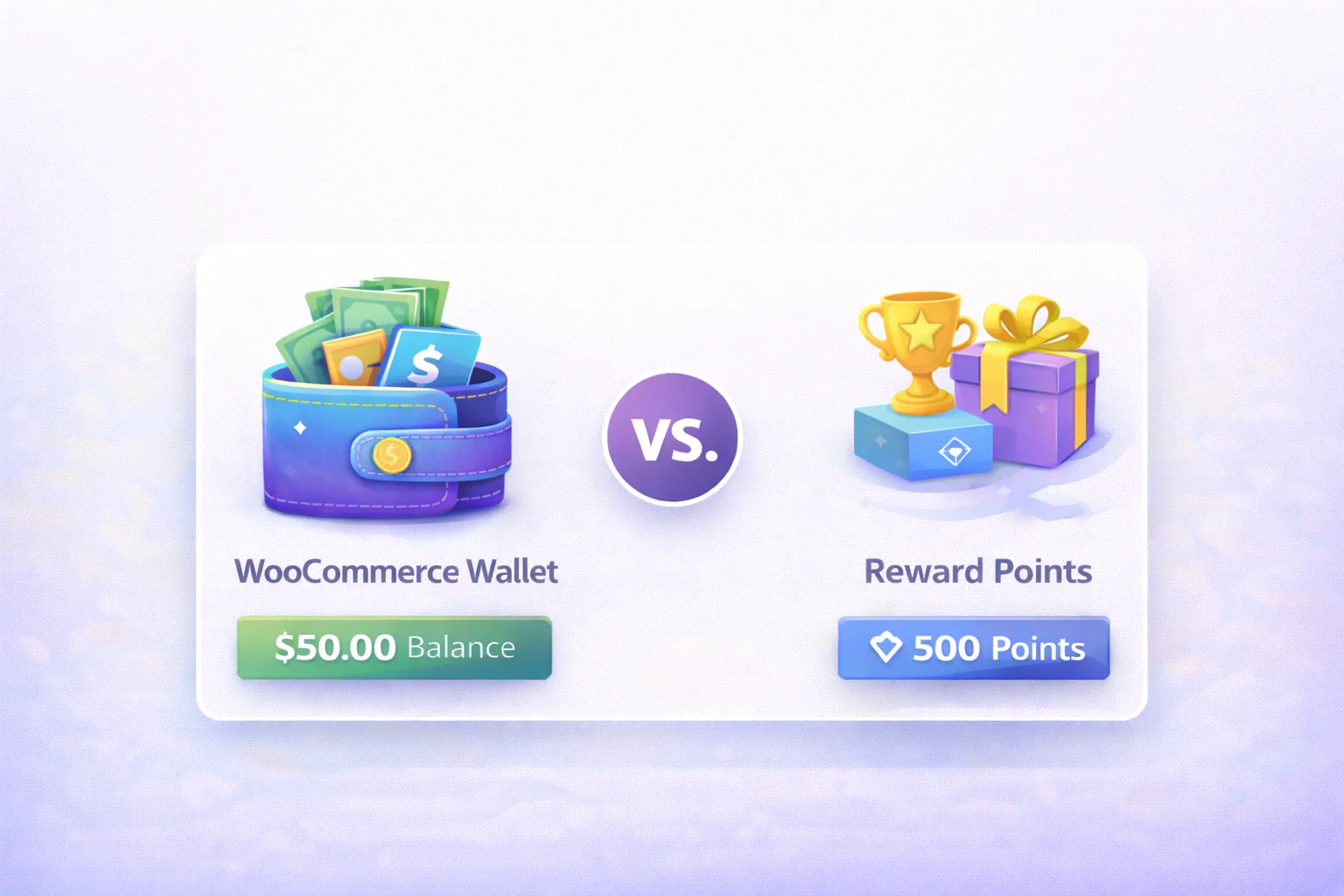
Ask ten WooCommerce store owners what “loyalty program” means and at least eight of them will say reward points. It is the default mental model — the Starbucks Stars, the airline miles, the supermarket stamp card translated into pixels. Points are visible, gamified, and feel like a strategy. They have been the dominant loyalty mechanic in e-commerce for the better part of two decades.
But wallet-based cashback has been growing fast — and for good reason. A wallet balance is simpler to understand, faster to feel, and in many store configurations, more effective at driving the specific behaviour that store owners actually want: the repeat purchase. Not the review, not the referral, not the badge. The next order.
This is not a question with one correct answer. The right choice depends on what your store sells, who buys it, and what kind of relationship you want to build with your customers. What this article provides is an honest framework for thinking through that choice — and a look at why a growing number of WooCommerce stores are concluding that the most powerful answer is not one or the other, but both.
Smart Wallet by NEXU WP is one of the few WooCommerce plugins that handles both — a full wallet with cashback on one side, and a configurable reward points system on the other — from a single plugin. We’ll show you how that works. But first, the comparison itself.
Quick verdict before we dive in
Wallet / Cashback
Best for: immediate repeat purchases, refund retention, high-frequency buyers. The customer always knows exactly what their balance is worth.
Reward Points
Best for: engagement-driven stores, communities, brands where accumulation and status matter as much as the discount itself.
How each system actually works in practice
Before comparing them, it is worth being precise about what each system is, because the terms get used loosely. A wallet system and a points system both reward customers for purchasing — but they do so in fundamentally different ways, and those differences have real consequences for customer behaviour.
The wallet: cashback in real currency
In a wallet system, a customer completes a purchase and a percentage of the order value — say, 5% — is credited to their store wallet as actual currency. If they spent $80, they receive $4.00 in wallet credit. That number is unambiguous. It appears in their account area. It reduces their next order total by exactly $4.00. There is no conversion rate to understand, no “how many points do I have and what are they worth?” The value is immediate and transparent.
Wallets can also receive credits from other sources: refunds, top-ups by the customer, manual credits from the admin. This makes the wallet function less like a pure reward mechanism and more like a financial relationship — the customer has an account with a balance, and that balance is theirs to use or (if withdrawal is enabled) to take back.
The points system: accumulated value with a conversion layer
In a points system, the customer earns points — typically a set number per dollar spent, or per action taken (review left, account created, referral made). Those points accumulate in their account and can be redeemed, at a configured conversion rate, for a discount on a future order. The discount might be 100 points = $1, or 500 points = $5, or any ratio the store sets.
The abstraction of points — the layer between the action and the reward — is both points’ greatest strength and their most significant limitation. The strength: points can be awarded for almost any action, not just purchases. A customer who leaves a review, shares on social media, or refers a friend can earn points without spending money. Points can also expire, creating urgency. They can be tiered, creating status levels. They can be branded, creating identity. Points are a flexible tool for shaping behaviour across the full customer lifecycle.
The limitation: the conversion layer introduces cognitive friction. Customers who do not understand what their points are worth are less motivated by them. Research on loyalty programme abandonment consistently finds that “I didn’t know what my points were worth” and “I forgot I had them” are two of the most common reasons customers disengage. The very abstraction that makes points flexible also makes them easy to forget.
Head-to-head: 8 dimensions that matter
Here is how wallet cashback and reward points compare across the dimensions that actually determine whether a loyalty mechanic drives repeat purchases — not just sign-ups.
| Dimension | Wallet / Cashback | Reward Points |
|---|---|---|
| Clarity for the customer | ✓ Exact currency value, always visible | △ Depends on how clearly the conversion rate is communicated |
| Repeat purchase pull | ✓ Strong — visible balance creates clear incentive to return | △ Moderate — effective only when customers remember and understand their balance |
| Engagement beyond purchases | – Limited to purchase-based credits | ✓ Reviews, referrals, sign-ups, birthdays, social shares |
| Setup complexity | ✓ Simple — set a cashback percentage, done | △ More configuration needed for rates, rules, expiry, tiers |
| Refund handling | ✓ Refunds credit directly to wallet — money stays in ecosystem | – Points rarely used for refunds; card refund typically required |
| Brand / status effect | – Purely transactional — no tiers or badges | ✓ Tiers, levels and badges create identity and aspiration |
| Urgency / expiry mechanics | – Wallet balances typically do not expire (a feature, not a bug) | ✓ Points can be set to expire, creating urgency to redeem |
| Customer trust signal | ✓ Withdrawal option makes balance feel genuinely owned | △ Points feel owned, but cannot be withdrawn — locked to the store |
The psychology behind each system
Understanding why each system motivates customers requires looking at two different psychological mechanisms. Wallets and points do not just operate on different mechanics — they operate on different parts of the brain.
The endowment effect is the psychological phenomenon where people assign greater value to things they already possess than to equivalent things they do not yet have. A customer with $6.40 in their store wallet does not think of that as “a potential discount if I buy something” — they think of it as money they already have that they would lose by not using it. This is the same psychological force that makes unused subscription services feel wasteful. The wallet credit is already theirs. Not returning feels like leaving money on the table.
The goal gradient effect is the finding that people accelerate their effort as they approach a goal. Customers who are 80 points away from a 500-point reward threshold will buy more frequently than those who are 480 points away, even though both are “close.” Points systems that show customers their progress toward the next redemption threshold — “You’re 120 points from a $5 reward” — actively exploit this effect. The accumulation narrative creates momentum. The threshold creates urgency.
Neither effect is categorically more powerful — but they suit different customer relationships. The endowment effect that drives wallet behaviour is most powerful for customers who already have a balance and are considering their next purchase. The goal gradient effect that drives points behaviour is most powerful for customers in an active accumulation phase who are not yet near a threshold. This is one of the reasons the two systems are not mutually exclusive: they can motivate the same customer differently at different points in their lifecycle with your store.
Which system suits which store type
The most honest answer to “wallet or points?” is that it depends on your store. Here is a practical framework for working out which system — or which combination — fits your situation.
Wallet cashback works best when…
Your customers purchase frequently (consumables, subscriptions, regular replenishment). You want refunds to stay in the ecosystem. You sell to customers who are motivated by clear, simple financial benefit rather than gamification. Your average order value is high enough that a 3–5% cashback feels meaningful in absolute terms. You want a system that requires minimal customer education — the value of $4.00 needs no explanation.
Reward points work best when…
Your customers have a strong community identity around the brand (hobbyist stores, niche products, stores with active review cultures). You want to reward non-purchase engagement — reviews, referrals, social sharing. Your product category has lower purchase frequency and the accumulation narrative helps maintain engagement between orders. You want to create loyalty tiers that make top customers feel recognised beyond just getting a discount.
Both systems work best when…
You have a mixed customer base with both high-frequency buyers and community-engaged customers. You want purchase cashback to be the default reward and points for additional engagement actions. You want customers to be able to convert their points into wallet credit for spending — the two systems feeding into each other. Your goal is not just repeat purchases but a full loyalty ecosystem where every interaction earns something.
Smart Wallet: the plugin that runs both systems from one place
Most WooCommerce stores that want both wallet cashback and reward points end up running two separate plugins — one for each system. The compatibility between them is hit-or-miss, the admin interface is fragmented, and the customer sees two entirely separate loyalty mechanisms with no connection between them.
Smart Wallet by NEXU WP is built around a different premise: the wallet is the centre of the loyalty ecosystem, and both cashback and reward points feed into it. Here is what that looks like in practice.
The wallet card — the customer’s loyalty dashboard
Everything the customer needs to see in one place
The wallet card in the customer’s account area shows their current balance, their available points balance, and their transaction history. Both the wallet credit and the points tally are visible simultaneously — there is no switching between two separate sections of the account. The customer sees one loyalty relationship with the store, not two fragmented systems running in parallel.

Cashback configuration
Set global or per-product cashback rates in minutes
From the Cashback tab in Smart Wallet settings, you configure what percentage of each completed order is credited to the customer’s wallet. The cashback only triggers on orders that reach “completed” status — protecting you from crediting returns that will be refunded. You can set a global rate that applies to everything, or configure different rates for specific product categories, giving you the flexibility to use cashback as a margin-aware tool rather than a flat cost.

Reward points configuration
Points that earn on purchases — and convert directly to wallet credit
Smart Wallet’s reward points system awards points on every completed purchase at a rate you configure. Where Smart Wallet differs from standalone points plugins is in the conversion: customers can convert their accumulated points directly into wallet credit, at whatever rate you set. This bridges the two systems — points become a secondary pathway into the same wallet that cashback feeds. For the customer, everything ultimately arrives in one place. For the store, both mechanisms drive repeat purchases toward the same endpoint.

Full transaction history
Every credit, every debit, every point conversion — logged and visible
One of the most common sources of customer distrust in loyalty programmes is opacity — the customer does not know where their balance came from, what happened to a credit they expected, or why their points changed. Smart Wallet’s transaction history shows the customer every movement on their account: cashback credits, point conversions, wallet payments, top-ups, refund credits. The full audit trail, available from the customer account page at any time, eliminates the uncertainty that causes support tickets and erodes confidence in the programme.

The case for running both — and how the numbers look
The most compelling argument for the combined approach is not theoretical — it is mechanical. When cashback and points both funnel into the same wallet, every interaction the customer has with your store creates a reason to return. The cashback from last week’s purchase is sitting in their wallet. The points from leaving a review last month are convertible to additional credit. Together, the balance they see when they next visit your store is larger — and a larger balance creates a stronger pull.
| Scenario | Wallet only | Points only | Both combined |
|---|---|---|---|
| After $100 purchase (5% cashback, 10pts/$1) | $5.00 in wallet | 1,000 pts ($5 equiv.) | $5.00 wallet + 1,000 pts |
| Customer also leaves a review | No reward | +200 pts | +200 pts → convertible to $1.00 |
| Total visible loyalty balance before next visit | $5.00 | $6.00 equiv. (if understood) | $6.00 (after conversion) — fully transparent |
| Pull to return | Strong — clear $5 waiting | Moderate — depends on point awareness | Strongest — maximum balance, full clarity |
Illustrative figures based on a 5% cashback rate and a 10-points-per-dollar earn rate with a 100-points-to-$0.50 conversion. Actual figures depend on your configured rates.
Measuring what is working: the admin analytics view
A loyalty programme that is not measured is not managed. Smart Wallet’s admin dashboard gives you the numbers you need to evaluate whether the cashback rate is set correctly, whether customers are actually converting points to wallet credit, and how wallet balances translate into repeat purchases over time.

The Customers tab shows each registered customer’s current wallet balance and points total — a quick way to identify your highest-balance customers and understand whether the loyalty programme is concentrated or broadly distributed. The Reports tab gives period-based performance data: total cashback credited, total points awarded, total wallet spend. These numbers tell you whether customers are engaging with the programme or treating it as invisible.
Frequently asked questions
The wallet vs. reward points question has a genuine answer: it depends on your store, your customers, and what behaviour you are trying to reward. Wallet cashback is better when simplicity and repeat purchase frequency matter most. Reward points are better when engagement, community, and cross-purchase actions are the primary loyalty levers.
But the more interesting question is whether “one or the other” is even the right frame. For most stores, both systems reward different aspects of the same customer relationship — and combining them, with points converting into wallet credit, creates a loyalty ecosystem that is more compelling than either system alone.
The only thing that has historically made that combination impractical is the overhead of running two separate plugins. Smart Wallet removes that overhead entirely. The wallet and the points system are in the same place, configured from the same admin panel, and visible to the customer in the same account page. The combination is genuinely straightforward — and from $39 per year, it is difficult to make an argument for anything less.
Smart Wallet — cashback wallet and reward points for WooCommerce, from $39/year
A full cashback wallet system. A configurable reward points layer. Points that convert directly to wallet credit. Transaction history for every customer. Withdrawal option. Admin reporting dashboard. Refund-to-wallet support. One plugin. One admin panel. One licence.
Smart Wallet by NEXU WP
From $39/year · Single site licence · Both systems included · No code required

Just got this set up for our store and wow, the wallet system is way cleaner than those old points programs. Customers actually see their balance as real money no confusing conversions or having to explain how points work. we had our first repeat purchase within hours because the credit was right there, no mental math required. honestly, wish we'd switched sooner instead of dealing with points for years
I've been running a WooCommerce store for years, and loyalty programs always feel like a gamble. This breakdown of wallets vs. reward points was helpful, especially the part about points feeling "gamified." That's true customers do love chasing those little numbers. But I'm still not sure which one actually gets them to come back more often. the article mentions wallets might be better for repeat purchases, but points seem to keep people engaged longer. Wish there was a clearer answer for stores like mine that sell niche products
Just set this up for a travel client and the refund to wallet feature is so slick. No more lost credits or confused customers refunds go straight back to their balance.
The points system is super easy to track right in the account dashboard. watching them add up after every purchase makes it feel like I'm actually getting rewarded for shopping here