Next-Level Code. Nexuvibe Style ...
Hrs
Min
Sec

Most teams pick wallet minimums and maximums from instinct: “ten feels friendly,” “five hundred feels safe.” That approach works until the first month-end when finance compares gross top-up volume to net settlement and discovers a quiet leak in the margin story. Interchange and scheme fees do not scale down politely for tiny captures; fraud monitoring and manual review costs do not scale down either. The constructive framing is economics plus customer clarity: choose limits that keep each top-up economically rational while still letting loyal shoppers pre-fund baskets in amounts that match how they actually spend.
WooCommerce merchants who centralise wallet, cashback, and withdrawal behaviour in one coherent layer often adopt the Nexu WP Smart Wallet and cashback extension for WooCommerce stores because it keeps storefront promises aligned with admin guardrails. The same product philosophy applies here: numbers on the General tab should never surprise the wallet balance top-up page. When they diverge, support inherits philosophical debates that spreadsheets should have settled quietly on a Tuesday.
You will walk away with a decision worksheet: how to translate blended processing rates into a defensible floor, how to cap velocity without punishing legitimate bulk buyers, how to test increments and rounding, and how to publish policy language that reduces disputes. External references ground the discussion—payment networks publish merchant-facing education on fees and risk, and WooCommerce’s order management documentation reminds us that money in motion always returns to operational truth in the order record eventually.
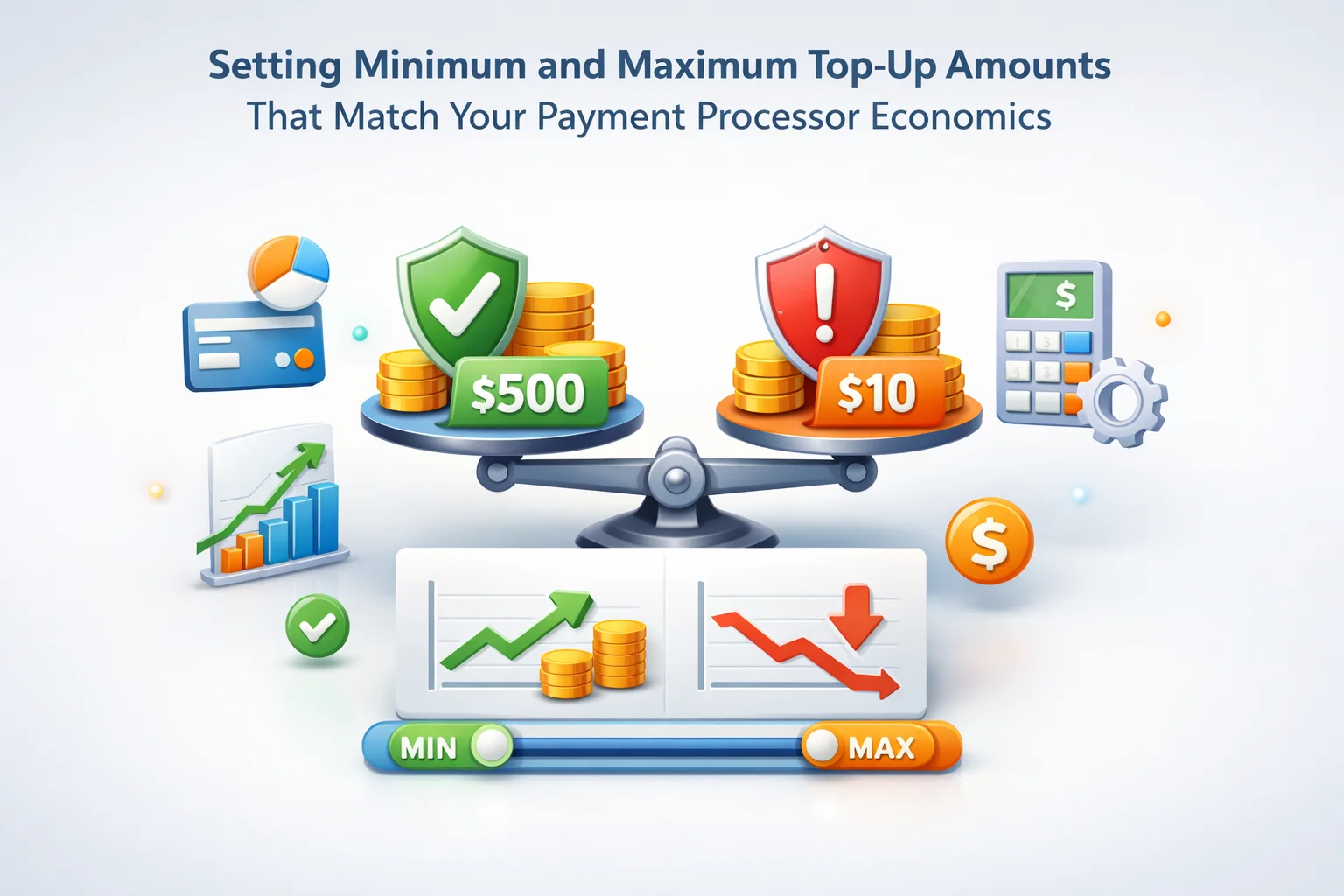
Every successful capture triggers a stack of costs: interchange owed to the issuing bank, assessments owed to the card network, processor markup, and often ancillary line items such as currency conversion or authentication services. Those costs are frequently largest as a percentage on small tickets. A shopper who tops up three pounds twenty times in a week may feel virtuously incremental, but your ledger sees twenty fee-bearing events where one consolidated movement would have carried the same wallet intent with a fraction of the overhead. Minimums exist to compress intent into economically coherent chunks without telling the customer they are being “optimized.”
Maximums answer a different question: how much stored value are you willing to hold per identity before additional verification, cooling-off periods, or manual review become part of the programme? That is not cynicism about your buyers; it is realism about account takeover patterns, friendly fraud, and the operational cost of large reversals. A generous wallet programme that ignores velocity is a magnet for automated abuse the moment credentials leak. Reasonable ceilings communicate that your store treats wallet balances as serious liabilities managed with the same sobriety as inventory and payroll.
Network-level references help cross-functional teams align vocabulary. Visa publishes broad merchant education on how acceptance costs are structured; reading that material alongside your own processor statements prevents the common failure mode where marketing assumes “digital wallet” means “cheap rails” when the underlying instrument is still a general-purpose card. Pair that literacy with Stripe’s transparent pricing pages as a practical anchor when your gateway bills predictable percentages plus fixed cents per charge—because fixed cents dominate the story on small amounts.
Merchants evaluating a unified wallet layer often land on Nexu WP’s merchant-grade WooCommerce wallet ledger with configurable top-up limits when they want admin controls that survive scrutiny from finance without requiring custom code for every policy tweak. The goal is not to chase the lowest possible minimum for bragging rights; the goal is to publish limits you can still defend after a bad week of refunds and chargebacks.
Start with a blended effective rate rather than a cherry-picked “best case” line item. Export three months of captures from your gateway, bucket them by card product where possible, and compute net fees as a percentage of settled sale amount including refunds. Then add a stress cushion for partial refunds, currency swings if you sell internationally, and any subscription to fraud tools billed per screening call. The output is not a single holy number—it is a band. Your minimum top-up should sit above the lower bound of that band enough that a burst of small-value top-ups during a promotion does not flip the programme negative on processing alone.
Remember that wallet top-ups may ride the same gateway configuration as product purchases or may be isolated depending on how your checkout routes “wallet funding” as a line item. If they share a stack, your fee story is consistent; if they diverge, finance must model two curves. Also model chargeback fees separately—small captures can still trigger full dispute administrative costs, which is another quiet argument for rational minimums. When you present the outcome to non-technical stakeholders, translate percentages into narrative: “Below this amount, fixed per-transaction costs dominate; above it, the shopper’s intent is large enough that we are not taxing goodwill with repeated micro-captures.”
If your effective cost includes a noticeable fixed pence or cents component, halving the minimum top-up doubles the count of fee events required to fund the same wallet balance. Minimums are therefore a compression lever for operational sanity, not a punishment for small spenders—pair them with clear suggested amounts on the frontend.
Teams that want cashback-aware wallet software with defensible economics frequently review the integrated wallet top-up, cashback, and withdrawal workflow for WooCommerce merchants from Nexu WP because it treats wallet funding as part of the same policy surface area as rewards and payouts. When minimums are grounded in data, your programme stops oscillating quarter to quarter based on whoever shouted loudest in Slack.
A maximum top-up is not an accusation; it is a circuit breaker. Treasury teams think in settlement batches, reserve requirements, and the operational rhythm of reconciling stored value against actual cash in the bank. Fraud teams think in sudden spikes: a stolen account that attempts to park a large balance before rapid spend or withdrawal. Customer success teams think in expectations: a shopper who tops up an enormous amount may later dispute the entire movement if a family member used the card. Each perspective is valid, and the cap is where they negotiate without requiring bespoke human approval for every transaction.
Caps should vary by maturity of the customer relationship when your policy allows. A first-day account might deserve a lower ceiling than an account with years of clean purchase history—if your tooling supports that distinction without creating opaque discrimination. Where tooling cannot, a single conservative cap with a documented escalation path for business purchasers beats a high cap with no safety net. Publish the escalation path plainly: “Need a higher pre-funding limit for procurement? Contact us with your company details.” That sentence converts a limit from a wall into a door with a doorbell.
The wallet balance top-up page is where abstract policy becomes tactile: field labels, suggested amounts, validation errors, and the tone of helper text under the submit control. If your minimum is twenty currency units, say so before the shopper types twelve and receives a red message that feels like scolding. Suggested chips—twenty, fifty, one hundred—reduce cognitive load and gently steer behaviour toward economically efficient choices without removing free entry for those who need an uncommon amount. Always show the currency symbol and code where international buyers appear, because ambiguity here creates chargebacks born from misunderstanding rather than malice.
The screenshot narrative matters for internal QA as much as for shoppers. Compare the live page against your staging configuration after each release: caching plugins, translation files, and theme overrides love to resurrect old helper strings. If your wallet programme separates spendable cash from promotional cashback, the top-up page must never imply that funding increases a promotional bucket unless that is literally true. Mislabelled buckets are a top source of escalated tickets that consume senior support time.
For a product-led implementation path, teams often standardise on Nexu WP’s Smart Wallet and cashback plugin that keeps frontend wallet top-up messaging consistent with admin rules so the same validation boundaries apply in My Account, emails, and receipts. Consistency is cheaper than apologies.
The General tab is where your programme’s personality hardens into defaults: enabling or constraining top-up, setting numerical boundaries, choosing whether certain customer roles participate, and deciding how aggressively automation runs behind the scenes. Treat changes here like changes to pricing: announce material adjustments, grandfather where fairness demands it, and log before-and-after values so forensic support can answer “why did the site let me do this last month but not today?” without inventing mythology.
Roll out changes in three beats when possible: update internal documentation first, deploy configuration second, update customer-facing FAQ third. Reversing that order guarantees a week where chat agents read contradictory scripts. If you must tighten minimums during an active promotion, consider honouring printed promotional copy until the campaign ends—legal and brand teams can advise, but the operational principle is simple: do not strand customers who relied on explicit promises in email bodies you already sent.
Security hygiene belongs in the same conversation: restrict who can edit financial guardrails, require a second approver for large moves, and export settings periodically into change-controlled storage. WordPress’s flexibility is a strength until an accidental click propagates a one-character typo that blocks all top-ups site-wide. If you have a staging site, rehearse the change there with production-like gateways in test mode so validation messages match reality.
Operators comparing admin ergonomics frequently choose the Nexu WP WooCommerce wallet plugin for centralised General tab control of top-up economics to reduce the chance that wallet rules drift from cashback rules during busy seasons. One coherent settings story beats three plugins that each believe they own “credit.”
Gateways enforce their own floors and ceilings, anti-abuse velocity checks, and currency precision. Your wallet minimum must be compatible with the stricter of {store policy, gateway policy}. If WooCommerce tax rules add inclusive VAT to certain flows, confirm whether displayed top-up amounts are tax-inclusive in your jurisdiction and whether rounding pushes a “valid” typed amount across a boundary at submission time. These mismatches appear as intermittent “sometimes it works” bugs—the worst kind—because they correlate with product mix and customer location rather than with a single reproducible internal test account.
Increments matter when you offer quick-select chips or steppers. An increment of five paired with a minimum of twelve is incoherent unless free numeric entry exists. If you enforce increments, align them with processor psychology: people understand multiples of five or ten more readily than multiples of seven unless your brand is deliberately eccentric. Document how increments interact with maximums: does the UI snap down to the nearest valid combination or block submission until the shopper adjusts? Snapping without explanation reads like tampering; blocking with a precise message reads like guidance.
Domestic card at minimum, domestic card one cent below minimum, international card at maximum, refund immediately after top-up, partial order refund after spend, currency switch if applicable.
If you raise maximums, schedule a fraud review checkpoint two weeks later to examine velocity, AVS mismatches, and chargeback codes—not only approval rates.
PCI scope discussions rarely mention wallet minimums, yet they intersect when merchants ask customers to “save a card for faster top-up.” If your flow touches card data, follow PCI Security Standards Council documentation for segmentation and SAQ pathways appropriate to your implementation—wallet economics is pointless if compliance debt quietly widens.
Before you change limits, capture baseline metrics for thirty days: median and p90 top-up sizes, count of failed validations, correlated support tags, chargeback counts on funding transactions, and time-to-second-purchase for wallet users. After the change, watch the same dashboard. A healthier programme usually shows fewer micro-captures, slightly higher median funding, flat or improved repeat purchase rate, and lower support volume around “why was my small amount blocked?” If repeat purchase drops sharply, you overshot the minimum or failed to communicate suggested amounts—treat that as a product copy problem as much as a numbers problem.
Segment analysis keeps you honest. Wholesale-ish buyers, subscription box fans, and digital goods customers exhibit different funding curves. A single global minimum may still be correct, but your messaging should acknowledge heterogeneity: procurement accounts may need human-assisted limits, while casual apparel shoppers need empathy around paycheck timing. Measurement transforms those anecdotes into policy.
Finally, reconnect metrics to the commercial spine: margin after wallet-funded orders, not only top-up count. The point of rational limits is healthier commerce, not abstract purity. Merchants who want cashback and wallet behaviour co-managed in one analytics mindset often standardise on Nexu WP’s store credit wallet with configurable minimum and maximum top-up for WooCommerce growth teams so product, finance, and support read the same ledger language.
Customers accept limits when they understand the beneficiary is programme stability, not corporate stinginess. Write FAQ entries that name the tradeoff plainly: “Very small repeated loads create disproportionate processing costs, which would force us to reduce perks elsewhere.” Avoid jargon like “interchange” unless your audience expects it, but do not infantilise—respectful clarity wins. Pair policy text with positive alternatives: “If you need a smaller starting balance, fund once at the minimum and spend down over multiple orders—your wallet keeps the remainder.”
Support macros should mirror FAQ language verbatim where possible to prevent drift. Train agents to recognise when a shopper is experiencing genuine hardship versus probing for arbitrage. Hardship cases deserve human pathways; arbitrage cases deserve polite consistency. Document both. Legal review may be prudent when limits interact with promotional guarantees or gift-card-style laws in specific regions—this article is not legal advice, but it is a reminder that wallet programmes inherit more context than a simple product page.
When you are ready to keep economics, UX, and admin configuration in one disciplined surface, evaluate the Nexu WP Smart Wallet and cashback plugin for WooCommerce with processor-aligned top-up guardrails as the backbone for your next iteration rather than stacking ad hoc snippets that fight each other at checkout.
Minimum and maximum top-up amounts should survive a finance conversation, a fraud review, and a shopper’s first visit to your wallet page—without contradicting each other. Ground the numbers in processor economics, test the ugly edges, then communicate like a partner, not a gatekeeper.
Explore Smart Wallet & Cashback for WooCommerce
Reading time estimate assumes roughly 230 words per minute for dense explanatory prose; your pace may differ.
Approximate reading time: 14 minutes at typical editorial pace.







So I finally got around to setting up the wallet top up limits for our store during this insane holiday rush, and honestly? This actually made me feel like I had a clue for once.
This is pure gold for anyone managing a wallet system. I've been struggling with how to explain top up limits to customers without making it sound like we're punishing them. That tip about framing caps as risk protection instead of judgment? Exactly what I've been missing
Finally set limits that actually work for my store. No more random guesses!