
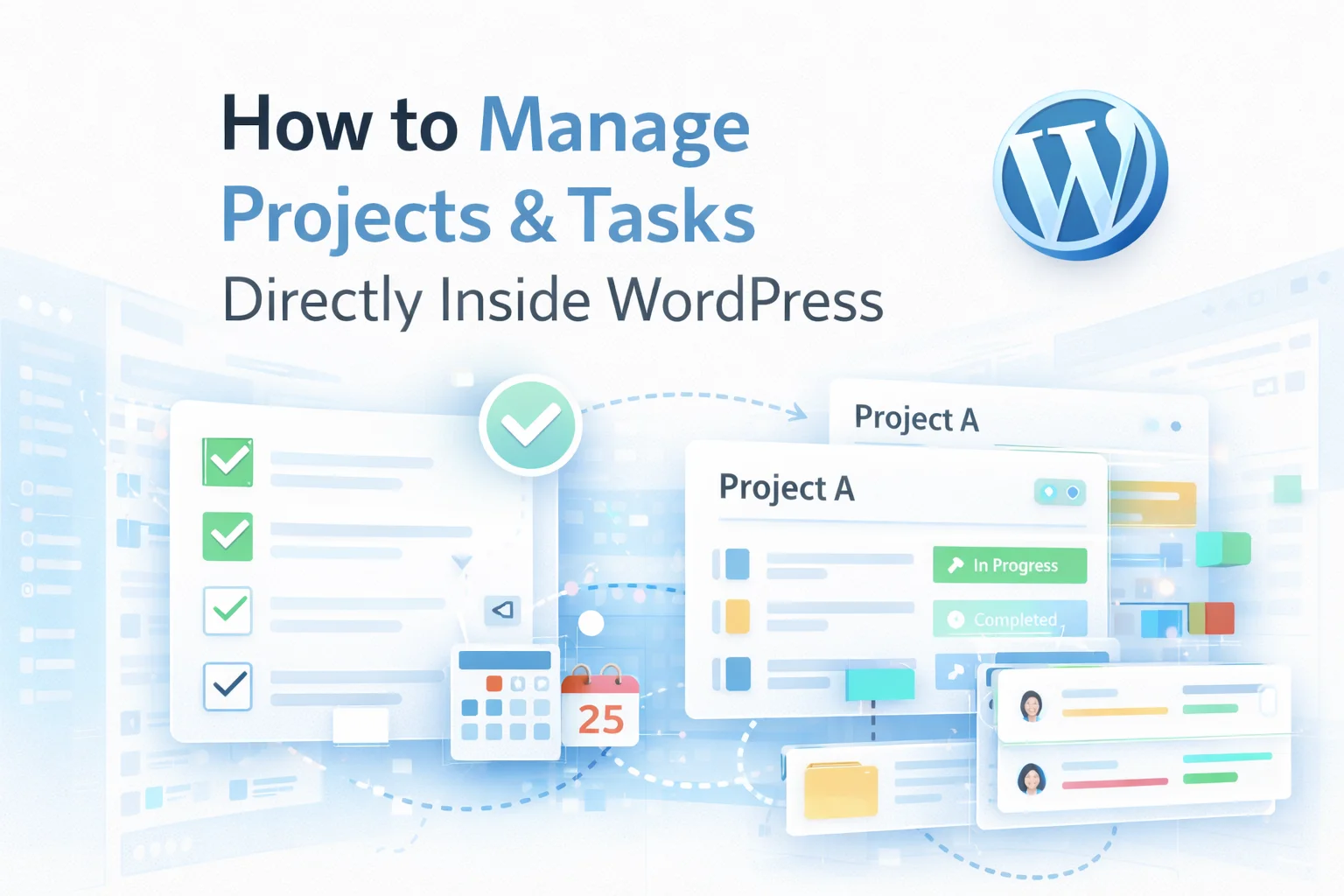
Picture a typical Tuesday for a WordPress agency. The developer has a task in Asana. The designer has feedback sitting in a Figma comment. The copywriter got instructions in a Slack message from last week that may or may not still reflect the current brief. The project manager is trying to hold all of this together in a tool that has no idea any of these people work in WordPress — and no idea that the actual deliverable is a page inside a CMS.
This is not a description of a dysfunctional team. This is a description of almost every WordPress team over five people, running a perfectly normal set of tools that were never designed to work together — and certainly not designed around the reality that the work itself happens inside a content management system.
The irony is that WordPress is one of the most capable workflow platforms on the planet. Teams use it to run complex publishing operations, multi-site networks, WooCommerce stores with thousands of SKUs, client portals, membership platforms. And then they bolt on three separate external tools to manage the people doing that work, because nobody ever thought to put the project management inside the same environment as the work.
This guide is about changing that — what WordPress-native project management actually looks like, why it works better for teams whose entire workflow lives inside the admin, and how to set it up without rebuilding everything from scratch.
The real cost of managing WordPress work from outside WordPress
The standard argument for external project management tools is that they are purpose-built for task management — better kanban boards, more detailed reporting, richer integrations. That argument is not wrong. Asana, Trello, Linear, and their equivalents are genuinely well-designed tools.
But there is a hidden cost that never shows up in any feature comparison: the cost of context switching. Every time a WordPress team member needs to update a task, they leave the environment where the work is happening, navigate to a separate platform, find the right project, find the right task, update it, and come back. That round trip takes thirty seconds when everything goes smoothly. It takes three minutes when it does not — when you cannot find the task, when you need to re-explain something you already explained in a WordPress comment, when the notification came in two hours ago and you have now lost the thread of what you were doing.
Research on knowledge worker productivity consistently finds that it takes an average of 23 minutes to fully return to deep focus after a context switch. Most WordPress team members switch contexts fifteen to thirty times a day. Some of those switches are unavoidable. The ones that exist purely because the task management tool is in a different tab from the work are not.
There is also the information fragmentation problem. A task in Asana references a page in WordPress. The comment thread about that page lives in Slack. The design feedback lives in Figma. The brief lives in a Google Doc. Nobody has a complete picture of any single piece of work without opening four different tabs — and when someone new joins the team, onboarding means teaching them which platform each type of information lives in, which is its own kind of overhead.
None of this means external project management tools are bad. The question is whether a team whose work is almost entirely inside WordPress has a better option — one that reduces the friction without sacrificing the structure. In 2026, the answer is yes.
What WordPress-native project management actually looks like
WordPress-native project management is not just “a task list inside the admin.” That exists and it is fine for basic to-do tracking. What we are talking about is a fully integrated system where tasks, team communication, project context, and the people doing the work all live in the same environment — without tab-switching, without re-explaining context, and without a separate platform login for every team member.
The key elements are: task creation and assignment, status tracking, team messaging tied to the same environment, and a way for team members who work outside the admin to stay connected without being forced into WordPress daily. Get all four in one place and the context-switching problem largely solves itself.
This is exactly what Nexu delivers: a WordPress plugin that combines a real-time team messenger with a built-in project task system for WordPress, so the entire conversation and workflow around a piece of work lives in the same admin panel as the work itself. No external accounts, no context switching, no subscription seat for every contractor you bring in.
How to set up WordPress-native project management with Nexu
Setting up Nexu is not a week-long migration project. It is a plugin install and a few minutes of configuration. Here is how it works in practice.
Install the plugin — your WordPress users are already your team
After installing Nexu’s internal team messenger, every WordPress user on your site automatically gains access. No separate sign-up, no new credentials to manage. The people already in your WordPress installation are your team. Nexu recognises that and gets out of the way.
Create your project channels
Set up group channels for each active project or client. One for the WooCommerce redesign. One for the content calendar. One for internal operations. Each channel keeps all conversation about that project in one place — not scattered across Slack threads, email chains, and comment sections on different pages.
Start assigning tasks
Nexu’s built-in project task system lets you create tasks, assign them to team members, and track status — all from inside WordPress. The task lives in the same environment as the conversation about it. When someone updates the task, the team sees it. When they have a question, they ask it in the same place.
Connect remote teammates via Telegram
The step that turns Nexu from a tool for people who are always in WordPress into a tool for your whole team. Team members who do not live in the admin — freelance designers, copywriters, contractors, SEO consultants — link their Telegram and receive all Nexu messages there. Their replies come back into Nexu for everyone else. The team inside WordPress sees a unified conversation; the person working in Figma never has to open WordPress at all.

What this looks like in practice for different team types
Abstract descriptions of project management tools only go so far. Here is what this actually looks like for the three most common WordPress team configurations.
WordPress agency managing multiple client sites
Each client gets its own channel in Nexu. The developer working on a site update posts in that channel when the work is done. The PM checks the staging link without leaving WordPress and marks the task complete. The account manager — who works mostly in Google Docs and checks WordPress twice a week — receives the update in Telegram and replies from their phone. That reply appears in the Nexu channel for the whole team.
Before: developer posts in Slack, PM opens a new tab to Asana, account manager checks email. After: one channel, one update, everyone informed. The task is where the conversation is.
Content publishing operation
The editorial team works entirely inside WordPress — drafting, editing, scheduling. A content calendar channel in Nexu handles all coordination: who is writing what, which articles are in review, which need a featured image before they can go live. Tasks are created directly from conversations — “someone needs to write the intro for the March roundup” becomes an assigned task, trackable without leaving the admin.
The editor-in-chief stops chasing people across Slack threads. The status of every piece of work is visible in the same panel where the writing happens.
WooCommerce store with an operations team
Store manager, product team, developer, and support lead all work out of WordPress. When a product launch needs coordination — images, descriptions, pricing, shipping rules, banners — a project channel handles all of it. Tasks for each component are assigned and tracked in the same place where the product pages are being built.
The external tools that used to manage this work never knew what a WooCommerce product page was. Nexu does not need to know either — it just needs to be in the same environment so the people working on it can communicate without going somewhere else.
Inside Nexu: what you actually get
Nexu is described as a team messenger with project tasks — but it is the way those two things sit together that makes it more than a chat panel with a to-do list bolted on.
Messages, replies, reactions, file sharing — the full chat experience inside WordPress. No refresh required, no polling delay. The conversation about a piece of work is in the same place as the work.
Create tasks, assign them to team members, track status. Tasks live next to the conversations about them. When someone updates a task, the team sees it. When they have a question about it, they ask in the same place — not in a separate Slack thread that gets disconnected from the task within 48 hours.
Remote or part-time team members connect their Telegram and receive all Nexu messages there. Replies flow back into WordPress for the rest of the team. Nobody falls out of the loop because they were not in the admin that day.
One channel per project, per client, or per department. Team members join only the channels relevant to them. Conversations stay organised without the complexity of tools built for organisations ten times your size.
Bookmark any message — a brief, a staging URL, a specific instruction from a client. The thing you need to find again is one click away instead of somewhere in last Tuesday’s scroll history.
Each team member sets their own preference. Appreciated when your team spends full working days in the admin and the default WordPress white background gets old after hour four.
Why this matters even more in an AI-first search landscape
In 2026, a growing share of search queries are being answered directly by AI — Google’s AI Overviews, ChatGPT search, Perplexity. The content that gets surfaced in those summaries is not the content that optimised hardest for keyword density. It is the content that answers specific, practical questions with genuine depth and accuracy. “How do I manage projects inside WordPress ” is exactly the kind of practical question AI search handles directly — and it favours precise, experience-based answers over generic overviews.
This has a direct implication for how WordPress teams operate. The teams producing the most useful, well-researched content are the ones whose internal operations are tight enough to produce it consistently. A team spending two hours a day on context switching and cross-platform coordination is a team with two fewer hours to write, research, edit, and publish.
AI search engines surface content that is detailed, accurate, and structured around real questions. The teams producing that content consistently are the ones with tight feedback loops between writers, editors, developers, and SEO strategists. A WordPress-native project management setup makes those feedback loops shorter — which makes the content better — which makes it more likely to appear in AI Overviews and AI-generated answers. Operational efficiency and content quality are not separate disciplines for a WordPress team. They compound each other.
Every hour saved on coordination is an hour available for the kind of content work that moves the needle in 2026 search. For a content-focused WordPress team, that is the difference between publishing one well-researched article a week and publishing two.
WordPress-native vs external project tools: an honest look
| Criteria | Nexu (WP-native) | Asana / Trello / Linear |
|---|---|---|
| Context switching | None — stays in WP | High — constant tab switching |
| Setup time | Minutes | Hours to days |
| Per-seat cost | None — flat licence | $10–$25/user/month |
| Team messaging | Built in | Separate tool needed |
| Data location | Your server | Third-party cloud |
| Remote team support | Via Telegram bridge | Full access (external anyway) |
| Advanced reporting | Basic | Extensive |
The one area where external tools have a clear edge — advanced reporting — matters most for large enterprise teams tracking complex portfolio metrics. For the vast majority of WordPress teams, daily friction reduction is worth considerably more.

Frequently asked questions
The shift toward WordPress-native project management is not about abandoning structure — it is about putting the structure where the work actually is. Every tool you use to manage a WordPress project that lives outside WordPress is a translation step. Sometimes translation is unavoidable. Often, for the majority of WordPress teams, it is not.
For teams that spend their days building, publishing, and managing inside the WordPress admin, the most efficient version of project management is one that never asks them to leave. In 2026, that is a plugin install away.
Nexu — tasks, chat, and team coordination, all inside WordPress
Real-time team messenger. Built-in project task system. Telegram bridge for remote teammates. One plugin, one environment, zero context switching. Your team’s work and the conversation about it — finally in the same place.


Hey everyone, this actually cuts down on tab chaos for real. No more bouncing between Asana and WordPress tasks just live where the work happens now
Hey! I love the idea of managing projects right in WordPress instead of bouncing between apps. But how does this handle real time updates?
Finally cut through the tab mess