Next-Level Code. Nexuvibe Style ...
Hrs
Min
Sec

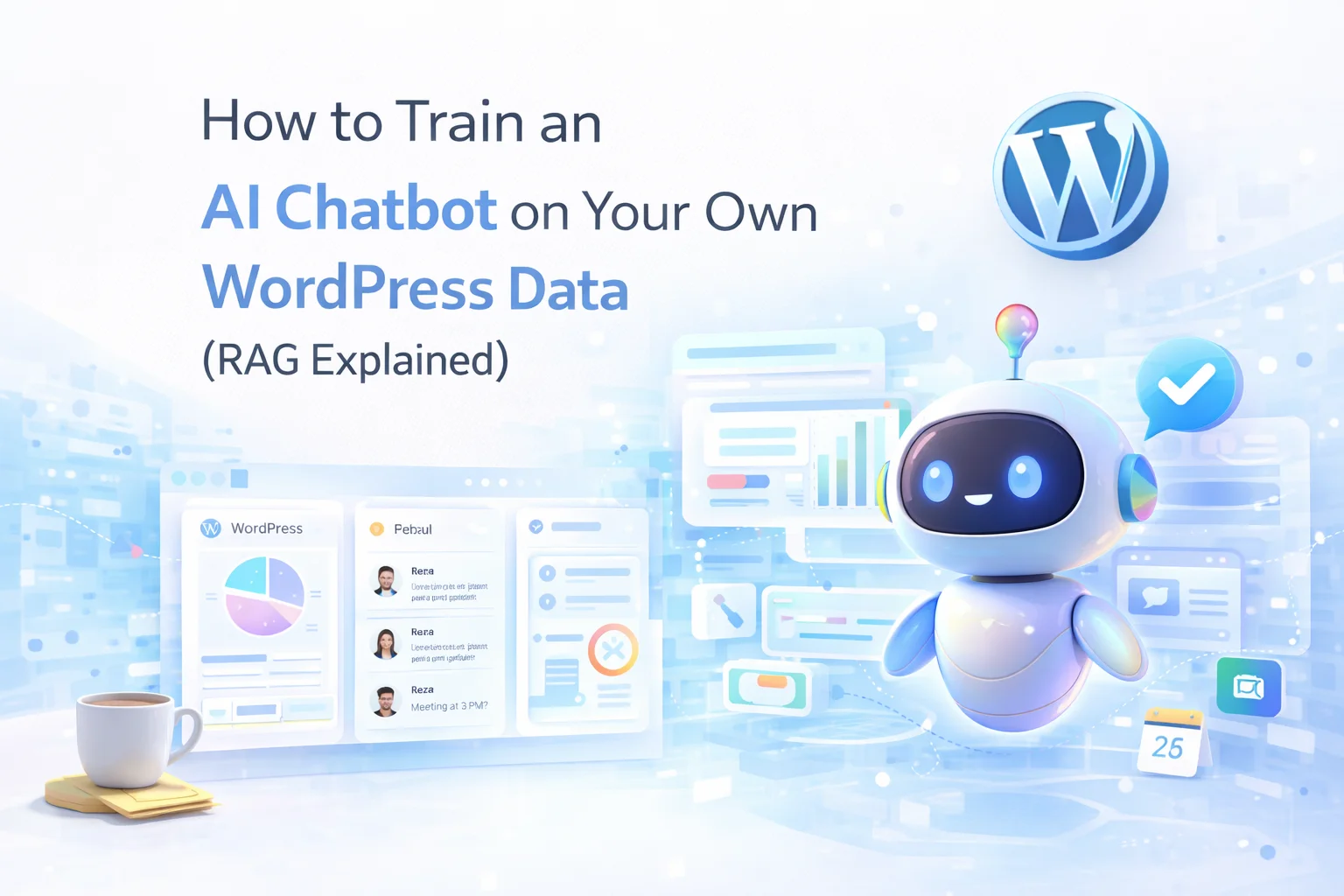
An AI chatbot that only knows general information is not particularly useful for your specific website. A visitor landing on your product page and asking “does this plugin work with WooCommerce?” does not want a generic answer — they want a precise response pulled directly from the content you have already written. The chatbot that gives that answer is not magic. It is a chatbot trained on your own data using a technique called RAG.
Retrieval-Augmented Generation — RAG — means that instead of relying solely on what a language model learned during training, the chatbot first searches a knowledge base built from your own content, then generates a response grounded in what it finds there. The result is a chatbot that genuinely knows your site: your products, your policies, your documentation, your FAQs.
This guide walks through exactly how RAG works, why it matters specifically for WordPress sites, and how you can train a genuinely smart chatbot on your own content — without writing a single line of code.
And if you want the entire process handled automatically inside WordPress, Nexu AI Chatbot for WordPress – SmartChat Assistant Plugin with Auto-Indexing & RAG is built precisely for that.
Large language models like GPT-4 or Claude are trained on enormous amounts of text scraped from the internet. That training gives them broad knowledge — but it stops at a fixed point in time, and it does not include anything specific to your site. They do not know what you sell, what your return policy says, or how your plugin handles edge cases. When a visitor asks something site-specific, the model either guesses or admits it does not know. Neither outcome is what you want from a support chatbot.
RAG solves this with a two-stage process. In the first stage, your site’s content is indexed — posts, pages, WooCommerce products, documentation, FAQs — and converted into numerical representations called embeddings, which are stored in a vector database. In the second stage, when a visitor asks a question, the system converts that question into an embedding too, searches the vector database for the closest matching content, and feeds those relevant passages to the language model as context. The model then generates a response based on what it found in your content, not what it vaguely remembers from training.
That difference matters enormously for WordPress sites with specialised content — WooCommerce stores, knowledge bases, membership sites, technical documentation, agency portfolios. A chatbot that genuinely knows your content becomes a 24/7 support layer that never makes things up and never sends visitors elsewhere for a straight answer.
Regardless of which tool you use, the mechanics of training an AI chatbot on your WordPress data follow the same pipeline. Understanding each stage makes it easier to know what is happening under the hood — and to appreciate why auto-indexing is so important once your site is live.
The plugin reads your WordPress content — posts, pages, custom post types, WooCommerce product descriptions, FAQ entries. Long pieces are broken into smaller chunks so each one can be retrieved independently. Chunk size affects both retrieval precision and API cost, and good plugins let you tune this.
Each chunk is sent through an embedding model — typically OpenAI’s text-embedding-3-small or text-embedding-3-large — which converts the text into a high-dimensional vector of numbers. This vector captures the semantic meaning of the text. Two chunks about the same topic will have vectors that are mathematically close to each other, even if the exact words differ.
The embeddings are stored in a vector database alongside the original text they represent. Depending on the plugin, this database can live inside WordPress itself — in your existing database — or in an external service like Pinecone. Keeping data inside WordPress means your content never leaves your server, which matters for privacy-conscious site owners.
When a visitor submits a question, the system embeds that question using the same model and searches the vector database for the chunks with the closest semantic distance. This is not keyword matching — a visitor asking “how do I get my money back?” will correctly retrieve your refund policy page even if it never uses those exact words.
The retrieved chunks are handed to the language model alongside the visitor’s question. The model sees: “here is what the visitor asked, and here is the relevant content from the site.” It generates a natural, conversational response grounded entirely in your content. No hallucination, no generic filler — just an answer based on what you have actually written.
Here is a problem that almost nobody talks about when they first set up a RAG chatbot: your content changes. You publish new posts. You update product descriptions. You revise your pricing page. You add a FAQ. If the vector database is not updated to reflect those changes, the chatbot keeps answering based on stale information — the equivalent of handing a customer service representative a manual printed six months ago and hoping for the best.
Plugins that require manual re-indexing place an invisible ongoing burden on your team. Someone needs to remember to run the index after every meaningful content update. In practice, this almost never happens consistently. The chatbot drifts out of sync with the live site. Visitors get outdated answers, and whatever trust the chatbot built starts to erode.
Most WordPress chatbot plugins that support RAG fall into one of two camps: either they are technically capable but require significant configuration — API setups, external vector databases, custom prompt engineering — or they are simple to set up but send your data to third-party servers and give you limited control over what happens to it. Nexu AI Chatbot for WordPress – SmartChat Assistant Plugin takes a different approach entirely.
Native RAG · Auto-Indexing · Internal vector DB · Data stays on your server
SmartChat is designed from the ground up to make RAG accessible to WordPress site owners who are not developers. After installation, the plugin indexes your site content automatically. When content changes, the index updates without any manual step on your part. The chatbot your visitors see always draws from the most current version of your site — and because the vector database lives inside WordPress itself, your content never leaves your server.
Here is what the actual setup process looks like when using a WordPress AI chatbot with built-in RAG and auto-indexing like Nexu SmartChat.
Install Nexu SmartChat from the WordPress plugin directory or upload the zip file directly. You will need an OpenAI API key — this key handles both the embedding process (converting your content into vectors) and the generation process (producing chatbot responses). Enter it in the plugin settings. This is the only step that requires anything outside of WordPress itself.
Choose which content types to include in the knowledge base: posts, pages, WooCommerce products, custom post types, documentation pages. Think about what visitors most commonly ask about. For a WooCommerce store, product descriptions, shipping policies, and FAQs are usually the highest-value sources. For a membership site, course descriptions and support documentation make the most impact.
Trigger the first indexing run with a single click. The plugin reads all selected content, splits it into chunks, sends each chunk to the OpenAI embedding model, and stores the resulting vectors in your WordPress database. Depending on the volume of content, this takes anywhere from a few seconds to a few minutes. You can watch the progress directly in the admin panel.
Write a system prompt that tells the chatbot who it is and how it should behave. Something like: “You are the support assistant for [site name]. You answer questions based on the site’s content. If a visitor asks something outside your knowledge base, tell them you don’t have that information and suggest they contact the team directly.” Then customise the widget: position, colours, avatar image, welcome message, and placeholder text.
Turn on auto-indexing so that every content update triggers an automatic re-index of the changed pages. Then activate the chatbot. The widget appears on your site immediately. From this point, the chatbot handles visitor questions around the clock — drawing from your live content, updating itself whenever you publish or edit anything, and never fabricating information it does not have.
There are three main approaches to training an AI chatbot on your own data. Each has legitimate use cases, but for most WordPress site owners the comparison is fairly straightforward once you look at what each method actually requires.
| Criteria | RAG (recommended) | Fine-tuning | GPT Assistant |
|---|---|---|---|
| Accuracy on site-specific content | ✓ High | Medium | Medium |
| Automatic updates when content changes | ✓ | ✗ | ✗ |
| API cost | Low | Very high | Moderate |
| Setup complexity | Simple | Very complex | Moderate |
| Data stays on your server | ✓ | ✗ | ✗ |
| No-code setup possible | ✓ | ✗ | Partial |
Fine-tuning makes sense for very specific tasks where you have large amounts of structured training data and the behaviour of the model itself needs to change — not the knowledge it draws from. For the vast majority of WordPress sites that simply want an accurate, up-to-date chatbot trained on their existing content, RAG is the correct method every time.
Training an AI chatbot on your own WordPress data delivers genuine value across almost every type of site, but some use cases produce particularly strong outcomes because the gap between what visitors need and what a generic chatbot can provide is largest.
Shipping times, return policies, product compatibility, size guides — the questions that flood inboxes before every purchase decision. A chatbot trained on your actual product data and policies handles all of these without any team intervention, 24 hours a day.
Users search documentation for help and often fail to find what they need with keyword search. A chatbot that reads the entire documentation set and retrieves the relevant section for each question is a fundamentally better experience than a search box — and it keeps users on the page.
Visitors want to understand your process, your pricing range, what kind of clients you work with, and whether you can handle their project. A chatbot trained on your services pages and case studies gives substantive answers that move prospects forward rather than bouncing them to competitors.
When a site has hundreds or thousands of articles, internal search often surfaces mediocre results. A RAG-trained chatbot becomes a smart content navigator — “do you have anything about X?” becomes a question the chatbot can answer directly from your archive.
A chatbot that knows general information is a general-purpose tool. A chatbot trained on your WordPress data is something more specific and more valuable — a support layer that handles visitor questions accurately, reduces load on your team, and helps people make decisions faster without ever fabricating information it does not have.
RAG is the technology that makes that possible. And with Nexu AI Chatbot for WordPress – SmartChat Assistant Plugin with Auto-Indexing & RAG, the entire pipeline runs inside your WordPress installation — no external databases to manage, no manual maintenance to remember, no technical overhead to absorb. Just a chatbot that genuinely knows your site.
Native RAG. Automatic indexing. Vector database inside WordPress. Supports all content types — posts, pages, WooCommerce products, custom post types. One plugin that turns your site into a 24/7 intelligent support assistant trained on your real content and always up to date.






Hey everyone! as a chef running a food blog on WordPress, I was blown away by how easy this RAG setup made it to train a chatbot on my own recipes and FAQs. No more vague answers visitors ask about substitutions or cooking times, and the bot pulls exact details from my posts.
Hey! Finally a guide that explains RAG without all the confusing tech talk
Finally, a chatbot that pulls answers straight from my site's content. no more vague responses!
So if I train this on my tour FAQs, will it actually pull the right answer when someone