Next-Level Code. Nexuvibe Style ...
Hrs
Min
Sec

Every WordPress site owner who considers video advertising has the same fear: what if the ads drive people away? It is a legitimate concern. We have all been on sites where a video ad hijacks the page, auto-plays with sound blasting, covers the content we came to read, and makes us swear never to return. Those experiences give video advertising a bad reputation that it does not entirely deserve.
The truth is that video advertising and good user experience are not mutually exclusive. The platforms that do video advertising well, YouTube being the most obvious example, serve billions of pre-roll ads per day without their audience abandoning the platform. The reason is not that YouTube users love ads. It is that YouTube implements ads in a way that feels predictable, fair, and proportionate. The viewer knows an ad is coming, knows they can skip it after a few seconds, and knows the content they want is on the other side of that brief moment.
Your WordPress site can achieve the same balance. This guide is specifically about how to implement video ads without degrading the experience that makes your site worth visiting. We will cover the UX principles that separate good video ad implementation from bad, the specific technical choices that protect performance, and the practical settings you need to configure to get the balance right.
Before we talk about doing it right, it is worth understanding why so many sites get it wrong. The mistakes are remarkably consistent, and almost all of them come from the same root cause: prioritizing short-term ad impressions over long-term visitor relationships.
Nothing sends a visitor to the back button faster than unexpected audio blasting from a page they just opened. Research from the Nielsen Norman Group consistently ranks auto-playing audio ads as the most annoying online experience, ahead of even popup overlays. Modern browsers have responded by blocking auto-play audio entirely in many contexts. If your video ad strategy relies on forced audio, it is already broken.
Video ads that float over the page, follow the user as they scroll, or cover content with a semi-transparent overlay are a direct assault on the visitor’s intent. The person came to your site for a specific reason. When you physically block that content with an ad, you are communicating that the ad is more important than their needs. Most visitors respond by leaving and not coming back.
Making viewers sit through a full 30-second ad with no skip option works on platforms like Hulu where the viewer has committed to a 45-minute show. On a WordPress page where someone came to read a 4-minute article, a 30-second forced-view ad represents an absurd time tax. The viewer did not sign a streaming contract. They clicked a link. Forcing them to watch a full ad before accessing your content is a relationship you will only have once.
Many video ad implementations involve loading external player scripts, bidding scripts, and tracking pixels on page load, even before the viewer interacts with anything. These scripts add 2 to 5 seconds to initial page load on slower connections. According to Google’s research, 53 percent of mobile users abandon pages that take longer than 3 seconds to load. If your video ad implementation is adding seconds to page load, you are losing visitors before they even see the ad.
Good video ad implementation follows three principles that align the ad experience with the visitor’s expectations. When all three are in place, video ads become a tolerable, sometimes even acceptable, part of the experience. When any one is missing, resentment builds and your traffic suffers.
The most important UX principle in advertising is predictability. When a viewer clicks play on a video, they mentally commit to watching something. A pre-roll ad before the content they chose to watch is predictable because every major video platform has trained this behavior. The viewer expects a brief ad moment, and they know the content is coming next. Compare this to an outstream video that suddenly starts playing as you scroll past a paragraph. That is unpredictable, and unpredictable ads feel hostile. By using in-player pre-roll ads that only trigger when the viewer clicks play, you keep the experience predictable.
The skip button is not a weakness in your ad strategy. It is your strongest UX tool. When viewers feel trapped, they feel resentful. When they feel they have control, they relax. Counterintuitively, research from Google shows that skippable ads often outperform unskippable ads in brand recall because the viewer who chooses to keep watching past the skip point is genuinely engaged, not merely captive. A 5-second skip window gives the advertiser enough time for a hook. The viewer who stays is worth more than the viewer you forced.
A 30-second ad before a 2-minute tutorial video is absurd. The ad is 25 percent of the total viewing time. A 10-second ad before the same tutorial is a 8 percent time tax, which feels much more reasonable. The ad length should be proportional to the value and length of the content it precedes. For short WordPress videos (under 5 minutes), keep ads under 15 seconds. For longer content (10 minutes or more), 20 to 30 second ads can work. The ratio matters more than the absolute length.
The format you choose for your video ads determines most of the UX outcome. In-player pre-roll, where the ad plays inside the same video player that holds the main content and only starts when the viewer clicks play, avoids every major UX sin listed above.
There is no auto-play because the viewer initiates playback. There is no overlay because the ad plays inside the existing player element, not on top of other content. There is no unexpected audio because the viewer clicked play knowing they were about to watch something. And there is no page speed impact because the ad creative does not load until the viewer triggers playback.
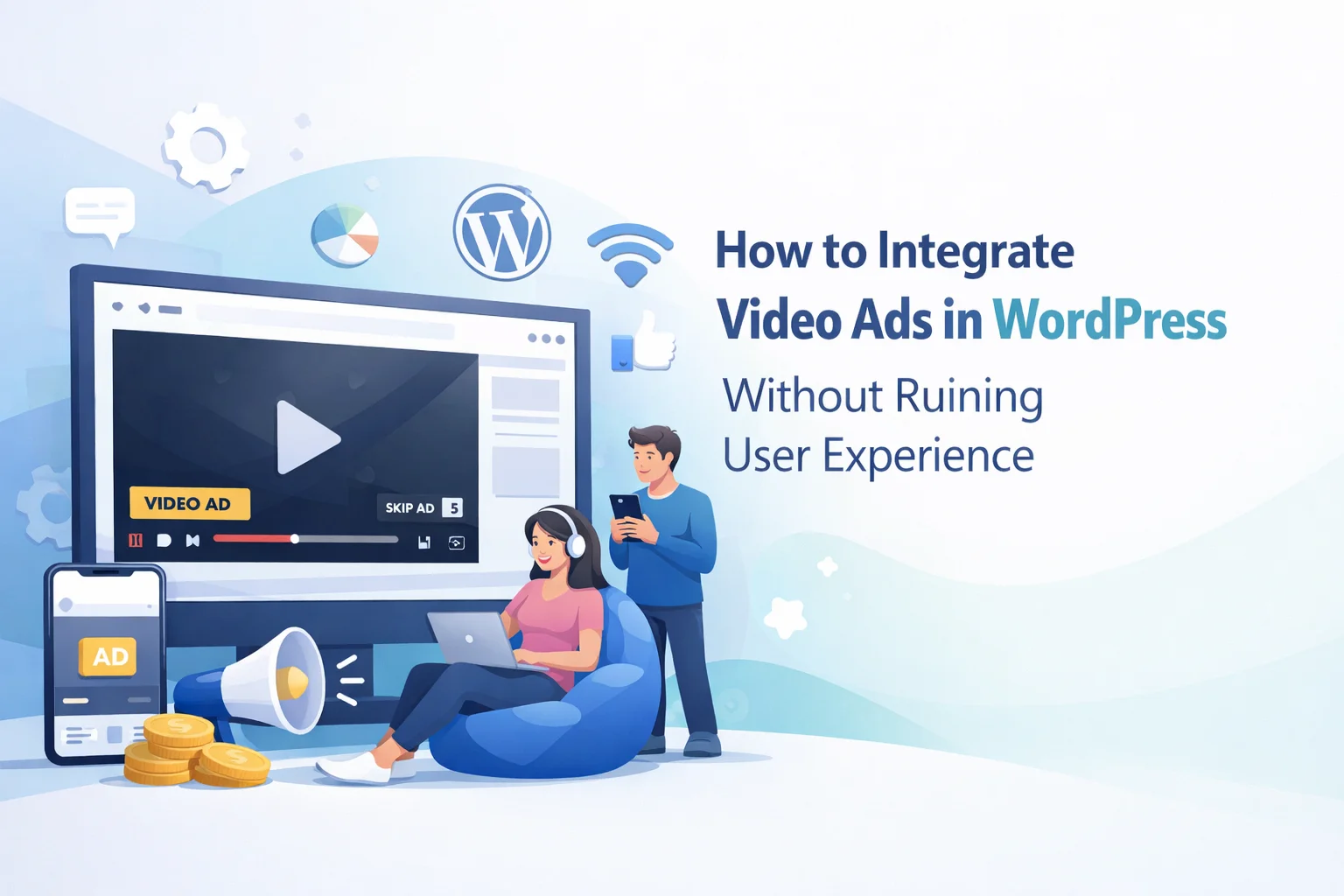
This is the approach the Elementor Video Ads plugin for user-friendly WordPress video monetization takes. It extends the standard Elementor Video widget with a Video Ads section on the Content tab. The ad controls sit next to the main video settings. The ad plays before the main content inside the same player. The viewer gets a skip option after your configured timing. The whole experience stays within the same widget element the viewer already intended to interact with.
The placement inside the Elementor editor also helps your team maintain UX quality over time. When the ad settings are visible next to the video settings, editors are naturally prompted to think about both together. Does this ad make sense with this content? Is the skip timing reasonable for this page? Those questions surface naturally when the controls are co-located, which is harder to achieve when the ad configuration lives in a separate admin area disconnected from the content.
Page speed is not just a technical metric. It is a foundational UX element. Google’s Core Web Vitals framework treats page performance as a ranking signal because slow pages are a direct UX problem: they make visitors wait, they increase cognitive load, and they signal that the site does not respect the visitor’s time.
Many video ad implementations violate page speed by loading scripts on initial page render. External ad networks need to run bidding auctions, load creative assets, initialize tracking pixels, and set up viewability measurement before the ad even appears. All of that happens during page load, competing with your content for bandwidth and rendering resources.
Self-hosted pre-roll ads that load on user interaction avoid this entirely. When the ad creative is a video file in your WordPress media library or a URL pointing to YouTube or Vimeo, nothing loads until the viewer clicks play. Your page renders at full speed. Your Core Web Vitals scores are unaffected. The ad creative loads on demand, after the page is fully rendered and the viewer has committed to watching.
Not every page on your site should carry a video ad. Strategic restraint is one of the most effective UX tools you have. Knowing where to leave ads out is as important as knowing where to put them in.
The global settings in the WordPress admin panel make this strategic placement practical. You can enable a site-wide video ad campaign and then exclude specific pages, post types, or templates where ads would be inappropriate. This exclusion-based approach is more sustainable than the alternative of individually adding ads to each qualifying page because it ensures new content gets the ad by default while protected pages stay clean.
The right balance between revenue and user experience is not something you figure out once and forget about. It is a continuous calibration that depends on your specific audience, content type, and traffic patterns. The only way to get it right is to measure, adjust, and measure again.
Monitor three data sources simultaneously. First, the plugin’s built-in statistics for ad-specific metrics: impressions, skip rates, and visit action clicks. These tell you how the ad itself is performing. Second, your site analytics tool (like Google Analytics ) for broader site behavior: are bounce rates increasing on pages with video ads? Are return visit rates declining? Is average session duration changing? Third, your direct feedback channels: are visitors complaining about ads in comments, support tickets, or social media?
The signal to watch for is not whether some people skip your ads. Most people will skip when given the option, and that is perfectly healthy. The signal is whether your overall traffic and engagement metrics are declining after implementing video ads. If your traffic is stable or growing and your skip rates are reasonable, your balance is working. If traffic starts declining, you have pushed too far and need to pull back: shorter ads, longer skip-free pages, or fewer pages with ads enabled.
The most successful WordPress publishers treat their ad strategy as an ongoing experiment, not a one-time decision. They adjust skip timing seasonally, rotate ad creative monthly, review exclusion rules quarterly, and monitor audience metrics continuously. The tools for this experiment are built into the plugin and your analytics platform. The judgment is yours.
Video advertising on WordPress does not have to be a compromise between revenue and experience. When you choose the right format (in-player pre-roll), configure it with respect for the viewer (fair skip timing, proportional ad length), protect your site’s technical performance (on-demand loading, no third-party script bloat), and use data to continuously calibrate the balance, you end up with a monetization layer that generates meaningful revenue without giving your visitors a reason to leave.
The Elementor Video Ads plugin for WordPress video monetization without UX compromise gives you the controls to implement this balance: per-widget ad configuration, configurable skip timing, global campaigns with exclusion rules, and performance statistics that inform your ongoing decisions. The implementation takes minutes. Getting the balance right takes attention, but the reward is a revenue stream that grows with your audience instead of at its expense.
Pre-roll ads that load on demand, respect viewer control with configurable skip timing, and protect your page speed. Run global campaigns with smart exclusions to keep sensitive pages ad-free.







Finally found a guide that actually nails video ads. I clicked the link expecting another generic fluff piece, but this one breaks down exactly why most sites mess up whether it's annoying autoplay, terrible placement, or ignoring load times. that stat about users bouncing after 3 seconds really hit home for me. After adjusting my ad timing based on their tips, my bounce rate actually dropped. no gimmicks or "secret hacks," just solid UX advice that works. If you're trying to monetize without driving people away, this is worth your time
Hey everyone! my buddy told me about this guide after I ranted about losing traffic from those annoying popup video ads. The real problem wasn't the ads they just showed up in the worst way possible. This pre roll method keeps things clean and predictable, and you can skip them just like on YouTube. No more random loud audio or content getting blocked mid read. My bounce rate actually went down after I made the switch.
Friend recommended this guide for video ads solid tips on avoiding auto play audio (seriously, saves so many