Next-Level Code. Nexuvibe Style ...
Hrs
Min
Sec

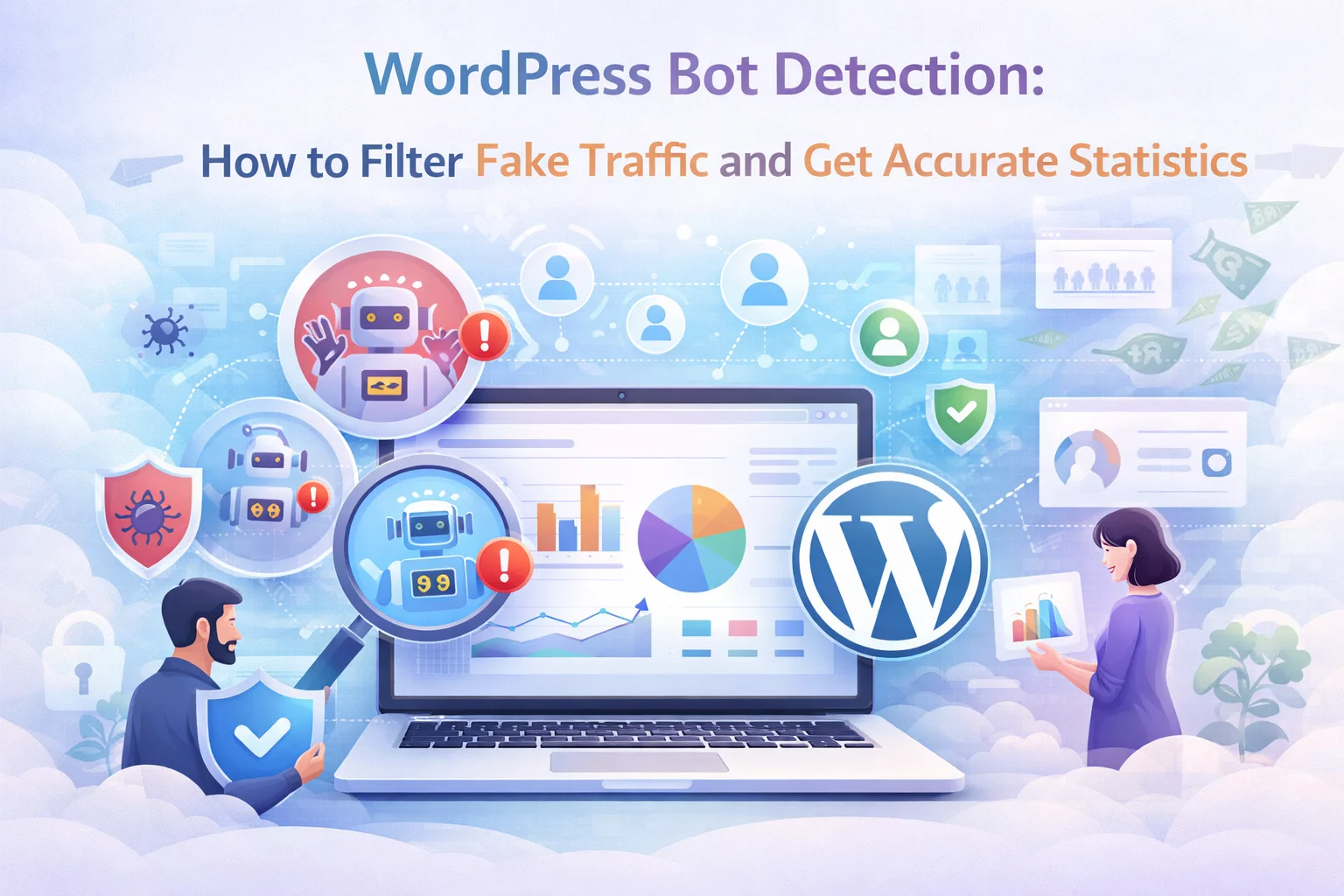
There is a number in your WordPress analytics that is almost certainly wrong: your total visitor count. Not because your analytics plugin is broken, but because a significant portion of what it counts as “visitors” are automated programs, not people. Search engine crawlers, spam bots, SEO scrapers, vulnerability scanners, AI training crawlers, and content thieves all generate HTTP requests that look, to a basic analytics system, like visitor traffic.
The scale of this problem in 2026 is larger than most WordPress site owners realize. Industry research consistently shows that automated bot traffic accounts for 30 to 50 percent of all web traffic globally, and for smaller WordPress sites without sophisticated bot mitigation, the percentage can be even higher. If your analytics show 10,000 monthly visitors and you have no bot filtering, your actual human visitor count might be 5,000 to 7,000. Every conversion rate calculation, every content performance assessment, and every marketing ROI analysis built on the inflated number is misleading.
This article explains how bot detection works in WordPress analytics, why it has become more important with the rise of AI crawlers, and how to ensure the data you make decisions on represents real human visitors.
Not all bots are malicious, and understanding the categories helps you decide what to filter and what to allow. Legitimate search engine crawlers from Google, Bing, and other search engines need to access your site for it to appear in search results. You want these bots to crawl your site, but you do not want them counted in your visitor statistics. They are not visitors. They are indexing machines.
The newer category that has grown dramatically since 2024 is AI training crawlers. Companies building large language models send automated scrapers to harvest content from the web, including your WordPress site. These crawlers can generate substantial traffic and, unlike search engine crawlers, they do not generally benefit your site in return. Common examples include GPTBot, ClaudeBot, and various academic research crawlers. A single AI crawler can generate hundreds or thousands of page requests per day on a moderately sized WordPress site.
Then there are the genuinely malicious bots: spam bots that submit fake form entries, vulnerability scanners that probe your site for security weaknesses, credential stuffing bots that attempt to brute-force your login page, and content scrapers that copy your posts for spam sites. All of these generate traffic that looks like visitor activity if your analytics cannot distinguish them from humans.
Bot detection in analytics plugins works through several layers. The first and most basic layer is user agent matching. Every HTTP request includes a user agent string that identifies the software making the request. Known bots like Googlebot, Bingbot, and GPTBot identify themselves in their user agent strings. A bot detection system maintains a database of these known bot identifiers and filters matching requests out of your visitor statistics.
The second layer is behavioral analysis. Some bots do not identify themselves honestly. They use user agent strings that mimic real browsers to avoid detection. Behavioral analysis catches these by looking at patterns that distinguish automated requests from human behavior: abnormally fast page load sequences (a human cannot click through 50 pages in 10 seconds), requests to pages in a systematic order (crawling through a site alphabetically), or requests that never trigger JavaScript events (indicating they are not rendering the page like a real browser would).
The third layer is IP reputation analysis. Known bot networks operate from specific IP ranges, often associated with data centers rather than residential internet connections. Analytics that cross-reference visitor IPs against known bot infrastructure can filter out traffic that originates from cloud servers and hosting providers rather than from real internet users.
The NEXU WordPress analytics plugin with advanced bot detection and traffic filtering combines these layers to provide a comprehensive bot filtering system. Detected bots are categorized and logged separately, so you can see exactly what automated traffic your site receives without it contaminating your human visitor data. This transparency is important: you should be able to audit what your analytics is filtering and verify that legitimate traffic is not being incorrectly excluded.
There is a psychological temptation to prefer higher visitor numbers, even when you know they are inflated by bots. A report showing 50,000 monthly visitors feels better than one showing 30,000, even if both sites have the same number of actual human visitors. But inflated numbers are not just vanity metrics. They actively harm your decision-making.
If your analytics show 50,000 visitors and 500 conversions, your conversion rate appears to be 1%. If your actual human visitors are 30,000, your real conversion rate is 1.67%. That difference changes how you evaluate your site’s performance and where you invest in improvements. A site with a 1% conversion rate might seem like it needs a complete redesign. A site with a 1.67% conversion rate might just need better targeting to reach 2%.
Inaccurate traffic data also affects advertising decisions. If you sell ad space based on inflated traffic numbers, advertisers will eventually notice that their ads are not performing proportionally to the reported traffic and will stop buying. If you are buying ads and measuring their effectiveness against inflated visitor counts, you will underestimate the true cost per human visitor acquisition and make poor budget allocation decisions.
Start by installing an analytics plugin that includes bot detection as a core feature rather than an afterthought. Review the bot detection logs to understand what automated traffic your site currently receives. You may be surprised by the volume and variety of bots that are accessing your content regularly.
If you want to block AI crawlers specifically, add directives to your robots.txt file. While not all AI crawlers respect robots.txt, the major ones (GPTBot, ClaudeBot, Google-Extended) generally do. This reduces the load on your server and removes a growing source of non-human traffic from your analytics.
Compare your analytics data before and after enabling bot detection. The drop in total visitor count tells you how much of your previous data was bot traffic. Use the clean numbers going forward as your baseline for all performance metrics and marketing decisions. It may be a smaller number, but it is a true number, and decisions built on truth outperform decisions built on inflated estimates every time.
Clean data is the foundation of good strategy. Everything else, content optimization, marketing spend allocation, conversion rate analysis, depends on knowing how many real people actually visit your site and what they do there. Bot detection is not an optional advanced feature. In 2026, with the explosion of AI crawlers and automated scraping, it is a prerequisite for analytics that mean anything at all.
Advanced bot detection. AI crawler identification. Transparent filtering logs. Human-only visitor statistics you can trust for real business decisions.






Got this for a client who was sick of inflated stats
Hey, just set this up on my practice's site. The bot filtering actually made my conversion numbers drop but in a good way. Turns out half my "visitors" were junk. saved me from chasing bad data
So if this plugin blocks bots, how do I know it won't flag Googlebot too?
Hey, so I installed this to clean up my traffic stats, but how do I actually tell if it's working? my numbers dropped, sure, but are those really bots being filtered or just legit visitors getting blocked?