Next-Level Code. Nexuvibe Style ...
Hrs
Min
Sec

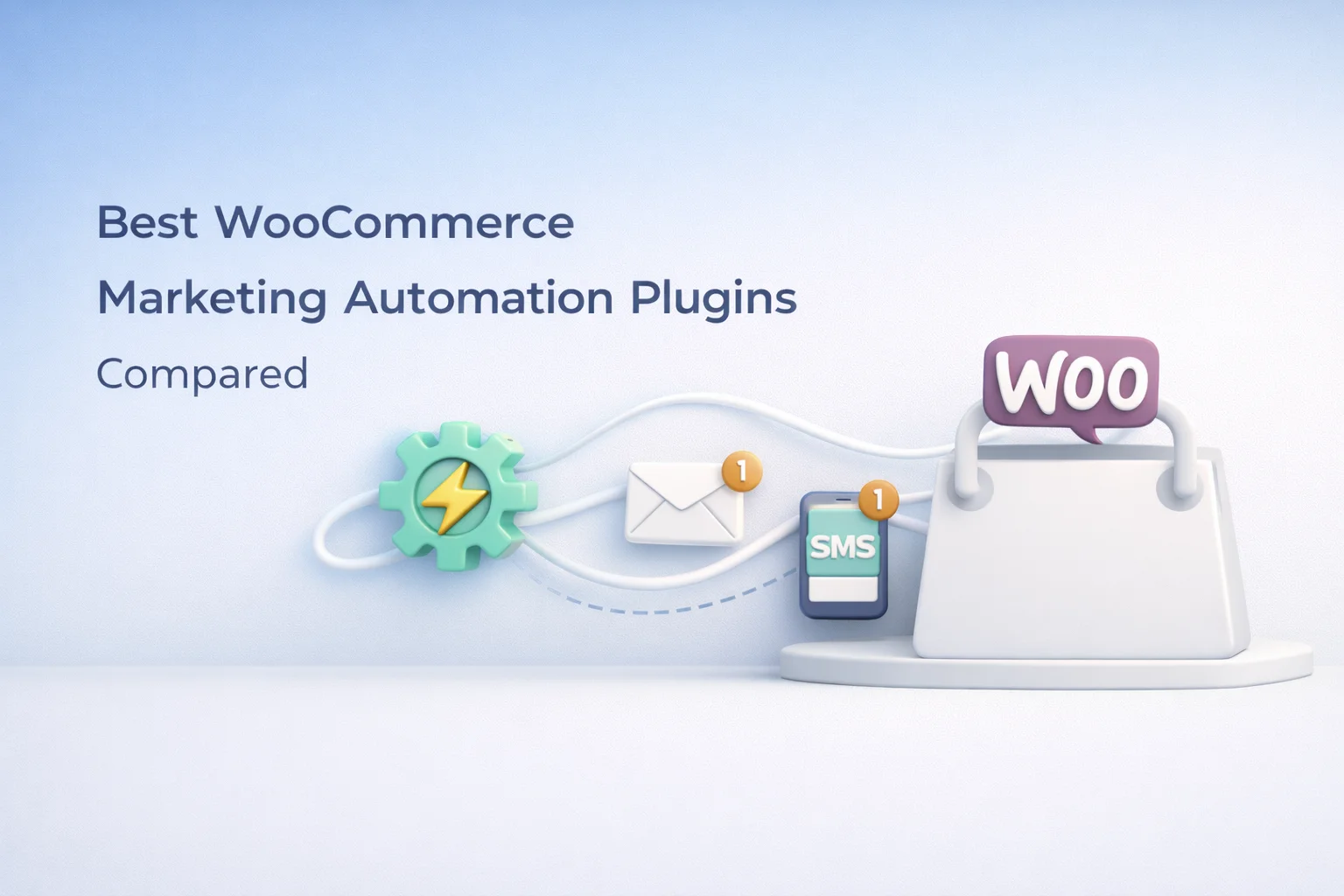
Choosing a marketing automation plugin for WooCommerce is one of those decisions that feels simple until you actually start looking. The WordPress plugin ecosystem has no shortage of options, and every one of them claims to be the best. The reality is more nuanced. Each tool makes different tradeoffs between features, complexity, pricing, and where your data actually lives. Some are self-hosted plugins that keep everything inside your WordPress installation. Others are SaaS platforms that require sending your customer data to an external service. Some focus narrowly on email. Others try to cover email, SMS, segmentation, workflows, and AI in one package.
This comparison looks at the marketing automation options that are most relevant for WooCommerce store owners in 2026. We evaluate each one based on criteria that matter in daily use: what channels it supports, how it handles automation workflows, whether it includes an email builder or makes you code templates by hand, how it approaches audience segmentation, where your data is stored, and what it actually costs when you account for the sending fees that some platforms charge on top of their subscription price.
Full disclosure: we develop one of the plugins in this comparison, Nexu AI Automate Marketing for WooCommerce email SMS and workflow automation. We are transparent about that. We also believe that the right tool depends entirely on your store’s specific needs, and we will be honest about where other tools may be a better fit for certain use cases. A comparison that hides its biases is less useful than one that states them plainly.
Before looking at individual tools, it is worth understanding why certain criteria matter more than others when choosing a WooCommerce marketing automation plugin. Feature lists are easy to compare. Operational realities are harder to see until you are already committed to a tool.
SaaS platforms store your customer data on their servers. Self-hosted plugins store it in your WordPress database. This distinction affects GDPR compliance, vendor lock-in, and what happens to your marketing data if you stop paying. With a self-hosted plugin, your contacts, segments, and campaign history stay in your database regardless of your subscription status. With a SaaS platform, canceling often means losing access to your audience data.
A $16/month subscription sounds affordable until you realize it covers only 500 contacts and the price jumps to $59/month at 2,500 contacts. Some tools charge per email sent. Others charge per contact. A self-hosted plugin with a flat annual fee and no per-contact pricing has a fundamentally different cost trajectory as your list grows. When comparing, always calculate the 12-month cost at your expected contact count.
In 2026, a marketing automation tool that only handles email is incomplete. SMS has become a critical channel for time-sensitive messages like cart recovery, flash sales, and shipping updates. The question is whether email and SMS live in the same automation builder (so you can mix channels in a single flow) or whether SMS is bolted on as a separate feature that requires its own configuration and workflows.
We selected six tools that represent the main approaches to WooCommerce marketing automation. Three are SaaS platforms with WooCommerce integrations, and three are self-hosted WordPress plugins. This mix reflects the real decision most store owners face: do you want your marketing platform inside WordPress or outside it?
Omnisend is a SaaS email and SMS marketing platform built for ecommerce. It integrates with WooCommerce through a connector plugin and stores all data on Omnisend’s servers. Its strength is polish: the email builder is well-designed, the pre-built automation workflows cover common ecommerce scenarios (welcome series, cart abandonment, post-purchase), and the segmentation is based on purchase behavior. It also includes push notifications, which most competitors do not offer.
The tradeoff is cost and data ownership. Omnisend’s free plan is limited to 250 contacts and 500 emails per month, which is essentially a trial. The Standard plan starts at $16/month for 500 contacts but climbs steeply as your list grows. At 5,000 contacts, you are looking at $65/month. SMS costs are billed separately on top of that. Your customer data and campaign history live on Omnisend’s servers, which means switching away requires an export process and you lose access to historical analytics.
Klaviyo is the market leader in ecommerce email automation and arguably the most powerful option on this list in terms of raw capability. Its segmentation engine is exceptionally granular, its predictive analytics can forecast customer lifetime value and churn risk, and its automation builder supports complex conditional logic that other tools cannot match. The WooCommerce integration syncs product catalogs, order data, and customer profiles in real time.
Klaviyo’s limitation is price. The free tier covers 250 contacts with a cap of 500 email sends. Beyond that, pricing starts at $20/month for up to 500 contacts and increases to $100/month at 5,000 contacts. SMS is priced per message. For a store sending 10,000 emails and 1,000 SMS messages per month, the total cost can reach $150 to $200/month. That is a significant budget commitment for a small to mid-size WooCommerce store. The platform also has a learning curve that reflects its depth: getting the most out of Klaviyo requires time investment in understanding its flow builder, segment conditions, and reporting.
Mailchimp is the most recognized name in email marketing and offers a WooCommerce integration that handles product syncing, purchase tracking, and basic automation. Its email builder is solid, its template library is extensive, and it handles the basics of ecommerce email well: abandoned cart flows, order notifications, and product recommendation emails.
However, Mailchimp’s WooCommerce automation capabilities lag behind dedicated ecommerce tools. The automation builder is less flexible than Klaviyo’s or even Omnisend’s. SMS support exists but is limited to the US and UK. Segmentation is functional but not deeply tied to WooCommerce data in the way that purpose-built tools manage. Pricing follows a tiered model that can get expensive: the Standard plan at 5,000 contacts runs around $75/month, and Mailchimp famously counts unsubscribed contacts toward your limit, which inflates costs.
AutomateWoo is the official WooCommerce automation extension, now maintained by Automattic. It is a self-hosted plugin, so all data stays in your WordPress database. It supports email-based automation with triggers for cart abandonment, purchases, reviews, wishlists, and subscriptions. It also includes SMS capability, a referral program add-on, and coupon generation.
AutomateWoo’s strength is its tight integration with WooCommerce core, and it works well for its intended purpose: rule-based automation triggered by store events. Its limitation is that the email design experience is basic. There is no drag-and-drop email builder. Emails are composed using a simple text editor with HTML support, which means designing visually rich emails requires coding knowledge or an external tool. The automation builder is functional but less visual than newer alternatives. It also does not include AI-assisted content generation. At $9.92/month (billed annually at $119), it is reasonably priced for what it does.
FunnelKit Automations (formerly Autonami) is a self-hosted WordPress plugin that combines CRM-like contact management with email and SMS automation. It takes a broader approach than AutomateWoo, positioning itself as a complete marketing automation suite for WordPress. The visual automation builder is well-designed, and it supports branching logic, A/B testing of emails, and detailed contact profiles that track purchase history and engagement.
FunnelKit’s pricing reflects its ambitions. The Automations-only plan starts at $99.50/year for a single site, but most users need the full FunnelKit suite (which includes the funnel builder, checkout optimizer, and cart abandonment) at $249.50/year. At higher tiers, it reaches $399.50/year. The email builder is functional but not as refined as dedicated email tools. SMS is supported through Twilio integration.
Nexu AI Automate Marketing is a self-hosted WooCommerce plugin that combines email automation, SMS marketing, a drag-and-drop email builder, dynamic coupon generation, audience segmentation, and AI-assisted content creation in a single package. All data stays in your WordPress database. There is no per-contact pricing and no per-email sending fee beyond what your hosting or SMTP provider charges.
The visual workflow builder supports multi-step automations with email and SMS actions in the same flow. The email builder uses a block-based approach with column layouts, merge tags, and saved templates. The AI assistant can draft email copy, refine individual blocks, and generate automation flows from prompts. SMS is handled through Twilio integration or custom webhooks, with rate limiting and phone number mapping built into the settings.
Where Nexu AI Automate Marketing differs from the SaaS options is the pricing model and data ownership. It is priced at $89/year for a single site, with no per-contact fees regardless of list size. At 500 contacts, that is cheaper than any SaaS option. At 10,000 contacts, the price gap is dramatic. The tradeoff is that you need your own email sending infrastructure (your host’s mail server or an SMTP service like Brevo, Amazon SES, or a similar provider), which SaaS platforms handle for you.
In candid terms: this plugin’s weakness compared to Klaviyo is the depth of analytics and predictive modeling. It does not forecast customer lifetime value or churn probability. Its strength compared to AutomateWoo is the email builder and AI assistant. Its advantage over all three SaaS options is cost predictability and data ownership. For a store doing under $50,000/month in revenue that wants email, SMS, and automation in one self-hosted package without escalating monthly fees, it occupies a space that the other tools on this list do not.
The following table compares all six tools across the criteria that matter most for daily WooCommerce marketing operations. This is not an exhaustive feature matrix. It focuses on the capabilities that differentiate these tools in practice.
The plugin-level comparisons above are useful, but the more fundamental decision is the hosting model. This choice affects your cost trajectory, data ownership, vendor dependency, and technical requirements more than any individual feature comparison.
You want everything managed for you, including email deliverability, server infrastructure, and sending reputation. You are comfortable with per-contact pricing and the cost trajectory it implies as your list grows. You do not mind your customer data living on a third-party server. You value the convenience of not managing SMTP configuration or dealing with sending limits on your hosting provider. You want advanced analytics and predictive features that require significant data processing infrastructure (Klaviyo’s strength).
You want your customer data in your own database with no vendor lock-in. You prefer flat annual pricing that does not increase as your contact list grows. You are willing to set up your own SMTP service (which is straightforward with providers like Amazon SES at fractions of a cent per email). You want to keep your entire marketing stack inside WordPress rather than sending data to external platforms. You value the ability to switch plugins without losing your contact database.
There is no single best WooCommerce marketing automation plugin. There is a best plugin for your specific situation. If you are doing significant revenue and need enterprise-grade analytics, Klaviyo is hard to beat despite its cost. If you want a solid SaaS experience with good ecommerce features at a moderate price, Omnisend is a strong choice. If you want the official WooCommerce extension with no frills, AutomateWoo does its job reliably.
If you want email, SMS, a visual email builder, AI content assistance, audience segmentation, and dynamic coupons in a single self-hosted plugin with flat annual pricing and no per-contact fees, Nexu AI Automate Marketing’s all-in-one WooCommerce marketing automation solution is designed for exactly that use case. We built it because we saw a gap between expensive SaaS platforms and basic self-hosted tools that lacked email design and AI capabilities.
Whichever tool you choose, the important thing is to actually set it up and run it. An imperfect automation that is live and sending recovery emails today is worth more than a perfect evaluation process that delays your first campaign by three months.
Visual workflows, drag-and-drop email builder, SMS via Twilio, dynamic coupons, audience segments, AI content assistant. Your data stays in your WordPress database. $89/year flat.




Love the detailed comparison super helpful for narrowing things down. But I'm curious: when you say "the reality is more nuanced," does that mean some plugins claim to be self hosted but still offload data externally?
Ugh, this guide feels like a sales pitch in disguise. Says it's unbiased but just pushes their plugin.
Just wanted to say thanks for this comparison guide super helpful breakdown of the SaaS vs. self hosted options. Had no idea some of these plugins actually send your customer data off site. It's kinda annoying that you lose access if you cancel, but at least now I know exactly what I'm getting into. definitely saved me a major headache down the road!