Next-Level Code. Nexuvibe Style ...
Hrs
Min
Sec

Most WordPress site owners discover their media library is becoming a problem through symptoms rather than alerts. The upload speed slows down. A backup takes twice as long as it used to. Hosting sends a warning about disk usage. By the time these things happen, the media library has been silently accumulating files for months or years, and the size has grown well past what shared or even managed hosting was really designed to handle.
The thing is, a large WordPress media library is not inherently a sign of poor management. It is usually a sign that a site is working. More content, more images, more products, more contributors. Growth creates files. The question is not whether your media library will fill up. It is whether you have a plan for when it does.
This guide walks through seven specific signs that your WordPress media library has reached the point where offloading to external storage is no longer optional. For each sign, we explain why it happens, what it costs you if you ignore it, and what the fix actually looks like in practice.
The most obvious sign is one you cannot ignore: your hosting control panel flags a storage warning, usually somewhere between 75% and 90% capacity. Most site owners assume this means they need to upgrade their hosting plan. That instinct is expensive and often wrong.
The reality is that WordPress hosting is priced around PHP execution, database access, and managed infrastructure. It is not optimized for bulk file storage. A managed WordPress host charging $40 a month for 30GB of space is giving you high-quality compute resources at a premium. Using those resources to store thousands of JPEG files is one of the most inefficient ways to spend your hosting budget.
When you offload your WordPress media library to an external FTP or SFTP destination, you free up the majority of your hosting disk space immediately. The files leave your server. Your WordPress site keeps working because the plugin rewrites output URLs to point at your CDN or FTP-served domain, so visitors never know the files have moved.
This is a sign that often goes unnoticed because backups usually run at night. But when a backup that once took 15 minutes now takes 90 minutes, and it is growing, something has changed. In most cases, the thing that has changed is the size of your /wp-content/uploads folder.
WordPress backups by default include the uploads directory. For a site with two years of images, product photos, PDFs, and video thumbnails, that directory can easily reach 10GB, 20GB, or more. At that size, backup jobs consume significant server resources, take long enough to interfere with scheduled tasks, and produce backup archives that are difficult to store and restore quickly.
When your media files live on an external FTP or SFTP server, your WordPress backup only needs to cover the database, themes, and plugins. That is typically under 500MB. Your backup time drops from an hour to under three minutes. Your restore process is dramatically faster. And the media files themselves, which rarely need to be restored from backup because they do not change, can be backed up independently on a slower schedule from your FTP destination.
Largest Contentful Paint (LCP) is one of Google’s Core Web Vitals metrics, and it directly affects your search engine rankings. Google considers an LCP under 2.5 seconds “good.” Above 4 seconds is “poor.” If your site’s LCP score is failing, your media serving strategy is one of the most likely culprits.
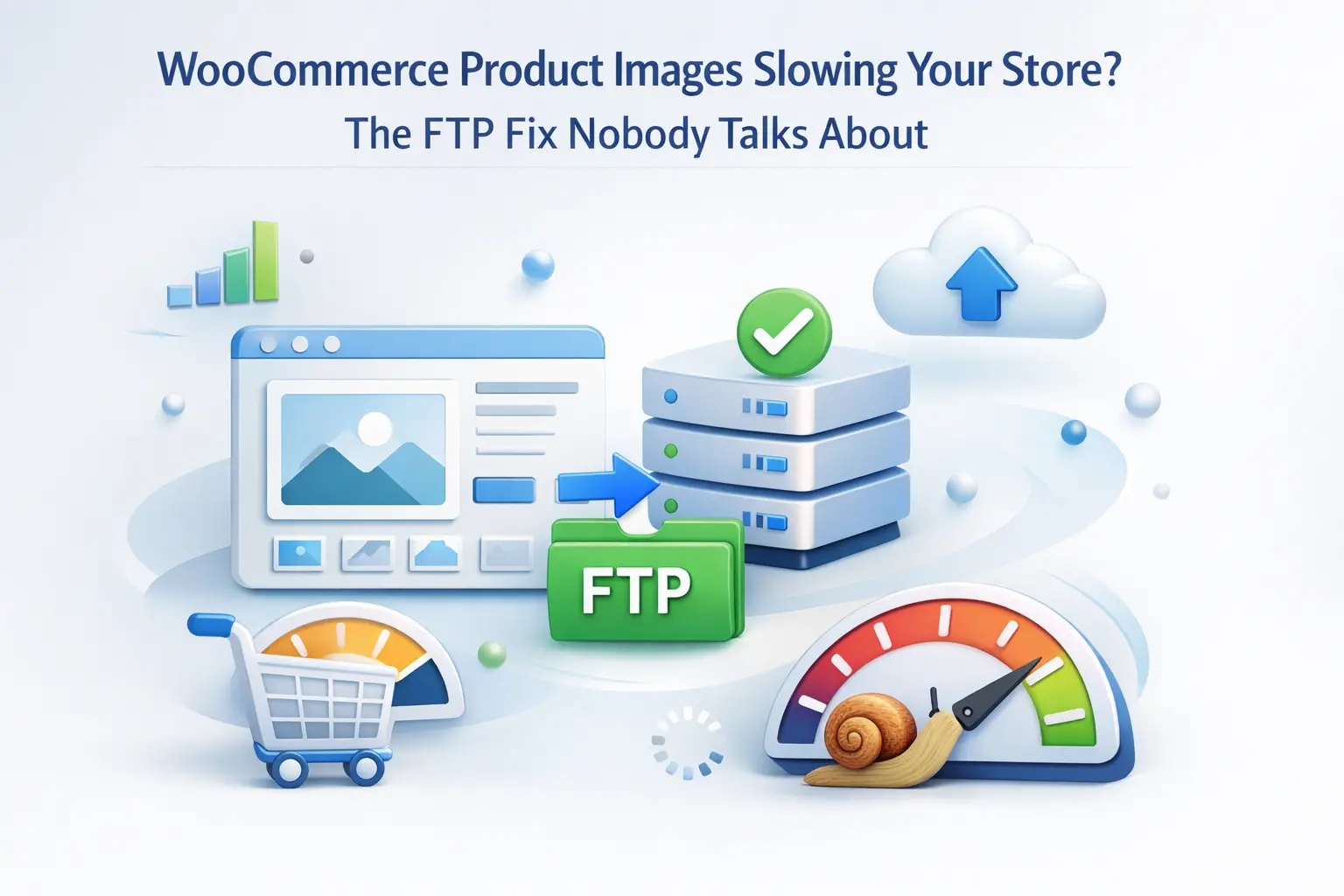
The relationship between media library size and LCP is not always direct, but it becomes real as hosting resources get strained. When the same server is handling PHP requests, database queries, and serving thousands of static image files, something has to give. Under traffic load, image delivery slows, TTFB increases, and your LCP score deteriorates even if the images themselves are well-optimized.
Moving media to an external FTP server, combined with a CDN for delivery, separates static file serving from dynamic WordPress execution. Your WordPress server focuses on what it does best. Your CDN focuses on what it does best: fast global delivery of static files. The result is measurably better LCP scores. According to Google’s Web Vitals documentation, LCP heavily depends on resource load time, and serving images from a CDN edge location is one of the most reliable ways to reduce that load time.
If you have ever migrated a WordPress site with a large media library, you know the experience. The database migrates in seconds. The theme and plugins move in a minute. Then you sit and wait while gigabytes of image files transfer from one server to another. An 8GB uploads folder can add two to four hours to what should be a 20-minute migration.
For agencies managing multiple client sites, this is a recurring productivity drain. For individual site owners, it is the thing that makes you delay migrations you know you should do, sometimes indefinitely. When your media files already live on an external FTP server, a site migration becomes a database export, a theme and plugin copy, and a configuration update. The files are already where they need to be.
This is one of the underappreciated benefits of a proper WordPress media offload solution for agencies and freelancers. The client site becomes dramatically easier to move, clone, or hand off because the heavy assets are decoupled from the WordPress installation itself.
This is a sign that surprises many people because it has nothing to do with how much storage space they have used. Inodes are filesystem entries. Every file, whether it is 1 byte or 1 gigabyte, consumes one inode. Most shared hosting plans cap inodes at a specific number, often 100,000 to 250,000, regardless of storage space.
When you hit inode limits, WordPress cannot create new files. Uploads fail silently or with confusing errors. Plugins that write temporary files stop working. This is not a theoretical edge case. It is a common failure mode on shared hosting for sites that have been running for two or more years with regular media uploads. Offloading your media library moves those tens of thousands of thumbnail files off your hosting server’s filesystem entirely.
Thumbnail regeneration is something most site owners do rarely but inevitably: when you switch themes, install a new plugin that adds an image size, or change your media settings. The process rewrites every thumbnail size for every image in your library. On a small library, it takes a few minutes. On a library of 5,000 or more images, it can run for 20 to 40 minutes, consume significant server resources during that time, and occasionally time out or fail partway through.
A thumbnail regeneration that takes 30 minutes is a signal that your media library has grown to the point where routine maintenance tasks are genuinely painful. That pain only grows over time as the library gets larger. There is no configuration change that makes thumbnail regeneration fast on a library of 20,000 files. The only real solution is to stop adding to that volume of files on your primary server.
This is the sign that is easiest to miss because it feels like the rational next step. Your hosting plan has 50GB included. You are at 45GB. Upgrading to the next tier gets you 100GB and feels like a straightforward solution. But if the majority of your usage is from media files, you are paying for a premium hosting environment just to store files that do not need a premium hosting environment.
Consider what you are actually paying for when you upgrade a managed WordPress hosting plan. You are paying for faster PHP execution, better database performance, managed security, and expert support. None of those things apply to static image files. A JPEG does not benefit from managed WordPress infrastructure. It benefits from cheap, reliable storage and fast CDN delivery. Those are two entirely different products at two entirely different price points.
Before you move forward, it is worth being honest about what a media offload to FTP solves and where its boundaries are. Understanding this clearly will help you set the right expectations.
Disk space and inode exhaustion on your hosting server. Backup size and duration. Migration time and complexity. Serving static files at scale without straining your WordPress server. The ability to grow your media library indefinitely without upgrading your core hosting plan. These are the real, measurable problems that a media offload workflow is designed to address.
Unoptimized image file sizes. Poor image compression practices. Slow PHP execution on your server. Database bloat from unused post metadata. These problems need their own solutions. Offloading is infrastructure. It is not a substitute for using modern image formats like WebP, setting reasonable quality levels, or cleaning up orphaned media files.
The thing that worries most site owners about offloading is the URL question. If you move files to an external server, will all the internal links pointing to those files break? Will your pages suddenly show empty image placeholders? This is a legitimate concern and it is the exact problem that a well-built offload tool needs to handle correctly.
The right approach, and the one used by quality offload plugins, is output-based URL rewriting rather than database rewriting. This means the plugin does not go through your database and change every image URL. Instead, it rewrites image URLs on the fly as each page is rendered. The database remains untouched. Your editing experience in the WordPress admin stays exactly the same. But when a visitor loads a page, the image URLs they receive point to your CDN or external domain rather than your hosting server.
The sync process itself should be controllable and visible. A progress view that shows how many files have been transferred, how many remain, and whether anything failed is not a luxury feature. It is the difference between a confident project and one where you are left guessing whether anything actually moved. For large libraries, the ability to run parallel transfers significantly reduces the time needed to move thousands of files.
Moving your existing library is only part of the solution. For offloading to remain effective long-term, new uploads need to follow the same path automatically. If you offload your existing 10,000 images but new uploads continue going to your hosting server, you will be back in the same situation within a year.
Automatic upload behavior means the plugin intercepts each new media upload in WordPress and sends it to your FTP destination, optionally deleting the local copy after confirming the transfer was successful. When this is working correctly, your hosting server’s media footprint stops growing permanently, regardless of how much content you publish.
The monitor tab in a well-built offload plugin serves a similar role to the dashboard in a server management tool. It gives you a health picture: is the connection active, are system requirements met, is the environment ready to process uploads? For sites where offloading is a background process, this is the screen you check when something feels off rather than digging through server logs.
If any one of these signs applies to your site today, it is worth evaluating a media offload workflow seriously. If two or more apply, the case for moving now rather than later is strong.
Storage pressure is one of those problems that rarely resolves itself. It accumulates. And the longer you wait, the more disruptive the fix becomes. Offloading while your library is at 5,000 files is a much smoother operation than offloading at 50,000. If you recognized yourself in one or more of the signs above, the practical next step is to evaluate a dedicated WordPress media offload workflow before the next storage warning arrives.
A good offload plugin gives you a clear progress view, output-based URL rewriting that keeps your database untouched, and automatic upload behavior so the problem does not return. It costs a fraction of what you would spend on a hosting upgrade and solves the structural problem rather than just buying more time. WP FTP Media by NEXU WP is built around exactly this workflow: move your library, serve it via CDN, and keep new uploads following the same path automatically.
WP FTP Media offloads your WordPress media library to an external FTP or SFTP destination, serves files via your CDN base URL, and keeps new uploads following the same path automatically.





Hey, quick question does this guide show how
Thumbnail regen was the sneaky storage hog.
This guide's breakdown of the 7 signs is solid, but I'm curious about the FTP offload piece. Does moving product images to FTP actually fix server response times during peak traffic, or just free up disk space? My Woo store's media library is 12GB and growing, and I need to know if this will stop the slowdowns during sales events
Hey folks, just wanted to drop a quick note about this guide. Been running a WooCommerce store for years, and I always figured storage warnings were just part of the game. turns out, thumbnail regeneration was eating up way more space than I realized.