
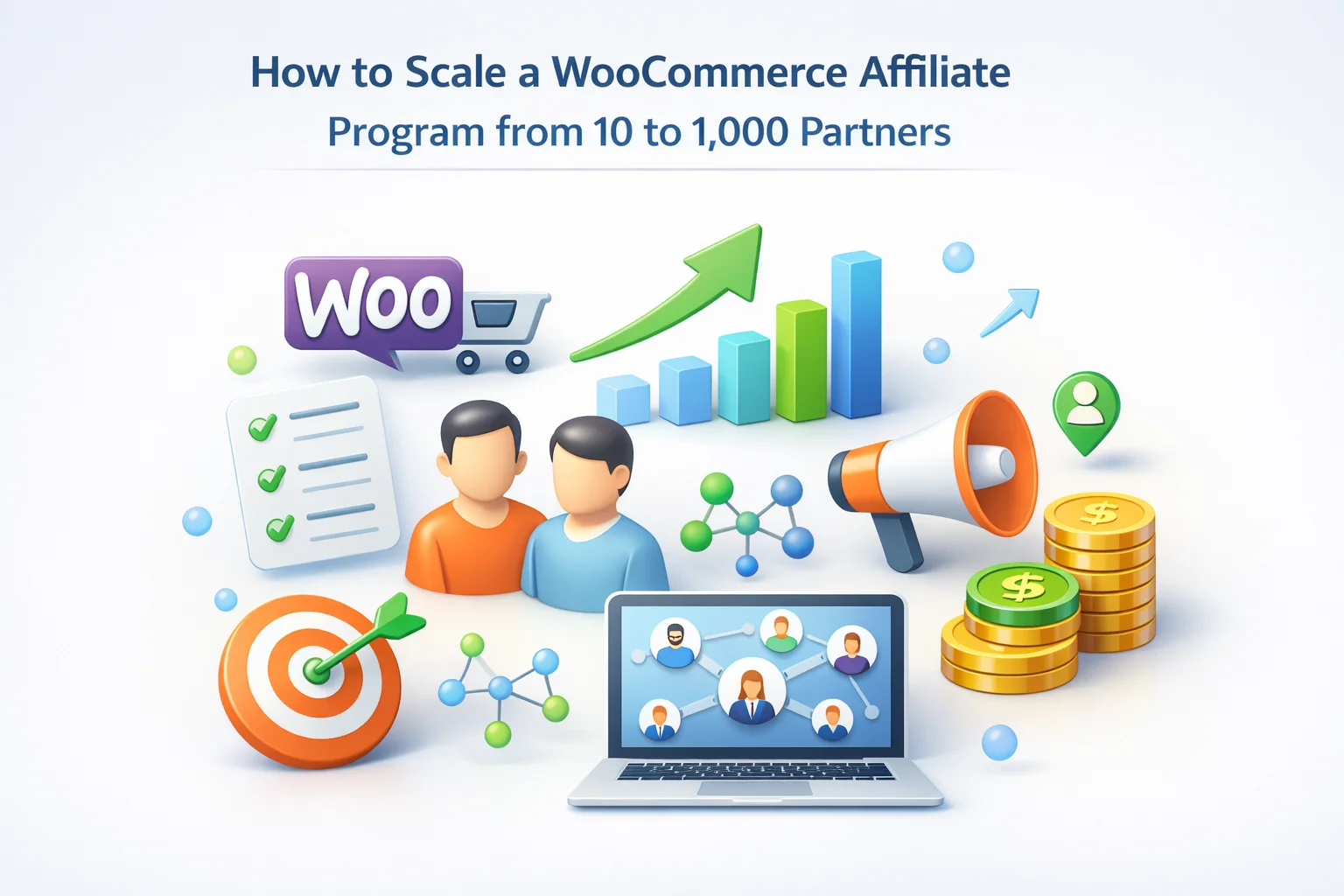
Most WooCommerce affiliate programs plateau between 10 and 30 affiliates — not because the opportunity is not there, but because the founder-led approach that got the program started does not scale. The same store owner who personally reviewed every application, manually emailed each new affiliate, and hand-picked every partner becomes a bottleneck when the program needs to process 40 applications a week, onboard 15 new affiliates a month, and maintain active relationships with 200 existing partners simultaneously.
Scaling an affiliate program is not primarily a technology problem — it is a systems design problem. The technology you need at 1,000 affiliates is not fundamentally more sophisticated than what you need at 10. What changes is the degree to which every process is documented, automated, and repeatable without requiring individual human judgment on each case.
This guide covers the full scaling journey in three stages — the foundations stage (0–50 affiliates), the systems stage (50–250 affiliates), and the reputation stage (250–1,000+ affiliates) — with specific action items, automation investments, and program structure changes at each stage. The infrastructure throughout is provided by Affiliate Engine’s WooCommerce affiliate program management plugin, which is designed to scale with a program from its first affiliate to its thousandth without requiring a platform change.
Stage 1 (0–50 affiliates): Building the foundations
The foundations stage is where most of the structural decisions are made that will either enable or constrain future scaling. A program with a well-configured plugin, a converting landing page, a documented onboarding process, and validated tracking can scale relatively smoothly. A program that skipped any of these becomes increasingly painful to fix as the affiliate count grows.
Before recruiting affiliate number eleven, verify that tracking works correctly across all paths (cookie, coupon, mobile), that the hold period covers your refund window, that self-referral blocking is active, and that all notification emails fire correctly with the right content. Fixing technical problems at 10 affiliates takes an hour. Fixing them at 150 affiliates means retroactively explaining incorrect commission records to 150 people. Invest the time now.
The first ten affiliates should be recruited personally — email outreach to content creators you have identified, direct messages to customers who mention your products on social media, personal invitations to industry contacts. This manual approach is not a limitation; it is deliberate intelligence gathering. Which affiliate types respond? What questions do they ask before joining? What makes them actually promote? What creative formats do they prefer? The answers to these questions shape your systems for every affiliate who comes after.
Every question an early affiliate asks is a gap in your onboarding materials. Every complaint is a friction point. Every request for a specific creative format is a product roadmap item. Build a simple running document of affiliate feedback from the first ten. When you systematize onboarding for the next hundred, this document is the blueprint. Affiliates who joined early and were listened to become vocal advocates within their creator communities — a word-of-mouth recruitment asset that money cannot directly buy.
After three months with your first cohort of affiliates, calculate the metrics that will guide all future scaling decisions: average revenue per active affiliate per month, average commission per affiliate per month, activation rate (what percentage of approved affiliates ever share their link), and average time from approval to first referral. These baselines tell you what “normal” looks like — so that when you scale, you can identify whether performance is tracking normally or whether something in the system needs adjustment.
The most common Stage 1 mistake is treating affiliate count as the primary success metric and growing too fast before the product experience is validated. If your activation rate is 20% — meaning only 1 in 5 approved affiliates ever promotes — scaling from 10 to 100 just means you have 80 inactive affiliates instead of 8. Diagnose activation rate before scaling headcount. The right target at Stage 1 is a 50%+ activation rate within 30 days of approval. Below that, fix the onboarding and product experience first.
Stage 2 (50–250 affiliates): Building systems
At Stage 2, the bottleneck shifts from “not enough affiliates” to “not enough process.” The founder who personally managed 20 affiliates cannot personally manage 150. The approval email written by hand for each new affiliate cannot scale. The ad-hoc recruitment approach that worked via personal network cannot fill a 200-person program. This stage is about replacing personal attention with repeatable systems that deliver a consistent quality experience without requiring the same person to be involved in every interaction.
Every standard affiliate communication should be automated by Stage 2: submission confirmation, approval with referral link and code, 7-day check-in, 14-day nudge, new referral notification, commission approved notification, payout request confirmation, and payout processed confirmation. These are not low-quality automated messages — they are well-crafted templates that were written using the feedback from your Stage 1 affiliates and deliver a better experience than manual emails that arrive inconsistently. Automation is what makes quality experience scalable.
At Stage 2, the 80/20 principle becomes visible: roughly 20% of your affiliates are generating 80% of your commission-driven revenue. The tier system is the mechanism for recognizing and rewarding these high performers — without requiring a separate negotiation with each one. Typically two tiers work well at this scale: a standard tier (your base commission rate for all affiliates) and a partner tier (a higher rate for affiliates who hit a defined monthly revenue threshold). The threshold should be set so that roughly your top 15–20% qualify. The tier uplift does not need to be large — 3–5 percentage points above the standard rate is enough to be motivating.
By Stage 2, you need inbound affiliate applications arriving without personal outreach for each one. This requires three investments: an optimized program landing page that ranks for “[your niche] affiliate program” searches, a mention in your post-purchase email sequence (“Did you love your order? Share with your audience and earn commission”), and a brief affiliate program mention in your store footer and navigation. Together, these three channels can generate a steady stream of inbound applications without ongoing effort. Add to this a quarterly targeted outreach campaign to 10–20 specific creators you have identified — this keeps the active recruitment muscle exercised even as the inbound pipeline grows.
At Stage 1 you may have gotten by with a minimal creatives pack. At Stage 2, creative friction is a meaningful barrier to affiliate activation. Expand the creatives library to include: product images in multiple aspect ratios (1:1, 4:5, 16:9, 9:16), seasonal campaign assets updated quarterly, a text-based caption pack with multiple hooks and calls to action, and a short-form video B-roll pack if your products photograph or film well. Every asset added to the creatives library removes one excuse not to post. The affiliates who would promote but have not yet are often waiting for a specific creative format — providing it converts them from inactive to active without any outreach.

The most common Stage 2 mistake is applying the same communication cadence, the same commission rate, and the same management attention to all 200 affiliates equally. Your top 30 affiliates deserve more of your time and better rates than your 170 occasional promoters. Failing to differentiate means your best affiliates feel like they are in the same program as people who share one Instagram story a year — and eventually they join a better program that recognizes their contribution more explicitly. Tiered rates and a dedicated “partner” communication track for top performers are not optional at this stage.
Stage 3 (250–1,000+ affiliates): Building reputation
At Stage 3, the program has reached a size where its reputation within creator communities becomes the primary growth engine. Affiliates talk to each other — in Discord servers, YouTube creator communities, niche Facebook groups, and personal conversations. A program with a track record of reliable payments, fair treatment, and responsive support generates organic referrals from existing affiliates who recommend it to their peers. This word-of-mouth within creator networks is the most powerful and least expensive recruitment channel that exists at scale.
In creator communities, the most discussed topic about affiliate programs is payout reliability — specifically, programs that miss payment dates, hold commissions indefinitely, or create opaque disputes that are hard to resolve. A program that pays on time, every time, with a transparent commission record that affiliates can verify themselves, generates the kind of social proof that no marketing campaign can replicate. One affiliate telling their community “they always pay on the first, never a problem in two years” is worth more than any recruitment page. Build this reputation by executing your payout schedule without exception, communicating proactively when anything unusual occurs, and making the commission record in the affiliate dashboard accurate and complete.
At 300+ affiliates, a quarterly email to your partner tier (top 20%) that shares aggregate program performance, upcoming product launches, seasonal campaign plans, and any commission rate updates creates a sense of genuine partnership that most programs do not offer. This email should feel like a business briefing, not a newsletter — specific numbers (total commissions paid last quarter, top-performing product categories, average order value trends), specific upcoming opportunities, and a specific ask (here is our summer campaign and here is how to participate). Affiliates who feel like business partners with advance intelligence are more loyal and more proactive than those who feel like program participants.
At Stage 3, your existing affiliates are your best recruitment channel. Many of them have colleagues, collaborators, or friends in similar creative niches who would benefit from your program. Create a formal “refer an affiliate” incentive — a one-time bonus for each affiliate they successfully recruit who becomes active within 30 days. This turns your 500 affiliates into 500 recruitment agents, each working within their own professional network. The cost (a one-time recruitment bonus) is typically far lower than the customer acquisition value of a quality new affiliate, and the channel-fit of a new affiliate referred by an existing one is generally excellent.
A 1,000-affiliate program where 700 affiliates have been inactive for six months is not a 1,000-affiliate program — it is a 300-affiliate program with a lot of noise in the data. At Stage 3, quarterly list management becomes essential: segment active affiliates (any referral in last 90 days), warming affiliates (no referral in 90–180 days), and dormant affiliates (no referral in 180+ days). Each segment gets a different treatment: active affiliates receive the partner communications; warming affiliates receive a targeted re-engagement with a specific campaign invitation; dormant affiliates receive a final check-in and are removed if unresponsive. This keeps your active affiliate count meaningful rather than inflated by historical approvals.
The 80/20 of affiliate performance: where to focus at every stage
The 80/20 principle operates in affiliate programs with remarkable consistency — roughly 20% of affiliates generate 80% of the program’s commission-driven revenue at every scale. Understanding this clearly changes how you allocate time, resources, and commission budget across the affiliate population.
The practical implication of this distribution is that the 20 affiliates at the top of a 100-affiliate program warrant as much personal attention as the other 80 combined — because they are generating four times the revenue. Identifying who those 20 are at each quarterly review and ensuring they are on the partner tier, receiving the quarterly briefing, and feeling genuinely valued is one of the highest-return activities in affiliate program management.
Metrics to track at each stage
The metrics that matter at Stage 1 are activation rate (% of approved affiliates who share at least once within 30 days), average commissions per active affiliate per month, and time to first referral after approval. These measure program experience quality — not scale. A high activation rate and strong per-affiliate revenue tell you the foundation is solid enough to scale. A low activation rate signals a product experience or onboarding problem that scaling will amplify, not solve.
Add: inbound application volume per month (is the funnel working?), application-to-approval ratio (is the funnel attracting quality?), tier upgrade rate (how many affiliates are hitting the partner threshold?), and admin hours per affiliate per month (is management time scaling linearly with affiliate count, which is unsustainable, or staying roughly flat as automation improves, which is the target?). If admin hours per affiliate are not declining as you scale, you are not systemizing fast enough.
Add: active affiliate count as a percentage of total approved (this is the list health metric — if it drops below 40%, too many dormant affiliates are diluting the program), affiliate-referred revenue as a percentage of total store revenue (the channel contribution metric), affiliate churn rate (how many affiliates disengage per quarter), and new affiliates referred by existing affiliates (the word-of-mouth metric that indicates program reputation is strong). A mature program at Stage 3 grows its active affiliate count faster than its approved affiliate count — because word of mouth is bringing in quality applicants faster than churn removes them.
The full scaling roadmap at a glance
The path from 10 to 1,000 affiliates is not a straight line of doing the same things at increasing scale. It is a series of deliberate transitions: from personal to systematic, from systematic to reputational. Each transition requires letting go of what worked in the previous stage and investing in what the next stage requires — before the previous stage’s approach becomes the bottleneck.
Affiliate Engine’s WooCommerce affiliate program management and scaling plugin supports every stage of this roadmap — the technical configuration and tracking that Stage 1 requires, the automated notifications, performance tiers, and application workflow that Stage 2 depends on, and the affiliate management tools, list hygiene features, and commission reporting that Stage 3 needs — in a single plugin that scales from your first affiliate to your thousandth without a platform migration.
One plugin. Every stage of affiliate program growth — from launch to 1,000 partners.
Affiliate Engine supports every stage of the scaling roadmap — technical tracking, automated notifications, performance tiers, list management, and commission reporting — in a WooCommerce plugin that grows with your program without requiring a platform change.

Do they even explain how they vet all
This guide totally nailed the 10 to 100 partner transition. we crashed into that wall hard when our pizza shop's affiliate program grew past 20 partners suddenly, manually tracking payouts and answering the same questions over and over was eating up half my week. The systems checklist (especially that tiered approval workflow) slashed that down to maybe two hours total. My only tiny wish is it had more on handling underperformers without ruining relationships. but honestly, this saved me from having to hire a VA just to keep up. really helpful!
Hey everyone! Snagged this during the spring sale, and the stage by stage breakdown is chef's kiss. I've been stuck at 50 affiliates for months, and the "reputation and automation" section for 100+ really opened my eyes. the part about manual processes becoming bottlenecks? Yeah, that's my life in a nutshell. a quick start checklist for the automation tools would've been nice spent way too long Googling but honestly, still worth every penny if you're serious about growing