
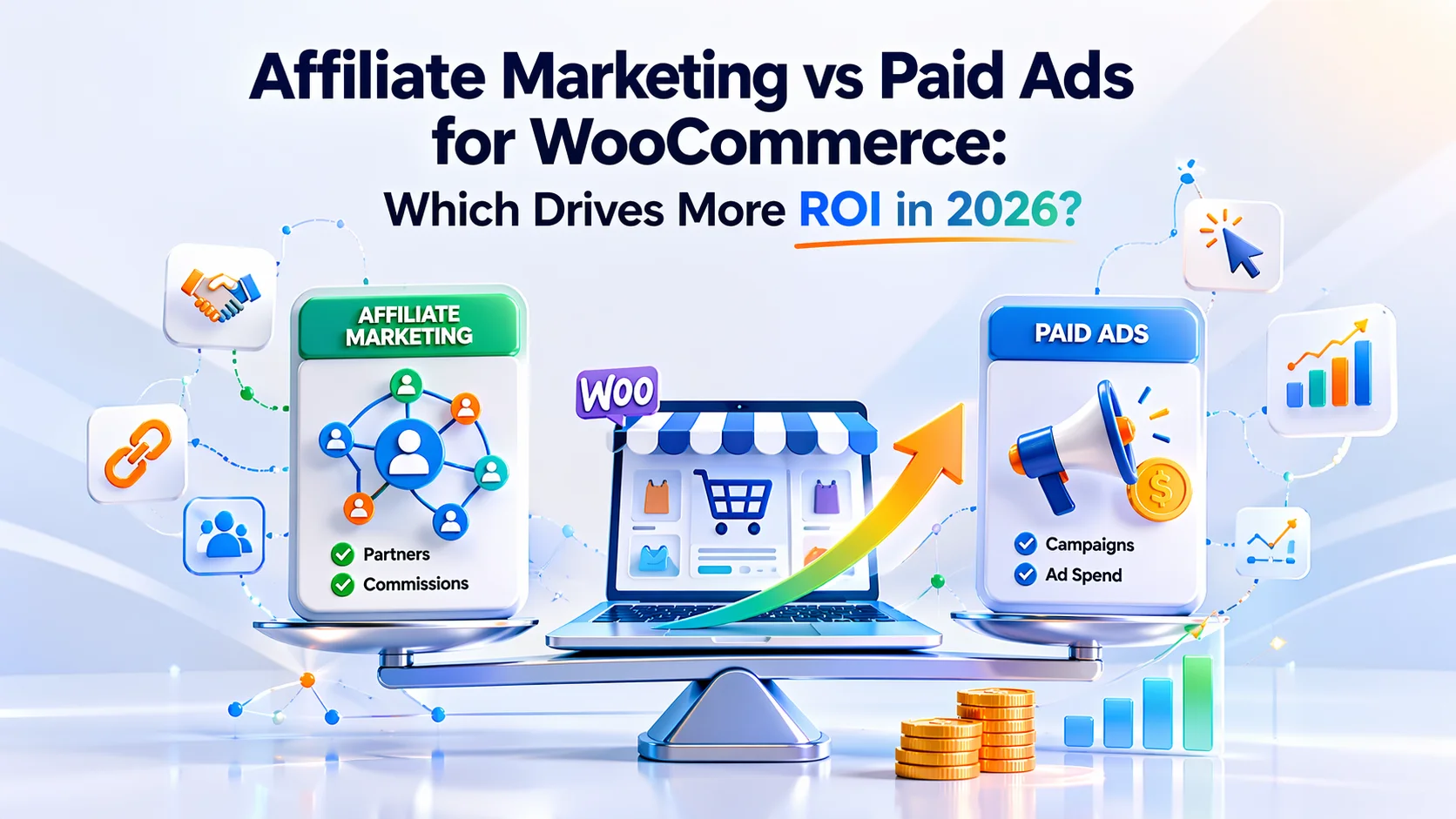
WooCommerce merchants in 2026 rarely choose a single channel. They run prospecting ads, retargeting, email flows, and some form of partner or creator programme. The conflict appears when budgets are zero-sum: every dollar moved from paid social to affiliate commissions is a dollar finance wants justified with forecasts affiliates cannot guarantee the way a cost-per-click bid can be dialed down in an ad manager.
ROI comparisons fail when attribution is sloppy. If your pixel credits paid media for every checkout that also touched an affiliate link, you will overstate ads and understate partners, or the reverse depending on last-click defaults. Start with definitions: gross margin after discounts, variable fulfilment, and expected returns; then allocate credit using experiments, not only platform dashboards. Google’s guidance on conversion tracking fundamentals in Google Ads is a useful anchor for how platforms think about signals, even when your store runs on WooCommerce rather than a hosted stack.
This guide frames how to compare affiliate and paid channels without magical thinking, how WooCommerce operations change each channel’s unit economics, and where a referral infrastructure tool such as Affiliate Engine, a WooCommerce affiliate programme management and commission tracking plugin keeps partner costs observable instead of hiding inside vague “influencer spend” budget lines nobody reconciles monthly.
Cash timing: prepaid media versus post-sale commissions
Paid ads consume cash before revenue. You fund impressions and clicks, then hope conversion rates and average order value close the gap fast enough for your treasury comfort. Healthy affiliate programmes usually pay after orders settle, which improves working capital but shifts risk to partners who may promote less aggressively if payouts feel slow or opaque. Neither model is intrinsically superior; they stress different parts of the business.
If you are bootstrapped with thin reserves, leaning on performance partners can preserve cash during inventory-heavy months, provided you still budget for programme management time. If you are venture-backed and optimizing for growth velocity, prepaid acquisition with tight creative iteration may dominate even at higher nominal CAC. The ROI question is incomplete until you attach a cash constraint and a risk tolerance. Document both beside your MER targets so marketing does not debate tactics in a vacuum while finance wonders why the bank balance diverged from the slide deck assumptions nobody updated after the last freight shock.
Treat affiliate commissions as a variable cost of goods sold mentally, not as “free marketing,” or you will underprice products relative to true acquisition spend.
Creative supply and message-market fit
Ads let you test hundreds of angles per week if your team or agency can produce variants. Affiliates supply their own voice, which can outperform polished brand creative because it reads native on platforms where users sniff out corporate tone. The trade-off is control: you govern claims through guidelines and contracts, not through a centralized ad review queue that blocks unpublished drafts.
WooCommerce merchants selling regulated categories need legal review of partner claims more than splashy DTC brands selling mugs. Build a creative library inside your affiliate admin when your tooling supports marketing materials so partners reuse approved copy. Affiliate Engine includes marketing material publishing so affiliates download consistent assets instead of improvising risky health or earnings statements that attract regulator attention or chargebacks from misled buyers who screenshot promises you never authorised.
Fast iteration, tight geo and audience controls, predictable spend pacing, rising creative fatigue without refreshes.
Borrowed trust, diverse formats, slower scale without recruitment, requires enforcement and fraud awareness.
Measurement: why last-click ROI lies to everyone
Last-click models favour retargeting and branded search while undervaluing upper-funnel affiliates who introduced the product days earlier. WooCommerce order exports show revenue, but they do not automatically resolve philosophical attribution wars. Run holdout tests where possible: geo-based, audience-based, or time-based splits that pause affiliate coupons for a window while holding ads constant, then compare incremental revenue against control regions. Imperfect tests beat perfect arguments in Slack.
Server-side tagging and consent banners changed what browsers send to pixels; rely on your order database as ground truth for sales totals while using ad platforms for directional efficiency within their own auctions. For broader web performance context that indirectly affects landing page conversion, see web.dev guidance on Largest Contentful Paint because slow product pages waste both ad clicks and affiliate traffic.

Portfolio thinking: blend rules that survived past hype cycles
Use paid ads for cold audiences with measurable caps; use affiliates for vertical communities where authenticity matters; use owned email for repeat purchase. When channels overlap, coordinate offers so partners are not undercut by site-wide coupons that invalidate their economics. Nothing erodes affiliate ROI faster than a surprise stackable discount your performance team launched without checking programme terms.
Seasonality also differs: ads can spin up in hours for a flash inventory clearance; affiliates need lead time to script and film. Plan launches with a timeline that respects creator production constraints, then layer retargeting to capture traffic their content generates but does not immediately convert. The combination often beats either alone even when spreadsheets argue for austerity during budget reviews that treat channels as interchangeable widgets instead of complementary behaviours along a journey map real shoppers actually follow on noisy feeds full of competing offers and distractions.
| Scenario | Lean toward |
|---|---|
| New category needs education | Affiliate explainers plus selective prospecting ads. |
| High-intent branded search spike | Paid search with tight controls; protect partner codes from cannibalisation. |
| Liquidation event | Paid social scale; affiliates optional for storytelling. |
Compliance: disclosures, coupons, and brand safety
Affiliate content must disclose material connections in ways viewers notice. Paid ads carry their own labeling rules on platforms. WooCommerce merchants should publish plain-language programme terms covering coupon misuse, trademark bidding if restricted, and consequences for deceptive claims. Enforcement beats policy PDFs nobody reads. The FTC Disclosures 101 resource remains a concise training anchor for partners.
Brand safety on ads is largely about exclusion lists and placement controls; brand safety on affiliates is about recruitment filters and monitoring. Fraud tooling in modern affiliate stacks flags self-referrals and suspicious click patterns so you do not pay commissions on manufactured activity. That protection is part of affiliate ROI because every fraudulent dollar is both wasted cash and distorted learning that misleads your next budget split decision across channels competing internally for credit and executive attention spans that skim dashboards without reading footnotes analysts spent hours annotating carefully.

Incrementality tests your CFO will actually accept
Finance teams distrust marketing experiments that change fifteen variables at once. Prefer designs with a single clear intervention: pause affiliate coupons in two matched states while holding national ads flat, or rotate creator cohorts on alternating weeks while monitoring new customer share, not only revenue totals contaminated by returning buyers your CRM already knows. Publish pre-registration of the test window so nobody retrofits narratives after results disappoint egos in the room where budgets get decided under fluorescent lights that make every chart look harsher than it did on a laptop during the late-night prep session that produced optimistic footnotes finance later questions with uncomfortable precision.
Small stores can approximate incrementality with promo-code exclusivity: unique partner codes that do not appear in ads isolate contribution imperfectly but cheaply. Pair that isolation with refund-adjusted revenue from Woo exports so you do not pay commissions on orders that bounce. Affiliate Engine’s coupon-linking behaviour matters here because misconfigured codes break both trust and measurement simultaneously, turning a clean test into mud. When in doubt, replicate the test after a major site change such as checkout block migrations that alter conversion curves and invalidate prior baselines everyone forgot to archive when engineering shipped the release during a holiday freeze you thought was stable.
Document exclusions: lightning sales, stockouts, and PR spikes belong in appendices so future readers understand outliers. Without that context, someone will paste chart screenshots into board decks and imply causality that experimental design never supported. Good governance is part of ROI because bad governance produces churn in leadership patience for marketing experimentation budgets that shrink after one sloppy presentation triggers a narrative of wasted spend that lingers longer than the actual miss size justified objectively with confidence intervals adults should demand before drawing lines on whiteboards with permanent markers that symbolise how hard it is to erase first impressions once executives decide a channel is “inefficient” based on vibes.

Operational load: who staffs each channel
Paid ads need buyers who understand auction dynamics and creative strategists who iterate fast. Affiliate programmes need recruiters who vet partners, compliance-minded reviewers who approve applications, and finance operators who process payouts on schedule. If you launch affiliates without headcount, ROI looks poor because unanswered emails stall promotion. If you scale ads without creative bandwidth, ROI collapses into fatigued audiences seeing the same asset for six weeks straight across every placement until performance charts resemble a sad slide into indifference nobody wants to present on the weekly growth call.
Tooling reduces but does not eliminate labour. Centralised dashboards, automated emails on applications and payouts, and fraud logs shrink meeting time. Choose stacks that fit your team size honestly rather than optimising for feature checklists a solo founder will never touch. Affiliate Engine’s WooCommerce fraud logging and affiliate payout workflow plugin features target merchants who process real volume, not toy programmes with three partners and zero governance.
Synthesis
There is no universal 2026 winner between affiliate marketing and paid ads for WooCommerce. Paid ads excel when you need controlled scale and rapid experimentation; affiliates excel when borrowed credibility and niche audiences drive conversions pixels undervalue. ROI emerges from margin discipline, honest attribution tests, and operational readiness to support whichever channels you activate.
Build a portfolio, protect partners from coupon chaos, and treat WooCommerce order data as your source of truth. Affiliate Engine provides the admin and affiliate-facing structure to track referrals, manage commissions, and run payouts with fraud awareness so partner economics stay legible next to ad dashboards. Affiliate Engine – Ultimate WooCommerce Referral & Affiliate Marketing Plugin is the concrete reference point throughout this comparison whenever WooCommerce-specific mechanics matter beyond abstract channel theory or conference keynotes that gloss over reconciliation work real teams perform nightly.
Revisit allocations quarterly with a simple mandate: improve incrementality, not vanity metrics. If a channel cannot show a plausible story under conservative assumptions, cut or cap it, regardless of how loudly an agency promotes its proprietary blend of machine learning buzzwords that never quite map to your SKU-level gross margin reality when returns spike after a viral video misrepresents sizing or colour accuracy in ways your customer service inbox documents painfully with photo evidence and refund requests that finance classifies as preventable acquisition failures.
Document decisions in one page: hypothesis, test design, results, next action. Future you will not remember why November leaned into creators unless you write it down while evidence is fresh. That discipline turns debates from religion into operations, which is where WooCommerce stores actually win against competitors who chase shiny tactics without retaining institutional memory across employee turnover that wipes oral history overnight when nobody updates the wiki until it is too late during the next peak season crunch everyone swore would be planned earlier this year compared with last year’s chaos that somehow repeated anyway despite slide decks promising lessons learned that were never operationalised into checklists people actually follow under pressure when traffic spikes hit.
If you need a single takeaway for executives who will not read twelve pages, here it is: paid ads buy speed; affiliates buy trust-heavy reach; your store wins when finance sees both as controllable levers with explicit caps, not as magic beans that replace the hard work of product quality and post-purchase support that ultimately determine whether cohorts repurchase and whether creators remain willing to attach their names to your brand when their audiences ask hard questions in comment threads that never sleep across time zones and platforms you only partially monitor without help from partners who care about their own reputations as much as yours in the long run.
Add a simple guardrail slide to every quarterly review: maximum acceptable blended acquisition cost as a percent of gross margin, separate caps for paid and partner channels, and a rule that pauses scaling when refund rates exceed a threshold for two consecutive weeks. Those guardrails sound pedestrian, yet they prevent the exuberant overspend cycle that starts when a single viral affiliate clip convinces the room to double bids on lookalike audiences that were never truly lookalike because seed quality was polluted by bargain hunters who will not repeat at full price once the coupon ends and reality returns to baseline conversion you should have measured with cleaner cohort definitions from the beginning instead of optimising for short-term revenue spikes that finance later reverses in clawback-heavy categories.
When you consolidate reporting, prefer exports that reconcile to WooCommerce net revenue after refunds rather than platform-reported revenue that can diverge materially during high-return categories like apparel or electronics with restocking nuances your affiliates may not mention in hero hooks that emphasise excitement over fit guidance you still need to communicate clearly on PDPs and sizing charts that creators sometimes skip when filming fast vertical video that converts short term yet generates support debt long term if expectations drift from reality shoppers experience unboxing at home under normal lighting instead of studio glow.
Close each quarter with a single table: paid spend, estimated incremental contribution from tests you trust, affiliate commissions paid, affiliate-driven net revenue from WooCommerce exports, and a narrative footnote listing data quality issues you will fix next quarter. That discipline turns ROI conversations from theatrical debates into maintenance work everyone can schedule. The merchants who win in 2026 are not the ones with the cleverest slogans; they are the ones who keep clean books while iterating creatives and partner tiers without confusing motion for progress when dashboards glow green for reasons nobody can reproduce under tighter measurement rules you should have adopted earlier before scale made fixes expensive politically and technically across teams that barely share a calendar let alone a canonical metric dictionary everyone references without rolling eyes in meetings that could have been emails but were not because culture still rewards presence over written clarity that survives staff churn and timezone gaps between agencies and in-house leads who mean well yet speak subtly different dialects of analytics jargon inherited from previous vendors each team trusted for too long without standardising definitions centrally.
Make affiliate contribution as visible as your ad spend
Affiliate Engine centralises WooCommerce partner tracking, commissions, and payouts so channel comparisons use real order data.


Okay, so I'm running a seasonal sale next month and this guide got me thinking how do you actually handle the cash flow timing when paid ads eat up your budget before sales even come in, but affiliate payouts don't hit until after? My ad spend is all front loaded, while commissions only come post sale.
Finally found a guide that doesn't pretend one channel beats all. The breakdown on attribution sloppiness saved us from misallocating budget between affiliates and ads.
Finally, someone gets how messy attribution can be.
The breakdown of prospecting ads vs. partner programs is useful, but the legal note about regulated categories got buried. That's the kind of detail smaller merchants might miss until it's a problem.