Next-Level Code. Nexuvibe Style ...
Hrs
Min
Sec

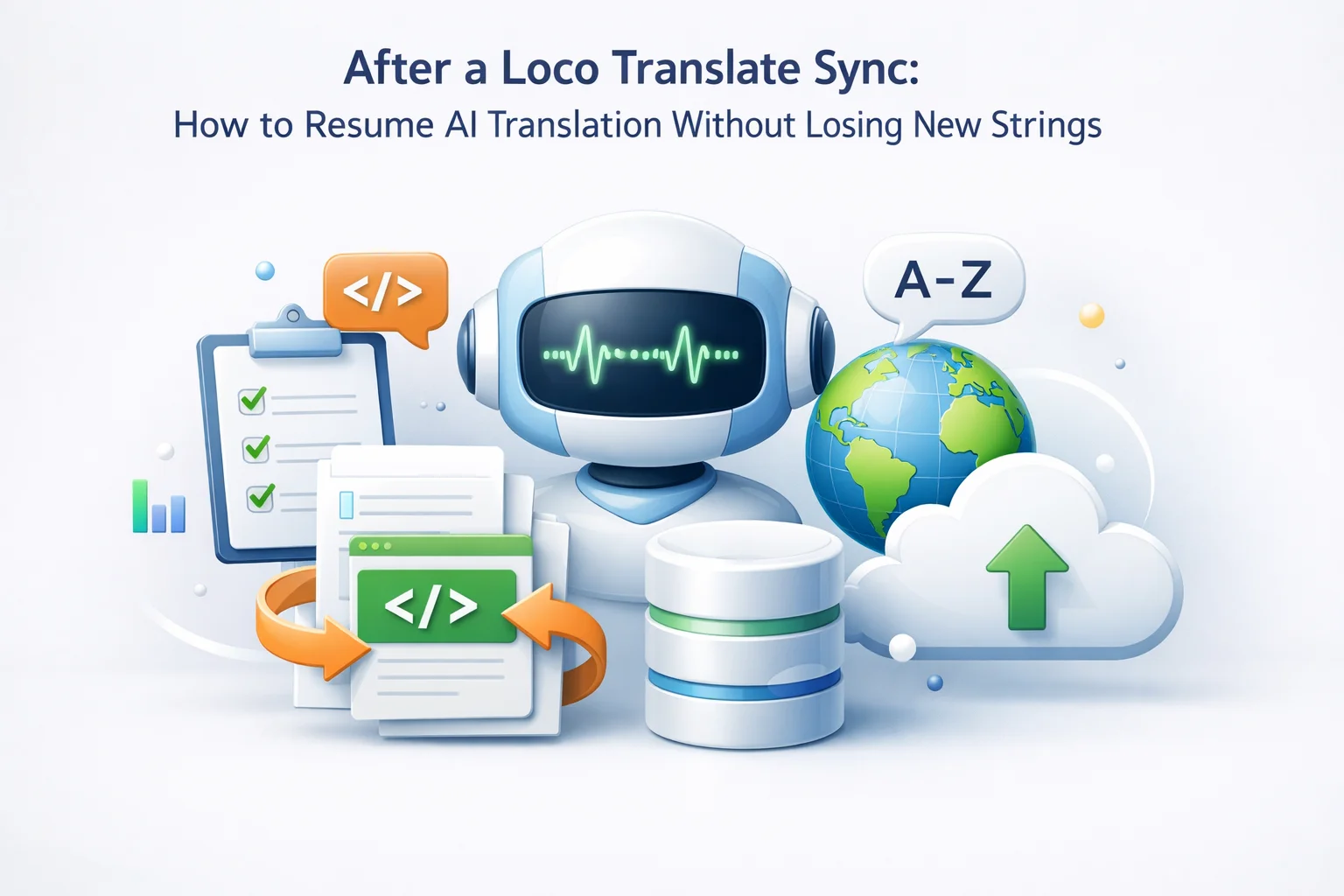
Maintenance releases are where multilingual stores bleed money in small increments. A payment gateway updates its admin labels, a WooCommerce email template adds a new sentence about digital delivery, and your theme ships a revised block pattern title. None of that is exciting until you open Loco and see hundreds of fresh empty rows sitting next to strings a reviewer signed off three sprints ago. The question is not whether you will translate the new material. The question is whether you can do it without inviting collateral damage.
Loco exposes the full inventory, which is both the strength and the trap. Sync gives you an honest picture of what the codebase now claims needs human language, but it does not tell you which rows are safe to machine-assist in bulk and which rows are legally sensitive, brand-controlled, or dependent on fragile placeholders. Teams that treat “sync → bulk everything” as a single action routinely discover that fuzzy markers, duplicate sources, and editor reloads erased context they needed to keep.
The practical path is to separate three concerns: identify what changed, protect what is already correct, and then restart automation in a scope that matches the risk. When you need throughput without surrendering QA discipline, a WordPress Loco Translate automatic AI translation add-on designed for controlled bulk refills after template syncs belongs in the stack because it keeps the human editor in charge of where automation runs, instead of the other way around.
When you synchronize a theme or plugin bundle inside Loco Translate, you are asking the tool to reconcile the gettext template the vendor ships today with the language file your site maintains locally. That reconciliation can introduce new message identifiers that never existed in your previous export, retire obsolete paths, or mark translations as fuzzy when the English source moved but the translator’s prior wording might still be valid with a light edit. None of that is inherently dangerous. What creates incidents is acting on the refreshed list without reading the state machine gettext uses to describe uncertainty.
WordPress itself leans on the same internationalization primitives across core, themes, and the WooCommerce ecosystem, which means your PO rows are not “blog paragraphs.” They are contractual microcopy adjacent to money movement: authorization versus capture language, subscription renewal reminders, refund windows, digital fulfillment confirmations, and account emails that must stay aligned with what your legal team approved in the primary market. A sync that pulls fifty new rows from a gateway update is not fifty equal tasks. Some rows are cosmetic labels. Others are obligations. Your resume plan should treat them differently even if they share a file.
These are the rows your QA team usually wants to fill first because they surface in the UI as English leaks. They are also the safest starting point for automation if placeholders and HTML are intact, because you are not arguing with an existing reviewer decision. Treat them as the default scope for a first AI pass after sync.
Fuzzy is gettext’s way of saying “this might still be right, but a human should confirm.” Bulk automation that blindly overwrites fuzzy entries can destroy perfectly good copy because the model never saw your brand glossary. After sync, triage fuzzy rows before you allow any mass operation across the file.
Vendors move strings between PHP files or split strings across blocks. Loco will show you where the string now lives. That metadata matters when you are debugging “why this label appears twice” or chasing a child theme override. It also helps you avoid translating the same English twice under two paths when a single shared translation would be cleaner operationally.
Official WordPress guidance on internationalization is explicit that user-facing strings should be wrapped for translation at the source. Loco is where those wrapped strings become maintainable artifacts for your locale. If you want a refresher on the underlying API expectations while you audit a sync, the Theme and plugin internationalization documentation on developer.wordpress.org is the correct anchor, not a random blog summary.
Another detail practitioners watch after sync is how WooCommerce and third-party extensions register strings: some bundles ship a formal .pot you can diff against your last export, while others expose strings only after certain admin screens load or features toggle. That difference changes how confident you can be about “completeness” on day one. If your QA plan assumes the catalog is static the moment sync finishes, you will schedule a bulk run too early, then repeat work when the next admin visit reveals another dozen rows. Build a short waiting window for high-churn plugins, or walk the critical admin paths once in staging to force lazy-loaded strings to appear before you lock a translation sprint.
Bulk translation feels like progress because the progress bar moves. After a sync, though, the file is a mix of legacy certainty and fresh uncertainty. Running the same instruction across both populations collapses those categories into one output stream. You risk rewriting checkout verbs that were battle-tested in A/B tests, rephrasing tax strings that accounting already signed, or “improving” email copy that must stay aligned with an external PDF policy pack.
There is also a mechanical reason to avoid whole-file reruns: placeholders and HTML snippets are unforgiving. A model might reorder clauses in a way that reads fluent yet breaks %s substitution, split a printf pattern, or translate content inside shortcodes. Loco does not magically repair that damage. Your store does not fail gracefully when a formatted price renders as a broken token on the cart page. The right mental model is release engineering: you want a green build, not a fast build.
When you are ready to layer automation back in, prefer tooling that assumes this discipline rather than fighting it. The Nexu WP Loco AI Auto Translator plugin for WooCommerce and theme string updates is built to live inside the Loco editor and bulk flows you already use, so you can restart work in slices that match the file’s risk profile instead of pretending all rows are equal.
There is also an organizational failure mode worth naming: the person who runs bulk automation is not always the person who owns tone and legal nuance. After sync, those roles collide because the tool makes it tempting for anyone with admin access to “clear the queue.” Establish a simple permission story—who may run wide batches, who may only use per-row assist, and who signs off on fuzzy clearance—so speed does not become an unowned risk. The goal is not to slow down launches. The goal is to make acceleration traceable when a client asks why a line changed.
Treat every sync like a database migration. You would not run ALTER TABLE on production without a snapshot. Your PO and MO pair are likewise stateful artifacts. The checklist below is what senior implementers run on client retainers where a single botched translation merge turns into a weekend rollback. It is intentionally boring, because boring prevents escalations.
Add one more habit that costs almost no time: paste your pre-sync and post-sync exports into a diff tool that understands gettext, or at least a text diff with careful attention to msgid blocks. You are looking for three outcomes. First, confirm that translations you care about are still present and not accidentally emptied by a merge tool quirk. Second, list new msgid values with line context so your translators know what feature introduced them. Third, capture fuzzy markers as a work queue rather than discovering them visually by scrolling thousands of rows. That diff becomes the agenda for the day, not the Loco grid itself.
Download the current locale file before you run any bulk assist. Name it with the site slug, locale, and release tag. Store it beside your deployment notes. This single habit eliminates ninety percent of panic when someone asks you to prove what changed.
If your production store is mid-sale season, validate the post-sync plan on staging first. Matching versions matters because msgid sets shift between patch releases more often than teams admit.
Fuzzy rows should never be an “everyone” bucket. Put a name on who clears them. That person should understand placeholders and brand legal constraints, not just fluency.
Create a short internal note listing domains that require legal sign-off. When AI assistance resumes, those domains get manual review first, automation second.
If you are new to Loco itself, keep the plugin’s official distribution page bookmarked. The Loco Translate plugin listing on WordPress.org is the right place to confirm compatibility expectations and support channels before you blame automation for a core workflow gap.
The highest-leverage sort order after sync is simple: empty msgstr entries that block visible English leaks, especially on cart, checkout, and account surfaces. Second pass: fuzzies where the English change was trivial, such as capitalization or punctuation fixes. Third pass: admin-only strings that help store operators but do not appear on customer receipts. Everything else waits on explicit tickets.
Scoping is not just moralizing about risk. It is how you keep API budgets and reviewer hours aligned. A WooCommerce site with fifteen extensions can add thousands of strings in a year. Your business does not need all of them perfect on day one of a minor release. It needs the money path coherent, the emails legally aligned, and the account area believable in the target language. Let that priority drive what automation is allowed to touch in the first 24 hours after sync.
This is where AI-assisted Loco Translate bulk translation that preserves reviewer-approved copy earns its place: it is designed to accelerate the empty-and-safe majority while keeping your governance gates visible in the editor instead of hidden in a one-shot export script you cannot audit.
If you operate in multiple markets, repeat the scoping exercise per locale. The same English sync might produce different urgency in French than in Japanese because one storefront has live ads pointing at checkout while another is still pre-launch. A shared English diff is still the source of truth for what changed in code, but the priority order of locales should follow revenue and compliance exposure, not alphabetical order. Document that decision briefly in your ticket so the next maintainer does not undo your sequencing because they forgot the campaign calendar.
Sometimes you cannot wait for the perfect moment. A product manager hot-fixes copy in production, a vendor ships a string hotfix, and Loco’s list is mid-refresh while customers are actively checking out. In that situation, the fastest safe move is often micro-batch work directly beside the string you can see, using the same mental model a developer uses when cherry-picking commits: small, reviewable units.
The Loco editor is where human judgment and automation meet. When AI actions are available beside individual rows, you can translate a clutch of checkout labels, verify placeholders face-to-face with the English column, and save without pretending you “finished” unrelated domains. That pattern prevents the whiplash of reloading a massive grid and losing your place.
Pair this with a simple team rule: no one clears a fuzzy string in a money-adjacent domain without a second pair of eyes. That sounds slower than full automation. It is faster than explaining to finance why a subscription renewal notice promised the wrong cadence in German.
Editor-first work also pairs well with spot testing in the storefront. When you save a handful of checkout labels, switch to the front end in the target language, hard-refresh, and confirm the string actually appears where you think it does. Loco’s mapping to templates is usually faithful, but page builders, conditional templates, and plugin-specific loading rules can mean a translated row still does not surface until another string elsewhere changes. A five-minute smoke test prevents you from declaring victory while customers still see English on a decisive screen.
Large batches fail for mundane reasons: rate limits, gateway timeouts, PHP max execution time, or a human closing a laptop lid mid-run. The file format itself is text, which is good news. A clean resume strategy relies on knowing which rows were committed to disk before the interruption and which were mid-flight only in browser memory. Your process should never assume partial UI state equals partial file state.
After any interrupted bulk attempt, re-open the bundle, sort by modified time if Loco exposes it, and re-export the PO for a diff against your pre-run backup. That diff is the truth. If new translations appear, decide whether they meet your placeholder standard before you run another batch. If nothing changed on disk, you lost only time, not data, and you can safely restart with tighter concurrency or smaller slices.
Turbo-style concurrency settings are attractive when a deadline looms, yet they are the first place rate limits bite. If your operations team already manages API keys for other products, treat translation like any other queued workload: backoff, jitter, and measurable error rows beat heroic single-shot runs.
When you resume after an error, separate “retry the same rows” from “skip and log.” Some failures are deterministic: a string contains markup the model is instructed not to alter, or your prompt forbids translating tokens that appear anyway. Re-running the same row ten times will not help. Log those exceptions, route them to a human, and continue with the next slice so the job finishes with a clean inventory of what still needs hand work. That discipline is how agencies keep client trust: the end state is known, not guessed from a progress bar that hit one hundred percent while quietly skipping hard cases.
A sync from WooCommerce or a marketplace extension often adds many near-duplicate labels: “Order,” “Orders,” “Order number,” “Order details.” Without a glossary, each row becomes a stylistic dice roll. Customers perceive that inconsistency as sloppiness even if each individual string is technically fluent. Agencies that win here define a small set of canonical renderings and enforce them across files.
Your glossary should include more than brand names. It should capture how you translate “checkout” versus “payment,” whether you localize currency symbols, and how you phrase subscription renewal warnings. Legal teams care about those choices because they change meaning, not just tone. After sync, apply the glossary before you widen bulk coverage so the model does not invent competing synonyms row by row.
Connect that policy to tooling: WooCommerce multilingual maintenance when Loco pulls fresh strings from payment and subscription extensions is less frightening when fixed terms are enforced programmatically and reviewers spend time on exceptions, not on re-arguing basics.
Update the glossary when sync introduces new product lines or when legal renames a program. A stale glossary is worse than none because it trains everyone to ignore it. Keep a change log entry per term: who approved it, which storefronts it applies to, and whether it is mandatory or a preference. Optional terms can still guide AI outputs, but mandatory terms should block release if violated. That is how you keep automation inside guardrails without pretending the model remembers last quarter’s memo.
Mature teams document this workflow beside their deployment checklist: sync Loco on staging, export backups, triage empties and fuzzies with clear ownership, run scoped AI assistance, diff the PO, compile MO, smoke-test checkout and account emails in the target locale, then promote. The ritual sounds heavy until you compare it to the cost of shipping a scrambled string in production during a promotion.
If you operate across multiple sites, keep a shared glossary repository and reuse prompts that encode register expectations (“formal customer-facing German for EU storefronts”). The investment pays off when the fifth site in a network does not rediscover the same failure modes. Localization is never finished, but it can be predictable.
Close the loop with a short retrospective note after each release: how many new strings arrived, how many were filled with automation versus manual review, and whether any hotfixes were required in production. Over a quarter, those metrics tell you if your scoping rules are too loose or if a specific vendor bundle chronically churns. That is operational intelligence you cannot get from a single heroic night of translating. It also justifies tooling budgets with evidence instead of vibes.
When the pieces line up, resuming work after a Loco sync stops feeling like a crisis and starts feeling like a pipeline stage with measurable inputs and outputs. A Nexu WP Loco AI Auto Translator license that pairs editor controls with disciplined bulk processing fits that pipeline because it respects the same priorities senior implementers enforce: protect what is already right, translate what is newly missing, and prove every change with a diff you can defend to a client.




Hey everyone, just wanted to share my thoughts after using this with a recent Loco Translate sync. the guide actually does a pretty good job explaining how to add new strings without wrecking the ones you've already approved which is a huge plus. And that part about vendors moving strings between files? Ugh, that's been a pain for me before, so it's nice to see it addressed head on.
Got this for a client's WooCommerce setup, and the step by step checklist is actually really helpful. But I'm still stuck on one thing when you sync and pull in those fresh empty rows alongside the approved strings, how do you really know you've caught all the high risk ones before letting AI loose on the rest? The guide mentions scoping, but is there a way to automatically flag or separate the legally sensitive or brand controlled entries, or do you have to manually review everything first?
Hey folks, gotta vent about this guide. Look, I'm a site manager for a construction supply store running WooCommerce in three languages. When vendors push updates, Loco Translate syncs and suddenly I've got 200 new strings mixed in with the ones my team already approved