Next-Level Code. Nexuvibe Style ...
Hrs
Min
Sec

Literal translation asks whether the words sound right. Placeholder-aware translation asks whether the sentence still composes when PHP replaces each token with live data. Those questions diverge sharply in languages with different word orders, case systems, or agreement rules. A German reviewer may need the object before the verb cluster while keeping the first placeholder tied to the product title and the second tied to the price. If your tooling treats placeholders as optional decoration, you will ship elegant prose that crashes at render time.
Loco exposes the inventory of risky strings, but it cannot read your mind about which % symbols are sacred. Teams that scale gettext with assists need explicit rules: count placeholders before and after translation, forbid adding new format tokens, require positional specifiers when multiple types appear, and block “helpful” rewrites that merge two clauses into one without checking arity. This article walks through how those failures appear in real WooCommerce stacks and how to operationalize prevention.
When you centralize those rules inside Loco-connected assists, Loco AI Auto Translator gettext assists that preserve printf placeholders and correct word order on WooCommerce format strings gives reviewers a first line of defense before bad msgstr values compile into MO files on production.
Developers rarely hard-code a finished sentence like “Order 4821 ships Tuesday”. They hard-code a template: an English msgid with one or more placeholders, then pass dynamic values when the event fires. gettext stores that template; translators supply msgstr per locale; at runtime WordPress loads the MO, selects the translation, and PHP substitutes data. If the msgstr contains the wrong number of placeholders, PHP may emit warnings, swallow parts of the string, or substitute values into the wrong holes. Customers see awkward output; admins see log noise; automated tests often miss it because they only browsed the happy path in English.
WooCommerce multiplies the pattern because commerce is data-heavy: SKUs, fees, taxes, gateway responses, subscription renewal dates, and stock counts all land inside user-visible sentences. A subscription extension might announce the next charge with three injected fragments. A shipping plugin might combine zone names, method titles, and business days. Each integration is another place literal translation instincts collide with mechanical requirements.
REST or webhook logging sometimes surfaces format strings you never saw in the UI because only error paths emit them. When investigating a cryptic admin notice, copy the English msgid from logs, search the PO, and confirm the locale file still mirrors placeholder structure. Those rare paths are where arity bugs hide for months until a warehouse integration misfires on Boxing Day.
Every % character with a following specifier is a binding agreement with the code that calls sprintf or printf. Translators may reorder clauses around those anchors, but they cannot delete anchors or invent new ones without coordinating a code change.
The goal is not robotic word-by-word fidelity. The goal is grammatically correct target language that preserves placeholder count, type, and order mapping so runtime substitution reads as if a human wrote the final sentence with live data inserted.
The WordPress internationalization handbook for developers frames why translatable strings include variables; it is your team’s job to extend that guidance with commerce-specific examples from your own plugin stack so reviewers recognize risky rows before they approve catalogs.
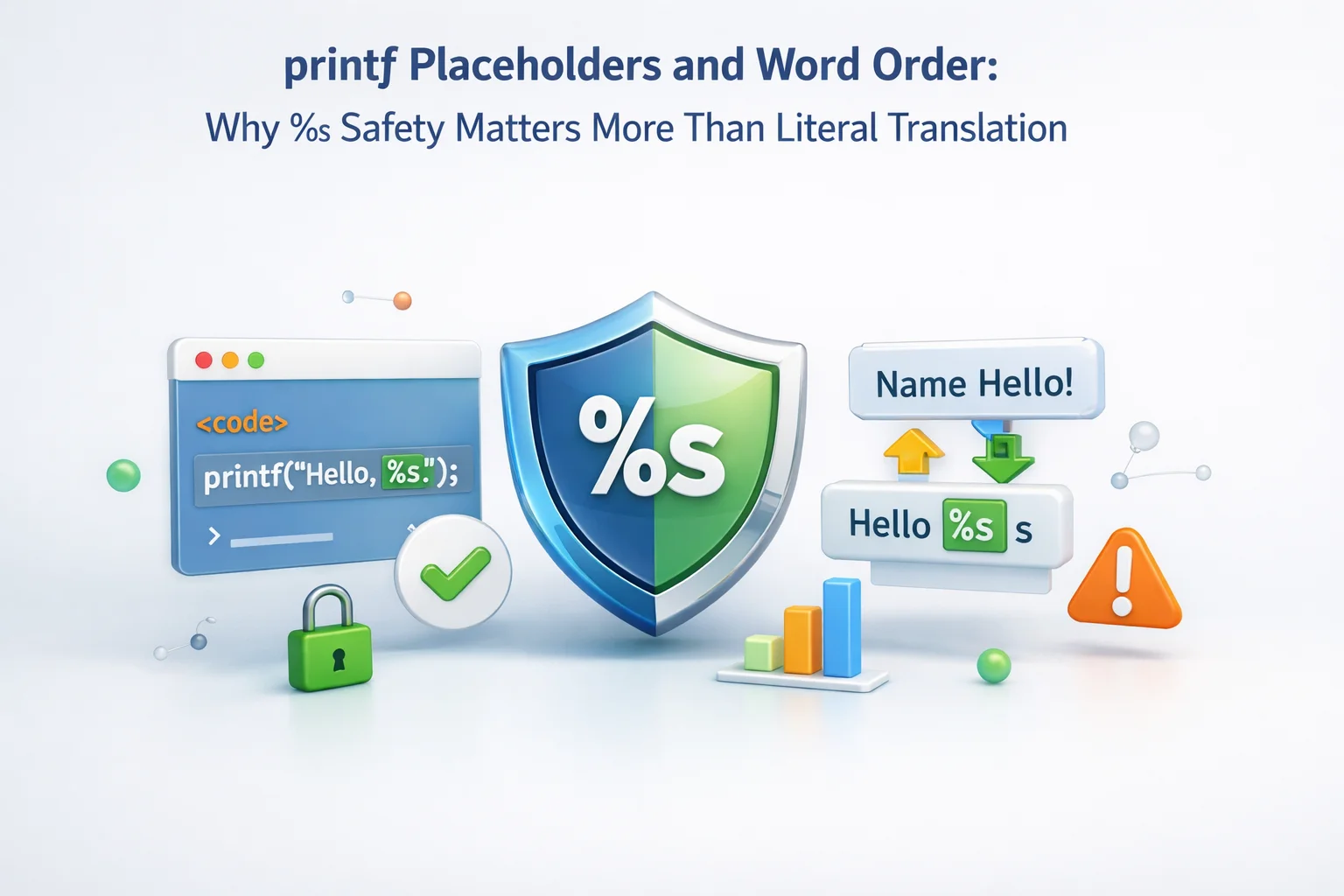
Simple strings with a single %s often survive translation without positional notation because there is only one hole. Complexity jumps when two or more placeholders appear. Non-positional order depends on the sequence arguments are passed. If the target language needs the second variable to appear textually before the first, translators must use numbered placeholders such as %1$s and %2$s so PHP maps arguments correctly. Without numbering, teams either accept awkward English-like ordering or gamble on a rewrite that accidentally swaps data.
If upstream English msgids lack numbering but your locale demands reordering, coordinate with the plugin author or fork a patch. Translators cannot invent numbering the code does not expect unless the underlying PHP uses argument-swapping APIs compatible with gettext’s positional format. Guessing wrong is worse than shipping slightly stiff word order.
Some teams standardize by opening a vendor pull request that converts fragile templates to numbered placeholders in the source language before translation begins. That upfront engineering tax pays off when you support five or more locales: you stop fighting the same arity bug in every PO file and instead fix the template once at the origin. Smaller shops without leverage on upstream schedules should still document which plugins are locked to English-only argument order so reviewers do not waste hours attempting grammatically perfect reordering that PHP cannot honor.
Fluent translation can still violate agreement rules when placeholders stand in for nouns with grammatical gender or case. A Slavic locale might need adjectives to agree with a product name injected later. If the template fixes adjective forms assuming masculine defaults, feminine product titles read wrong. The fix is not to delete placeholders; it is to rephrase using structures that remain grammatical regardless of the injected noun, or to split one long template into two shorter ones with separate translation entries. That is editorial engineering, not ordinary marketing translation.
Right-to-left locales add directional questions around embedded Latin SKUs, email addresses, or URLs inside sentences. Placeholders often isolate those fragments so bidi algorithms render predictably. Moving a placeholder across a clause boundary can strand neutral punctuation on the wrong side for Arabic or Hebrew readers. RTL QA belongs beside placeholder QA: open the same admin notice in an RTL locale, confirm numbers and prices still group correctly, and confirm parentheses or brackets that wrap placeholders did not invert visually in a harmful way.
Nexu WP Loco AI Auto Translator with default prompts that enforce sprintf placeholder counts on WooCommerce gettext rows helps teams encode that counting habit into every generation pass rather than relying on tired humans at midnight before a launch.
Not every percent character starts a placeholder. Sale banners might say “20% off”. If a translator localizes that line inside the same msgid as a real %s, escaping rules matter. gettext and PHP expect doubled percent signs for literal percents in some contexts. Confusion here produces strings that show raw specifiers on the front end or omit discounts entirely. Train reviewers to distinguish currency formatting, unit math, and sprintf tokens in the same paragraph.
HTML entities add another layer. If markup embeds attributes with encoded characters, translators working in raw PO text might break entities while moving tags. The placeholder discipline extends to angle brackets: you can reorder around tags, but you should not collapse nested markup without checking the theme still validates. Broken HTML inside a translated notice can blank entire admin sections in older browsers or accessibility tools.
The PHP manual page for sprintf documents specifier syntax and edge cases. Keep it bookmarked for engineering-heavy reviews where a project manager and a developer need a shared reference.
Policy beats hope. Your default system prompt for assists should state non-negotiables: never change placeholder count, never swap numbered indices, preserve tags exactly unless the source msgid moved them, and flag ambiguous strings for human review instead of guessing. Bundle-specific prompts can add domain examples, such as subscription renewal sentences your stack uses repeatedly. Examples beat abstract instructions because models pattern-match on concrete shapes.
Pair prompts with reviewer scripts. A lightweight pre-commit check can reject PO lines where placeholder counts diverge. Even a spreadsheet macro that highlights msgstr rows containing a different number of percent specifiers than their msgid catches obvious failures faster than eyeballing ten thousand lines.
Translator comments embedded in PO files are easy to ignore when assists run wide, yet they often carry crucial hints: “first placeholder is product name, second is coupon code”. Preserve those comments in Git and train reviewers to read them before approving msgstr changes. When comments are missing upstream, add your own in a forked PO only if your workflow allows, or mirror the guidance in an internal glossary row so the context survives exports.
Bulk fills are attractive when a plugin update drops hundreds of new msgids at once. They are also where placeholder errors scale. Structure batches so high-risk domains run with stricter prompts or smaller chunk sizes. Commerce-facing domains that mix prices, dates, and product titles should not share the same relaxed settings as purely descriptive help text about feature bullets.
Pause between phases long enough to compile MO files and click through critical paths. Automated progress bars show volume, not correctness. A staged approach feels slower on paper but avoids the catastrophic failure mode where a thousand broken notices reach production because nobody sampled the sprintf-heavy tail of the job.
WordPress Loco AI plugin for batch gettext fills that preserve %s and numbered placeholders in WooCommerce admin notices is most credible when teams pair it with phased rollouts: finish core checkout strings first, verify emails, then expand to secondary extensions.
Higher concurrency shrinks wall-clock time on enormous catalogs. It also shrinks the margin for human oversight. If your team enables aggressive turbo-style schedules, invest in automated arity checks first; otherwise you simply publish incorrect strings faster. Treat turbo as a reward for mature guardrails, not a shortcut around them.
Schedule turbo batches during business hours when a reviewer can watch the first few hundred completions, not exclusively at night when nobody is available to abort a run that veered off policy. The cost of pausing early is small compared with reverting a polluted PO from backup.
Even careful batches produce outliers. A model might merge sentences, drop a %d, or translate a proper noun that should have stayed fixed. Per-string workflows let a senior reviewer re-run one msgid with a tighter instruction block and immediate visual verification. Capture those incidents in an internal FAQ so junior translators recognize the same failure next week without repeating the repair from scratch.
When you fix a row, note whether the English msgid itself changed in the latest plugin release. If the vendor altered placeholder order in source, your old translation becomes invalid even if it once passed QA. Diffing POT updates before merging translations is dull work that prevents spectacular regressions.
The GNU gettext manual on plural forms complements printf discipline: many WooCommerce strings use plural headers that must remain synchronized with placeholder logic across singular and plural branches.
Switching translation endpoints should not relax placeholder policy. Export your prompt and verification checklist with each release tag. Staging and production should cite the same version. When operations rotates API keys, rerun a golden file containing ten notorious format strings from your storefront. If any msgstr shifts unexpectedly, halt promotion until configuration drift is understood.
Pick one order-received line, one failed payment notice, one stock reduction message, one subscription renewal reminder, and one shipping delay template. After every major gettext operation, render those five in a staging locale and confirm placeholders still bind to the correct live values. Expand the set as you discover historical incidents.
Documentation beats heroics. When a placeholder bug slips to production, write the postmortem with the exact msgid, the broken msgstr, and the fix. Link it from your glossary or style guide so the lesson compounds.
Train support staff to recognize placeholder failure signatures: duplicated words, bare percent signs in customer emails, or amounts that appear next to the wrong label. First-line support can screenshot the symptom and grep the msgid faster than engineering if you give them a short internal cheat sheet mapping symptoms to likely gettext domains.
Placeholder safety is the silent quality bar serious WooCommerce teams meet before they brag about fluent tone. Word order and agreement only shine when readers see correct prices, names, and dates in the sentences you intended.
If you want Loco-connected assists that treat printf skeletons as part of the contract, not optional decoration, the Loco AI Auto Translator WordPress extension for sprintf-safe WooCommerce gettext at scale keeps those rules in the same toolchain reviewers already use for bulk and single-string work.







Hey everyone! just wanted to say this printf placeholders guide was so helpful. i'm still learning web dev, and I never realized how much word order in translations could mess things up.
Just finished going through the printf placeholders guide, and it was seriously helpful for figuring out how WordPress and WooCommerce deal with dynamic strings. The part about how swapping a %s or %d can break live data was a total lightbulb moment for me. I help manage my school's website sometimes, and this definitely saved me from what could've been a messy bug with admin notifications. The only thing that tripped me up for a second was the mention of the 2026 update I double checked to make sure I wasn't looking at outdated info.
Just wanted to say this guide on printf placeholders saved me hours debugging a WooCommerce site where translated strings kept breaking the checkout flow. The part about non positional order and how REST errors expose hidden format strings? Gold.
Finally a guide that treats placeholders like the security risk they are. saved my Woo store from silent data leaks twice already. Wish it had more real world crash examples though