Next-Level Code. Nexuvibe Style ...
Hrs
Min
Sec

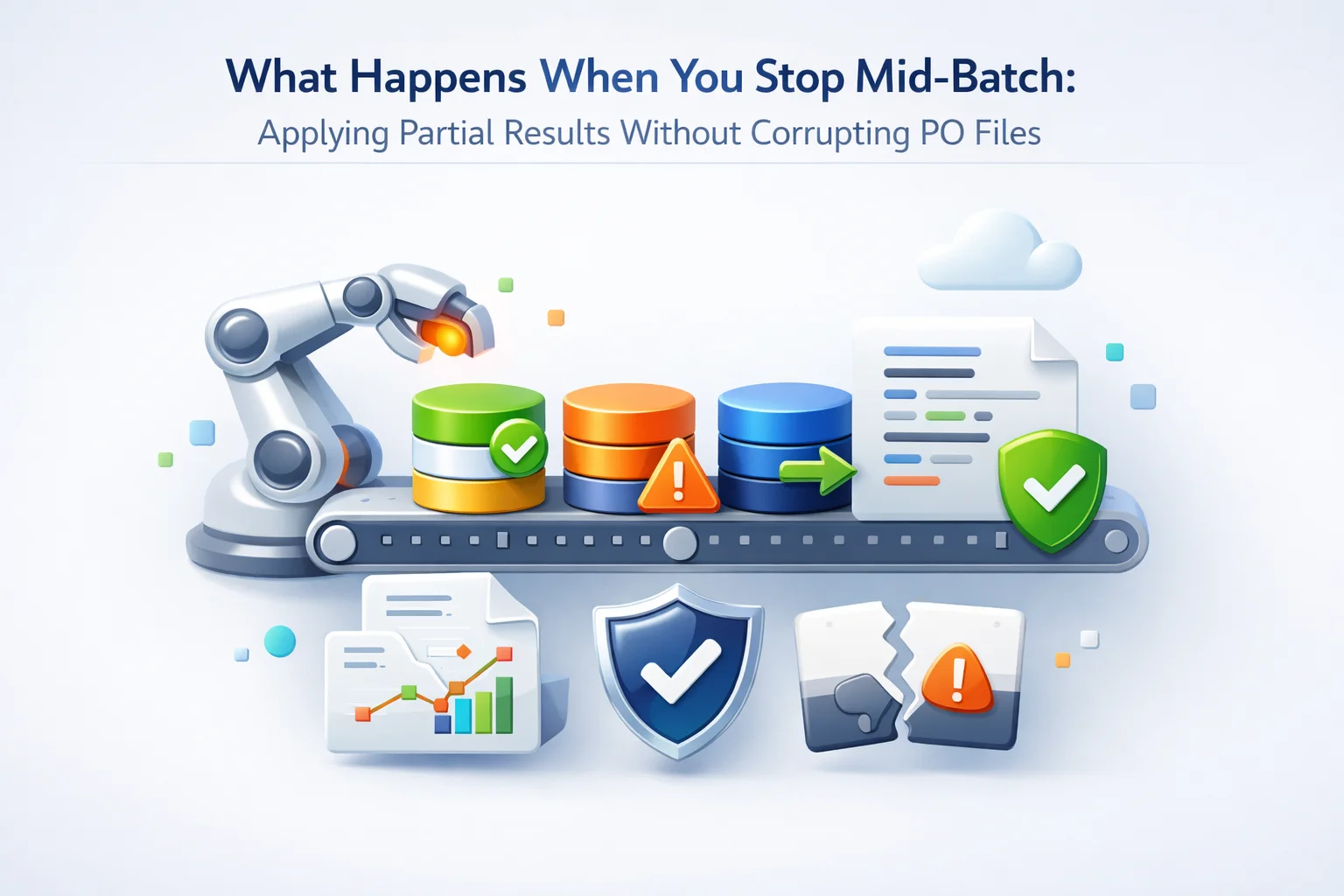
Partial progress is valuable inventory. Rows that already carry reviewer-approved msgstr values should not be thrown away because a progress bar stalled at sixty percent. The failure mode to avoid is invisible inconsistency: some rows saved to disk, others only held in browser memory, and nobody knows which until production MO files compile with gaps.
Treat every bulk wave like a database transaction with explicit commit points. Loco’s editor can save PO files to disk; your deployment pipeline should assume those saves are the source of truth, not the vendor dashboard’s notion of “job complete.” When assists resume, they should read the on-disk PO state, not a stale snapshot from an hour earlier.
Workflows that pair disciplined saves with Loco AI Auto Translator bulk fills that respect existing PO rows when you resume WooCommerce gettext jobs reduce the panic tax when someone stops a run on purpose.
“Mid-batch” is not one event. It can mean the operator clicked cancel because a glossary looked wrong. It can mean the browser lost WebSocket stability on hotel Wi-Fi. It can mean PHP hit max execution time while one hundred rows were mid-flight. Each case leaves different residues in memory versus disk. Your incident response should start by classifying which case you are in before touching merge tools.
A deliberate stop is healthy product management. Shipping half of a checkout domain because Friday ended is preferable to shipping hallucinated legal copy. Document intentional stops with a ticket note: last reviewed msgid, vendor preset, and whether MO files were deployed. Future-you should not guess from git blame alone.
An accidental stop needs forensic kindness. Blaming the operator obscures systemic fixes like shorter waves, stronger autosave, or staging queues. Postmortems should ask whether the batch size was too ambitious for the hosting tier, not whether someone closed a tab.
Save PO, export backup, tag git, write handoff note. Resume only after reviewers bless the partial catalog.
Assume nothing until you diff on-disk PO against last commit. Re-run msgfmt. Check for truncated file tails.
The GNU gettext manual on PO files remains the canonical description of msgid blocks; link it in onboarding so reviewers know what a healthy entry looks like on disk.
PO corruption is often mundane. A save interrupted mid-write produces a file that ends halfway through a quoted string. Less obvious duplicates arise when operators merge branches carelessly and end up with two POT headers or repeated msgctxt blocks. gettext tools then behave unpredictably, and reviewers waste days on symptoms instead of causes.
msgfmt is your first gate. Run it in CI on every PO change, not only before release. A compile failure is cheaper than a bilingual checkout that shows raw placeholders. Wire failure output to Slack or email so the person who stopped the batch sees the same error the build sees.
Teams that version-control translations should treat each bulk wave like a feature branch. Start from a clean working tree, run the wave, commit with a message that names domain, locale, vendor preset, and row estimate. If the wave stops, your worst case is `git reset` to the last good commit, not archaeology in Loco backups.
Lightweight tags help: `loco-bulk-woocommerce-de-20260417-wave2` costs seconds and saves hours when you need to compare partial assists across days. Pair tags with release notes so project managers see progress in business language, not only hex hashes.
When two operators work adjacent domains, rebase early and often. gettext conflicts are text conflicts; they are solvable, but only if you catch them before MO compile. Establish a rule: no simultaneous bulk assists on the same PO file without locking, even if Loco technically allows it.
The Git book chapter on tagging explains lightweight versus annotated tags; choose a style and stick with it across agency repos.
English msgids that change during a batch mark translations fuzzy. A mid-batch stop often coincides with plugin updates that refreshed source strings. Resuming without reviewing fuzzy rows risks shipping outdated translations that look “done” in Loco because msgstr is non-empty. Your resume checklist should always include a fuzzy sort pass.
Plural entries punish partial assists harshly. If only the first msgstr index filled before the stop, runtime may fall back to English for counts that map to higher indices. Before declaring victory on a partial wave, filter plural msgids and verify every index has intentional text or an explicit decision to defer.
Loco AI Auto Translator resume-friendly bulk jobs that skip already-filled msgstr rows in WooCommerce PO files lower the risk of overwriting reviewer work when you restart after a stop.
Progress meters measure vendor-side completion, local write queues, or both, depending on integration. Operators should confirm which. A meter at ninety percent with an empty msgstr in Loco means the UI lied to your emotions, not necessarily to your filesystem. Train staff to spot-check random msgids after stops instead of trusting color alone.
If your hosting uses object caching for admin AJAX responses, confirm whether assists bypass cache for writes. Stale reads after resume cause duplicate work or skipped rows. When in doubt, flush relevant caches on staging before validating partial files.
Sometimes reviewers polish high-visibility strings while bulk assists continue on long-tail admin text. Merging strategies must preserve human precedence. Export reviewer edits to a branch, rebase bulk commits underneath, or use gettext merge tools that honor timestamps if your workflow supports them. Never paste bulk output over hand-tuned checkout copy because it is faster.
Glossaries help merge discipline: if brand terms lock to approved forms, resumed assists converge instead of fighting reviewer choices. Refresh glossary attachments after legal updates so resumed batches do not resurrect forbidden phrasing.
Nexu WP Loco AI add-on with glossary-aware bulk fills after partial gettext checkpoints keeps resumed waves aligned with legal-approved vocabulary.
Before resuming, confirm API keys, model selection, and delay presets still match the wave you halted. Rotations mid-batch are common in enterprises. A resumed job on a different model can produce stylistic drift that reviewers perceive as corruption even when PO syntax is valid.
WordPress Loco AI plugin configuration export matching resumed gettext batches to prior partial commits prevents silent preset drift across environments.
If the first half of a batch used vendor A and someone resumes on vendor B, tone and terminology may shift mid-catalog. That is not PO corruption, but it is customer-visible inconsistency. Either finish the domain on the original vendor or run a reconciliation pass with glossary enforcement.
Commercial Loco AI Auto Translator stack for agencies recovering interrupted WooCommerce locale jobs should document vendor lock rules beside stop-resume playbooks.
Use the product’s cancel or pause control so in-flight rows finish writing.
Filename should include locale, domain, and timestamp.
Fix syntax before git commit.
Message references ticket ID and wave number.
Sort in Loco; export screenshots for compliance if needed.
Load cart paths that hit stopped domains.
Avoid blanket retranslate unless stylistic pass is intentional.
Attach diff stat, msgfmt log, and MO version deployed.
Reference WordPress internationalization APIs when explaining to stakeholders why partial PO updates still require compile and deploy discipline.
Some teams skip git because translators fear command lines. That choice does not remove the need for checkpoints; it moves them to ZIP exports, hosting snapshots, or Loco’s own backup copies. Whatever you pick, name artifacts with locale, domain, timestamp, and operator. A folder of files called backup-final-really-final.zip is how partial progress becomes folklore instead of inventory.
Distributed editing amplifies risk. If one reviewer works in Loco while another edits the same PO through a desktop PO editor, the last save wins and mid-batch assists become the least of your problems. Enforce a single editing surface per file per day, or merge using disciplined three-way diff tools with a human referee.
Managed hosts that offer nightly disk snapshots are not gettext-aware; they freeze whatever was on disk at 3 a.m. Use them as disaster recovery, not as a substitute for intentional commits after each wave. Restoring a snapshot without understanding assist state can reintroduce English rows you thought you finished Tuesday.
Object storage replication and CDN caches rarely apply to PO files, but reverse proxies sometimes cache admin responses in misconfigured stacks. If you see impossible “already translated” rows right after a stop, verify cache headers on admin routes before blaming Loco.
For WooCommerce operational context on deploying changes safely, keep WooCommerce guidance on staging and testing updates beside your PO runbook so translators and release engineers share vocabulary.
Partial progress often ships first to staging. That is correct. Drift begins when staging PO advances while production waits for legal sign-off. Before resuming assists, export production PO, diff against staging, and reconcile intentional differences. Otherwise resumed batches on staging overwrite fixes that production never received, and you chase ghosts.
MO files should be regenerated from the reconciled PO every time, never hand-edited. If a mid-batch stop happened after MO compile but before deploy, rebuild MO from the same PO commit hash that msgfmt validated. Hash discipline sounds bureaucratic until a Black Friday deploy proves otherwise.
Document rollback: keep the previous MO pair in object storage with a version label. Rollback is not shame; it is adult operations. Partial batches make rollback more likely, not less, because commerce teams iterate faster when they trust they can undo.
Finally, communicate visibly to store staff when checkout copy is intentionally incomplete. Internal banners beat silent English fragments that support teams interpret as bugs.
Loco AI Auto Translator staging-to-production handoff notes for interrupted WooCommerce gettext deliveries should list last good commit, pending fuzzy count, and owner for the next wave.
Quantify resumes. Before restarting assists, count empty msgstr rows, fuzzy rows, and plural entries missing indices. After the next wave ends, count again. The delta should match your ticket estimate within a tolerance you publish. Wild mismatches mean hidden duplication, wrong filters, or a silently switched text domain.
Teach leads to say “paused” instead of “failed” when operators choose to stop. Language shapes blame. Paused implies a known state with artifacts; failed implies mystery. Mid-batch work deserves neutral vocabulary so teams optimize processes instead of hiding stops from metrics.
If executive pressure demands daily percent-complete charts, derive percentages from gettext stats tools on disk, not from vendor dashboards alone. Disk numbers tie to customer-visible outcomes; vendor numbers tie to billable tokens. Both matter, but they answer different questions.
Keep a one-line “resume preamble” comment in your ticket body: vendor, model, batch size, delay, and last msgid hash reviewed. Copy it into the git tag annotation. Six months later, that preamble saves a full afternoon of archaeology when the same client upgrades WooCommerce again.
Stopping mid-batch is an operational reality for WooCommerce gettext at scale. Corruption is optional. Treat on-disk PO files as the contract surface, bracket waves with git artifacts, validate with msgfmt, and resume with presets that respect existing reviewer work. When vendors, Turbo knobs, or API keys change, treat the next wave as a new experiment with its own tag, not a seamless continuation by assumption. The goal is boring recoveries: predictable diffs, calm standups, and shoppers who never see the drama. That standard is achievable with discipline, not luck, and with notes everyone can find.
If you want assists that fit this discipline instead of fighting it, the Loco AI Auto Translator WordPress extension for safe stop-and-resume gettext workflows on Loco-managed WooCommerce PO files belongs in the same runbook as your msgfmt CI gate and your git tagging convention.








Just wanted to say I hit a browser freeze at 62% during a huge WooCommerce translation batch, but the stop and resume trick actually worked
Hey, if I stop mid batch, does Loco
Saved my butt twice this week when Chrome froze during a big translation batch. the checkpoint system in the guide kept me from losing 300+ approved strings I just reloaded, double checked the PO file, and jumped right back in.