Next-Level Code. Nexuvibe Style ...
Hrs
Min
Sec

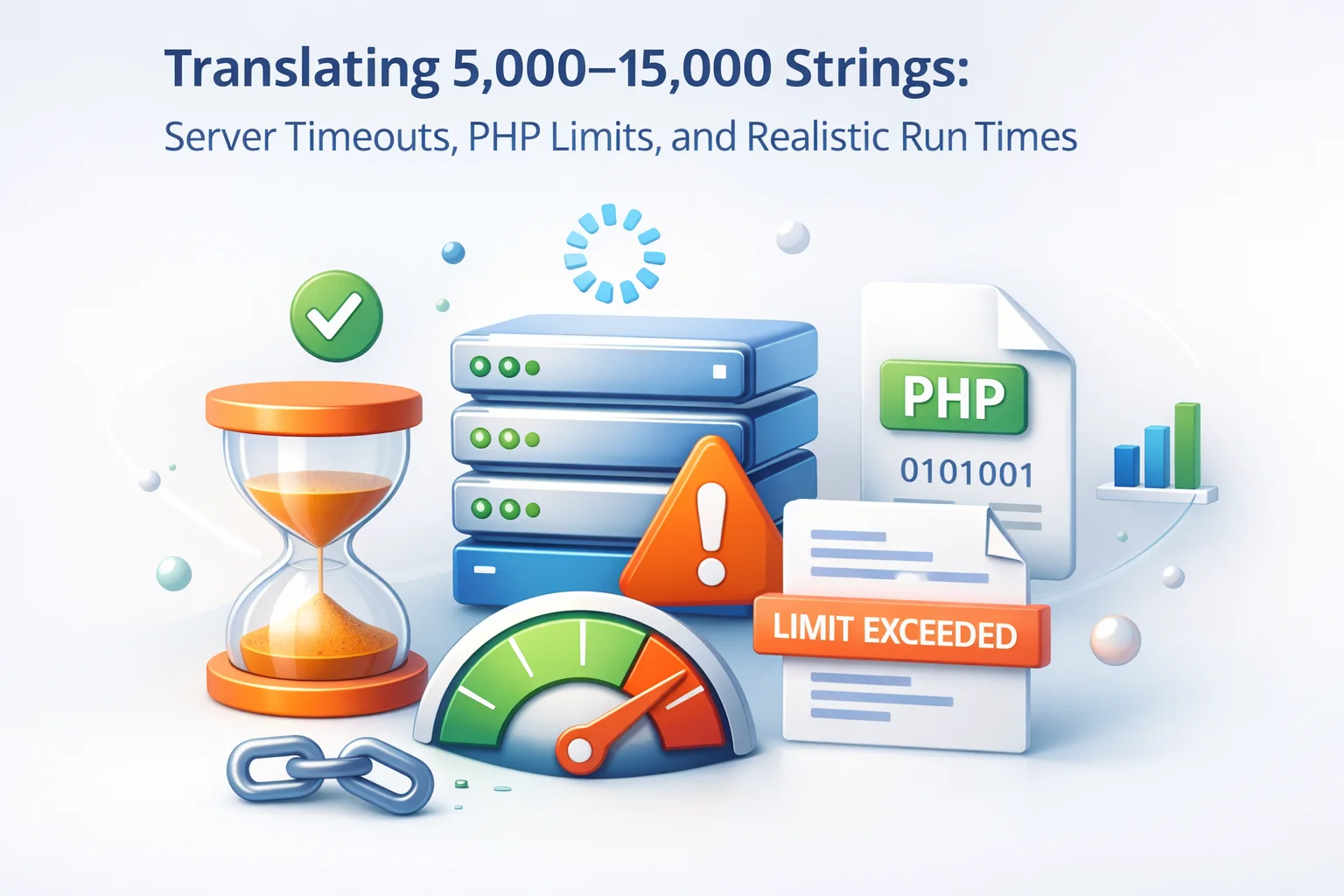
Small batches fail politely. Massive batches fail visibly: white screens, 502 gateways, partially saved PO files, and assists that restart from ambiguous state. The difference is rarely “better translation technology.” It is whether your hosting profile, PHP-FPM pool, and reverse-proxy timeouts were sized for long admin jobs in the first place.
Realistic run times combine three clocks: how fast your vendor returns completions, how fast WordPress can persist rows, and how long reviewers need to bless commerce-critical strings. Marketing pages love the first clock. Production incidents usually trace to the second.
Loco AI Auto Translator bulk gettext assists with wave-friendly checkpoints for five-thousand-plus string WooCommerce catalogs help operators align vendor throughput with what the server can actually commit before timeouts.
max_execution_time, memory, and admin request lifecycles.Five thousand strings is not five thousand equal tasks. A quarter may be trivial labels. Another quarter may bundle HTML, plural forms, or legal phrasing that demands slower assists and more reviewer time. Yet the server still loads Loco, hydrates the editor, serializes PO data, and writes to disk. Those fixed costs dominate early waves and lull teams into false confidence.
At fifteen thousand rows, probability catches up. A ninety-nine percent success rate per row still yields hundreds of failures unless retries are disciplined. Timeouts behave similarly: a one percent chance per minute of hitting a proxy limit becomes a near certainty over a multi-hour session unless you chunk work.
Treat scale thresholds as engineering requirements, not sales inconveniences. If a client cannot provision staging that mirrors production PHP limits, you are not staging; you are demoing.
Pick a wave duration target under your smallest known timeout, then count rows that fit. If unsure, start at thirty-minute waves and measure.
Log wall time per wave, rows committed, and errors. Without logs, every retry is superstition.
PHP’s configuration reference for max_execution_time explains how execution limits apply in web SAPIs versus CLI. Misreading that distinction causes teams to raise the wrong knob.
WordPress admin screens run inside PHP workers with execution budgets. When assists loop through rows inside one request, that request must finish before the worker is recycled. Increasing concurrency inside PHP without shortening per-request work can thrash the pool: other admin users see slow saves, Heartbeat stutters, and WooCommerce order screens time out.
Admins who multitask during mega-batches accidentally extend session lifetimes and trigger autosaves on unrelated screens. Those parallel requests compete for the same FPM children. Ask operators to dedicate a browser profile to the batch window, close unrelated heavy tabs, and silence plugins that poll aggressively.
Some hosts enforce hard caps regardless of ini settings. Managed WordPress platforms may kill long admin jobs to protect neighbors. Ask for explicit numbers. “We support WooCommerce” is not a timeout value.
CLI PHP often enjoys different limits. If your workflow allows exporting PO files and running offline merge or compile steps, you may offload work from browser-bound assists. Not every team has that pipeline; many legitimately need in-browser iteration. Choose consciously.
A fifteen-thousand-row PO is not fifteen thousand lines on disk; metadata, comments, and plural entries expand memory footprints. Loading the entire catalog into an array for diffing or assist previews can spike RAM. If memory_limit is conservative, WordPress may fatal error before you see a friendly Loco message.
Mitigations include splitting domains into separate PO files when Loco projects allow, working locale-by-locale, and avoiding parallel bulk assists on multiple giant files in the same PHP pool. Memory pressure also interacts with object caches that store large transients; flush stale transients if assists write progress markers. If opcache or JIT settings differ between web and CLI, compare both before you trust offline compile scripts to mirror production behavior.
WordPress documents wp-config.php constants that affect debugging and memory; pair that reading with your host’s actual php.ini values, not defaults from tutorials.
Even when PHP allows five minutes, nginx may cut the connection at sixty seconds. Cloud load balancers add another layer. Large batches must either complete under the shortest timeout in the chain or switch to chunked requests that return quickly while background workers continue. Many Loco-assisted workflows use sequential AJAX-style calls; each call must satisfy proxy budgets independently.
HTTP/2 multiplexing does not grant infinite patience. It multiplexes streams, not obligation to wait forever. Teams that move from VPS to container platforms sometimes discover shorter defaults; revalidate after every infrastructure migration.
Nexu WP Loco AI add-on with chunked bulk gettext waves sized for shared hosting timeouts reduces all-or-nothing requests that die at the proxy layer.
High-volume stores run cron, webhooks, and admin screens concurrently. A long Loco session competes for the same database and PHP workers that power order updates. Peak-hour batch assists are a scheduling mistake unless infrastructure is overprovisioned. Prefer nights or low-traffic windows for giant waves, and communicate that choice to operations.
High-Performance Order Storage shifts load patterns. It does not remove contention; it changes where queries land. Profile with Query Monitor or your APM tool during a test wave. Spikes that correlate with assist saves point to transactional bottlenecks, not mystical “slow translation.”
Read WooCommerce HPOS documentation before you blame gettext tooling for database pressure that actually comes from order throughput.
Large jobs need observable commits. Operators should correlate UI progress with PO file modification times or git diffs. A progress bar that races ahead while stat on the PO file stays stale is a warning flare.
Pair progress screens with exports: end each wave with a dated PO backup even if git commits happen hourly. Paranoid backups beat heroic recoveries.
Aggressive throughput presets can flood PHP with responses faster than it can persist rows. The vendor happily returns completions while your server drowns. Balance vendor concurrency with disk commit rates. Sometimes slower assists finish sooner because they avoid retry storms.
If you need vendor-side throttle guidance, revisit your batch-size and delay presets from the quota article in this series; server timeouts add a second independent ceiling.
Large string counts multiply small per-row overhead. A fifty-token system prompt is negligible once; multiplied across ten thousand rows it becomes hours of vendor time and PHP persistence work. Trim prompts for first-pass waves; run narrower high-instruction passes on commerce-critical domains only.
Loco AI Auto Translator glossary and prompt controls for predictable runtime on enterprise WooCommerce gettext counts help PMs explain why “same model” does not imply “same calendar.”
Failures at row nine thousand hurt morale. Give operators per-string tools to repair poison rows without rerunning the entire catalog. Snapshot settings before changing Turbo or vendor routes so support can reproduce the failure.
WordPress Loco AI plugin operational defaults for agencies running ten-thousand-row WooCommerce locales should live next to hosting SLA PDFs.
Build estimates from three layers: measured rows per hour on staging, reviewer throughput on checkout strings, and deploy windows. Publish ranges, not point estimates. Include explicit assumptions about hosting tier and maintenance windows. Add a buffer for the unknown unknowns: a plugin update mid-project, a legal hold on checkout wording, or a payment gateway string that suddenly becomes compliance-critical.
Wave schedule, hosting prerequisites, definition of “done” per domain, rollback plan.
Single-session completion on unknown hosts without calibration data.
Commercial Loco AI Auto Translator licensing for multi-site agencies delivering five-figure gettext projects should reference measurable wave metrics, not vanity concurrency screenshots.
WooCommerce and major extensions enqueue background tasks: webhooks, analytics exports, subscription renewals, and email retries. Those jobs share CPU and database capacity with your Loco session. A store that looks idle in the tab bar may still be busy under the hood. Before scheduling a fifteen-thousand-row weekend, inspect pending actions and failed queues. Clear poison tasks that retry forever; they steal seconds from every assist round trip.
WordPress cron is not a real-time scheduler. Missed ticks pile up. A backlog that fires dozens of events when someone loads admin can coincide with your bulk wave and exaggerate timeouts. For mission-critical batches, consider triggering system cron correctly or pausing nonessential plugins that schedule noisy hooks.
Observability beats intuition. Enable slow query logging for the batch window if policy allows. Correlate spikes with assist timestamps. Often the fix is an index or a deferred job, not a new translation vendor.
WooCommerce’s scheduled actions documentation helps operators understand what the queue is doing while gettext work runs.
Full-page caching rarely affects authenticated admin, but object caches do. Misconfigured persistent object caches can serve stale option values or stale translation-related transients. Symptoms include progress indicators that jump backward or row counts that disagree with disk. Document a cache-flush procedure for your stack and rehearse it before client-facing deadlines.
Redis memory pressure triggers evictions. Under eviction, recently written progress metadata may disappear mid-batch, confusing resume logic. Monitor memory usage and set sane TTL policies. Large batches deserve infrastructure attention, not only linguistic attention.
Security plugins that rate-limit admin AJAX can silently throttle assists after thousands of calls. Whitelist legitimate Loco endpoints with care rather than disabling protections wholesale. Involve security stakeholders; gettext urgency is not an excuse for opening holes.
When diagnosing odd latency, review WordPress performance optimization guidance for caching and database hygiene practices that intersect long admin jobs.
Agencies migrate clients between hosts with copy-paste confidence. gettext batches expose differences immediately. Re-run calibration on every migration even if CPU and RAM specs look better. Container orchestration often imposes stricter per-request budgets than legacy VPS images.
Compare php.ini values line by line: max_execution_time, memory_limit, max_input_time, OPcache settings, and realpath cache sizes. Small differences compound across thousands of iterations.
Update runbooks with the new shortest timeout. If the new host is faster for shoppers but stricter for admin, say so plainly in the project plan. Stakeholders prefer honest tradeoffs to surprise Friday failures.
Keep a “last known good wave” preset per environment. Name it after the host SKU. Delete obsolete presets to prevent junior staff from selecting last year’s VPS profile on this year’s platform.
Finishing assists is not finishing localization. msgfmt, MO distribution, theme child overrides, and CDN cache invalidation each add minutes to hours. Ten thousand rows that compile cleanly still need smoke tests on cart, checkout, and account endpoints. Budget that wall time explicitly or your “translation complete” email arrives before shoppers see results.
Staging deploys should mirror production paths: same mu-plugins, same object cache, same multilingual plugins if any. A staging compile that skips a production-only optimization plugin can hide fatal errors until go-live night.
Rollback rehearsals matter more at five figures than at five hundred. Practice restoring the previous MO bundle under stress. If rollback takes thirty minutes, say so in the runbook. Clarity reduces panic when assists discover a toxic msgid at row eleven thousand two hundred.
Finally, communicate to finance that large catalogs may require additional reviewer hours billed separately from bulk assists. The server may finish; humans still govern brand risk.
Translating five thousand to fifteen thousand strings is a hosting and project-management problem dressed as a translation task. PHP execution, memory, proxies, and WooCommerce admin contention set hard ceilings. Vendor quotas add another. Successful teams measure waves on staging, chunk work to fit the shortest timeout in the chain, and communicate ranges grounded in those measurements. They also rehearse failure: if wave three dies, everyone knows which git tag to trust and who owns the resume.
When you need assists that respect those ceilings instead of pretending they do not exist, the Loco AI Auto Translator WordPress extension for large-scale Loco gettext batches on WooCommerce with timeout-aware wave planning belongs in the same portfolio as your hosting audit checklist and your msgfmt CI gate. Treat that bundle as infrastructure documentation, not a magic button. The button still needs a sober host underneath it.





Saved my butt on Black Friday.
Bought this for a client's multilingual store, and the session handling is a nightmare. kept losing progress mid batch because the admin timed out while I was checking other tabs
Hey, this guide was a lifesaver for our WooCommerce translation mess.