Next-Level Code. Nexuvibe Style ...
Hrs
Min
Sec

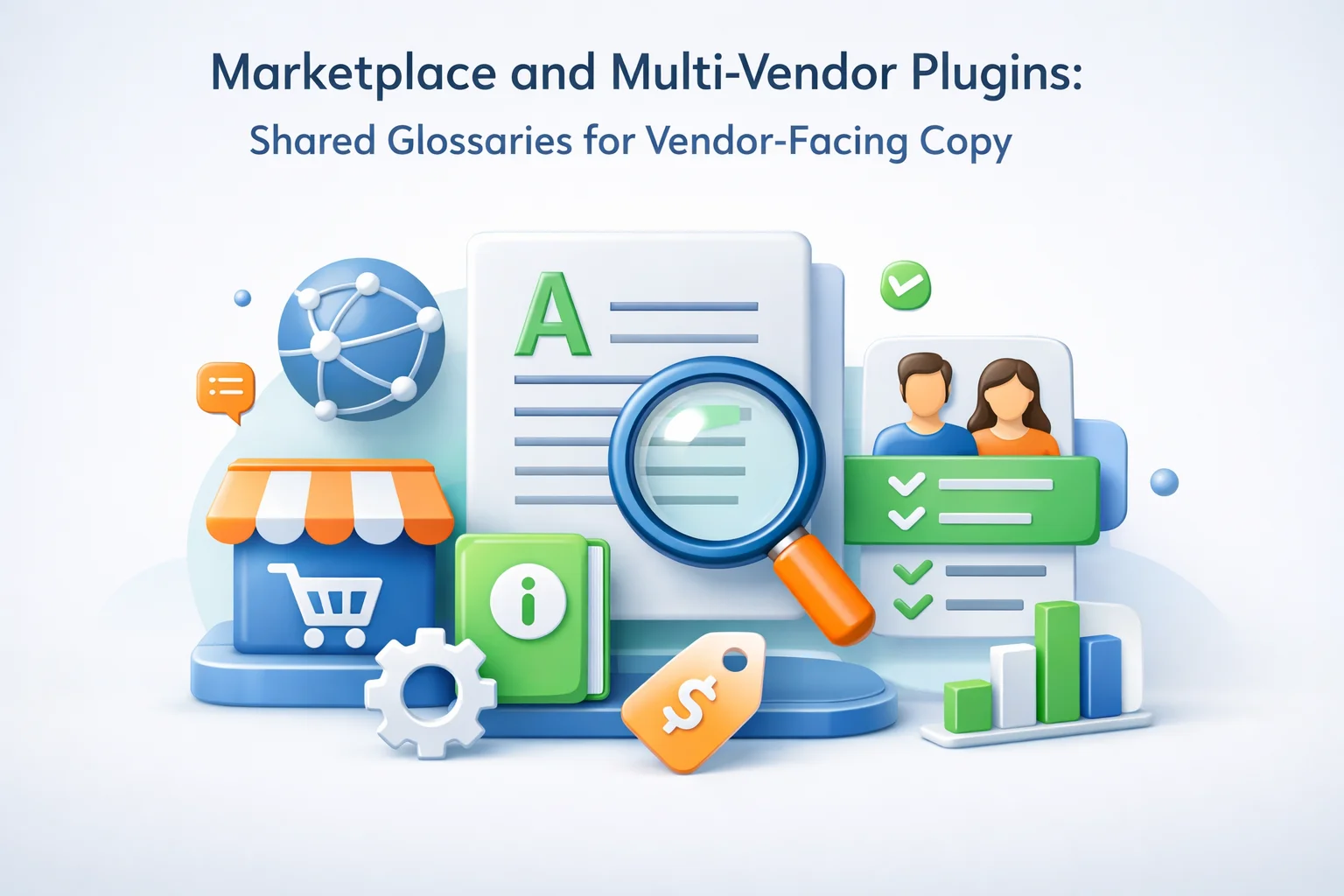
Marketplace operators live in triplicate copy: what shoppers see at checkout, what vendors see in dashboards, and what admins see when mediating disputes. gettext scatters those sentences across domains introduced by the core marketplace extension, payment splits, shipping labels, tax helpers, and membership gates. Translating each domain in isolation produces fluent sentences that still contradict each other.
Vendor marketplaces also surface trust and safety language: prohibited items, authenticity claims, and strike policies. Those gettext rows sit next to commercial vocabulary but carry reputational risk when translated aggressively or euphemistically. Your glossary should include a tone lane for enforcement copy that is firm, plain, and consistent across warnings and emails.
A shared glossary is not a luxury; it is the contract that keeps “payout,” “earning,” “deduction,” and “hold” aligned when money moves between three parties. Assists accelerate translation only after that spine exists; before it, bulk runs amplify inconsistency.
Auctions, bids, and offers introduce yet another dialect inside some multi-vendor stacks; reserve verbs like “sold,” “outbid,” and “reserve price” in the glossary next to fixed-price vocabulary so vendors never learn one mental model from the dashboard and another from buyer emails about the same listing.
Loco AI Auto Translator for WooCommerce multi-vendor gettext with glossary prompts and bulk assists in Loco Translate pays off when operators treat vendor vocabulary as a platform asset, not a per-plugin afterthought.
Shoppers care about trust badges, delivery promises, and refund rules. Vendors care about payout timing, commission math, and penalty language. Operators care about dispute workflows, compliance, and audit trails. Each group reads different msgids, yet all infer platform integrity from whether words line up.
When gettext translates “fee” as one term on the buyer checkout and another on the vendor ledger, both sides assume someone is hiding something. The fix is rarely more translation; it is a glossary decision made once, then enforced everywhere assists touch marketplace domains.
WooCommerce’s translation documentation explains how core strings reach Loco. Marketplace extensions add parallel paths; your playbook should extend that doc with a domain inventory and a column for audience: buyer, vendor, or operator.
Disputes and chargebacks often cite vendor dashboard wording alongside buyer receipts. When those strings diverge in translation, mediation teams waste hours reconstructing which screen was “correct.” A shared glossary does not eliminate disputes; it narrows them to facts instead of vocabulary accidents.
Agencies onboarding marketplace clients should request the operator’s latest English vendor handbook before touching gettext. That handbook is the implicit source of truth assists never see unless you paste excerpts into prompts or glossary notes.
Marketplace economics hinge on a handful of verbs and nouns. Commission can be inclusive or exclusive of tax. Payout can mean “initiated,” “sent,” or “available.” Holds can be risk holds, tax holds, or dispute holds. If gettext treats those as interchangeable synonyms, vendors reconcile numbers that never match their expectations.
Finance should publish a short canonical English table: term, definition, where it appears, and forbidden paraphrases. Localization imports that table into glossary rows before assists run. Translators adapt grammar; they do not invent alternate economic meanings.
Tiered fee structures—category-based commissions, volume breakpoints, or promotional rebates—multiply msgids that reuse the word “fee” with different meanings. Split glossary entries by msgid prefix or plugin slug when the same English surface word maps to different formulas. Assists need that disambiguation or they will collapse concepts for elegance.
Tax-inclusive and tax-exclusive displays affect both buyer checkout and vendor earnings breakdowns. If your platform shows both, glossary notes should state which string accompanies which number formatter output. Mismatch here creates accounting panic, not mere UX friction.
Start with platform-neutral entries that apply to every plugin: marketplace, vendor, payout, order split, and dispute. Add extension-specific entries only when a plugin introduces a novel concept. Resist duplicate glossary rows that differ by capitalization only; assists treat them inconsistently.
Version glossaries when pricing models change. A new category fee or reduced commission promo is a glossary event, not only a pricing event. Snapshot exports beside MO builds so you can prove which terms were live during a vendor dispute.
GNU gettext’s concepts overview helps technical leads explain msgid context to marketplace PMs who wonder why similar English needs multiple locked entries.
For cross-border marketplaces, split glossary namespaces by country when the same language carries different commercial law terms. Spanish for Spain and Spanish for Mexico may share many rows but should not share liability vocabulary blindly.
Document “do-not-translate” rows explicitly when partner payment brands or regulatory phrases must remain in English or a mandated script. Assists should see those flags in prompts; reviewers should see them in Loco tags or external spreadsheets linked from tickets.
When two plugins expose the same concept with different msgids, consider a translation memory process outside Loco: export, align, re-import. Glossaries handle terminology; TM handles sentence reuse. Together they stop drift better than either alone.
Review glossary diffs in pull-request style: author, reviewer, and link to the business change that triggered the update. Marketplaces that treat glossaries like code review survive audits; those that edit live without history invite “we never said that” arguments from every side.
Sellers archive onboarding copy. Verification failures, tax document requests, and prohibited product reminders become evidence in appeals. gettext rows in those flows should mirror your published policies, not paraphrase them creatively.
Assists excel at drafting polite tone; they struggle when politeness softens mandatory compliance language. Prompts should instruct assists to preserve modal verbs and obligations exactly and faithfully as finance and legal approved in English, then localize grammar around that spine.
Bank account and tax identifier prompts vary by corridor; never reuse a US-centric template msgid globally without counsel review. A string that reads neutral in English may imply a specific legal entity type in translation if assists choose a localized term with narrower meaning.
Vendor appeals often attach onboarding screenshots. QA should include a pass that verifies those screens in every supported locale quarterly, not only at launch. Plugin updates can reintroduce English fallbacks that bypassed notice because nobody re-opened the vendor wizard.
Marketplaces often surface vendor handling times beside buyer delivery estimates. If gettext shortens “ships within two business days” on the storefront but leaves the vendor dashboard verbose, shoppers and sellers argue over lateness with different sentences in hand.
Align units and calendars: business days versus calendar days belong in glossary notes, not only in English source. Assists should see those notes whenever msgids mention time.
WordPress’s i18n handbook remains the reference for translators preserving placeholders in sprintf strings when shipping integrations inject tracking tokens.
Drop-ship and third-party fulfillment plugins add vendor-facing error strings when labels fail or carriers reject addresses. Those errors surface to buyers as delayed orders. Glossary alignment between “vendor fault” and “carrier fault” messaging prevents both sides from blaming the marketplace for wording that pointed the wrong direction.
Print-on-demand workflows sometimes expose production SLAs in vendor gettext that buyers never see until a late shipment triggers a refund. Keep production-time nouns consistent with customer-facing delivery promises or support will translate operational reality for angry shoppers line by line.
Operators running multisite or regional storefronts sometimes enable different plugin combinations per site. A glossary updated on the flagship site may not propagate to a satellite vendor portal. Treat glossary deployment like schema migration: scripted, logged, and verified.
Document which site ID owns the canonical MO files for vendor tools. Ad-hoc edits on staging clones create “works on my sandbox” translations that never reach production vendor dashboards.
Vendor subdomains and separate login URLs complicate cookie consent and policy footers; gettext for those footers should follow the same glossary-driven terminology as the main marketplace even when a different theme loads. Operators often forget vendor portals use alternate header templates with their own msgids.
White-label marketplaces rebrand frequently. Each rebrand triggers marketing excitement and gettext churn. Freeze vendor money vocabulary during rebrands unless counsel explicitly updates master English; otherwise assists happily “refresh tone” on commission rows that were legally vetted last quarter.
Monthly diff vendor-facing domains against the glossary export. Flag new msgids that mention money without any matching glossary entry whatsoever.
Once money vocabulary and onboarding obligations are locked, long-tail vendor notices and admin labels can move faster. Turbo-style batches help when sampling proves placeholders stay intact across sprintf-heavy domains.
Keep bulk filters scoped: exclude domains that mix buyer and vendor strings in one file if your QA team cannot stratify samples. False confidence from green progress bars is a recurring marketplace failure mode.
Stratify samples toward sprintf-heavy rows and any msgid containing payout, ledger, penalty, suspension, or verification. Those clusters carry disproportionate dispute weight compared to generic admin labels that fill most PO files.
Log bulk runs with timestamps and operator identity. When a vendor cites a confusing sentence, you can answer whether it predates your glossary lock or postdates a rushed batch. That answer determines whether you fix translation, product, or communication—not all three at once.
Peak seasons strain assist endpoints. Multi-provider Loco AI Auto Translator routing for marketplace gettext during high-volume vendor events avoids stalled releases when one provider throttles.
Vendor dashboards are not a safe playground for experimental translations. Capabilities should map to your gettext policy: junior linguists translate long-tail admin labels; senior reviewers own commission and payout surfaces.
Rotate API keys on the same schedule as payment integrations. Marketplace teams sometimes treat assist credentials as “marketing tooling” and forget they touch production-adjacent strings.
Separate WordPress capabilities so vendor-facing bulk assists require a role that includes marketplace operations training, not merely translate_posts. Editors who publish blog content should not inherit gettext powers that rewrite payout explanations by accident.
Publish an internal “pause assists” checklist for payout incidents: who disables bulk, who notifies linguists, and who re-enables after MO rollback. Panic without a checklist produces half-reverted files and mixed-language vendor dashboards.
WooCommerce developer notes on block-based experiences matter when vendor storefronts adopt blocks; gettext exposure can shift without a line-of-business owner noticing.
Vendor mobile apps or progressive web shells that reuse WooCommerce APIs may ship hard-coded English fallbacks for rare errors. Document those gaps in your localization charter so executives do not promise parity your gettext stack cannot deliver alone.
Finally, pair glossary governance with vendor education: a one-page PDF in each locale that explains commission vocabulary using the same terms as the dashboard reduces tickets even when gettext is perfect. Alignment is a product communication problem as much as a translation problem.
Multi-vendor success depends on vendors trusting numbers and words on your platform. gettext spread across plugins makes inconsistency the default outcome. A shared glossary spine, enforced prompts, and gated bulk assists turn translation into a reliability layer instead of a source of disputes.
Treat every major plugin upgrade as a glossary regression test: export vendor domains, diff against the previous release, and schedule review for new money-adjacent msgids before marketing announces multilingual vendor tools. The upgrade that “only refactored code” still shifts strings often enough to matter.
Loco AI Auto Translator as the Loco Translate assist suite for WooCommerce marketplace vendor gettext with glossary prompts bulk progress and multi-provider routing supports operators who treat vendor vocabulary as part of platform architecture.
Ship vendor-facing localization the way you ship fee schedules: versioned, audited, and boringly consistent—because boring, predictable language is what builds trust when money moves between three parties.
Measure success with operational metrics: fewer glossary-related support tickets, faster vendor onboarding completion in non-English locales, and shorter dispute mediation when screenshots disagree. Those outcomes justify the upfront glossary work more than vanity completion percentages in Loco ever could.
When two vendors argue in a forum thread and paste conflicting dashboard sentences, your team should be able to point to a glossary version, an MO build, and a QA screenshot—not to a translator’s memory. That discipline turns gettext from a cost center into evidence your marketplace runs deliberately and can defend its wording under scrutiny.






Hey, finally a guide that actually fixes vendor
Hey, does this handle strike policy wording everywhere?
Got this to keep vendor emails and dashboard labels consistent they kept using different words for the same thing.