Next-Level Code. Nexuvibe Style ...
Hrs
Min
Sec

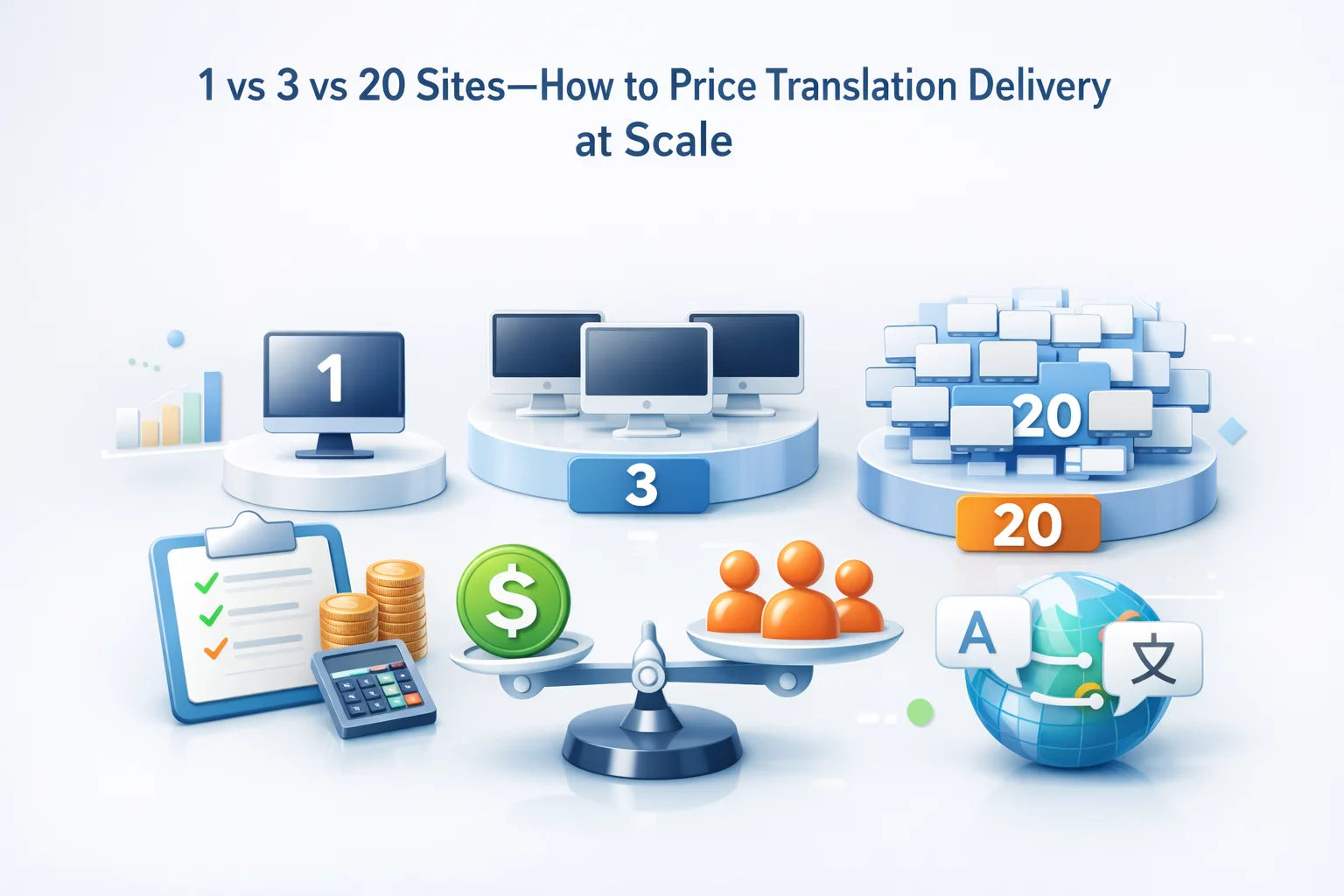
A solo license covers one production footprint; a three-site bundle usually maps to production plus staging plus a sandbox, or three small retainers you rotate carefully. Twenty-site tiers signal volume: either a growing portfolio, a multisite network, or an agency reselling standardized builds. None of those shapes tell you how many gettext strings exist—that depends on WooCommerce depth, extension count, and how often vendors ship updates.
Pricing translation delivery requires separating license economics from labor economics. The subscription line on your card is predictable; reviewer hours after a membership plugin update are not. Mature agencies bake gettext maintenance into retainers instead of pretending locales are “finished” at handoff.
Operational assists that scale across clients—governed bulk fills, per-client prompts, glossary enforcement—are where Loco AI Auto Translator as a Loco Translate assist suite for multi-site WooCommerce agencies earns a line item beside raw linguist rates. The sections below stay licensing-literate without endorsing a specific vendor tier you must verify against your contract.
A single-site entitlement is not permission to spin up unlimited client clones. Vendors define production URLs, staging allowances, and multisite behavior in their terms. Read the entitlement table before you quote a fixed-fee multilingual launch; a mismatch between client expectations and license reality becomes your discount, not theirs.
Solo practitioners often run one production store plus one staging domain under a personal license if the vendor permits. Agencies need explicit written policy: which client sites consume which seat, how freelancers access keys, and how you offboard translators without leaking credentials.
WordPress.org’s expectations for how plugins present upsells and handle user data belong in your vendor due diligence, not only legal review. Reference WordPress.org detailed plugin guidelines when evaluating whether assist products fit enterprise procurement questionnaires your clients send.
Three-site tiers often cover production, staging, and a development clone—or three lightweight production properties in a franchise model. The trap is using slot three as a rotating parking lot for unrelated clients. License audits and support tickets do not forgive creative seat-sharing; document assignments in your CRM alongside hosting invoices.
From a gettext perspective, three environments triple the verification surface if MO files diverge. Standardize deployment: promote the same translation bundle through environments with checksums or export manifests so QA does not chase ghosts.
Name a single owner for “promotion rights.” Junior developers should not compile MO files locally and FTP them to staging without a ticket, or you will debug three different Spanish checkouts in one afternoon. Pair Git or CI rules with Loco export discipline so the PO/MO pair that passed review is the pair that ships.
Three-site bundles also suit agencies running a flagship demo store, a partner sandbox, and one paying client—until the paying client needs isolation. If your commercial model depends on that geometry, budget an upgrade path in the proposal so you are not negotiating mid-retainer while a launch is live.
Prod + staging + dev for one client program, with keys rotated per environment.
Recycling slot three for ad hoc client experiments without entitlement coverage.
High seat counts align with productized WooCommerce offerings: repeatable theme stacks, known extension sets, and templated Loco projects. The economic win is operational: you amortize tooling and training across many installs. The economic risk is support: twenty production stores mean twenty checkout-critical gettext surfaces that can regress independently.
Price translation delivery with a base package plus a per-locale multiplier plus a per-extension-risk surcharge. Flat “we translate everything” quotes without discovery destroy margin when a client installs a marketplace plugin mid-contract.
At portfolio scale, correlation breaks: two stores can run the same theme version yet expose different string counts because one merchant enabled subscriptions and the other did not. Build a discovery worksheet that inventories active payment gateways, shipping plugins, membership flows, and B2B pricing modules before you promise a calendar date for “all languages live.”
Twenty seats also change who answers the 2 a.m. ping. Define an on-call rotation for gettext regressions tied to WooCommerce point releases, not only security patches. Clients remember checkout wording failures longer than they remember blog typography tweaks.
Use WooCommerce documentation on translating a store as a scope baseline when estimating cart, checkout, account, and email paths—agency quotes often underestimate email and PDF strings.
A flat fee for “Spanish plus French” sounds clean in the sales deck until the merchant swaps loyalty plugins during UAT. Retainers exist to absorb predictable churn: minor string updates after vendor releases, seasonal banner text inside gettext-backed templates, and quarterly glossary reviews. Without a bucket of hours, every delta becomes a negotiation, and your project managers become part-time contract lawyers.
Publish a change-order trigger list. Examples: new payment method with user-visible labels, additional market requiring a new formal “terms” tone, or a third-party checkout field that introduces gendered grammar in a target language. Clients respect boundaries when they see them before signing, not after the invoice arrives.
Metered assists complicate forecasting: throughput varies with batch size, provider latency, and how aggressively you fill empty rows. Agencies should model a conservative assists budget per client tier, then mark up for risk the same way you mark up hosting overages. Passing raw meter rates through without margin leaves you holding the bag when a Black Friday content freeze demands overnight passes across twelve stores.
Remote assists often meter by usage. Agencies can centralize billing for speed or require client-supplied keys for compliance. Each model changes your margin: centralized keys simplify operations; client keys simplify procurement questionnaires but complicate support when credentials expire during a launch window.
Write the choice into contracts: who rotates keys, who pays overages, and who approves throughput spikes during Black Friday gettext refreshes. Ambiguity there produces unpaid firefighting.
Segment keys by environment when clients insist on holding credentials. A common pattern is production keys in the client vault while staging uses agency test accounts with synthetic data only. Document that split in the runbook so a new engineer does not paste the wrong key into a screenshot during a support thread.
EU-facing merchants may require DPAs and subprocessors lists before any remote assist is enabled. Build a standard answers pack: what metadata leaves WordPress, retention windows, and how to disable assists without uninstalling Loco Translate. Sales cycles shorten when security review receives prose that matches reality.
Agency plans tempt you to run bulk jobs across many sites during business hours. PHP workers, outbound connection limits, and shared database load still apply. Throttle concurrency per client tier; document host limits in onboarding so account managers do not promise same-day bulk passes on budget hosting.
Productized delivery benefits from repeatable turbo presets: conservative defaults for shared hosting, higher ceilings for managed WooCommerce tiers. Save presets as part of your deployment kit.
Each client needs a glossary: SKUs that must not translate, legal phrases that must match footers, promotional vocabulary that must stay out of fee lines. Store those rules where assists can enforce them; otherwise translators reinvent tone on every project and you eat rework.
White-label agencies should version glossaries per client and never copy-paste between unrelated regulated industries. A healthcare footnote leaking into a fashion checkout is a contract event, not a typo.
Glossary meetings are billable for a reason. Stakeholders argue about “basket” versus “cart,” about formal versus informal second-person address, and about whether loyalty currency should localize. Capturing those decisions once prevents expensive re-voice passes when a new PM joins the account.
Align glossaries with storefront content governance: if marketing rewrites English hero copy weekly, gettext-only consistency will not save you. Decide which strings are stable enough for assisted fills and which channels need human marketing translators outside Loco’s scope.
Prompt libraries encode register: formal checkout, casual loyalty program, technical B2B account labels. New hires should attach prompts before touching production PO files. Without that discipline, twenty-site portfolios drift into inconsistent voice even when licenses are paid.
Reference WordPress internationalization guidance when training juniors why placeholders must survive assists unchanged.
Prompt libraries should carry ownership metadata: who approved the tone brief, when it last changed, and which client legal review covers claims language. At twenty sites, “tribal knowledge” in Slack is a liability; versioned prompts turn onboarding from oral history into a checklist.
Account managers need plain-language status: domains touched, percent complete, blockers from third-party English releases. Exporting spreadsheets mid-batch confuses clients; visible job progress reduces churn on long gettext phases.
Tie reports to contractual milestones: “checkout domain cleared in ES and FR” reads better than opaque row counts.
Executives rarely want PO exports; they want risk statements. Include what remains untranslated on purpose (third-party English-only tools), what awaits client legal sign-off, and which plugins are known string factories after updates. That framing prevents “you are only ninety percent done” misunderstandings when the last ten percent is politically blocked, not technically blocked.
For portfolio programs, aggregate anonymized progress dashboards across clients only if contracts permit. Some retailers treat gettext inventories as competitive data; default to per-client reporting unless you have explicit sharing clauses.
Clients eventually leave or bring operations in-house. Export Loco projects, prompt libraries, glossary CSVs, and environment key inventories in a single package. If licenses are non-transferable, plan a cutover window where the client purchases their own entitlement before you revoke access.
Document subprocessors and data flows while assists were active; future security reviews will ask for historical scope, not only current quarter vendors.
Capture screenshots or exported setting summaries for assist configuration: which providers were enabled, default models or profiles if your stack uses them, throttle behavior, and glossary attachments. The next agency or in-house team should not reverse-engineer your intent from WordPress options alone. Store those artifacts beside Loco exports in the client archive bucket with dated folders.
When licenses are firm-owned but the client paid for implementation, clarify whether they receive a read-only operational guide without entitlement transfer. Many MSAs confuse access to outcomes (translated bundles) with access to vendor accounts. Spell it out to avoid acrimony during renewals.
Firm-wide defaults for assists (shared tone guardrails, banned terms) belong in an internal wiki; client-specific overrides belong in the bundle above.
Whether you seat one store or twenty, gettext work expands with WooCommerce complexity and vendor churn. Licenses buy the right to run software on defined footprints; they do not buy finished locales. Price delivery by risk-adjusted hours, assist leverage, and ongoing regression coverage. Invest in runbooks, prompts, and glossaries as reusable assets so higher site counts become profit instead of panic, and revisit entitlement mapping quarterly—the spreadsheet that worked at three sites will lie to you at fifteen.
When leadership asks whether to upgrade from three seats to twenty, answer with utilization and incident history, not aspiration: if gettext regressions already consume senior hours every month, tooling and seat headroom are usually cheaper than engineer churn, while a smaller tier plus strict client discipline can preserve margin when incidents stay rare. Align sales compensation with sustainable scoping so account executives cannot bury translators in impossible promises; a short gettext risk checklist before quote sign-off pays for itself the first time a client bolts on a marketplace at go-live minus three days. Loco AI Auto Translator as a scalable Loco Translate assist for agency WooCommerce portfolios belongs in the same planning conversation as seat counts and API budgets—compare total loaded cost, not sticker price alone.





Got the agency licensing guide and it's actually really solid for breaking down the cost differences between 1, 3, or 20 site setups. but here's the thing those 20 site tiers make it seem way simpler than it is.
I've been using the three site license for quick client experiments in that third slot, but I'm a little fuzzy on what happens if those clients don't have their own coverage. the guide talks about staging rules, but I'm not sure does swapping out that third slot for unlicensed tests break any terms, or would it just cause headaches down the road if we need support? Really just want to make sure I'm not setting myself up for trouble before I lean harder on this setup
This guide finally put into words what I've been wrestling with for years how to price translation work without getting burned on updates.