
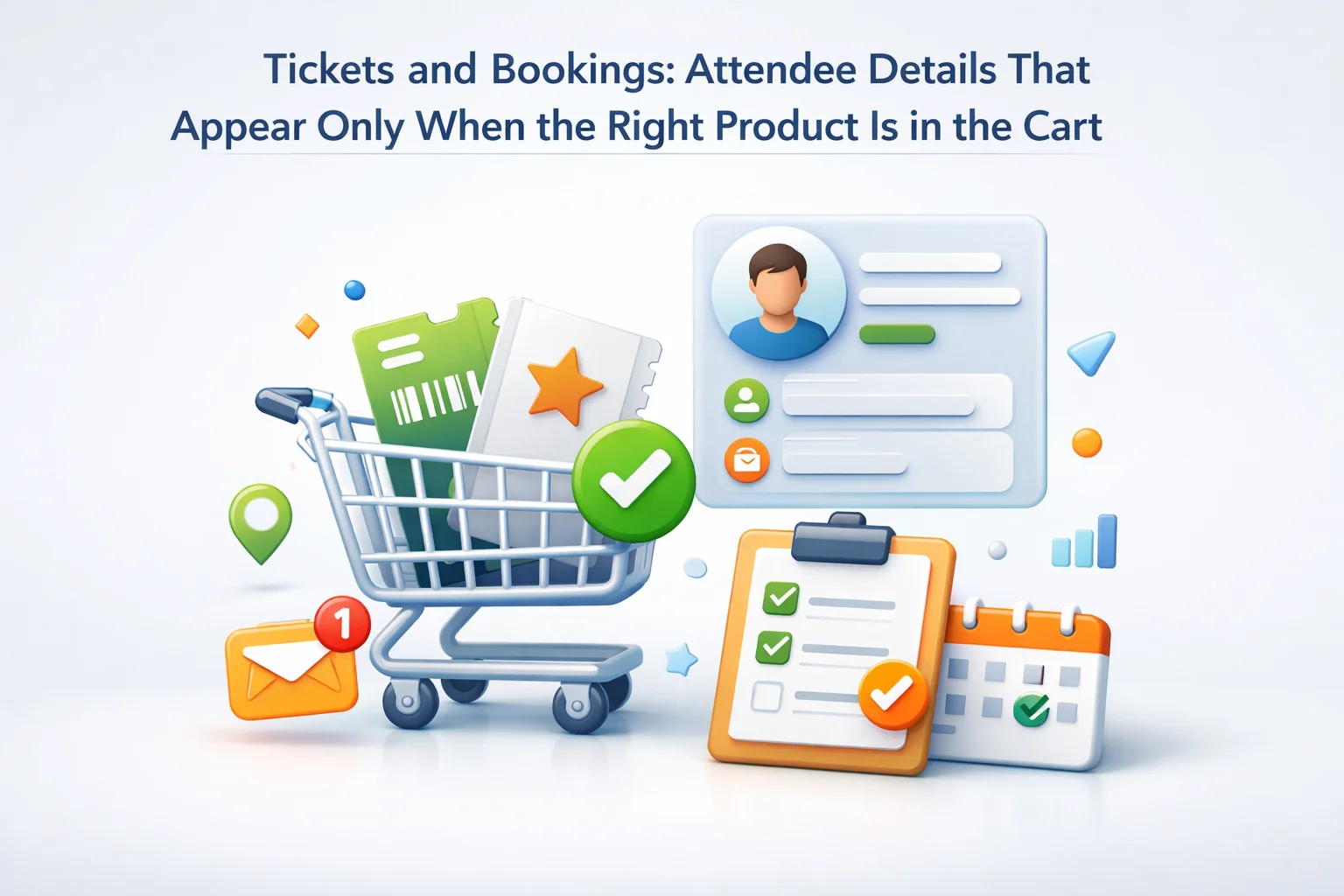
Event commerce on WooCommerce usually starts with simple SKUs: a variation per tier, inventory per session, maybe a PDF emailed afterward. The moment you sell more than one ticket per order or bundle a hoodie with a conference pass, checkout complexity arrives. Someone must collect attendee legal names, accessibility needs, or age confirmations without implying that a hoodie buyer is joining a seated dinner.
Global forms fail here because events are episodic and emotional. Buyers tolerate more questions when the context is obvious—“of course they need my partner’s name for the second seat.” Take the same questions out of context and they feel like surveillance. The implementation that respects customers binds fields to ticket product IDs or categories, not to the entire storefront.
You will map how to structure per-ticket prompts, how to keep multi-day festivals from duplicating fields, and how to QA mixed carts under Blocks checkout. The through line is WooCommerce checkout fields conditional on cart contents for ticket and event SKUs, so operational data still lands in order records your door staff can search.
Start from the door: what staff must see in the first ten seconds
Before you design fields, list the checkpoint moment. Some venues scan QR codes tied to order IDs; others read legal names against IDs. If your field strategy does not match the checkpoint, you will watch lines stall while supervisors search order notes. Attendee first name, last name, and email often suffice for digital tickets, but seated events may need birthdate for youth pricing or accessibility seating codes that must print on the badge.
Anything sensitive belongs behind consent copy and should be flagged admin-only if door volunteers should not read it. Medical information deserves minimization: ask only what changes seating or staffing, not a full health history. The WordPress privacy documentation is a good reminder to align collection with published policies and retention expectations, especially when you export attendee lists after the event.
If a field does not change who gets in or where they sit, move it to a post-purchase survey unless regulations require it upfront.
Per-product fields: bind prompts to the SKUs that represent seats
Ticket products are ideal candidates for per-product checkout fields because the interrogation is intrinsic to the SKU. A weekend pass and a single-day pass might need different follow-ups. A child ticket might need guardian contact. A VIP bundle might collect shirt size while general admission does not. Authoring fields on the product record keeps merchandising and operations aligned: whoever publishes the ticket also owns the questions.

Quantity >1: decide between repeated fields and representative contact
Two tickets might mean two legal names or one purchaser bringing a guest whose name is TBD. Forcing two full forms on mobile can tank conversion; allowing “secondary attendee: unknown, update via email” might be pragmatic if your policy allows transfers. Document the business rule, then encode it: either require iterative fields with clear numbering or collect a single primary attendee and send a self-service link for companions.
If you choose iterative fields, label them in human language: “Attendee 1 full name,” not “Name.” Pair with validation that prevents duplicate emails when uniqueness matters. For family events, consider allowing identical last names without flagging duplicates as fraud.
For workshops with capped seats, consider capturing skill level or prerequisite confirmations as radios rather than essays. Graders read radios; they resent parsing paragraphs for liability answers. If a free-text story truly matters, keep it optional and flag it for curator review rather than gate entry.
Children’s events may need guardian phone numbers distinct from the purchaser. Separate inputs reduce the odds that an emergency call goes to someone watching the show from another city. Label urgency plainly: “Day-of mobile for guardian onsite.”
For a deeper look at attendee metadata travels with ticket SKUs, see this related guide on WooCommerce Checkout for Event Tickets:How to Collect Attendee Names, Dietary Info, and Seat Preferences per Product.
Best when badges must match IDs exactly; expect longer mobile sessions.
Best when transfers are common; requires operational follow-up discipline.
Conditional logic for add-ons, donations, and bundles
Bundles muddy the water: a ticket plus poster might need a shipping address while the ticket itself does not. Rather than exposing shipping to every patron, tie address fields to physical add-on SKUs or shipping classes. Donation lines might need dedication text only when a checkbox signals “in honor of.” These are classic cart-content triggers; the checkout should expand once, predictably, after the cart stabilizes.
Avoid chaining invisible prerequisites. If meal selection appears only when a VIP pass is present, say so in helper text the moment VIP enters the cart. Surprises after the pay step are refunds, not teachable moments.
Merch-only carts should remain blissfully short. If a hoodie triggers shipping but no ticket is present, do not show attendee prompts just because the theme’s CSS resembles your event template. Cart rules need explicit positive matches on ticket categories rather than loose “if cart not empty” logic inherited from older snippets.
Charitable upsells sometimes need dedication names visible on public screens. Separate “public dedication text” from “private attendee notes” so you never accidentally project medical data to a gala slideshow. Consent checkboxes should reference the exact usage context, not a generic marketing opt-in.
Field order for events: contact, attendees, logistics, payment
Guests expect to confirm email early for digital delivery. Attendee-specific blocks should follow once the purchaser knows the cart is correct. Shipping for merch should appear only when needed. Drag-and-drop editors help you enforce that story without PHP, which matters when a volunteer coordinator temporarily joins the web team during festival week.

Blocks checkout spacing: when attendee panels grow wide
Event fields often arrive late in the stack, just before payment. Block themes can compress vertical rhythm differently than classic templates, which means long attendee panels may push wallets below the fold on small phones. QA with real devices, not only browser resizers. If payment feels “missing,” anxiety spikes even when the button is a scroll away.

Sponsors, tables, and B2B blocks: when attendee questions overlap procurement
Corporate tables blur consumer and business checkout. A sponsor might pay with a company card but still need individual guest names for badges. Rather than enabling a full VAT module for every patron, use a sponsor-specific SKU that reveals both attendee prompts and a compact invoice profile. Keep the language explicit: “Billing contact” versus “Guest of honor” prevents finance from chasing the wrong person for payment disputes.
Table purchases often involve later substitutions. If your policy allows swapping names until a cutoff, say so beside the fields and mirror the cutoff in confirmation emails. Staff should not discover the rule only when an angry sponsor forwards a six-month-old thread.
When purchase orders are involved, separate PO entry from attendee entry visually. Mixing them in one paragraph invites typos that break ERP imports. A short divider or tinted box signals that the purchaser is wearing two hats: organizer and guest wrangler.
Email confirmations and the admin order screen: keep staff and buyers aligned
Attendees screenshot confirmation emails when lines get long. If your templates omit field answers or bury them under generic headings, you will reprint badges from memory. Configure transactional emails so ticket holders see the same attendee names and selections your volunteers see in wp-admin. When answers change after purchase, send a concise amendment email that lists deltas, not an entire policy manual.
Inside the dashboard, train staff to use consistent filters and search terms. If you rely on WooCommerce order notes for gate issues, establish a prefix convention like “DOOR:” so searches stay reliable. The WooCommerce documentation on managing orders is a practical refresher for teams onboarding volunteers who only touch the admin once a year.
Custom fields should appear near line items when possible so context survives copy-paste into spreadsheets. If you export to box office software, map columns explicitly and test double-byte characters in names. Unicode failures on import are embarrassing at scale.
Refunds, transfers, and partial cancellations: what happens to attendee data
Policies matter as much as fields. If a ticket is refunded, decide whether attendee metadata should be anonymized, retained for fraud analysis, or deleted. If transfers are allowed, specify whether the purchaser can edit names in My Account or must email support. Checkout captures a moment in time; life cycle rules determine whether that moment becomes a liability later.
Partial refunds for bundles split across taxable and non-taxable components should not orphan half an attendee record. If your accounting team issues credit memos, ensure order metadata still explains which seat was cancelled. Ambiguity shows up as chargebacks when buyers insist they “only cancelled the shirt.”
Document edge cases in a runbook: weather cancellations, postponements, and artist swaps. The checkout form is not the place to explain every scenario, but the post-purchase email sequence should link to the runbook’s human-readable summary so goodwill stays intact.
When events move dates, decide whether attendee answers carry forward automatically or require reaffirmation. Dietary constraints can change across months; youth ticket ages might cross thresholds. A lightweight “confirm your details” campaign triggered by the date change often beats assuming silence implies consent.
Load testing the emotional moment: on-sale spikes and bot traffic
Hot shows behave like product drops. Checkout must stay responsive when concurrent sessions spike. Heavy conditional JavaScript or unoptimized image assets in theme headers still hurt, even if your field plugin is efficient. Run a dress rehearsal with realistic attendee data volumes, including worst-case cart sizes and slow mobile profiles.
If you throttle by IP or use a queue vendor, verify that throttling does not strip session cookies needed for field validation. Few things anger fans more than filling attendee forms twice because the edge network rotated their checkout session.
After the spike, read error logs for validation failures that cluster around specific devices. iOS autofill quirks often appear only under load when people rush. Fixing a label attribute or autocomplete hint between shows is cheap; apologizing on social media is not.
Accessibility and inclusive language at the gate
Ask about accessibility needs with dignity. Offer constrained choices when they map to real seating categories, but leave room for free text when nuance matters. Train volunteers never to verbalize sensitive answers aloud when scanning tickets. The checkout form should use clear, respectful labels mirrored in training decks so front-of-house language stays consistent.
Screen reader users benefit from logical tab order and explicit error associations. A long attendee panel that inserts new inputs dynamically must move focus thoughtfully, not dump users at the end of the page without context. These details are invisible until they are catastrophic for someone holding a timed entry slot.
If you provide companion tickets, explain how companion names will be used and whether companions receive separate emails. Confusion here creates no-shows and duplicate will-call lines.
Exports, backups, and replaying last year’s field graph
Annual events should not reinvent checkout from memory. Export JSON after each successful on-sale, note which fields mapped to which volunteer workflows, and import that baseline when you clone products for the next year. Adjust only what changed: new dietary option, new youth policy, new city ordinance. Incremental edits reduce the chance you forget a required prompt until hour one of sales.
Treat the export file as part of your event archive alongside ticket counts and financial reconciliations. When leadership asks why a particular question existed three years ago, the JSON answers definitively without relying on departed contractors. If you operate multiple brands under one Woo install, prefix internal notes so imports land in the correct property’s namespace.
Staging imports should follow the same order you use in production: pull the JSON, diff visually in admin, place test orders for each ticket tier, then promote. Skipping the diff because “it worked last time” is how a stray required field sneaks into a live on-sale while everyone is watching telemetry instead of phones.
Rollback drills deserve a calendar reminder. Once a quarter, time how long it takes to import yesterday’s known-good file and verify two historical orders still render correctly. If rollback exceeds your tolerance, automate snapshots or narrow who may publish field edits without review.

Ticketing is emotional commerce; the checkout should feel like a competent box office, not a generic mail-order form. Binding attendee questions to the right SKUs keeps merchandise buyers fast while still giving your crew the data they need at the door. Treat every new field like a microphone on stage: if it does not earn its place, cut it before opening night, and log the cut so finance agrees without last-minute surprises or noisy debates at go-live.
Nexu WP Advanced WooCommerce Checkout Field Editor for experiences, workshops, and ticketed events delivers per-product fields, cart-based logic, Blocks support, and portable JSON configs so on-sale week is about people and production, not surprise form bugs.
Collect attendee answers only when tickets are actually in the cart
Advanced WooCommerce Checkout Field Editor keeps merch buyers moving while event SKUs unlock the questions your door team relies on.


Just got this set up for our big annual conference after a coworker swore by it. The way it lets you tie attendee questions to specific ticket types not the whole store is a really helpful. No more confused emails from people wondering why we're asking for dietary restrictions when they're just buying a t shirt.
This dynamic field setup seems like a smart way to keep event questions tied to the right tickets.
Saved me when bundling tickets with merch. no more confused buyers!
The conditional fields work great for separating ticket holders from merch buyers, but mixing donations in the same cart still gets messy. Had to tweak the category rules to stop VAT prompts from popping up on simple t shirt orders