Next-Level Code. Nexuvibe Style ...
Hrs
Min
Sec

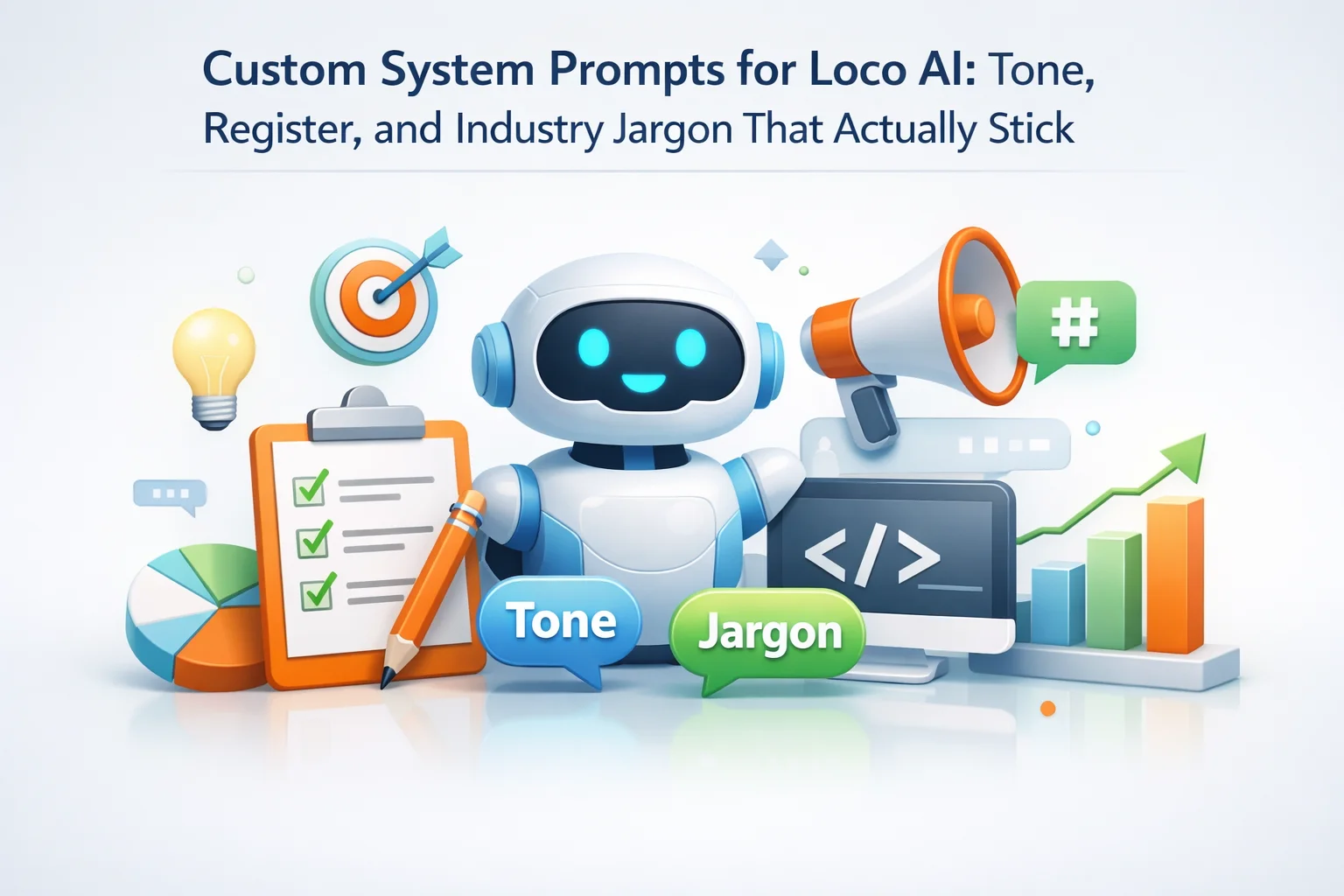
Store owners rarely see the instruction text that shapes thousands of target-language rows. Developers paste a plugin update, open Loco, and run a batch. If the steering text is vague, outputs vary between polite retail voice on checkout labels and stiff manual-speak on account screens, even though both belong to the same shop. That inconsistency is not a mystery of multilingual WordPress; it is a prompt design failure.
Strong prompts encode three layers: audience (shopper versus administrator), register (formal legal German versus conversational DACH retail), and vocabulary policy (which English trade terms must remain English, which acronyms expand, which risk disclaimers keep hedging language). When those layers are explicit, reviewers spend less time fighting adjectives and more time confirming that placeholders survived.
That is the gap Loco AI Auto Translator custom system prompt controls for WooCommerce gettext tone and terminology closes when teams treat prompts as part of release governance, not as a one-off experiment buried in a settings screen.
Automated translation backends still interpolate from whatever context they receive. Source English inside a WooCommerce string is not neutral either: it carries implied formality, regional spelling, and marketing posture. When your system prompt is empty, the backend still guesses an audience. On one row it may mirror breezy microcopy from a payment extension; on the next it may over-correct into textbook grammar that sounds like a government form. Shoppers notice the whiplash even if they cannot name it.
gettext work is industrial: thousands of short lines, many of them labels. Industrial work needs repeatable rules. Treat the system prompt as the stylesheet for words: a single place where you declare voice, forbidden constructions, and how to handle trademarks. WordPress itself documents how translatable strings should be prepared in code; your prompt is the companion document for what happens after those strings reach translators and automation. The WordPress internationalization developer reference is the upstream contract; your prompt is the downstream voice contract.
Different rows arrive from different authors at the vendor. A prompt aligns outputs that must read as one brand.
Refund windows and authorization holds need cautious language. Prompts can demand modal verbs your counsel prefers.
Tone is personality: warm, direct, playful within brand limits. Register is social distance: whether you address shoppers with formal pronouns, whether you avoid contractions in legal German, whether you use industry shorthand on B2B portals. Mixing them up produces prompts that say “friendly” yet the target language still picks honorifics because nobody specified register for that locale.
Write both explicitly. Example structure you can adapt: “Tone: approachable expert, never sarcastic. Register for de_DE: Sie-form for checkout and account, du-form only inside onboarding tooltips if marketing approved.” That single sentence prevents dozens of inconsistent rows where one translator assumed informal address because the English used “you” casually.
Locale variants deserve their own register lines. pt_BR and pt_PT disagree on vocabulary for basic commerce verbs; es_MX and es_ES diverge on second-person defaults. A single “Spanish: informal” bullet is insufficient when you ship to both Madrid and Mexico City. Maintain a short appendix keyed by locale code and reference it from the master prompt with “apply locale appendix ES_MX when target is es_MX.” That indirection scales better than one megaprompt nobody edits because it looks intimidating.
Accessibility copy benefits from explicit tone rules too. Screen reader users hear aria-label strings in sequence; if some sound like marketing and others like dry spec sheets, the experience feels disjointed. Instruct assists to keep aria text concise, literal, and free of humor unless your accessibility lead signs off. Prompts are where that constraint belongs, not in a Slack message three hours before launch.
Prompts should tell the model how to behave when English mixes catalog vocabulary with merchandising fluff. If your glossary already locks SKUs and partnership trademarks, the prompt’s job is to reinforce “never translate tokens matching this pattern” and to forbid creative synonyms for regulated words like “authorized” or “preauthorized” depending on jurisdiction. Duplicating the entire glossary inside the prompt is noisy; referencing the glossary as authoritative while listing only the top ten crisis words in the prompt keeps context windows focused.
For WooCommerce marketplaces, spell out vendor-facing versus buyer-facing vocabulary. A string that appears in the vendor dashboard can use insider terms that would confuse shoppers if reused on the storefront. If your prompt only mentions shoppers, vendor UI rows may sound oddly retail. Split prompts per surface when budgets allow, or add a conditional line: “If the source mentions seller, payout, or commission, use marketplace register B.”
Start from a template with labeled sections: audience, register, punctuation, currency presentation, risk language, and placeholder fidelity. Under placeholder fidelity, cite printf and HTML explicitly: “Preserve every %s, %d, and %1$s token exactly; never move placeholders relative to surrounding words unless the target language grammar demands it, and if it does, reorder minimally.” That language tracks what professional localization reviewers already enforce; putting it in the system prompt reduces back-end QA load.
Add a commerce subsection: taxes as inclusive or exclusive, subscription renewal verbs, and how to phrase free trials. English source strings often omit those nuances because the template supplies numbers at runtime. Your prompt can require translations to avoid promising amounts the template does not guarantee. Legal teams care about that gap more than they care about which synonym you picked for “checkout.”
Include a “do not embellish” clause for numeric-adjacent strings. Unconstrained assists sometimes insert rounding language or currency symbols the template will duplicate, yielding double symbols on the storefront. Specify whether the target locale should keep currency codes trailing amounts as the English does, or follow local norms, and align that decision with how WooCommerce formats prices for the locale. Inconsistent prompts here create tickets that blame translation when the real issue was presentation plus wording stacking badly.
For B2B catalogs, add credit-limit and net-terms vocabulary guidance. Words like “invoice,” “pro forma,” and “purchase order” map to different expectations in German wholesale trade than in US retail. A prompt line naming the business model reduces mistaken retail tone on negotiated checkout flows.
Bulk jobs across five thousand rows punish ambiguous instructions because errors scale. Tight prompts with hard rules outperform florid style guides. For small batches of marketing strings, a slightly looser prompt may allow idioms that rigid commerce rules would block. The operational move is to maintain two saved profiles: “WC_CORE_STRICT” and “CAMPAIGN_SOFT,” each versioned, instead of editing ad hoc text minutes before a run.
Document which profile each client approved. When a new account manager arrives, they should not infer tone from memory. Loco AI Auto Translator prompt presets for strict WooCommerce bulk versus creative storefront copy belong in the same configuration export you already treat as sensitive as API keys.
Order confirmation and shipment notices carry higher trust weight than hero banners. Shoppers forward those messages to accounting; fraud teams scrape them for inconsistencies. Prompts aimed at email text domains should forbid sensational punctuation, emoji unless brand policy explicitly allows them, and vague urgency like “immediate action required” unless legal approves that phrasing. Keep sentences short enough that mobile mail clients do not wrap mid-phrase in embarrassing places.
SMS and push notification strings, when they pass through gettext in extensions, need even tighter character discipline. Add a clause: “Prefer under 120 characters where English source fits under 90,” knowing targets will expand. Mention that URLs in messages must remain untranslated hostnames. Careless outputs occasionally localize TLDs in ways that break tracking parameters.
Subject lines deserve a dedicated profile. They compete inside crowded inboxes; clarity beats cleverness unless marketing owns the risk. Align subject-line prompts with the same compliance library you use for paid ads so you do not accidentally promise discounts the cart cannot apply.
Pick twenty representative msgids: five checkout verbs, five email subject patterns, five admin notices, five edge cases with plural placeholders. Run assists on staging with the old prompt, snapshot results, rerun with the candidate prompt, and diff. Accept only if improvements outweigh regressions. This is how you avoid “helpful” prompt edits that suddenly translate “Order received” into a phrase your ERP integration no longer matches.
Involve native speakers for languages with case government. A prompt tweak in English can shift article usage in Slavic targets. Golden-string testing is cheaper than fixing production MO files during a promotion week.
Automate what you can: store golden msgids in a spreadsheet with expected substrings (“must contain word X,” “must not contain word Y”). Human reviewers still judge fluency, but machines can flag obvious regressions like a vanished placeholder before anyone merges MO files. Tie that checklist to the same ticket ID as the prompt version bump so auditors can trace causality.
Switching translation backends between OpenAI, Anthropic, and Google stacks can change stylistic defaults even when instructions stay constant. Some stacks hedge more; others compress sentences. If your workflow rotates providers for cost or failover, re-run a shortened golden-string suite after each switch. Keep provider-specific notes: “Vendor stack X tends to over-formalize Spanish; add one line in es_ES prompts to prefer retail contractions where appropriate.”
The GNU gettext manual on plural forms remains essential reading when prompts mention count-sensitive sentences. Automated assists can guess plural rules incorrectly for rare locales; your prompt should insist on consulting the PO header’s Plural-Forms line rather than inventing patterns.
Store prompts in Git or your ticket system with identifiers that match release branches. When WooCommerce bumps minor versions, revisit prompts that mention inclusive tax wording or block checkout terminology. Assign an owner who understands both copy and engineering: a pure marketer may overfit voice; a pure engineer may strip nuance until legal objects.
Train support to recognize prompt-related incidents. If shoppers report sudden formal address where informal reigned, the first hypothesis includes an accidental prompt profile swap, not only a bad translator. Logging which profile was active during each bulk job turns guesswork into audit trails your enterprise clients expect.
Seasonal campaigns tempt teams to inject festive language into global prompts. Isolate holiday instructions in a short-lived profile that never touches payment-domain bundles. The cost of a cheerful metaphor on a refund deadline string is not worth the smile.
Cross-functional review beats monoculture. Invite someone from customer service to read the prompt once a quarter. They know which phrases generate tickets. A line that sounds elegant to marketing might terrify a shopper who interprets it as a hidden fee. Service vocabulary is a dataset prompts should respect.
Document failure modes, not only successes. When a bad batch ships, append a postmortem note to the prompt repository describing which clause was missing. Future hires inherit wisdom instead of repeating the same gap. gettext operations mature when they accumulate scar tissue deliberately rather than hiding incidents.
Finally, align prompts with your content style guide’s non-gettext sections. If the marketing site bans superlatives like “best” without proof, the prompt should ban them in checkout microcopy too. Divergence between visible pages and gettext-driven UI erodes trust faster than a slightly stiff button label ever could. Say so explicitly in the prompt library’s index page so newcomers see it on day one.
Use machine-readable slugs clients can cite in contracts.
Check in prompt text changes next to PO exports for the same release.
Delete festive or test prompts on a calendar reminder.
Handoffs between agencies compound prompt debt. One vendor writes a lyrical profile; the next inherits it without context and “simplifies” the text, stripping register lines they do not understand. Export prompts as plain UTF-8 files, attach a one-paragraph rationale summary the client signs in the ticket, and refuse silent edits. The same discipline you apply to wp-config secrets applies here: unauthorized changes are incidents, not preferences.
Custom system prompts are not literary exercises. They are control surfaces for multilingual revenue. When tone, register, and jargon policies live in one explicit block, WooCommerce gettext stops being a lottery and becomes a repeatable pipeline reviewers can trust.
If you are ready to standardize that pipeline inside Loco, the Loco AI Auto Translator WordPress plugin with configurable system prompts for gettext bulk and per-string translation gives your team a single place to encode voice rules instead of re-explaining them before every batch.






Finally a guide that explains why my checkout labels sound like a legal doc while my product pages
Hey, nice touch keeping "Ms." through checkout!
Hey everyone, as someone who's wrestled with multilingual storefronts before, I'll say this tool actually fixes that weird disconnect where your checkout page reads like a legal contract while your product descriptions are all casual and friendly