
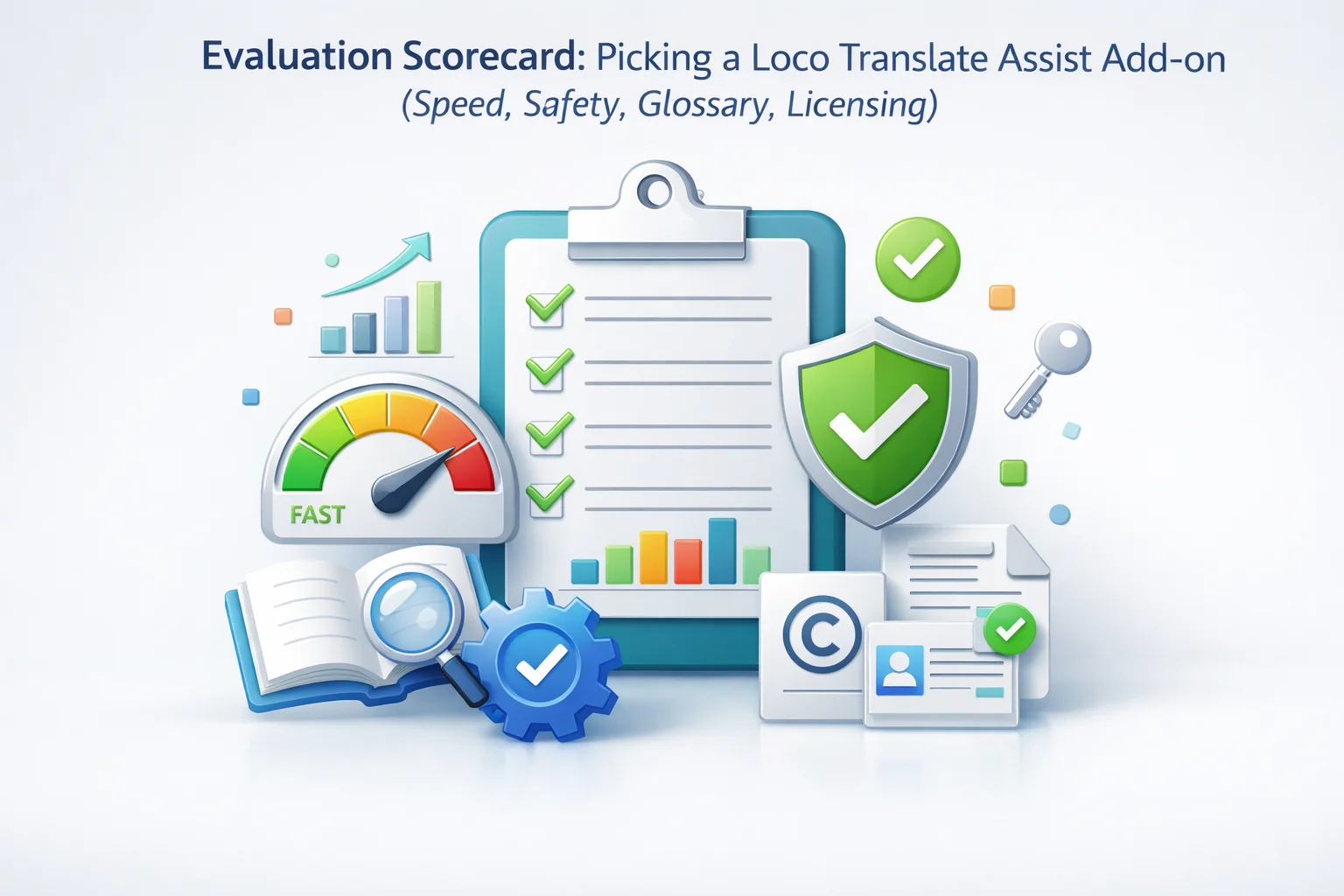
Feature matrices on landing pages optimize for excitement, not decisions. A scorecard forces weights: a multilingual marketplace with regulated copy cares more about glossary enforcement and auditability than raw strings-per-minute. A small catalog store may invert those priorities. Write weights down before you watch demos, or charismatic presenters will choose for you.
Use the same scorecard for every finalist. Half points matter less than consistency. When vendors refuse to answer a row, record “unknown” rather than guessing; unknowns become contract questions or disqualifiers. WordPress plugin ethics and user expectations are summarized in resources such as WordPress.org detailed plugin guidelines —bring that lens when evaluating how add-ons upsell, collect data, or handle licensing.
Separate “evaluation mode” from “negotiation mode.” During evaluation, you seek falsifiable answers. During negotiation, you seek contractual commitments. Mixing the two early produces fuzzy scores padded with promises that never ship. Capture demo claims as hypotheses, then verify in your stack before they influence totals.
Time-box the process. Open-ended bake-offs exhaust engineers and bias outcomes toward whoever arrived last. A six-week cap with two formal check-ins keeps vendors focused and prevents scope creep disguised as diligence.
One mature option to compare against your scorecard is Loco AI Auto Translator as a Loco Translate assist suite with multi-provider routing, glossary support, and batch controls inside wp-admin; the sections below name what to verify, not what to assume.
Build the scorecard before you build the shortlist
Start with stakeholders: engineering owns integration risk, marketing owns tone, finance owns variable spend from remote APIs, legal owns subprocessors. Each stakeholder assigns weights to categories summing to one hundred. Conflicts surface early: if legal assigns forty points to data residency and engineering assigns five, you resolve that before demos, not during contract review.
Define must-haves versus nice-to-haves. Must-haves are binary gates: works with Loco Translate without forking core, respects gettext placeholders, supports your minimum PHP version, allows distinct staging keys. Nice-to-haves belong in weighted scoring, not in silent assumptions.
Document evaluation environments: PHP version, WordPress version, WooCommerce version, active theme, and representative plugins. Score against reality, not a pristine sandbox that omits your heaviest gettext contributors.
Enterprise marketplace: Safety 35, Glossary 25, Speed 20, Licensing/Support 20. Solo store: Speed 35, Licensing 15, Safety 25, Glossary 25. Adjust honestly; the scorecard only works if weights reflect your world.
Normalize scores to a zero-to-five rubric per row before weighting, not yes/no checklists that hide severity. A “partial” on placeholder safety might deserve two of five, which changes totals more honestly than a green checkbox that masks edge-case failures.
Record evidence beside each score: screenshots, log excerpts, and the exact gettext slice you used. Scorecards without artifacts become opinion polls the moment someone new joins the project. When two reviewers disagree, the artifact decides—or you schedule a focused retest instead of debating memory.
Treat “works on our laptop” as a disqualifier unless your production topology matches. Managed hosts with different opcode caches, object caches, and outbound proxies change behavior in ways marketing sandboxes rarely reproduce. If a vendor cannot describe how their assist behaves behind a corporate forward proxy, score that gap explicitly rather than assuming parity.
Finally, separate procurement scoring from build-team happiness. A tool beloved by one power user but opaque to the broader localization roster will rack up hidden support tickets. Weight editor ergonomics and documentation as first-class rows, not footnotes appended after engineering signs off.
Speed and throughput: what “fast” must include
Raw strings-per-minute numbers rarely include error handling, retry storms, or rate limits. Ask how the add-on behaves when the vendor throttles, when TLS handshakes fail, and when half the batch succeeds. Partial success without clear resume semantics is operational debt.
Evaluate single-string latency separately from bulk throughput. Editors live in single-string flows during polish phases; bulk speed matters during initial imports. A product strong on only one axis will frustrate half your year.
Inspect whether high-throughput modes can be gated by role or environment. Finance may want caps that marketing considers annoying. Configurable velocity beats one-size “turbo” defaults.
Measure failure recovery: if a batch stops at sixty percent, does the add-on mark completed rows, skip safely, or leave ambiguous partial states? Ambiguity costs engineering hours and undermines trust with linguists.
Benchmark during realistic server load, not idle laptops. Translation assists compete with checkout traffic, cron, and imports. A fast demo on quiet hardware misleads capacity planning.
Ask vendors for reference architectures sizing guidance: recommended PHP workers, timeouts, and outbound concurrency. Missing guidance suggests immature field deployments, not infinite flexibility.
Model queue depth honestly: concurrent editors, nightly automation, and emergency “translate everything before the campaign” bursts do not arrive evenly. Score whether the assist sheds load gracefully—backing off, surfacing clear notices—or whether it amplifies contention until admins restart PHP workers.
Include observability in the speed column, not only wall-clock time. If your host provides APM or slow-query logs, verify assists do not correlate with spikes in admin-ajax or cron contention. Throughput that steals capacity from checkout-adjacent processes is not free velocity.


Safety: data boundaries, roles, and prompt hygiene
Any assist that sends gettext off-server introduces subprocessors. Score clarity: named endpoints, documented retention, and straightforward key rotation. Vague “secure cloud” language earns zero safety points until replaced with specifics your counsel accepts.
Role integration matters. If every Editor can launch bulk jobs, your WooCommerce store inherits translation spend risk and data exposure risk simultaneously. Prefer add-ons that align with WordPress security practices you already enforce: least privilege, MFA for admins, separate staging credentials.
Prompt and context fields can leak strategy if misused. Score training materials and defaults: does the vendor encourage minimal prompts or long pasted briefs? Your safety score should reflect realistic operator behavior, not idealized demos.
Evaluate logging of settings changes: who rotated keys, who enabled a new provider, who elevated throughput. If those events are invisible, your safety score should cap regardless of marketing claims about “enterprise readiness.”
Map data flows for subprocessors in regulated industries. Score bonus points only when documentation is current enough to paste into a DPIA appendix without heavy rewriting.
Score secrets hygiene: are keys stored in options tables in the clear, exportable with routine backups, or masked in UI? Rotation drills should not require database surgery. If operators must paste long-lived tokens into shared documents to keep projects moving, your safety rubric should reflect that operational reality, not the vendor’s happiest path.
Ask how assists behave when editors work offline or on flaky VPNs. Partial submissions that silently truncate prompts or duplicate batches can leak unintended text upstream. A safety winner documents idempotency, not only encryption-at-rest marketing bullets.

Glossary and consistency: beyond “we have a glossary flag”
WooCommerce gettext includes product names, fee labels, and legal snippets that must stay aligned across locales. Score how glossary entries apply during bulk runs, whether locks survive retries, and whether exceptions require explicit override notes. Glossaries that operators bypass weekly fail audits silently.
Plural forms and context fields interact with glossary rules. Award points only after testing languages with non-trivial plural rules, not only Romance languages with simple patterns.
Consider import and export: can legal own the canonical CSV while localization engineers sync into Loco? Friction there predicts whether your glossary becomes shelfware.
Score conflict resolution: when a glossary term collides with a product name that must remain untranslated, does the assist surface the override path clearly? Teams that fight the tool weekly will abandon glossary discipline and blame “the automation” instead of fixing process.
Include version history in your rubric if multiple stakeholders edit terms. Without audit trails, you cannot explain why a regulated label changed between releases—only that it did. That gap matters as much as initial translation quality for enterprises.

Provider flexibility and exit strategy
Vendor lock-in is a licensing and operations problem. Score whether you can switch endpoints without rewriting prompts, whether API keys are portable across projects, and whether the add-on supports multiple vendors for failover or cost arbitrage.
Ask what happens if a vendor changes pricing or deprecates a model class your workflows rely on. Add-ons that abstract model selection gracefully score higher than those hard-coded to a single path.
Score failover drills: intentionally misconfigure a staging key and observe error surfaces. Operators should see actionable remediation, not opaque failures that invite Slack panic.
Consider regional latency: assists routed through distant endpoints affect perceived speed even when strings-per-minute marketing looks identical. Award points for configurable regions that match your shoppers and your compliance story.
Score cost transparency per provider: some endpoints bill per character, others per request, and sale seasons spike both. An add-on that hides spend behind a single “go” button may win demos yet lose operations reviews when finance sees the invoice.
Exit strategy also means prompt portability. If prompts are stored in proprietary blobs you cannot diff in git, switching vendors becomes a rewrite project. Prefer assists that treat prompts and routing rules as inspectable configuration your team can version.

Licensing, updates, and support you will actually receive
Read entitlement scope: multisite counts, staging allowances, and whether agency use requires a separate tier. Surprise invoices are a licensing failure, not a finance surprise.
Score update cadence against WordPress and WooCommerce release schedules. Plugins that trail major releases for months accumulate risk in checkout-critical strings. Ask for a public changelog and mean time to compatibility for recent major versions.
Support channels matter when assists fail mid-launch. Score documented SLAs, community responsiveness, and whether critical bugs receive patches outside business hours for your timezone.
Inspect license transfer rules: acquisitions and divestitures move WordPress installs. Add-ons that trap entitlements in unmovable accounts become M&A friction worth scoring negatively before you need legal to unwind them.
Verify compatibility statements against your managed host’s PHP images and opcode settings. Rare extensions conflict with specific hardening modules; score honesty when vendors admit known incompatibilities instead of blaming the host generically.
Read licensing and update posture for finalists such as Loco AI Auto Translator like any vendor datasheet: confirm renewal mechanics, not only headline price.
Score refund and downgrade policies with the same rigor as uptime claims. A plugin that locks features silently after renewal failure can stall a launch harder than a temporary outage because teams do not notice until editors hit walls mid-sprint.
Ask how agencies should document client entitlements: reseller clauses, white-label support, and whether client sites inherit updates if the agency subscription lapses. Ambiguity there becomes contractual rework when accounts change hands.
Editor experience: friction costs adoption
Scores should include human factors. Do translators see assists where they work, or in disconnected screens? Do errors explain how to fix keys versus spewing HTTP codes? Poor UX drives shadow workflows—paste into external tools—that undo safety scores.
Measure onboarding time: hours from install to first successful batch on a staging clone. Add-ons that require brittle constants or undocumented filters lose points even if powerful for experts.
Accessibility and localization of the admin UI itself matter: if translators struggle with contrast, focus order, or untranslated chrome, throughput scores decay in practice. Include qualitative notes from real users, not only product managers.
Mobile admin usage is rare yet non-zero for executives approving emergency copy on phones. If critical approvals require desktop-only flows, record that limitation explicitly in risk registers.
Score training surfaces: short video walkthroughs, searchable docs, and in-product hints reduce time-to-competence for contractors. A powerful assist that only experts can drive will centralize work, create bottlenecks, and undermine the very throughput you purchased.
Capture qualitative feedback from linguists after a timed task—translate twenty checkout strings with and without assists. Numbers from product marketing rarely reflect fatigue, context switching, or the cognitive load of verifying placeholders under deadline pressure.

WooCommerce fit: domains, receipts, and extensions
Score using real domains: WooCommerce core, your gateway plugin, your subscription engine, your membership layer. Generic “works with WooCommerce” claims deserve skepticism until empty and plural strings from those domains translate correctly with placeholders intact.
Reference WooCommerce documentation on translating a store when defining test cases; align evaluation strings with how your catalog exposes fees, taxes, and digital goods policies.
Include marketplace scenarios if you allow vendor-submitted products: third-party gettext domains may introduce novel slang or inconsistent placeholders. Score how assists behave when domains multiply beyond core WooCommerce.
B2B price tables and quote flows often embed gettext in PDFs or emails rendered offline. Verify assists do not break width-constrained strings that looked fine in browser previews.
Score email and transactional templates as first-class domains: order notes, password resets, and subscription renewals often carry legal phrasing that must align with storefront copy. A mismatch between cart labels and receipt footers erodes trust faster than a slightly informal product title.
If you run headless or hybrid frontends, confirm which gettext paths still feed Loco and which bypass it. Scorecards based only on classic themes miss strings rendered in separate JavaScript bundles, leaving “done” locales half-finished in production.
Synthesis: from scores to a pilot and a decision memo
Total the weighted scores, but read qualitative notes beside numbers. A narrow numeric winner with red flags in safety may lose to a slightly lower score with transparent subprocessors and better role controls. Document the tradeoffs explicitly in a one-page decision memo future leadership can understand.
When scores tie, use tie-breakers declared in advance: prefer clearer subprocessors documentation, better WooCommerce test evidence, or faster security patch history—never improvised preferences that look arbitrary to procurement.
Re-run the scorecard annually or when major WooCommerce upgrades land. A winner in 2025 is not automatically a winner after template and gettext refactors in 2026.
Pilot on staging with real gettext slices, not lorem ipsum. Promote to production only after finance signs off variable spend assumptions and legal signs off data maps. The scorecard’s job is to make those approvals boring and fast.
Archive the final matrix with signatures from each stakeholder function. Future you will forget why a runner-up lost; dated notes prevent re-litigation during renewals.
Loco AI Auto Translator as a scored candidate for Loco Translate assists with providers, prompts, glossary, and batch governance should be validated like any other finalist: same weights, same tests, same skepticism.



This guide cut through the fluff when comparing Loco Translate add ons. Forced me to rank what actually matters glossary control over speed before vendors could spin their pitch. Saved me hours of back and forth
This scorecard saved my team hours when picking a Loco Translate add on for our fire department's training site. The six week cap with two check ins kept vendors honest no more endless "just one more demo" delays. We caught two that dodged our safety questions, and marking them "unknown" made it easy to cut them loose. Only downside? Wish it had a pre filled weight template for government sites like ours. Still, way better than guessing!
Not bad, but scoring gets messy fast. stick to whole numbers or you're just guessing.
The scorecard pushing you to define weights before demos is where the real magic happens. So many tools get chosen just because the sales rep crushed the pitch, not because anyone actually locked down the criteria first. we used this for three different vendors and it cut our decision time in half no more endless "but they seemed so confident!" debates. My only gripe is the glossary section assumes you've already audited all your terms, which isn't always realistic when you're knee deep in procurement