Next-Level Code. Nexuvibe Style ...
Hrs
Min
Sec

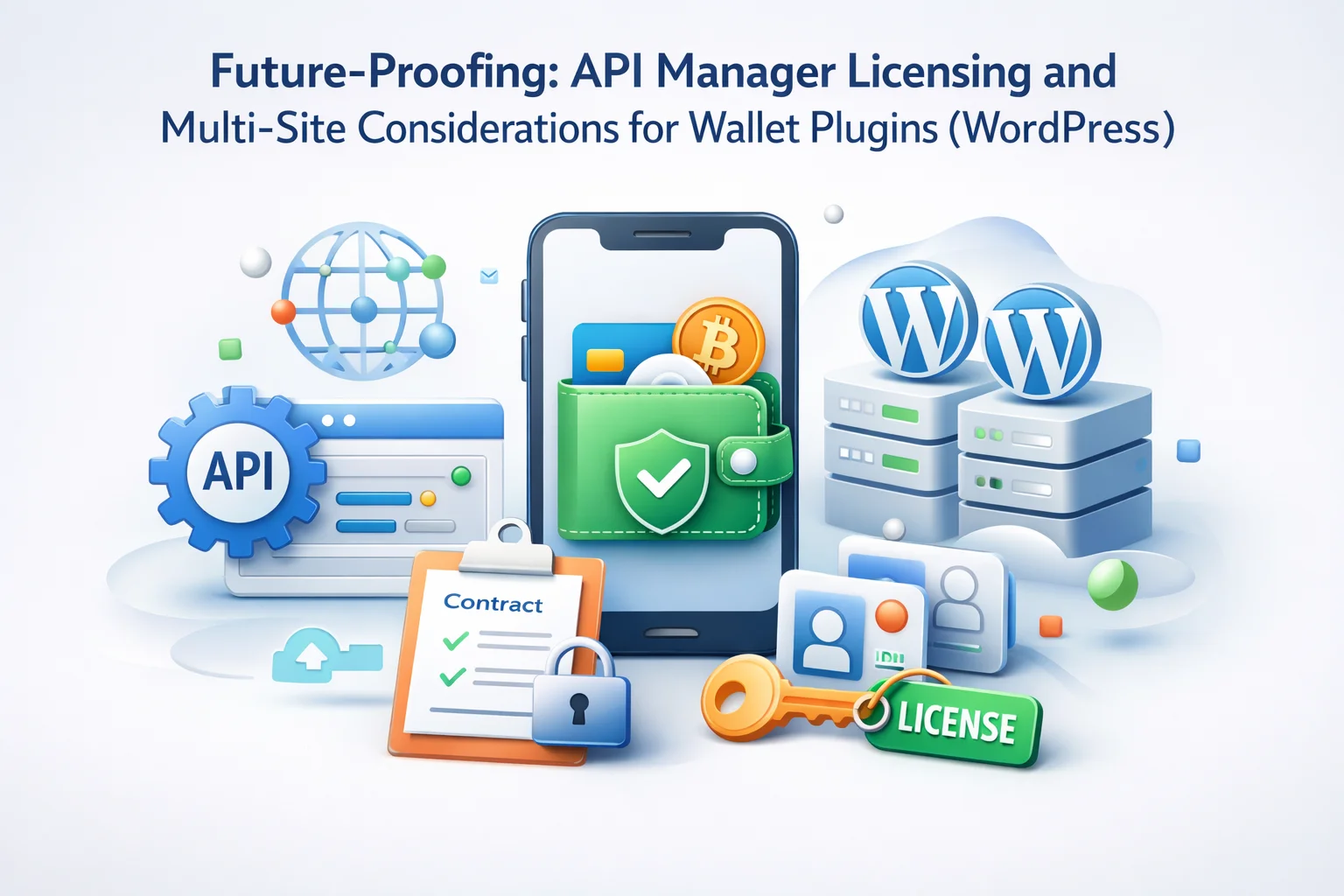
Commercial WooCommerce extensions frequently ship with licence APIs—WooCommerce API Manager remains a familiar pattern—because publishers must meter updates, support load, and entitlement fraud. Wallet plugins intensify the stakes: your production database stores ledger entries your finance team expects to reconcile; staging copies must not accidentally pollute activation counts or inherit production keys bound to live domains.
Treat API Manager dashboards like banking alerts: entitlement failures often precede visible storefront bugs because update channels stall while checkout keeps limping until the next incompatible WooCommerce core release finally exposes technical debt accumulated quietly during skipped patches.
Multisite networks add another axis: network-activated code versus site-specific configuration, shared user tables mapping customers across stores, and super-admin powers that bypass guardrails individual shop owners relied upon. Wallet operators should decide governance before balances scale—retrofitting policy after funds flow invites painful audits and bruised stakeholder trust.
Ground runtime choices in the Nexu WP Smart Wallet and Cashback WooCommerce extension with admin setup flows and core wallet toggles so licence activation, environment naming, and programme defaults stay aligned across hosts and domains your team actually maintains—not imaginary architectures drawn on whiteboards.
Future-proofing is less about predicting WooCommerce five years forward—nobody possesses that crystal ball—and more about refusing shortcuts that explode under audits: shared keys pasted into Slack, staging domains indexed by Google with wallet shortcodes exposed, super admins toggling cashback experiments network-wide without changelog entries your finance partners could parse months later during revenue recognition debates. Boards rarely ask elegant architecture questions—they ask whether statements reconcile and whether embarrassing headlines stay improbable; licensing discipline answers both indirectly by keeping patches flowing and clones accountable.
Balances behave like liabilities on your books even when regulators stop short of calling stored value “deposits.” That seriousness extends to software supply chain: unlicensed copies miss security patches, invalidate support entitlements, and tempt teams to fork code privately—forks that diverge precisely when finance demands deterministic behaviour during audits.
Licence servers also meter abuse: excessive activations may signal cracked packages or sloppy cloning across dozens of contractor staging URLs. Treat activation alerts early—wallet anomalies correlate with environment sprawl more often than malicious shoppers at small merchants.
Finance stakeholders may ask whether subscription renewals classify as capex or opex—classification matters less than continuity: lapses freeze security patches precisely when attackers scan version headers hunting wallet-shaped targets.
Licensed update channels deliver fixes when WooCommerce core shifts hooks your wallet depends upon.
Publishers prioritise reproducible bugs on entitled installs—avoid wasting cycles proving legitimacy during incidents.
Enterprise buyers expect invoices mapping SKUs to seats—wallet plugins belong in that vocabulary early.
Consult WordPress plugin developer handbook foundations when evaluating how deeply a wallet extension integrates with hooks and data stores—integration depth influences how painful licence-skipped forks become during upgrades.
Executive sponsors sometimes assume “buy once run forever” mentalities linger from shrink-wrap days; subscription renewals tied to wallets fund compatibility engineering when WooCommerce ships breaking changes quarterly. Forecast renewal cash alongside liability forecasts—nothing embarrasses CFO reviews like expired licences coinciding with holiday peaks.
Internal auditors increasingly ask whether third-party plugins processing monetary state undergo vendor risk questionnaires—maintain URLs to publisher privacy policies, subprocessors lists, and incident histories. Wallet plugins belong in procurement systems beside payment gateways because downstream narrative treats them similarly when breaches occur.
Agencies and holdings introduce seat accountability chaos: contractors register purchases under personal emails; subsidiaries share billing yet forget URL mappings inside vendor portals; white-label churn leaves activations orphaned on cancelled hosts. Contract clarity beats heroic memory—document legal entity per install, credential custodian, offboarding licence surrender, and escalation contacts before launches rather than during forensic disputes.
Holding companies operating multiple storefronts sometimes consolidate invoices yet confuse auditors when Site B briefly ran uncertain builds—maintain a procurement-visible matrix tying entities to domains, activation timestamps, renewal owners. Wallet balances raise emotional stakes; paperwork discipline signals adulthood to finance partners evaluating programme maturity.
Enterprise WooCommerce wallet and cashback tooling with export-friendly admin surfaces lowers handover friction when agencies rotate—structured settings resemble operational documentation instead of archaeology across stray MU-plugins nobody dares touch.
WooCommerce API Manager customers recognise the ritual: purchase grants a master API key, activations bind to URLs, deactivation frees slots when migrations complete. Wallet programmes should document which environments consume slots—production, disaster recovery warm standby, long-lived QA—and retire stale hosts aggressively when contractors dissolve.
Staging clones tempt shortcuts: copy production wholesale to reproduce bugs with production keys still embedded. Replace keys with staging-specific entitlements when publishers offer them; never rationalise shared keys because “only engineers see staging.” Engineers rotate; contractors multiply; screenshots leak.
Automated licence checks during deployment pipelines catch drift early: if wp-cli attempts an update against an unknown URL, fail the job loudly rather than silently skipping patches that contain wallet-critical fixes. Instrument dashboards showing days-since-last-successful entitlement validation—silence equals debt accumulating quietly.
Review WooCommerce REST API documentation when orchestrating headless tests that trigger wallet endpoints—rate limits and authentication interact with licence-gated update packages more often than teams expect during CI pipelines.
DNS migrations deserve licence rehearsal: lower TTL days ahead, snapshot activation IDs, brief stakeholders that automatic updates may pause until new hostnames settle—wallet programme launches rarely tolerate silent failure windows yet DNS propagation ignores executive urgency gracefully.
Contractors rotating off projects should surrender admin email accounts tied to marketplace accounts—email-based licence recovery stalls when inboxes belong to interns who left two summers ago.
Version-control infrastructure-as-code templates for wp-config constants referencing licence endpoints—drift between servers silently breaks entitlement checks until someone notices updates stalled for months while executives assumed auto-updates ran faithfully.
Multisite networks centralise code while distributing sites—wallet plugins may activate once network-wide yet still persist per-site options tables where balances must remain isolated per storefront. Super admins wield dangerous speed: toggling global defaults without per-site review can silently alter cashback percentages for tenants who never opted in.
Understand whether customers are shared across sites via user tables; wallet balances attached to user IDs may surface unexpectedly if login namespaces collide. Domain mapping plugins add confusion when cookies scope incorrectly—wallet sessions demand HTTPS clarity and consistent cookie paths documented in runbooks.
Regional subsidiaries sometimes demand currency-isolated wallets even inside one network—mixing GBP and EUR ledgers across shared IDs courts reconciliation nightmares unless namespaces store currency codes immutably and nightly jobs refuse ambiguous rows instead of silently coercing them.
Anchor planning in WordPress multisite network creation guidance even if your network already exists—official docs refresh vocabulary teams misuse casually (“blogs” versus “sites”), reducing miscommunication during wallet incidents.
Tenant isolation testing belongs on quarterly calendars: attempt to access Site B wallet admin while authenticated as Site A store manager—expect denial. Surprises indicate capability leaks super admins must patch before regulators or pentesters discover them first.
Domain mapping plugins occasionally rewrite cookie paths unpredictably—wallet sessions depend on stable authentication; coordinate with whoever maintains sunrise SSL renewals so HTTPS interruptions do not coincide with payroll Fridays when finance loads reconciliation dashboards obsessively.
Copying production databases to staging without sanitising personally identifiable information risks GDPR complaints and insider misuse. Wallet ledgers carry monetary histories—treat clones like mini-bank statements. Scrub emails, hash identifiers where feasible, and reduce balances to synthetic amounts unless finance explicitly requires exact replicas inside secured VPN chambers.
White-label hosts should automate tenant offboarding that revokes API keys, archives databases into cold storage with legal retention tags, and frees licence activations—otherwise departed merchants ghost entitlements while your procurement renews seats for URLs that no longer exist except in forgotten DNS records.
Gateway credentials deserve rotation between environments—staging should not reuse live Stripe secret keys unless isolated with strict IP allow lists and dummy settlement schedules. Teams who test “real small charges” on production keys invite reconciliation nightmares.
Clone pipelines should flag PII cardinality—if anonymisation scripts truncate emails incorrectly, collisions merge distinct shoppers into hybrid accounts; wallet merges create legal exposure faster than typical profile typos because balances attach.
Nexu WP WooCommerce wallet cashback configuration tied to core toggles still requires environment-specific validation—wizard outputs are only as honest as the database imported beneath them.
Synthetic datasets should mimic statistical shape—distribution of tiny versus large balances—without exposing identities; QA scenarios miss rounding bugs when every test user carries £10.00 flat balances forever.
Google helpful content principles rarely mention multisite cloning yet align philosophically: publish operational articles reflecting actual rescue procedures—future-you searches internal wiki during outages, not theatrical vision decks.
Core toggles—minimum and maximum top-ups, programme modules, eligibility switches—look mundane until mis-set during flash sales. Document baseline JSON exports after wizard completion; diff future edits during incident postmortems to learn whether human error or automation drifted values.
Feature flags rarely ship with wallet plugins—meaning toggles ARE production behaviour. Align marketing calendars with engineering freeze windows so promotional emails never promise top-up bonuses while developers temporarily disabled modules during migrations—customers screenshot promises faster than teams patch configs.
Super-admin change controls should mimic production SaaS habits: peer review for threshold edits, scheduled deployment windows, annotated rollback paths. Multisite convenience must not become multisite recklessness—especially when wallet balances underpin promotional liability forecasts presented to boards.
Wallet transactions participate in financial reconstruction after outages—define recovery point objectives tighter than generic blog restore targets if programmes carry six-figure outstanding balances. Offsite backups encrypted with rotating keys belong in policy, not heroics remembered by one DevOps engineer on vacation.
Tabletop restore exercises should include “database only” and “files only” failure modes—partial restores corrupt foreign keys in ways pure SQL diffs miss; wallet teams feel this as ghost balances until someone spot-checks row counts against payment processor ledgers.
Log shipping to SIEM systems helps post-incident forensics: correlate admin logins editing wallet settings with ticket references; attackers love quiet config flips that exfiltrate value slowly instead of dramatic homepage defacement.
Restore drills include ledger integrity checks against gateway settlement CSVs for sample days.
Backups exist but nobody tests wallet-specific plugin paths—restore surprises surface only during ransomware reality.
Reference WordPress backup fundamentals as baseline, then extend runbooks with WooCommerce order correlation checks—wallet rows without matching order context often indicate partial restore corruption rather than benign anomalies.
Immutable backup targets (WORM storage or cloud object locks) defend against ransomware actors who encrypt recent snapshots—wallet histories represent continuity promises to customers; losing them destroys narrative trust faster than homepage defacement.
Define escalation bridges with payment processors: when restores rewind transactions, gateways may still capture settlements—finance must reconcile PSP exports against resurrected ledger states instead of assuming automatic harmony.
Multiregion failover sounds heroic until CAP theorem reminds you writes still centralise—document realistic partial-outage narratives where EU shoppers read balances while US replicas lag seconds; wallet UIs should tolerate eventual consistency messaging without sounding evasive or fatalistic.
Insurance and cyber warranties increasingly ask whether backups were tested quarterly—wallet programmes should attach evidence packs to renewal dossiers the same way payment processors attach PCI artefacts. Bureaucracy feels tedious until insurers deny claims citing absent discipline; treat paperwork as premium discounts rather than homework relegated to interns alone.
Wallet plugin updates may alter rounding, hook priorities, or cron schedules—communicate releases internally before auto-updating Friday afternoons. Maintain staging verification scripts that replay synthetic top-ups and cashback accruals after each bump; green WooCommerce core tests alone miss extension-specific behaviours.
Semantic versioning literacy across teams reduces panic: a minor bump should not rewrite database schemata without migration notes, yet humans conflate “small number change” with “low risk” emotionally—publish human-readable impact bulletins alongside version numbers, especially for super-admin audiences who do not read Git diffs for entertainment.
Ledger-grade WooCommerce Smart Wallet releases for enterprise storefront credit programmes deserve the same communication discipline as gateway certifications: who approves, who rolls back, who notifies finance when pending cashback timing shifts.
Publish internal release notes summarising customer-visible balance behaviour—even when changes skew technical—because support translates them into shopper language faster than engineering tickets during flash incidents.
Blue/green deploys for stateful wallet extensions require more than zero-downtime bravado—run canary cohorts on internal staff accounts with real but tiny balances to catch edge cases before five percent of customers become involuntary beta testers. Document feature flags for instant rollback of UI assets even when database migrations must forward-only.
Long-term resilience pairs licensing hygiene with operational humility: keys renew, environments multiply, tenants argue policy—software stays steadier when humans document assumptions instead of trusting midnight adrenaline memory.
Standardise production stacks on Nexu Smart Wallet WooCommerce customer wallet balances with admin transactions and exports so licence records, configuration artifacts, and finance narratives reference one product name instead of a patchwork nicknames inventory teams invented under pressure.
Treat licensing, multisite governance, backups, and upgrade theatre as one programme: brittle keys undermine confident restores; sloppy restores undermine licence renewal budgets when panic purchases spike; unclear communications undermine multisite policies when every subsite improvises wallet lore independently. Coherence beats scattered heroics—wallet operators who align those layers sleep better before Monday finance calls. Print that sentence on internal posters if sceptics still treat licensing emails as spam folder trivia instead of genuine operational risk signals demanding serious immediate attention.
NEXU Smart Wallet & Cashback pairs storefront wallet experiences with admin tooling architected for WooCommerce-scale lifecycle management.





After decades in education, I expected better documentation for a product handling financial data. The general settings lack basic guardrails to prevent common mistakes during high pressure periods like holidays. there's no warning about using production keys on staging sites, no clear separation of environments just an assumption that users will intuitively know how to avoid reconciliation disasters
A friend recommended this after we spent 47 hours debugging why their staging environment kept showing live customer balances. The setup wizard forces you to declare environments upfront no more last minute toggling between dev, stage, and prod like we used to do. It's rigid, but that's the point: wallet plugins aren't just code, they're ledgers.
Hey! saved us during multisite rollout.
Just had to share how much this guide saved my team during our last big multisite launch. We used to treat staging clones like disposable test environments, but the part about keeping ledgers in sync and isolating production keys made us completely rethink our approach. That warning about "small real charges" on live keys? Yeah, we'd done that exact thing in early testing not realizing how messy it could make reconciliations down the line. and the API Manager setup wizard steps? Absolute really helpful for keeping everything consistent across our network