
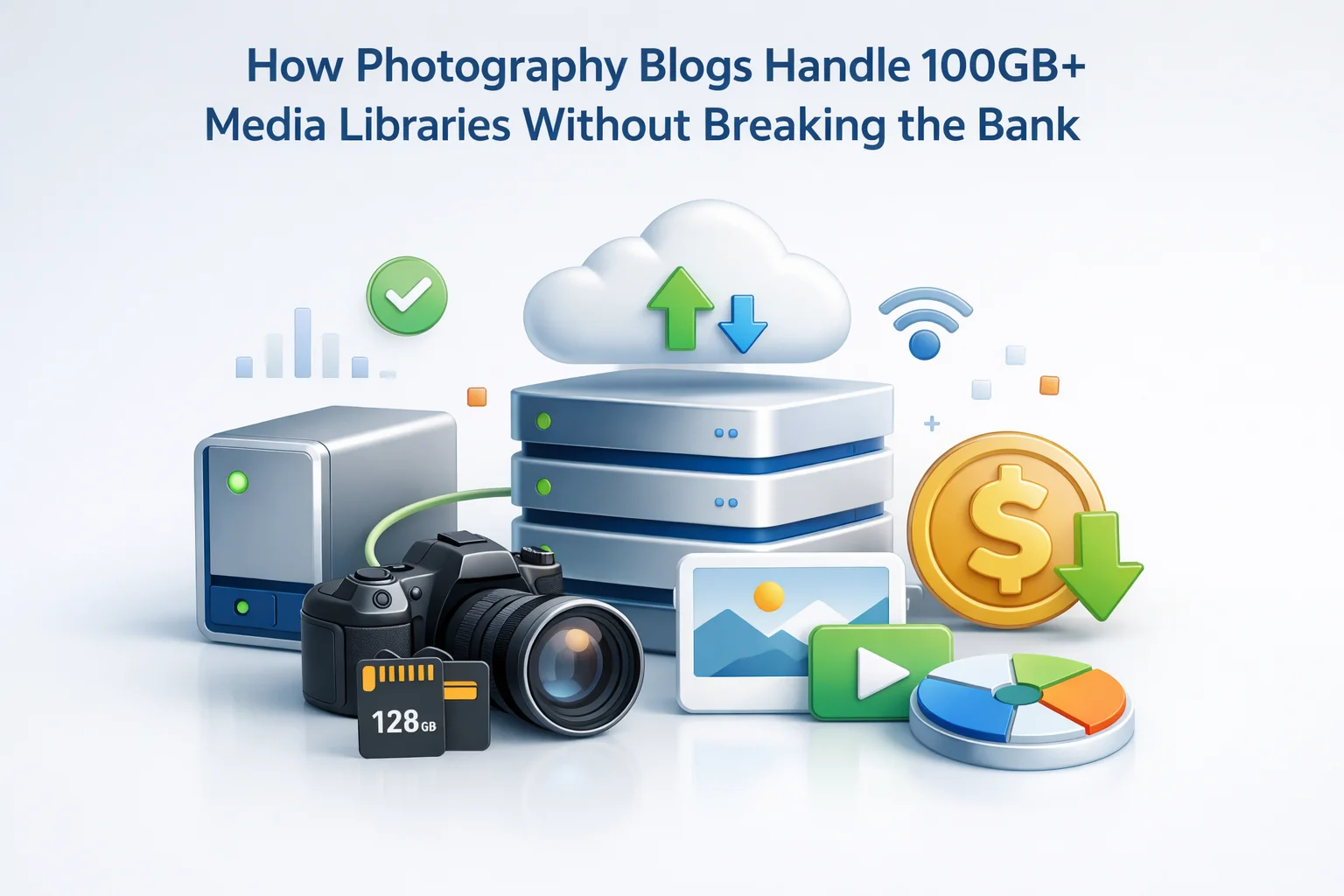
Photography is the most storage-intensive use case in the WordPress ecosystem. A single landscape shoot might produce 80 processed JPEGs averaging 4MB each. That is 320MB from one afternoon. Publish two shoots a month and you are adding 640MB of source images to your WordPress media library every month, before WordPress multiplies that into five or six thumbnail sizes per image. A photography blog with two years of regular content can easily accumulate 80GB to 150GB of image data, and that number only moves in one direction.
The photographers who manage this well have understood something that casual WordPress users often discover too late: the hosting environment that handles your PHP and your database was never designed to store hundreds of gigabytes of high-resolution image files at a price that makes sense. What looks like a hosting storage problem is actually an infrastructure mismatch, and the photographers who solve it cleanly do so by separating where images live from where WordPress lives.
This guide covers how that separation works in practice for photography-specific WordPress setups, what the cost structure looks like across different library sizes, how to maintain image quality throughout the offload and delivery pipeline, and what the workflow looks like for a photographer who publishes new shoots regularly.
Why photography WordPress sites grow faster than almost anything else
To understand the scale of the storage problem for photography blogs, it helps to compare the media generation rate across different WordPress content types. The contrast is significant.
A photographer publishing two gallery posts per week at 50 images each, with images averaging 2MB, is adding roughly 800MB of source image data per week before WordPress thumbnail generation. WordPress creates multiple resized versions of each image automatically, adding another 30% to 50% to the total file size on disk. At that rate, a photography blog crosses the 100GB mark in under two years of consistent publishing.
This growth rate makes photography one of the clearest cases for media offloading. The question is not whether the library will outgrow standard hosting. It is how quickly and how expensively. A photographer who sets up the offload workflow at the start of their site’s life never faces a storage crisis. One who waits until the first warning discovers the problem when it is already large enough to be genuinely disruptive.
The image quality question: does offloading affect what visitors see?
For photographers, image quality is non-negotiable. Before considering any infrastructure change, the first question is whether it affects the quality of the images visitors see. The answer is straightforward: offloading media to FTP and serving via CDN has no effect whatsoever on image quality.
The files transferred to the FTP server are exact binary copies of the files WordPress generated. No re-encoding, no recompression, no quality reduction. The JPEG that WordPress stored in your uploads directory is the same JPEG that gets transferred to your FTP server. The CDN delivers that same file to visitors. The pixel data is identical at every step.
Moving images to a CDN with global edge nodes often improves the visitor experience compared to serving from a single hosting server. Visitors physically closer to a CDN edge node receive images faster, with lower latency, than they would waiting for files to travel from your hosting server’s data center location. For a photography blog with an international audience, the CDN delivery improvement is perceptible, not just measurable. According to Google’s image optimization guidance, serving images from a CDN edge close to the user is one of the highest-impact improvements for image-heavy pages.
The only image quality consideration specific to photography is ensuring that WordPress’s image compression settings are configured correctly before images are uploaded. WordPress applies JPEG compression when generating thumbnails, and that compression setting affects quality. This is a WordPress configuration decision that happens before any file reaches the FTP server and is independent of the offload workflow. Setting WordPress’s JPEG quality to 90 or 95 in your theme or via a quality plugin is a separate step from the offload, and a worthwhile one for photography sites where image quality is central to the work.
The cost model at photography-scale library sizes
Photography libraries reach sizes that make the cost difference between hosting-based storage and FTP offload particularly stark. Where a standard blog might struggle with 10GB to 20GB, a photography site routinely reaches 50GB, 100GB, or 200GB within a few years of active publishing. At those sizes, the cost comparison becomes compelling even before considering the performance and workflow benefits.
At 100GB of photography media, the difference between hosting the files on managed WordPress infrastructure and storing them on a dedicated FTP server is the difference between a $50 to $80 monthly hosting bill and a $15 to $20 hosting bill plus $4 to $7 for FTP storage. That is a saving of $30 to $55 per month, or $360 to $660 per year, while maintaining or improving the visitor experience through CDN delivery.
At 200GB, the savings become even more pronounced because hosting providers at that storage level move into territory where they typically recommend VPS or dedicated server configurations. A photographer serving a primarily visual audience from a $120/month server because their images are filling a shared hosting environment is paying server-compute prices for a static file storage problem that a $10/month FTP box handles perfectly.
Gallery plugins and lightbox functionality: what changes and what does not
Photography WordPress sites almost universally use gallery plugins. Envira Gallery, FooGallery, Modula, NextGEN Gallery, and similar tools are central to how photographers present their work. Before any photographer considers a media offload workflow, the critical question is whether these gallery plugins continue to work correctly when images are served from a CDN rather than from the hosting server.
The answer is yes, and understanding why requires understanding how gallery plugins work. These plugins retrieve image information from the WordPress database, specifically the attachment post IDs, file paths, and metadata. They then generate HTML output that references the image files. The URLs in that HTML output are what visitors’ browsers use to download images.
Output-based URL rewriting intercepts these URLs after the gallery plugin generates them and before the HTML is sent to the browser. The rewriting happens at the WordPress output buffer level, which means it applies to everything in the HTML output regardless of which plugin generated it. Gallery image URLs, lightbox full-size URLs, thumbnail URLs, and any srcset attribute URLs are all rewritten to point at the CDN. The gallery plugin itself is completely unaware that any rewriting is happening. It behaves exactly as it would without the offload plugin.
Grid-based gallery layouts load thumbnail images which are rewritten at output to point at the CDN. Grid performance often improves with CDN delivery because thumbnails load from geographically proximate edge nodes rather than a single origin server.
When a visitor clicks a thumbnail to view the full-size image in a lightbox, the lightbox JavaScript fetches the full-size image URL from the link href or a data attribute. These URLs are also rewritten at output, so the lightbox loads the full-size image from the CDN. The large, high-quality version of the image loads from the nearest edge node rather than your hosting server.
WordPress generates srcset attributes with multiple image size URLs for responsive delivery. All URLs in the srcset are rewritten to CDN URLs. The browser’s responsive image selection works exactly as before, picking the appropriate size for the current viewport, but loading that size from the CDN.
Plugins that add right-click protection, disable image saving, or apply watermarks via JavaScript work at the browser level rather than at the file serving level. These continue to function after offloading because the JavaScript behavior is independent of where the image files are hosted.

The workflow for a photographer who publishes regularly
One of the practical concerns photographers raise about any infrastructure change is how it affects their publishing workflow. Photographers typically work in bulk: a shoot produces many images, editing produces a final selection, and publishing involves uploading dozens of images at once to a new gallery post. Any workflow friction at the upload stage is significant because it happens every time a shoot is published.
With automatic upload enabled in the FTP media plugin, the workflow from the photographer’s perspective is completely unchanged. They upload images to the WordPress Media Library exactly as they always have. The plugin intercepts each upload after WordPress has processed it, generated thumbnails, and stored the file metadata, then transfers the files to the FTP server in the background. The images appear in the Media Library immediately and can be inserted into gallery posts right away.
When a photographer uploads 60 images at once, WordPress processes them sequentially, generating thumbnails for each. The FTP transfer is queued and processed as each upload completes. The photographer sees all images appear in the Media Library as they complete processing, exactly as without the plugin. In the background, each processed image and its thumbnails are transferred to the FTP server and deleted locally once confirmed. The photographer’s hosting server receives none of the long-term storage burden from the shoot.

Migrating an existing photography library to FTP
For photographers who have been publishing for a year or more and already have a large uploads directory, the question is how to move the existing library without disrupting the live site. The answer is the bulk sync feature in a properly built FTP media plugin, which handles this as a background operation with visible progress.
The key for photography sites with large libraries is using parallel transfers where available. A library of 50,000 image files, including all thumbnail variants, takes much less time to transfer when multiple files are uploaded simultaneously than when they are transferred one at a time. Browser-mode parallel sync in WP FTP Media is specifically designed for this use case: fast, visible, and controllable so you can monitor progress and resume if interrupted.


What the complete photography blog infrastructure looks like
For a photography blog managing a large and growing media library, the infrastructure that makes the most sense financially and operationally has three components working together.
Handles PHP execution, MySQL database, WordPress admin, and page rendering. No longer needs to accommodate the media library. A plan sized for your actual visitor traffic and PHP workload, not for your image storage. This is often one or two plan tiers lower than what you would need if hosting media locally.
Stores all media files: source images, thumbnails, all variants. A 1TB storage box accommodates even the largest photography library for a predictable flat monthly fee. As the library grows, this cost only changes when you need to upgrade to a larger storage tier, which happens infrequently and at a fraction of the rate of hosting upgrades.
Delivers images from edge nodes close to visitors worldwide. For a photography blog, this is the component that most directly improves the visitor experience. Images load faster, gallery grids render more quickly, and lightbox full-size views appear with less latency regardless of where visitors are located.
Total monthly cost for this infrastructure: $20 to $40, regardless of how large the photography library grows. A photography blogger paying $80 to $120 per month for hosting that can accommodate their image collection is paying two to four times more than this architecture requires, for no improvement in what visitors see or experience.
The photographers who publish freely, without worrying about storage warnings or hosting plan upgrades, are the ones who separated these concerns early. The hosting serves the WordPress application. The FTP server stores the images. The CDN delivers them. WP FTP Media’s photography-optimized WordPress storage workflow is the plugin layer that connects these three components, keeps new uploads flowing to the FTP server automatically, and ensures every gallery, lightbox, and image on the site delivers from the CDN without any change to how the photographer works in WordPress.
Publish every shoot without watching your hosting storage bar
WP FTP Media offloads every image to flat-rate FTP storage, delivers them via CDN to visitors worldwide, works transparently with all major gallery plugins, and keeps your hosting plan sized for your actual traffic instead of your image library.





Did the job for my client's portfolio.
Wow, this actually puts numbers to what I've been dealing with for ages. I coach high school sports and shoot team photos every weekend, and I never realized how fast 80GB could balloon to 150GB just because WordPress generates all those extra thumbnail sizes
Didn't realize FTP could save so much