Next-Level Code. Nexuvibe Style ...
Hrs
Min
Sec

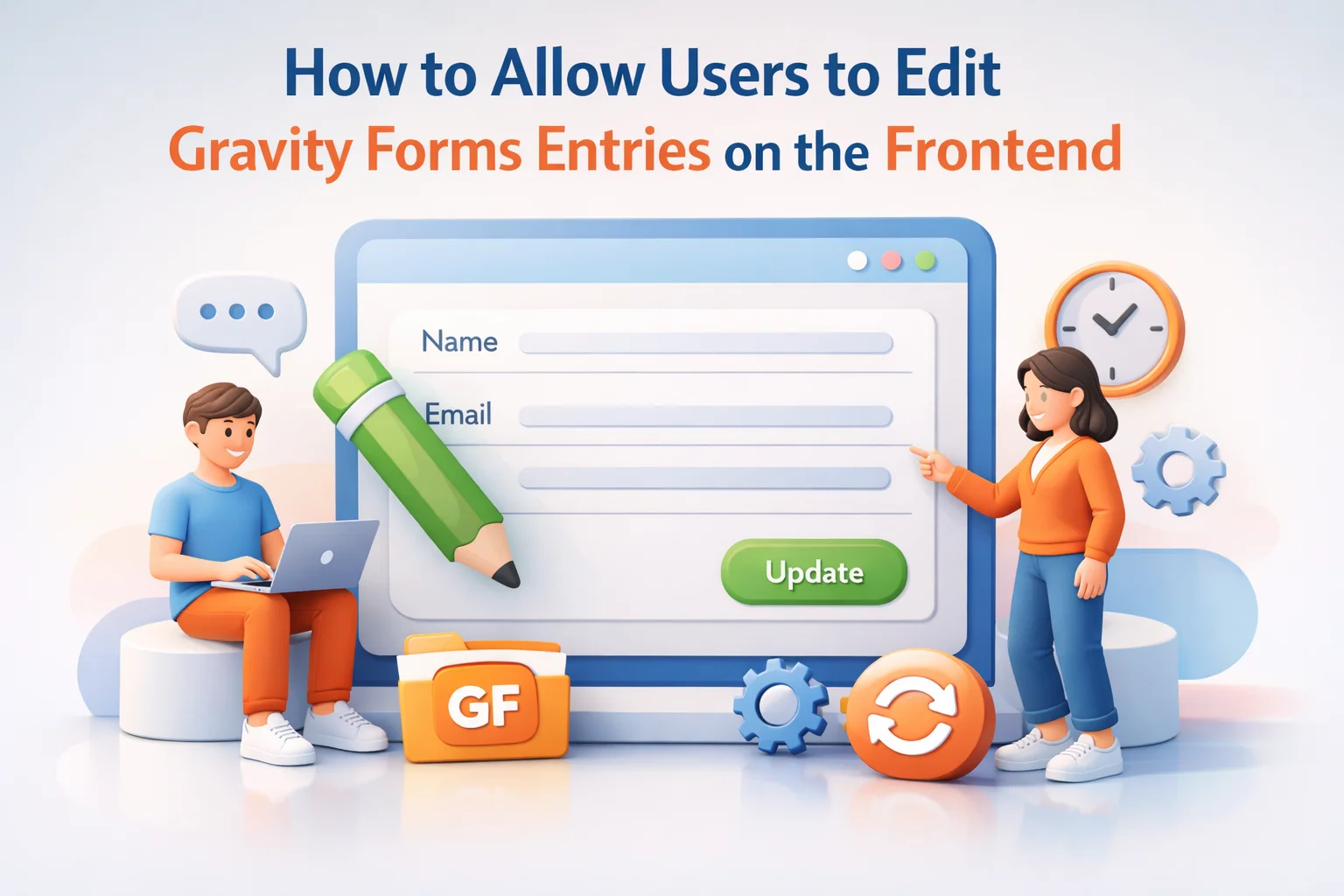
If you’ve been using Gravity Forms for any length of time, you’ve almost certainly run into this wall: a user submits a form, then needs to go back and change something. Maybe they made a typo in their address. Maybe they want to update their profile information. Maybe they submitted an application and need to revise it before a deadline. And Gravity Forms, for all its power, simply doesn’t offer a built-in way for users to do this from the frontend of your site.
The result? Your users are stuck emailing you to make changes, or you’re digging through the WordPress admin dashboard manually updating entries on their behalf. It’s frustrating for everyone involved. And if you’ve searched for solutions, you’ve probably found answers ranging from “write custom PHP hooks” to “buy this $200 plugin that does ten things you don’t need.” Neither of these is a satisfying answer.
This guide walks through the problem clearly, explains why the common workarounds fall short, and shows you how to implement frontend entry editing properly — including how to control which entries users can edit, what fields they can modify, and how to present the experience cleanly inside your WordPress site.
Gravity Forms is built primarily as a form builder and entry collection tool. Its data management layer — the entry editing interface — lives in the WordPress admin dashboard and is designed for administrators, not end users. There’s a very deliberate distinction in the Gravity Forms architecture between “data collection from the public” and “data management by administrators.”
This makes sense as a default, but it creates a hard problem the moment your use case involves any ongoing relationship with the data the user submitted. Job applications that need updating. Profile forms that users should own. Booking requests that need modification. Client intake forms with iterative revisions. In all of these scenarios, the user who submitted the data has a legitimate reason to go back and change it — but Gravity Forms gives them no way to do so.
The search query “how to allow users to edit Gravity Forms entries on the frontend” is one of the most common Gravity Forms support questions precisely because this gap affects such a wide range of real use cases. And the lack of a clean, built-in solution means that most people end up either building something fragile from scratch or giving up and managing everything from the admin panel.
It’s technically possible to pre-populate a Gravity Form with existing entry data using the gform_field_value filter and custom query parameters. But this approach requires writing and maintaining custom PHP, it only pre-populates values — it doesn’t actually link the submission back to the original entry — and it creates serious security vulnerabilities if the entry ID is exposed in a URL without proper authentication. Most implementations of this approach break on form updates, fail with conditional logic, and stop working when the form structure changes.
Some people solve this by simply upgrading user roles so they can access the WordPress dashboard and edit their entries directly. This is dangerous. Giving users admin or even editor-level access exposes your entire site to potential misuse. They can see other users’ entries, access plugin settings, and modify content they should have no access to. Even with role-limiting plugins, this approach is fragile, hard to audit, and fundamentally at odds with how WordPress user permissions are meant to work.
Gravity Forms has a Save and Continue feature that lets users save a partial form and return to it later via a unique link. This is useful for long forms, but it only works before the form is submitted. Once a user hits submit and the entry is created in the database, Save and Continue is no longer relevant. It solves a different problem entirely and gets misapplied constantly when people are actually looking for post-submission editing.
What you actually need is a layer between your users and your Gravity Forms data: a frontend interface that lets authenticated users see their own entries, open them for editing, and submit changes that update the original entry — not create a new one — all without ever touching the WordPress admin dashboard.
This is exactly what Nexu Portal — the frontend editing and user dashboard add-on for Gravity Forms is built to do. It creates a proper user-facing interface for Gravity Forms data management, with the kind of access control and UX polish that the raw workarounds can never provide.
The architecture is straightforward once you understand it. Nexu Portal creates a dedicated page on your WordPress site — your portal page — that logged-in users can access. On this page, users see a list of their own Gravity Forms submissions and can interact with each entry according to the permissions you’ve configured.
When a logged-in user visits the portal page, they see a filtered table of their own Gravity Forms submissions. Not everyone’s entries — just theirs. This filtering happens server-side, so there’s no way for a user to manipulate a URL parameter and see entries that don’t belong to them. Each row shows the fields you’ve configured as visible, along with the entry status and submission date.
When a user clicks to edit an entry, Nexu Portal loads the original Gravity Form pre-populated with their submitted data. The form looks and behaves exactly like the original — conditional logic, validation, file uploads, and all — but is pre-filled with what they already entered. They make their changes and submit.
This is the critical distinction from the pre-populate workaround. When the user submits their edits, Nexu Portal updates the existing entry in the Gravity Forms database. The entry ID stays the same. Notifications, conditional routing, and any integrations you have set up on the form can fire based on the updated data. Your admin sees the revised entry with the same ID and a clean audit trail.
Not every field should be editable by the user. Nexu Portal lets you lock specific fields so users can see them but not change them. You might want to display the original submission date, an internal reference number, or an admin-assigned status — visible to the user but not modifiable. You configure this field-by-field without writing any code.
One of the most important considerations in any frontend editing setup is access control. It’s not just about whether a user can edit an entry — it’s about which entries, which fields, and under what circumstances. These distinctions matter enormously in real-world use cases.
Beyond user-to-user access control, there are often business-logic reasons to restrict editing. A job application portal might allow editing only until the application deadline. A booking form might lock the entry once the booking is confirmed. A membership profile might allow users to update most fields but not their original join date or membership tier. All of these scenarios require conditional editing permissions, not just a simple on/off toggle.
Nexu Portal handles this through entry status integration. When an entry has a certain status — reviewed, approved, locked — you can configure the portal to show the entry as view-only rather than editable. This gives administrators a simple mechanism for closing the editing window on entries that have moved through a workflow stage.
Applicants submit their details through a Gravity Form and then need to upload additional documents, correct information, or update their availability. Without frontend editing, every change requires a manual admin intervention or a new submission that creates duplicate entries. With Nexu Portal’s frontend entry management for Gravity Forms, applicants handle this themselves.
Associations, communities, and directories built on Gravity Forms need members to be able to keep their profiles current. Email addresses change, job titles change, profile photos need updating. A frontend portal turns a static form submission into a living profile that the member owns and maintains.
Users who book through a Gravity Form often need to change dates, update headcount, or add notes before the booking is confirmed. Giving them a self-service editing interface reduces your admin workload and creates a much better customer experience than requiring them to email you for every change.
Agencies and service businesses often use Gravity Forms for client intake. Projects evolve, requirements change, and clients need to update the information they provided during onboarding. A self-service editing portal makes this seamless and keeps your project data accurate without creating a support ticket every time something changes.
Getting this working with Nexu Portal doesn’t require any custom code. Here’s the practical sequence from start to working frontend portal:
From the user’s side, the experience is clean and self-evident. They log in. They navigate to the portal page (which you’ve linked from your navigation menu, their account page, or a confirmation email). They see a table showing their submissions — the columns you’ve configured, showing the information most relevant to them. Each row has an edit button.
When they click to edit, the form opens pre-filled with their current data. It looks like the form they originally submitted — same layout, same styling, same field types — because it is. They make their changes, hit submit, and they’re done. No emails to administrators, no re-entering data they’ve already provided, no duplicate submissions cluttering your entry list.
This is the experience that users expect from modern web applications, and it’s the experience that Gravity Forms alone can’t deliver without a properly built frontend layer. The difference between “please email us to update your information” and “click here to update your information” is not a minor UX improvement — it’s the difference between a system that users trust and return to and one that creates friction every time they need to do anything after their initial submission.
Nexu Portal adds the missing layer: a secure, user-facing interface that lets your users view and edit their own Gravity Forms submissions without ever touching the admin dashboard.





Wow, this solved a headache I didn't even know I had! We use Gravity Forms for client intake, and constantly had people emailing to fix typos or update details. Now they can just log in and edit their own submissions no more back and forth. the "My Submissions" dashboard is clean and intuitive, even for non techy clients. Worth every penny.
Got this for a client project where users needed to tweak their submissions after the fact. biggest win? no more back and forth emails when someone fat fingers their info or needs to update a detail. Saves me time, saves them hassle. Not flashy, but it just works which is all I really care about for something like this.
Hey! love the edit feature just hoping updates
The plugin works but it's way too fragile. every time I update a form or tweak conditional logic, the frontend editing breaks and I have to reconfigure everything from scratch. Not worth the hassle