
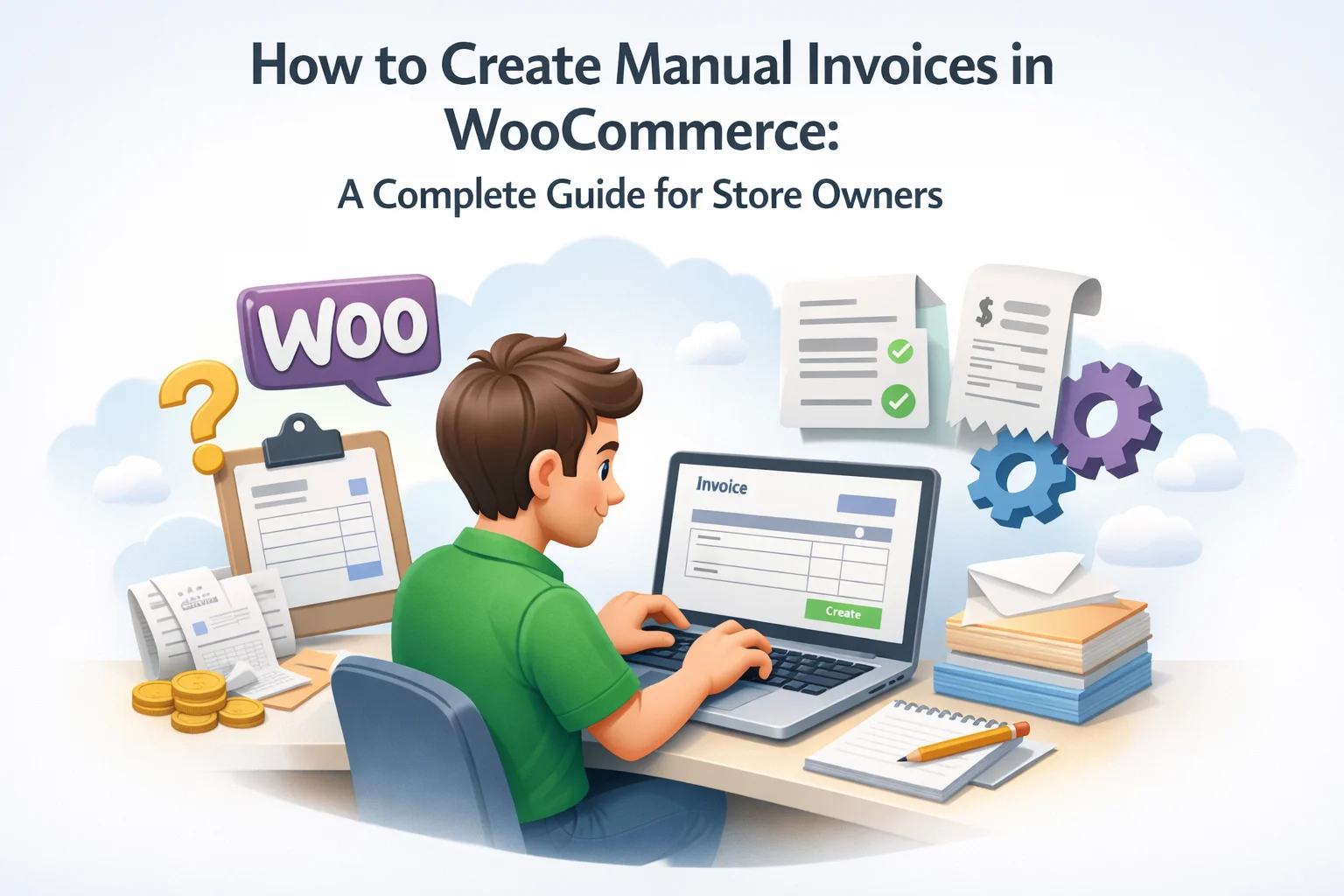
WooCommerce is built around a simple idea: a customer visits your store, adds products to the cart, and pays at checkout. That flow works beautifully — when it works. But many real businesses operate differently. A wholesaler places a phone order. A returning client wants an invoice emailed before payment. A custom service requires a quote that isn’t available as a product in your catalog. A corporate buyer needs billing details that don’t fit any standard field.
In all these cases, WooCommerce’s default checkout process is simply the wrong tool. What you need is the ability to create an order from the admin panel, attach a payment link to it, and send it directly to your customer — without requiring them to go through the storefront at all. That process is called manual invoicing, and WooCommerce doesn’t handle it natively in any way that works for a serious business.
This guide walks you through exactly how manual invoicing works, why WooCommerce’s built-in order creation falls short, and how to build a proper admin-to-client billing workflow using a dedicated solution like the WooCommerce manual order billing plugin for professional invoicing.
By the end, you’ll understand not just how to technically create a manual invoice, but how to do it in a way that looks professional, keeps your inventory accurate, and gets you paid faster.
What “manual invoicing” actually means in WooCommerce
Before we get into the how, it’s worth being precise about the what. A lot of guides use “manual invoicing” to mean simply creating an order from the admin panel. That’s part of it — but it’s not the whole picture. Real manual invoicing in a business context means the ability to initiate a billing transaction from the seller’s side, not from the buyer’s cart.
In practice, this means: you decide what the customer owes, you create the invoice, you send it to them, and they pay it. No storefront visit required. No product page. No checkout cart. The payment flow is driven by you, not by your website’s purchase mechanism.
This is exactly how B2B transactions, wholesale deals, service billing, and phone orders work in the real world. And it’s a workflow that WooCommerce’s native tools simply do not support in a usable way.
WooCommerce does allow admins to create orders manually from the backend. But this feature has a serious gap: it creates an order with a “pending payment” status, but there is no built-in way to send the customer a proper payment link. The customer would have to find the order in their account area and pay from there — which means they still need to know where to look, have an account, and navigate through the site. That is not how invoicing works for most businesses.
Who needs manual invoicing in WooCommerce?
The honest answer is: far more store owners than realize they need it. If you’ve ever told a customer “I’ll send you a payment link,” and then awkwardly tried to explain where to find their pending order on your site — you needed manual invoicing. Here are the scenarios that come up constantly:
A customer calls and orders three items. You need to capture that order inside your WooCommerce system — against inventory, linked to a customer account, with a proper record — and then give them a direct way to pay. With default WooCommerce this is a clumsy, multi-step process. With a proper manual invoicing plugin, you create the invoice, hit send, and the customer gets a payment link that takes them directly to checkout for that exact order.
Business buyers expect invoice-based billing, not shopping cart checkout. They need a document they can approve internally, route to accounts payable, and pay on terms. Your WooCommerce store’s public pricing may not even apply to them — they may have negotiated rates, volume discounts, or custom line items that don’t exist as products in your catalog. Manual invoicing is the only way to handle this correctly inside WooCommerce.
Agencies, freelancers, and service providers who sell through WooCommerce often need to invoice for work that doesn’t map cleanly to a product SKU. A web design project, a consultation package, a maintenance retainer — these need custom invoice line items, specific totals, and a payment process that the seller controls, not the buyer’s cart.
High-value orders are often split across multiple payments. The customer pays a deposit upfront, the rest on delivery. Standard WooCommerce checkout is all-or-nothing. Manual invoicing with partial payment support lets you create invoices for specific amounts against a single order, giving you and your customer total clarity over what’s been paid and what remains outstanding.
The manual invoicing workflow that actually works
Before jumping to the step-by-step, it helps to understand what a complete manual invoicing workflow looks like from start to finish. This is the flow that professional WooCommerce stores need — and what a dedicated plugin like NEXU WP’s WooCommerce custom invoices and admin billing plugin makes possible:
Step-by-step: creating a manual invoice in WooCommerce
Here is how the process works inside a properly configured WooCommerce store using a dedicated manual invoicing plugin. We’ll walk through each screen and what it’s doing, so you have a complete picture of the workflow.
From your WordPress admin dashboard, navigate to the Invoices section provided by the plugin. You’ll see a list of all previously created invoices and a button to create a new one. This is a separate interface from WooCommerce’s native order list — it’s purpose-built for the invoicing workflow, which means it shows you the information you actually need when billing a client rather than the fulfillment-focused data that WooCommerce’s order screen emphasizes.

The customer tab lets you assign the invoice to an existing WooCommerce user or enter new client information directly. You can populate billing address, contact email, phone number, and any custom fields relevant to your business. For B2B clients, you’d enter their company name and VAT number here. This information will appear on the final invoice PDF that the customer receives.

The items tab is where you build out what the customer is being charged for. You can add products from your WooCommerce catalog (which automatically pulls in pricing and triggers inventory deduction on payment), or add completely custom line items with their own descriptions, quantities, and prices. This is the key feature that makes the plugin genuinely useful for service-based businesses — you’re not limited to existing products.

The settings and extra tabs give you control over the invoice’s behavior: due date, payment terms, notes visible to the customer, internal admin notes, and any additional custom fields your business requires. For partial payment scenarios, you configure the deposit amount here — the invoice will reflect how much is being collected now and what remains outstanding.


Once the invoice is complete, you send it from the admin panel. The customer receives a professional email containing their invoice details and a direct link that takes them immediately to a payment page for that specific invoice. They don’t need to log into your site, navigate anywhere, or find their order. They click the link, choose their payment method, and pay. That’s the experience you want to deliver — and it’s one that builds trust and speeds up payment collection significantly.
Partial payments and staged billing in WooCommerce
One of the most frequently needed — and most underserved — features in WooCommerce is the ability to collect partial payments. Deposits, milestone billing, installment plans: these are all variations of the same core need, and WooCommerce handles none of them natively.

With a partial payment system built into your manual invoicing workflow, you can specify exactly what amount is being collected on a given invoice. The invoice makes it transparent to the customer: here’s the total, here’s what you’re paying now, here’s what remains. The customer sees that information clearly in their account view and in the invoice they receive.

How manual orders affect WooCommerce inventory
This is a concern that comes up constantly with store owners who are considering manual invoicing: if I create an order outside the normal checkout flow, will my inventory still be correct? The answer depends entirely on how the plugin you use handles this — and it’s a question worth asking explicitly before committing to any solution.
When you create a manual invoice that includes products from your WooCommerce catalog, stock should be held from the moment the invoice is created (to prevent overselling on the same products) and fully decremented when payment is confirmed. This mirrors exactly what happens with a standard WooCommerce checkout. A well-built manual invoicing plugin handles this automatically — you don’t need to manually adjust inventory separately.
When evaluating a WooCommerce manual invoicing plugin, check whether it: (1) reduces stock when the invoice is paid, not just when it’s created; (2) releases held stock if an invoice expires unpaid; (3) handles variable products and product variations correctly; and (4) reflects the inventory change in standard WooCommerce stock reports. These details matter more than they might initially seem, especially if you’re managing stock across multiple sales channels.
What the admin invoice record looks like
After an invoice is created and sent, the admin panel gives you a complete record of each invoice — status, amount, customer, and payment history. This is your audit trail for every manual billing transaction. For businesses that process dozens of manual orders per month, having a clean, filterable invoice list is not a luxury; it’s a basic operational requirement.

Manual invoicing vs. the default WooCommerce order creation: a direct comparison
To make the difference concrete, here is a direct comparison of what you get with WooCommerce’s native admin order creation versus a dedicated manual invoicing plugin:
The half-filled circles for WooCommerce Default reflect features that exist in some form but don’t work well enough to use reliably in a professional context. WooCommerce can technically create an order from the admin — but without a payment link, a professional invoice document, or a clean client-facing view, it’s a partial solution at best.
Why this matters more than it might seem
There’s a tendency to treat manual invoicing as a secondary concern — something to deal with once the “real” store is set up. That’s a mistake. For many WooCommerce businesses, a significant portion of their revenue comes through transactions that never touch the standard checkout flow. Phone orders, custom quotes, B2B accounts, service agreements: these are often the highest-value transactions a business processes.
Handling those transactions through a patchwork of workarounds — creating orders manually and then calling the customer to tell them to log in and pay — is not just inefficient. It sends a signal about how you operate. Sending a client a professional invoice with a single-click payment link sends a very different signal. It says you’re organized, you’re serious, and working with you is easy.
The WooCommerce custom invoices plugin for B2B and admin billing exists precisely to close the gap between what WooCommerce does out of the box and what real businesses need when they need to bill clients directly. It’s not a workaround — it’s the feature WooCommerce should have built in and didn’t.
The WooCommerce invoicing plugin that fills the gap
Create invoices from the admin, send direct payment links, manage partial payments, keep inventory accurate, and give clients a professional billing experience — without touching the standard checkout flow.


Didn't realize how many off site sales I was missing until I read this. Just the payment link trick has already saved me hours of back and forth with clients who refuse to use shopping carts.
No product page. Just the guide.
Just wanted to share my thoughts on this guide since I run a small music gear shop and handle custom orders daily. The section about WooCommerce's default checkout not working well for phone orders or special requests is spot on. I've had wholesalers call in bulk orders, and trying to jam those into the standard cart is a nightmare. this guide actually explains why that workflow fails in real life, which is way more helpful than most tutorials out there.
Oh man, this saved me!