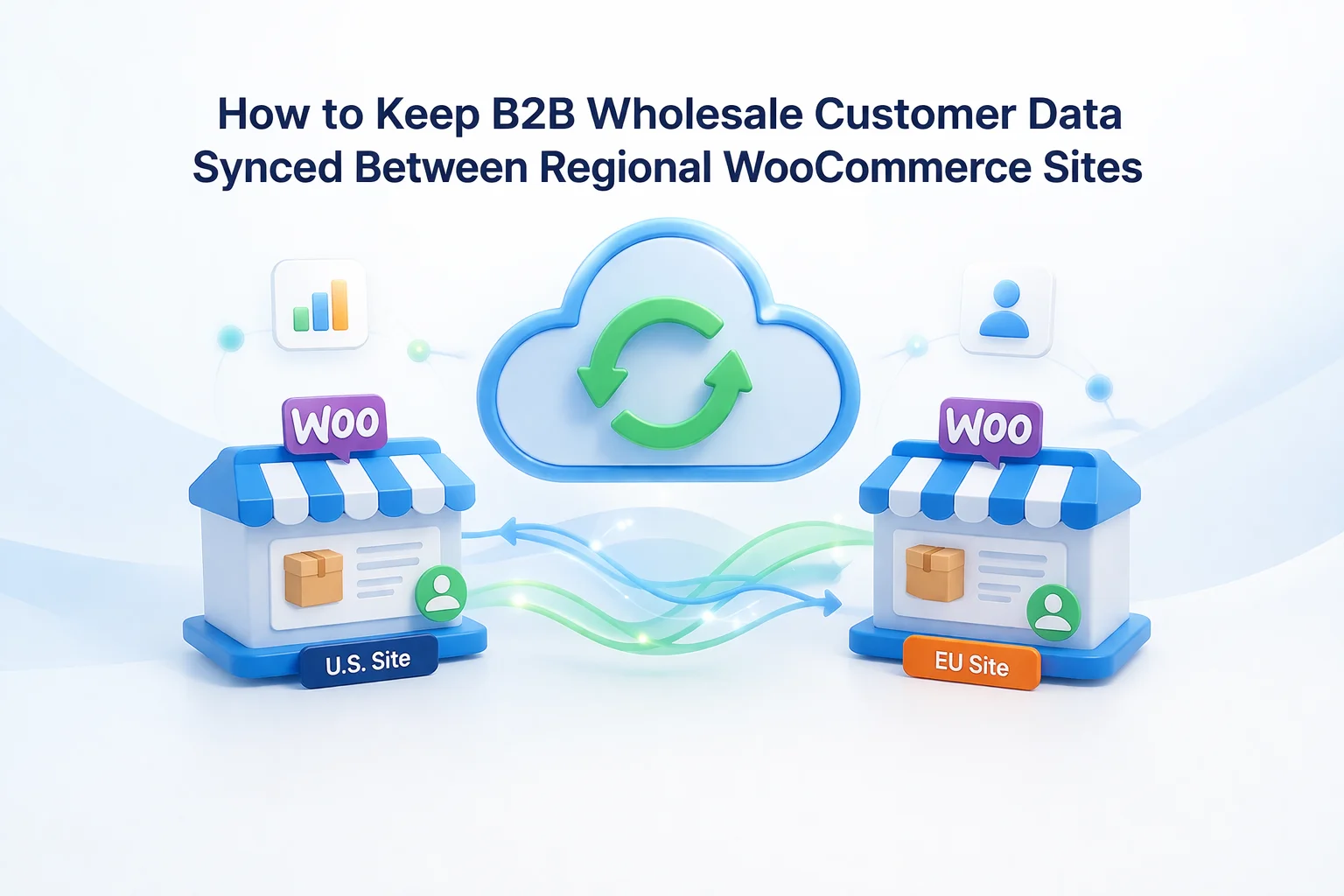
How to Keep B2B Wholesale Customer Data Synced Between Regional WooCommerce Sites
A wholesale buyer places an order in your UK store. The same buyer’s account in your US store has the wrong pricing tier, outdated company details, and no record of the credit terms your sales team negotiated. B2B wholesale sync is more complex than consumer sync — this guide covers every dimension of it, from custom pricing to tax-exempt status to company account structures.
15 min read Updated 2026 B2B E-Commerce Strategy Guide
Business-to-business wholesale operations on WooCommerce have user data requirements that are categorically more complex than consumer e-commerce. A B2C customer’s account essentially contains an email address, a name, and a shipping address. A B2B wholesale customer’s account is a multi-layered record: a company entity with multiple authorized buyer contacts, a negotiated pricing tier that may be specific to a product category or volume threshold, a credit terms agreement, tax-exempt certificates that vary by jurisdiction, a spend history used to calculate tier eligibility, and approved payment methods that may include net terms rather than credit card processing.
When a wholesale distributor or manufacturer operates multiple regional WooCommerce stores, every one of these data dimensions must be consistent across sites. A wholesale buyer who has been approved for Tier 2 pricing and net-30 payment terms on your US store must receive the same pricing tier and payment terms on your UK store without having to go through the approval process again. Their tax-exempt certificate status — valid in their jurisdiction — must be recognized on the regional store for their market. Their company account must show the correct set of authorized buyer contacts regardless of which regional store they are accessing.
This guide covers the full architecture of B2B wholesale customer data sync across regional WooCommerce stores. It addresses the specific data categories that make wholesale sync different from consumer sync, the WordPress and WooCommerce meta fields that carry this data, and how WooCommerce B2B wholesale customer sync across regional stores keeps this data consistent without requiring your sales team to manually update each regional store every time a customer account is approved or modified.
We reference the most commonly deployed B2B WooCommerce plugins throughout this guide — WooCommerce B2B, B2B King, Wholesale Suite, and YITH WooCommerce Wholesale — noting how each one stores its data and what that means for sync configuration. The underlying principles apply to any B2B WooCommerce plugin that uses user meta and custom roles to manage wholesale access and pricing.
What this guide covers
→Why B2B wholesale customer sync is fundamentally different from B2C consumer sync.
→The seven B2B-specific data categories that must be consistent across regional stores.
→How major B2B WooCommerce plugins store wholesale tier and approval data — and which fields need to sync.
→Company account structures and multi-contact sync: how to handle B2B accounts with multiple buyer contacts.
→Tax-exempt status and regional tax configuration: what to sync and what must stay regional.
→The master-authoritative principle for B2B: which team owns the data and which site’s version wins.
Why B2B wholesale sync is categorically different from B2C sync
The difference is not a matter of degree — it is a matter of kind. Consumer sync carries identity data: who this person is and how to contact them. Wholesale sync carries commercial relationship data: what this company is authorized to buy, at what price, under what payment terms, and with what tax treatment. Getting consumer sync wrong produces inconvenience. Getting wholesale sync wrong produces incorrect pricing, incorrect tax treatment, unauthorized access to wholesale pricing by retail accounts, or rejected orders at checkout because payment terms that were negotiated on one regional site are not recognized on another.
B2C consumer sync
Email, name, phone
Billing address
Shipping preferences
Communication opt-ins
Loyalty tier (if applicable)
5–8 standard meta fields
B2B wholesale sync
All B2C fields plus:
Company name, VAT/tax ID
Wholesale approval status
Pricing tier assignment
Credit terms and limits
Tax-exempt certificates
Minimum order thresholds
Authorized buyer contacts
Net payment method eligibility
20–40+ meta fields depending on plugin
There is also a fundamentally different approval process in B2B that has no parallel in B2C. A retail customer self-registers and is immediately active. A wholesale customer typically goes through a vetting process — trade credit check, business verification, VAT registration confirmation — before being approved. The approval status itself, and any conditions attached to it, must be synced across regional stores. An unapproved wholesale applicant on the US store should not be able to access wholesale pricing on the UK store simply because no approval record exists there yet.
The seven B2B-specific data categories and their sync requirements
1
Wholesale approval status and role
Controls access to wholesale pricing — must sync immediately
The most critical data point in a B2B wholesale network is the approval status: is this account approved as a wholesale buyer? Most B2B WooCommerce plugins represent this through a custom WordPress role (e.g., wholesale_customer in Wholesale Suite, b2b_customer in B2B King) plus a user meta flag indicating approval state.
Wholesale Suite: Role wholesale_customer. Meta keys: wwp_wholesale_role
B2B King: Custom role per tier. Meta: b2bking_b2buser, b2bking_group_id
2
Pricing tier assignment
Directly affects what a buyer pays — highest financial impact if wrong
Wholesale pricing tiers define what percentage discount or what fixed price a buyer receives on products. A Tier 1 buyer might receive 20% off list price; a Tier 2 buyer 35%; a strategic account 50%. These tiers are assigned by the sales team during account approval. The tier must be consistent across regional stores because the buyer expects the same pricing regardless of which regional store they access — and because a pricing discrepancy between regional stores can create arbitrage situations where buyers order exclusively through whichever store has the most favorable pricing.
Important nuance: The pricing tier (e.g., “Tier 2”) should sync globally. The actual prices at each tier are regional — they are denominated in local currency and may reflect local market conditions. Sync the tier assignment, not the price values themselves. The regional store applies its own local pricing schedule to the synced tier.
3
Company account and business identity data
The entity behind the individual buyer contact
B2B purchases are made by individuals on behalf of companies. The company identity data includes: registered company name, trading name (if different), company registration number, VAT number or tax identification number, industry classification, and the company’s billing address. This data must be consistent across regional stores because it is used for invoice generation, tax compliance, and customer communications. A company that changes its registered name or VAT number needs that change to propagate to all regional stores simultaneously.
Sync these fields: Company name, VAT number, company registration number, industry
Keep regional: Local billing address, local registered office address (may differ per jurisdiction)
4
Credit terms and payment method eligibility
Net-30/60/90 terms — high operational risk if wrong
Many wholesale buyers operate on credit terms — net-30, net-60, or net-90 payment terms where the invoice is due a specified number of days after delivery. These terms are typically granted after a trade credit assessment and represent a specific commercial agreement. If a buyer has been approved for net-30 terms on the US store but the UK store does not have this information, they will be asked to pay immediately at checkout — which contradicts the commercial relationship your sales team has established.
Plugin-specific: B2B King stores credit terms in b2bking_net_terms and credit limit in b2bking_credit_limit user meta. These must be included in the sync scope. WooCommerce B2B uses wc_b2b_net_terms.
5
Tax-exempt status and certificate data
Jurisdiction-specific — most complex sync decision in B2B
Tax-exempt status is the most jurisdiction-specific data category in wholesale B2B. A buyer who is VAT-registered in the UK and purchases zero-rated for VAT purposes has a tax treatment that is specific to the UK context. That same buyer purchasing from your US store may have a different tax status — they may be exempt from US sales tax in certain states, or they may not be. Tax exemption certificates are jurisdiction-specific documents. Syncing a UK VAT exemption flag to a US store would be technically incorrect and potentially create compliance issues.
Sync globally: Tax-exempt status flag (boolean — is this account tax-exempt in principle), VAT registration number for identity verification
Keep regional: Jurisdiction-specific exemption certificates, local tax rates applied, local tax-exempt documentation
6
Minimum order quantities and purchase restrictions
Account-level overrides to default MOQ rules
Some wholesale accounts have negotiated minimum order quantities that differ from the store’s default minimums — a large distributor may have a lower MOQ because they purchase consistently at volume, while a newer account may have higher minimums as a condition of their wholesale approval. These per-account MOQ overrides are stored as user meta and must be synced to regional stores so that the buyer’s purchasing experience is consistent regardless of which regional store they order from.
7
Account manager assignment and internal notes
Operational data for sales team consistency
Many B2B WooCommerce implementations allow individual wholesale accounts to be assigned to a specific sales account manager. When a buyer contacts support on a regional store, the support team should be able to see who the buyer’s account manager is without having to look it up in a separate CRM. Similarly, internal notes added by the sales team (special instructions, relationship history, override authorizations) should be accessible across regional stores so any team member can provide consistent service.
How B2B WooCommerce plugins store wholesale data: the sync configuration implications
Configuring sync for B2B wholesale data requires knowing exactly which user meta keys each plugin uses for the critical data categories. The following covers the major plugins in concrete terms.
Data category
Wholesale Suite / WooCommerce Wholesale
B2B King
Wholesale role
wholesale_customer role
b2bking_b2buser meta + custom role
Pricing tier
wwp_wholesale_role
b2bking_group_id
Company name
billing_company
billing_company
VAT/Tax number
billing_vat_number or custom
b2bking_vat_number
Net payment terms
Via WooCommerce Net Terms plugin meta
b2bking_net_terms, b2bking_credit_limit
Approval status
wwp_registration_approval_status
b2bking_enabled
Finding your plugin’s meta keys before configuring sync The meta keys listed above are accurate for current versions of these plugins but can change between major versions. Before configuring your sync scope, verify the actual meta keys in use on your installation by running SELECT DISTINCT meta_key FROM wp_usermeta WHERE user_id = [test_wholesale_user_id] ORDER BY meta_key on an approved wholesale customer account. This gives you the definitive list of meta keys for your specific plugin version and configuration.
B2B purchasing is rarely done by a single individual. A company account typically has multiple authorized buyer contacts: a primary account holder who sets up the account and manages the commercial relationship, plus additional purchasers — a procurement manager, regional buyers, department heads — who are authorized to place orders under the same account terms. This creates a relationship between user accounts that consumer WooCommerce does not have to handle.
In most B2B WooCommerce implementations, sub-buyers are linked to the parent account through a user meta field — typically storing the parent account’s user ID or company ID in the sub-buyer’s user record. For example, B2B King uses b2bking_subaccounts_parent to link sub-accounts to the parent company account. This relationship meta must be synced alongside the user records themselves.
Maintaining parent-child relationships across regional stores
When syncing sub-buyer accounts to regional stores, the parent account’s user ID on the regional store must match the user ID stored in the sub-buyer’s b2bking_subaccounts_parent meta. This is only possible if the parent account’s user ID is consistent across stores — which it will be if the parent account was also synced from the same master site. The sync order matters: the parent account must be synced to the regional store before the sub-buyer accounts. The sync system’s queue must process the parent account event before processing the sub-buyer events for the same company.
New sub-buyer contacts added to existing accounts
When a company adds a new authorized buyer to their account — a new procurement manager, for example — this new sub-buyer account is created on the master site. The sync system must detect this new user creation event, identify that the user is a sub-account of an existing company account, and propagate both the user record and the parent-child relationship to all regional stores. If the parent account’s ID on the regional store differs from the ID stored in the sub-buyer’s meta, the parent-child relationship will be broken on the regional store.
The master-authoritative principle in B2B: who owns the data and which site wins
In a B2B wholesale network, the question of which site’s version of a customer record is authoritative has direct commercial implications. The answer must be deliberate and documented, not determined by whichever sync event happens to arrive last.
The recommended approach for B2B wholesale networks is a strict master-authoritative model where the site where the commercial relationship is managed — typically the site where sales team members process approvals, set pricing tiers, and configure credit terms — is the canonical source of truth for all B2B data. Regional stores are read-only recipients of this data. No regional store should have the ability to change a buyer’s pricing tier, approval status, or credit terms — those changes must be made on the master site and propagated outward.
The one exception: regional-specific overrides Some B2B networks allow regional sales teams to grant region-specific pricing overrides — a special price for a particular product for a particular buyer in a specific region, distinct from their global pricing tier. These regional overrides should be stored as region-specific meta keys (not the global tier meta) so that the sync system does not overwrite them when the master site pushes a global tier update. The global tier propagates globally; the regional override stays on the regional store database and is never propagated to other regions.
Key B2B lifecycle events that require immediate sync propagation
B2B wholesale accounts have specific lifecycle events that require faster-than-standard sync propagation because the commercial and financial consequences of delay are significant.
B2B lifecycle event → sync urgency → consequence of delay
New wholesale account approved
Immediate
Buyer cannot access wholesale pricing on regional stores until their approval status syncs — first cross-regional order attempt fails
Pricing tier changed (upgrade/downgrade)
Immediate
Buyer continues receiving old pricing on regional stores — either paying too much (after upgrade) or receiving pricing they are no longer entitled to (after downgrade)
Account suspended or revoked
Critical — immediate
Suspended buyer retains wholesale access and pricing on regional stores — potential for unauthorized orders and revenue risk
Credit limit updated
Same day
Buyer can exceed or is blocked below their actual authorized credit limit on regional stores that have not received the update
Net payment terms granted or revoked
Critical — immediate
Buyer placed on payment hold on master cannot place orders on regional stores — or buyer no longer eligible for net terms can still use them on unsynced regional stores
B2B wholesale sync configuration checklist
The following checklist is specific to B2B wholesale deployments. It supplements the standard multi-site sync configuration with the wholesale-specific items that determine whether the commercial relationship data is correctly managed across regional stores.
B2B wholesale configuration item
Audit your B2B plugin’s meta keys: Run the SELECT DISTINCT meta_key query on a test wholesale account to get the definitive list of meta keys for your plugin version. Use this list to configure the sync metadata scope rather than relying on documentation that may be outdated.
Add all B2B commercial data meta keys to sync scope: Include approval status, pricing tier/role, company name, VAT number, credit terms meta keys, and credit limit. Exclude order statistics (_order_count, _money_spent) and any regional tax certificate meta keys.
Configure sync direction as one-way from master: The master site where your sales team manages approvals and pricing tiers pushes to all regional stores. Regional stores cannot push B2B commercial data back to the master. This prevents regional teams from accidentally modifying wholesale terms.
Map wholesale roles explicitly in role mapping: Ensure your B2B plugin’s wholesale customer role is mapped correctly on every regional store. If the regional store uses a different B2B plugin with different role names, document the mapping carefully and test access to wholesale pricing after role sync.
Test the complete B2B checkout flow on each regional store after sync: Using a test wholesale account, verify that the correct pricing tier applies at checkout, that payment terms options are available if the account has them, and that tax treatment is correct for the regional store’s jurisdiction. Do not launch cross-regional wholesale without completing this checkout verification.
Test account suspension propagation explicitly: Change a test wholesale account’s approval status to suspended on the master site. Verify the status propagates to all regional stores within the expected window and that the account cannot access wholesale pricing on any regional store after the sync completes.
B2B wholesale customer data sync is the most commercially sensitive user data category in the WooCommerce ecosystem. Getting it right means your sales team’s carefully negotiated terms and approvals are honored automatically across every region you serve. Getting it wrong means pricing inconsistencies, unauthorized access, payment disputes, and the erosion of the commercial relationships your team has built.
Nexu User Sync’s WooCommerce B2B wholesale customer data synchronization across regional stores provides the configurable metadata scope, master-authoritative direction control, role mapping, and real-time propagation that wholesale networks require — keeping pricing tiers, approval status, and commercial terms consistent across every regional store your wholesale buyers access.
🔗Implementing a hybrid WooCommerce B2B B2C setup eliminates the need for separate regional stores while maintaining distinct pricing, tax rules, and customer data structures. →
Pricing Tier Sync · Approval Status · Credit Terms · Company Account Structure · Master-Authoritative
Every negotiated term. Every approved account. Consistent across every regional store you operate.
Nexu User Sync keeps your B2B wholesale customer data — pricing tiers, approval status, credit terms, company accounts, and tax configuration — consistent across all your regional WooCommerce stores with master-authoritative one-way control.
As a sales-driven developer and the founder of NexuWP, Mahdi focuses on building WordPress solutions that don't just work—they convert. From AI-powered bulk translation engines to high-efficiency media offloading, he helps business owners automate the "grind" so they can focus on global growth. He is a pioneer in integrating advanced LLMs into the WordPress workflow.
The self registration works smoothly for quick activation definitely a plus for getting new buyers up and running fast. My only hesitation is how it fits with our current approval process
Mansour jabinpour2 months ago
Thank you for reaching out. your team can still review and assign tiers before activation, even with self registration in place let me know if you'd like to discuss how it works.
Daniel Jackson3 months ago
Got this for our team's multi region B2B stores, but syncing buyer contacts took way more manual work
mehdiadmin3 months ago
Thank you.
Richard Hernandez3 months ago
Hey folks, just wanted to share how this guide saved me a ton of head scratching with regional tax setups. We run three Woo stores (US, EU, AU) and keeping tax exempt statuses in sync while letting local rates stay local was a nightmare until now
Please log in to leave a review.
Manage Consent
To provide the best experiences, we use technologies like cookies to store and/or access device information. Consenting to these technologies will allow us to process data such as browsing behavior or unique IDs on this site. Not consenting or withdrawing consent, may adversely affect certain features and functions.
Functional
Always active
The technical storage or access is strictly necessary for the legitimate purpose of enabling the use of a specific service explicitly requested by the subscriber or user, or for the sole purpose of carrying out the transmission of a communication over an electronic communications network.
Preferences
The technical storage or access is necessary for the legitimate purpose of storing preferences that are not requested by the subscriber or user.
Statistics
The technical storage or access that is used exclusively for statistical purposes.The technical storage or access that is used exclusively for anonymous statistical purposes. Without a subpoena, voluntary compliance on the part of your Internet Service Provider, or additional records from a third party, information stored or retrieved for this purpose alone cannot usually be used to identify you.
Marketing
The technical storage or access is required to create user profiles to send advertising, or to track the user on a website or across several websites for similar marketing purposes.




The self registration works smoothly for quick activation definitely a plus for getting new buyers up and running fast. My only hesitation is how it fits with our current approval process
Got this for our team's multi region B2B stores, but syncing buyer contacts took way more manual work
Hey folks, just wanted to share how this guide saved me a ton of head scratching with regional tax setups. We run three Woo stores (US, EU, AU) and keeping tax exempt statuses in sync while letting local rates stay local was a nightmare until now