Next-Level Code. Nexuvibe Style ...
Hrs
Min
Sec

Failed checkout experiments usually share a root cause: multiple systems trying to own the same field keys, priorities fighting in hooks, or theme CSS hiding required inputs while JavaScript still enforces them. Buyers see incomprehensible errors; your logs show silent JavaScript exceptions. The business impact is immediate: every minute checkout is down is revenue bleeding, especially if paid traffic still lands on a broken pay button.
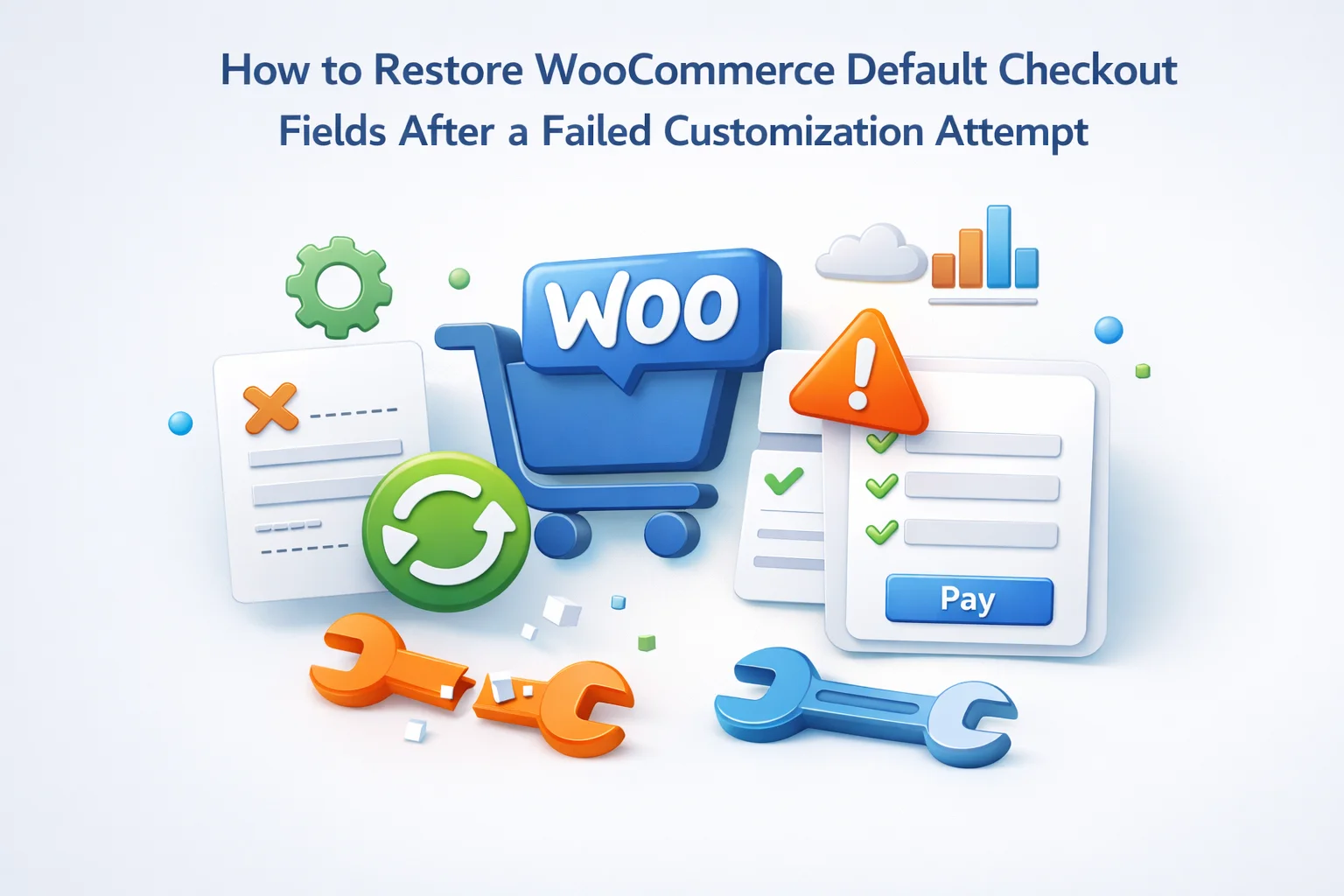
Restoration is not nostalgia for vanilla WooCommerce. It is a controlled return to a known-good baseline so you can reintroduce customization through a single system of record. Field editors with import and export make that baseline reproducible. Snippet sprawl does not. This article gives you a recovery sequence, prevention habits, and a healthier rebuild path anchored in maintainable WooCommerce checkout field configuration with safe reset and export workflows.
You will learn how to diagnose layer conflicts, when to disable snippets versus plugins, how staging saves your weekend, and how to document a rollback so the next experiment does not feel like roulette.
Keep a printed runbook if your agency rotates staff. Digital docs help, but checkout incidents often coincide with VPN or SSO issues. A PDF in a shared drive with phone numbers for hosting escalation beats a Confluence page nobody can reach during DNS failures. Update the PDF when WooCommerce major versions ship, not only when disasters strike.
Intermittent failures are worse than hard outages because you ship while broken. Watch for required fields that are invisible, address fields that duplicate, shipping methods that never load, or payment buttons that spin forever. Open the browser console on checkout: recurring errors referencing undefined blocks or failed REST calls often trace to incompatible customization layers rather than your gateway.
Mobile-only failures frequently trace to CSS overflow or sticky headers covering submit buttons. Always reproduce on a physical phone, not only responsive mode. Touch targets that work with a mouse can fail when a parent container captures gestures. If your customization added accordions, verify they expand before validation runs.
Business metrics lag technical signals. Watch failed payment rates, cart-to-order conversion, and average time on checkout. A sudden spike in session length with flat traffic often means buyers are retrying broken flows. Pair quantitative dashboards with qualitative session replay where privacy policies allow.
Server logs matter too. Fatal errors from typoed hooks stop execution mid-page. Warnings may look harmless yet cascade into blank sections. Capture timestamps and correlate with deploys. If your host rotates logs quickly, enable persistent logging during incidents.
Start with the last change. Git blame your theme functions.php, snippet manager entries, and field plugin exports. If no version control exists, assume the worst: you are archaeology. Still, disable recent snippets first because they are fastest to toggle. Then swap to a default storefront theme in staging to see if checkout resurrects. If it does, your child theme owns the conflict.
Document every toggle. A spreadsheet with columns for plugin name, version, on/off state, and observed checkout behavior prevents circular debugging where you retry the same combination twice. Time stamps matter when multiple people rotate through an incident channel.
Translation and string plugins can filter labels unexpectedly. If checkout suddenly shows blank headings, disable string overrides temporarily. Multilingual setups multiply filters; a harmless English tweak can desynchronize German checkout if gettext caches stale. Flush translation caches when your stack includes persistent object caches.
Plugin conflicts follow a bisect pattern: deactivate nonessential plugins in groups, never all at once on production without a maintenance window. Always have a staging clone. Refer to WooCommerce guidance on testing for plugin and theme conflicts for a methodical approach that avoids false negatives.
Pay attention to must-use plugins. They survive normal deactivate toggles in admin, which makes them invisible suspects. Rename the mu-plugin folder temporarily in staging only to confirm whether a hidden autoloader hijacks checkout. Production changes to mu-plugins deserve the same ceremony as database migrations.
Toggle off recent additions; clear opcode caches if your host uses them.
Hidden inputs and zero-height wrappers cause “required field” paradoxes.
If a field editor stores configuration separately from core WooCommerce settings, resetting fields should not erase products or orders. Export the broken config before reset so you can diff what changed. Import a known-good JSON from staging if production diverged. Treat configs like code: branch, test, merge.
Distinguish between removing a field from the form and deleting historical meta on old orders. The former is safe for forward flow; the latter is an analytics and support disaster. Default restoration should affect new checkouts first. If you must scrub legacy meta, schedule offline jobs with backups and communicate to finance if reports shift.
When uninstalling plugins, read the uninstall behavior. Some offer to wipe data; others leave residue. Understand which outcome you need. A clean uninstall may be correct after a failed migration, but it also destroys hours of legitimate field work unless backed up.
If you relied on custom code referencing old field keys, resetting defaults without updating snippets will trigger notices or warnings. Search your codebase for the keys before reset. A five-minute grep prevents a fifty-minute mystery. Keep a key registry in your internal wiki tied to the export filename that introduced them.
Classic shortcode checkout and Cart and Checkout Blocks do not break for identical reasons. Blocks rely on React hydration; a stray script dequeue can blank the checkout root. Classic is more forgiving yet more entangled with theme templates. Identify which experience you serve in production before copying fixes from tutorials aimed at the other stack.
Mixed stacks during migrations cause double checkout pages bookmarked by customers. Put redirects in place and communicate URL changes in email footers. SEO considerations matter less than payment success during cutovers, but broken canonicals confuse logged-in users who bounce between old and new URLs.
If you recently enabled Blocks experimentally, confirm compatible versions of WooCommerce Blocks, cart/checkout inner blocks, and any field plugins that declare Blocks support. Partial compatibility sometimes means fields render yet fail validation on the server, the worst of both worlds.
Review WooCommerce Cart and Checkout Blocks documentation when errors mention inner blocks or Store API failures. The fix may be updating WooCommerce or a compatibility shim, not deleting customer fields.
After restoration, reintroduce custom questions slowly. Start with one field, place a test order, verify meta, verify emails. Add the second field only after the first is stable. Big-bang configuration is how you repeat the incident. Prefer conditional rules that default off until validated.
Pair each new field with acceptance criteria: who reads it, which email surfaces it, whether ERP needs it. Fields without owners become zombie data. Zombie data encourages future developers to add duplicate fields with slightly different keys, resurrecting the chaos you just cured.
Use realistic test personas: guest consumer, logged-in wholesale buyer, mixed cart with subscription and one-time goods. Edge cases reveal validation loops that happy-path testing misses. Automate smoke tests where budget allows; at minimum, maintain a manual script in Notion your interns can follow without interpretation.
Once defaults behave, layer complexity where SKUs truly need it. Per-product fields reduce blast radius: a misconfiguration affects one product line, not every cart on the internet. Keep global defaults boring and stable; let exceptions carry promotional experiments.
Catalog hygiene supports this pattern: retire SKUs that triggered bespoke fields if those products are end-of-life. Old fields hanging around confuse new merchandisers who assume they still apply. Quarterly catalog audits should include a checkout field appendix listing which products still justify exceptions.
Defaults can be logically correct yet ergonomically wrong. After recovery, revisit order: email before phone if digital fulfillment matters; company after name for B2C-heavy catalogs. Drag-and-drop editors let merchandisers participate without opening PHP files. Document the final order in your runbook so the next contractor does not “optimize” blindly.
Validation order matters psychologically: ask for shipping destination before optional marketing questions so buyers understand why you need data. If optional fields appear before required ones, abandonment rises because the form feels longer than it is. Usability testing five participants often surfaces ordering mistakes that analytics alone hide.
After reordering, rerun accessibility spot checks: tab order, screen reader announcements for new fields, and color contrast on error states. Recovery efforts sometimes strip ARIA attributes accidentally when themes merge. A quick pass with automated scanners plus manual keyboard navigation prevents regressions that invite complaints and legal risk.
Production surgery without a clone is how small stores lose weekends. Mirror data with anonymization if regulations require it, but mirror plugins and theme versions faithfully. Replay the failing checkout path in staging with the same payment gateway test mode. If you cannot reproduce the failure, you are either missing a plugin version skew or a CDN-cached asset differs between environments.
Promote fixes with a checklist: database migrations complete, caches flushed, object cache invalidated, cron healthy, webhooks retested. A “fixed” staging site that skips webhook verification will celebrate prematurely while production still drops orders at the edge.
Match PHP version, WooCommerce version, and theme child state.
Capture browser console, network tab, and server error logs in one ticket attachment.
Prefer toggles and imports over wholesale reinstalls unless corruption is proven.
Aggressive minify pipelines concatenate scripts in orders that break dependencies. After you restore PHP-side fields, stale JS bundles may still reference removed hooks. Purge full-page caches, CDN edge caches, and browser service workers if your PWA experiments went sideways. Test incognito after each purge layer so you know which layer haunted you.
Coordinate purges with marketing launches. A newsletter blast during cache invalidation exaggerates perceived downtime because every new visitor misses warm caches simultaneously. If you must purge, do it in a low-traffic window and monitor origin load while edges refill. Log purge events next to deploy logs so correlations are obvious next week. Small discipline now prevents conspiracy theories later. Treat observability as part of checkout reliability, not an optional luxury reserved for larger shops only today, tomorrow, and next launch too.
Security plugins deferring JavaScript for performance can defer checkout-critical scripts. Whitelist WooCommerce checkout endpoints explicitly rather than whitelisting blindly. Document the whitelist entry: future you will not remember why checkout was exempted.
If checkout remains broken after disabling customizations, inspect database health: orphaned postmeta explosions, autoloaded options bloating sessions, or custom tables from retired plugins. Tools exist in hosting panels to repair tables; use them cautiously and backup first. Compare wp_options entries for stale checkout templates referencing deleted block themes.
Malformed serialized arrays in options break silently. If a snippet wrote serialized PHP incorrectly, restoration requires removing the bad option row, not toggling another plugin. This is the moment to hire a WooCommerce specialist if you are out of depth; hourly expertise is cheaper than days of downtime.
Write a one-page incident summary: trigger, blast radius, time to detect, time to restore, root cause, preventive actions. Store exported configs in dated folders. Require two-person review for production changes during high-traffic weeks. Incidents are expensive tuition; do not waste the lesson.
Share the summary with non-technical stakeholders in plain language: what customers experienced, how long payments were at risk, what you will do differently. Transparency builds trust and secures budget for staging environments that seemed optional last quarter.
Schedule a follow-up ticket for each preventive action. Unassigned good intentions decay. Owners and due dates turn policy into practice. Link tickets to your configuration exports so auditors can trace changes across releases.
Healthy teams centralize checkout customization in tools designed for it rather than scattered snippets. Consolidation does not limit creativity; it limits unowned code paths that wake you at midnight. Nexu WP Advanced WooCommerce Checkout Field Editor for reversible checkout layouts and field resets is built for operators who prefer sleep to grep.
Defaults are not a punishment. They are the stable runway from which you launch experiments that can land safely. Restore, prove payments work, then iterate with exports, staging, and a single source of truth. Your future incidents will be shorter because your past ones were documented.
Celebrate small wins aloud: tell the team when checkout returns to baseline, when the first clean test order succeeds, when exports are archived. Morale matters during incidents. A calm, visible timeline reduces side-channel “fixes” that reintroduce chaos while you are still verifying the root fix.
Advanced WooCommerce Checkout Field Editor helps you snapshot, reset, and rebuild checkout fields without losing operational control.





Found this after a bad code snippet froze checkout during the rush.
So I snagged this guide in a total panic when my checkout fields vanished right in the middle of Black Friday madness. Got everything back online, but now I've got duplicate address fields clogging up my admin panel and zero options to delete them. Did I skip a step when resetting things?
This isn't about resetting to boring defaults it's about controlled recovery so you can rebuild the right way.