Next-Level Code. Nexuvibe Style ...
Hrs
Min
Sec

If your storefront sells digital licences that deliver instantly, “processing” may barely exist—statuses zip from payment confirmation to completion in seconds. If you ship physical goods internationally, “processing” could span days while inventory allocates, warehouses pack, carriers collect, and customs shuffle paperwork. Wallet programmes do not care which narrative is nobler; they care which status transitions your extension listens to when deciding whether shoppers earn cashback or spend converted credit. Misaligned listening produces misaligned expectations—finance sees liability spike at the wrong cadence; support inherits tickets from people who believe the brand lied.
Teams standardising incentive delivery on WordPress commerce often anchor wallet infrastructure in NEXU Smart Wallet and Cashback for WooCommerce because programme configuration, ledger history, and operational dashboards stay co-located—reducing guesswork when you adjust which order moments should move value.
The sections ahead connect status vocabulary to incentive risk, dissect completed-versus-processing trade-offs, map hook timing pitfalls, explore chargebacks and settlement delays, discuss split shipments and partial refunds, outline customer-visible communication strategies, offer reconciliation approaches when teams disagree, and finish with a testing matrix suitable for staging sign-off before high-traffic promotions.
Practitioners sometimes inherit programmes configured years earlier—hooks chosen when the catalogue was simpler. Treat recurring calendar reminders to revalidate status semantics against today’s fulfilment partners, ERP fields, and fraud tolerances; inherited innocence becomes operational debt silently. Pair reviews with changelog discipline so engineers know which deployment altered incentive timing when finance suddenly sees liability curves bend. Add calendar invites owners cannot ignore—passive documentation without scheduled review rots.
Pick incentive triggers that match the financial and operational moment you are willing to defend publicly—then write help-centre prose and admin runbooks that say the same thing.
WooCommerce models commerce as orders traversing states—pending payment, processing, completed, refunded, cancelled, and vendor-specific additions. Those states bundle operational meaning: money authorised, fulfilment underway, obligations settled. Extensions hook into transitions—when status changes from A to B—to enqueue emails, decrement stock, notify fulfilment APIs, or post loyalty points. Wallet plugins inherit that architecture: incentives become conditional on transitions rather than on vibes.
Documenting which hooks your programme relies upon matters because WooCommerce core and gateways sometimes update statuses in sequences that surprise merchants migrating from bespoke platforms. If marketing announces “cashback after purchase,” engineers must translate that slogan into precise triggers—paid? processing? completed?—and legal must agree those triggers align with promotional fine print.
Subscription and membership extensions may introduce renewal orders with different risk profiles—initial conversion versus recurring billing. Wallet incentives that made sense on first purchases may distort lifetime value metrics if reapplied blindly each cycle. Decide explicitly whether renewals qualify, under what ceilings, and whether prepaid wallet balances should participate differently than card tenders.
B2B quotations with negotiated net terms scramble consumer-oriented defaults: completion might track accounts-receivable settlement rather than shipment. If WooCommerce statuses cannot mirror that sophistication alone, supplementary meta fields or ERP-driven custom statuses appear—wallet hooks must recognise those adaptations or incentives will mis-fire systematically for your highest-value buyers.
Official references such as WooCommerce documentation on order statuses anchor vocabulary across teams—use them when leadership debates whether “processing” implies shipment or merely payment acceptance.
Stores composing incentives inside the Nexu WP WooCommerce wallet plugin with cashback automation still own policy translation—software supplies levers; merchants supply promises worth keeping.
When leadership asks “which status is safest?” resist false simplicity. Safety is contextual: safest for liability recognition differs from safest for headline conversion uplift. Produce scenario tables—SKU categories, shipping service levels, fraud rates—rather than shouting acronyms across conference tables.
Processing frequently indicates payment accepted and fulfilment queued—yet merchants remap meanings. Some digital sellers auto-complete at payment because nothing physical ships; others keep processing until manual fraud checks clear. Completed often signals fulfilment concluded—digital delivery finished, pickup handed over, or shipment delivered—yet some teams complete at label print to satisfy carrier integrations. Wallet incentives keyed to “completed” therefore reward different realities depending on internal SOPs.
Choosing processing-based cashback favours shoppers sooner and increases exposure to refunds before goods ship; choosing completion-based cashback aligns incentives with settled fulfilment narratives but invites complaints during long shipping seasons. Neither choice is universally correct—consistency and disclosure determine whether trust compounds or erodes.
Seasonality magnifies divergence: holiday parcel delays stretch processing-to-completion intervals; flash digital promotions compress them to seconds. A trigger tuned for December shipping realities may feel sluggish in August software sales—either accept seasonal variance openly or introduce conditional rules acknowledging catalogue differences.
Marketplace sellers shipping from third-party warehouses might learn completion only after partner confirmations arrive—latency differs from vertically integrated merchants. Comparative benchmarking against peers misleads unless fulfilment topology matches.
Finance teams often prefer completion-aligned triggers because refund volume drops once orders truly finish; marketing teams sometimes prefer earlier triggers because programmes aim to lift conversion during checkout consideration. Alignment exercises should produce written decisions—avoid hallway compromises that vary by campaign week.
When evaluating tooling, consider Smart Wallet and Cashback extension for WooCommerce stores as a foundation that keeps incentive configuration reviewable when leadership revisits triggers each quarter.
Hooks express powerful automation—and duplicate firing ruins ledger trust. Race conditions emerge when gateways send asynchronous notifications, when staff bulk-edit orders during migrations, when plugins replay events after retries. Idempotent designs attempt to recognise already-processed orders; disciplined monitoring surfaces anomalies when recognition fails.
Debouncing controversial transitions helps when statuses oscillate due to integration bugs—temporary processing spikes before settling back. Rather than silently swallow errors, log enough context that engineers reconstruct timelines during post-incident reviews.
Incident commanders benefit from predetermined severity rubrics assigning wallet anomalies—duplicate credits warrant faster escalation than benign notification delays—to avoid adrenaline-fuelled mis-prioritisation mid-outage.
Enterprise observability stacks sometimes aggregate PHP warnings—surface wallet-related anomalies distinctly so they do not vanish inside generic HTTP 500 noise. Correlate spikes in ledger writes with deployments, gateway incidents, or marketing launches to isolate root causes faster than grep alone allows.
Queue-based workers complicate hook timing: asynchronous jobs may reorder execution versus synchronous checkout responses. Customers experience wallet updates seconds or minutes later—acceptable if labelled; catastrophic if simultaneous marketing emails imply instantaneous crediting.
Understanding WordPress hook fundamentals—priority order, anonymous removals, conflicting callbacks—prevents mysterious overrides. The WordPress Plugin Handbook introduction to hooks remains essential reading for anyone debugging incentive callbacks alongside WooCommerce lifecycle docs.
Merchants layering cashback onto complex stacks benefit when wallet logic stays explicit—products such as the configurable customer wallet and cashback rules for WooCommerce from Nexu WP aim to reduce opaque side effects that multiply under hook contention.
Payment authorised does not universally mean settlement final—card networks permit disputes days or weeks later depending on segments and jurisdictions. Wallet cashback recognised instantly at payment capture may evaporate morally if chargebacks claw funds after incentives already converted into repeat purchases.
Risk teams sometimes mandate delayed crediting windows mirroring refund policies—completion hooks plus additional hold periods—creating tension with marketers promising immediate gratification. Transparent pending states inside My Account reconcile those tensions better than silent delays followed by reactive apologies.
Alternative payment methods—bank transfers, pay-later invoices—reshape what “paid” means relative to card authorisations. Status progression may stall in intermediate custom states until funds clear; wallet hooks ignoring those nuances credit prematurely or never. Inventory each gateway’s status choreography in onboarding documentation for payment methods you truly offer, not merely those enabled experimentally.
Consult network rules and processor statements with finance; general educational materials—such as card-brand dispute overview pages—help cross-functional audiences grasp why instant ledger credit carries exposure. Ground conversations in contractual realities rather than assuming WooCommerce statuses mirror cash in bank accounts.
Treasury teams may ask how wallet liabilities reconcile to cash positions when incentives precede settlement—maintain bridge tables translating ledger movements into anticipated funding timelines when programmes scale materially.
Programmes needing disciplined visibility pair operational dashboards with extensions like Nexu WP Smart Wallet product for WooCommerce-led loyalty programmes so ledger narratives remain inspectable when disputes arise.
Split fulfilment fragments customer perception: one order, multiple tracking numbers, staggered completions. Should cashback accrue proportionally per shipment or only after final parcel delivers? Percentage-of-order programmes invite rounding debates; flat-per-order perks invite gaming attempts splitting carts artificially.
Partial refunds claw back incentives unequally if original calculations referenced gross totals yet refunds exclude shipping or bundle components unevenly. Ledger entries should carry references explaining clawback arithmetic—future you will not remember informal Slack agreements.
Statuses may churn during edits—manual adjustments, tax recalculations, ERP synchronisation correcting addresses. Each jitter risks duplicate hooks unless extensions guard transitions with order meta fingerprints or immutable event IDs.
Bundled kits complicate partial fulfilment: crediting cashback on the entire basket when only subset ships frustrates finance if remainder cancels. Consider line-item-level logic where programmes scale—status alone may be too blunt an instrument.
Gift orders introduce recipient versus purchaser dynamics—wallet incentives tied to billing identity might diverge from emotional loyalty narratives if recipients become repeat buyers under different accounts. Policy clarity prevents accusations of arbitrage.
Inspect wallet movements alongside order notes during investigations—teams running structured programmes via NEXU Smart Wallet and Cashback for WooCommerce typically locate narrative context faster than stores relying on disconnected spreadsheets.
My Account pages should narrate incentive states plainly—pending crediting while orders complete, available spend once holds release, expiration clocks where relevant. Ambiguous labels train customers to misinterpret balances, producing support volume unrelated to technical failures.
Email templates must mirror the same vocabulary; contradictory wording between transactional email and on-site wallet surfaces invites screenshots posted publicly. Localise thoughtfully—languages carry nuances around “completed” versus “closed.”
Agents deserve macros aligned to actual ledger behaviour—not aspirational scripts written before refund policies tightened. Refresh macros whenever triggers change.
Mobile-first shoppers screenshot balances aggressively—ensure responsive layouts avoid truncating decimal precision or hiding pending labels behind collapsed accordions unintentionally.
Push notifications amplifying “reward earned” messages must guard against premature sends if asynchronous jobs replay—sequence notifications after ledger commits validate.
Strong published guidance aligns with contemporary search quality expectations; referencing general frameworks like Google’s helpful content guidance reminds teams that merchant education pages should demonstrate firsthand operational clarity—not recycled assertions.
Quarterly planning meetings surface predictable tensions—growth targets pushing earlier rewards versus finance insisting on slower recognition. Instead of adjudicating emotionally in the room, chart scenarios: projected refund curves, incentive liability under each trigger, sensitivity if shipping delays lengthen.
Escalate ambiguous regulatory questions early when stored value resembles deposits; jurisdictions differ. Counsel input belongs beside engineering estimates—speed without legality invites existential risk.
Archive decisions with version numbers inside internal wikis; future campaigns should link to the decision record rather than reinventing rationale.
Executive dashboards summarising wallet liability should annotate incentive recognition policies—otherwise boards misinterpret spikes as operational failures rather than timing effects from deliberate trigger choices.
Cross-border tax changes mid-quarter can alter net eligible purchase calculations; coordinate with accounting before blaming technology for variance.
Solutions that bundle configuration with transparent histories— the Nexu WP WooCommerce wallet plugin with cashback automation among them—help stakeholders audit what changed when incentives swing quarter-to-quarter.
Construct a spreadsheet listing scenarios in rows—payment authorised then refunded before completion; partial shipment completion sequences; cancellation after wallet debit; admin manual completion toggling—and columns for expected ledger behaviour, observed behaviour, screenshot evidence, owner sign-off date.
Include asynchronous gateway simulations when feasible; sandbox environments occasionally diverge from production latency profiles yet still reveal ordering bugs.
Rotate testers—fresh eyes spot assumptions veterans overlook. Repeat matrix after major WooCommerce upgrades or gateway plugin replacements.
Privacy-conscious sample data avoids exposing real customer identifiers—synthetic personas with escalating edge histories work well.
Automate regression suites where feasible—scripted CLI tasks creating orders, advancing statuses, asserting ledger deltas shrink human error during repetitive release cycles.
Include daylight-saving and leap-second edge cases only if your logging timezone conversions proved fragile historically; otherwise maintain pragmatic scope.
Postmortems after production incidents should update the matrix—testing artefacts that never evolve become theatrical props rather than operational guardrails.
Executive sponsors occasionally request “one-slide” summaries—distil scenarios and outcomes without omitting vetoed paths; glossing over discarded trigger choices revisits debates later when someone reinvents them unaware. Embed links to staging evidence repositories with durable permissions so departed engineers do not take living knowledge with them. Annotate slides with deployment dates—context collapse causes teams to revisit settled arguments years later unless histories remain legible. Name document owners, not just shared drives.
Instant digital completion, delayed physical completion, mixed carts, subscription renewals if applicable, high-value orders triggering manual review holds.
Forced webhook retries, toggling statuses manually to emulate ERP corrections, reversing refunds, attempting duplicateCompletion transitions.
Ledger exports, matching order IDs, gateway settlement references, timestamp notes in UTC, approval signatures from finance on chosen triggers.
Comprehensive tooling reduces theatre—programmes anchored in Smart Wallet and Cashback extension for WooCommerce stores combine configurable triggers with histories administrators can trace when stakeholders ask inconveniently specific questions mid-meeting.
Longitudinal metrics separate healthy programmes from brittle ones: track average elapsed time between payment capture and incentive recognition, variance by gateway, refund rates segmented by incentive timing cohorts, and satisfaction scores among wallet users versus non-users. Sudden shifts after WooCommerce updates or gateway plugin bumps appear as trend breaks rather than anecdotal glitches. Pair quantitative trends with qualitative support tags—agents marking “cashback delayed again” expose narrative gaps metrics alone hide. When metrics and stories diverge, audit instrumentation before blaming customers. Schedule semi-annual policy reviews even absent incidents—carrier integrations and regulatory guidance evolve; static programmes decay quietly until peak traffic exposes outdated assumptions about which status meant finished.
Configure incentives, inspect ledger evidence, and ship customer messaging that survives scrutiny—without improvising definitions under pressure.
Processing versus completed is not trivia—it is schedule risk made visible. Choose triggers deliberately, rehearse transitions, narrate balances honestly.

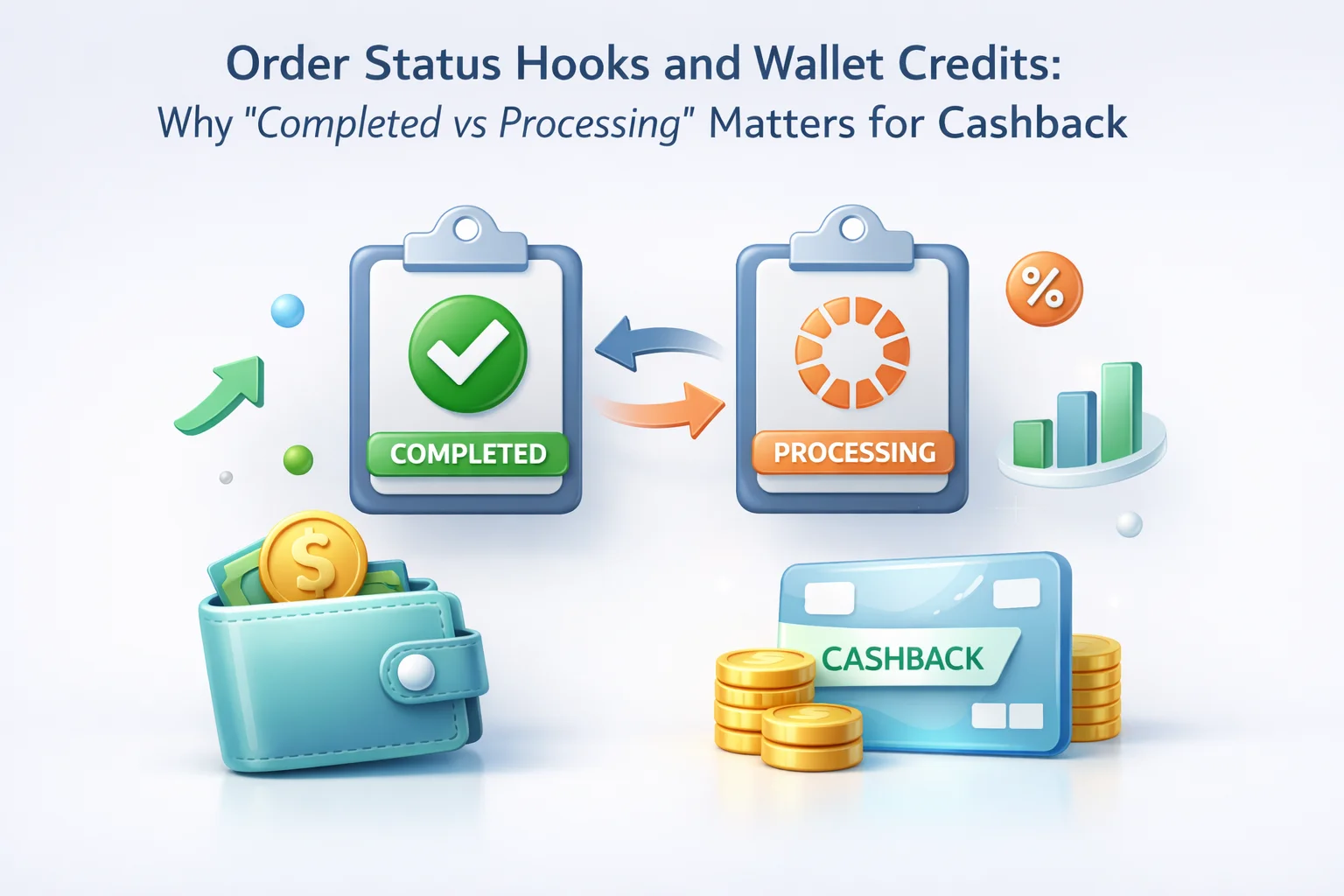


Hey everyone! just wanted to share how this plugin's order status hooks saved me from a cashback nightmare. My store ships internationally, so "processing" can drag on for days warehouse delays, customs, you name it. Before this, credits hit wallets the second payments cleared, and let's just say my risk team wasn't thrilled when returns spiked. Now? We tie rewards to "completed," and the difference is night and day. no more angry shoppers waiting for credits or finance panicking over premature payouts
Finally got our cashback timing right after reading this. Saved us from angry customers and fraud alerts
Just wanted to say this breakdown on order status hooks saved me hours of debugging. the part about "processing" vs "completed" for cashback timing was exactly what my team needed to align our wallet credits with fulfillment realities.
Really appreciate the detailed take on status hooks! Here's my situation: we've got a hybrid shop (digital downloads plus physical merch), and right now our wallet plugin gives cashback at the "processing" stage. Our fraud team hates it, but customers get pretty upset if we hold off until "completed