Next-Level Code. Nexuvibe Style ...
Hrs
Min
Sec

Running multiple WooCommerce stores makes business sense for many organizations. Regional stores serve local markets with appropriate currencies and shipping. Brand-specific stores maintain distinct identities. Wholesale and retail operations serve different customer segments. The operational logic is sound, but the customer experience often suffers.
Without central login, each store becomes an island. Customers create separate accounts on each domain. They maintain different passwords, re-enter billing information, and lose purchase history when moving between your properties. From their perspective, these feel like completely unrelated businesses, even when they carry the same branding and are owned by the same company.
Central login transforms this fragmented experience into a unified one. A customer creates an account on any store and that account works everywhere. They log in once and move between stores without additional authentication. Their profile, billing details, and saved information follow them. This guide walks through exactly how to implement central login across multiple WooCommerce stores on different domains.
Multiple WooCommerce stores emerge from legitimate business requirements. Understanding the scenarios helps clarify why central login matters and what specific synchronization needs each situation creates.
store-us.example.com, store-eu.example.com, store-asia.example.com. Different currencies, tax configurations, shipping options, and sometimes product catalogs. But customers who travel or relocate should not need new accounts. Their purchase history and preferences should be accessible regardless of which regional store they visit.
Companies with multiple brands often maintain separate storefronts for each. brandA.com and brandB.com might have completely different visual identities but share ownership. Customers who buy from both brands benefit from unified accounts, especially for loyalty programs or cross-brand promotions.
retail.example.com for consumers and wholesale.example.com for business buyers. Different pricing, minimum quantities, payment terms, and checkout flows. But businesses that buy wholesale often also buy retail for personal use. A unified account lets them switch contexts without juggling credentials.
shoes.example.com, clothing.example.com, accessories.example.com. Separate stores allow specialized merchandising, SEO, and marketing for each category. Customers browsing across categories expect their cart, wishlist, and account to work seamlessly rather than starting fresh on each domain.
Without central login, every store boundary creates friction. This friction has measurable business impact beyond just customer annoyance.
This fragmentation affects conversion rates, customer lifetime value, and support burden. Customers abandon purchases when forced to create new accounts. They contact support asking why their login does not work. They lose trust in your brand’s technical competence. Every store boundary becomes a potential customer loss point.
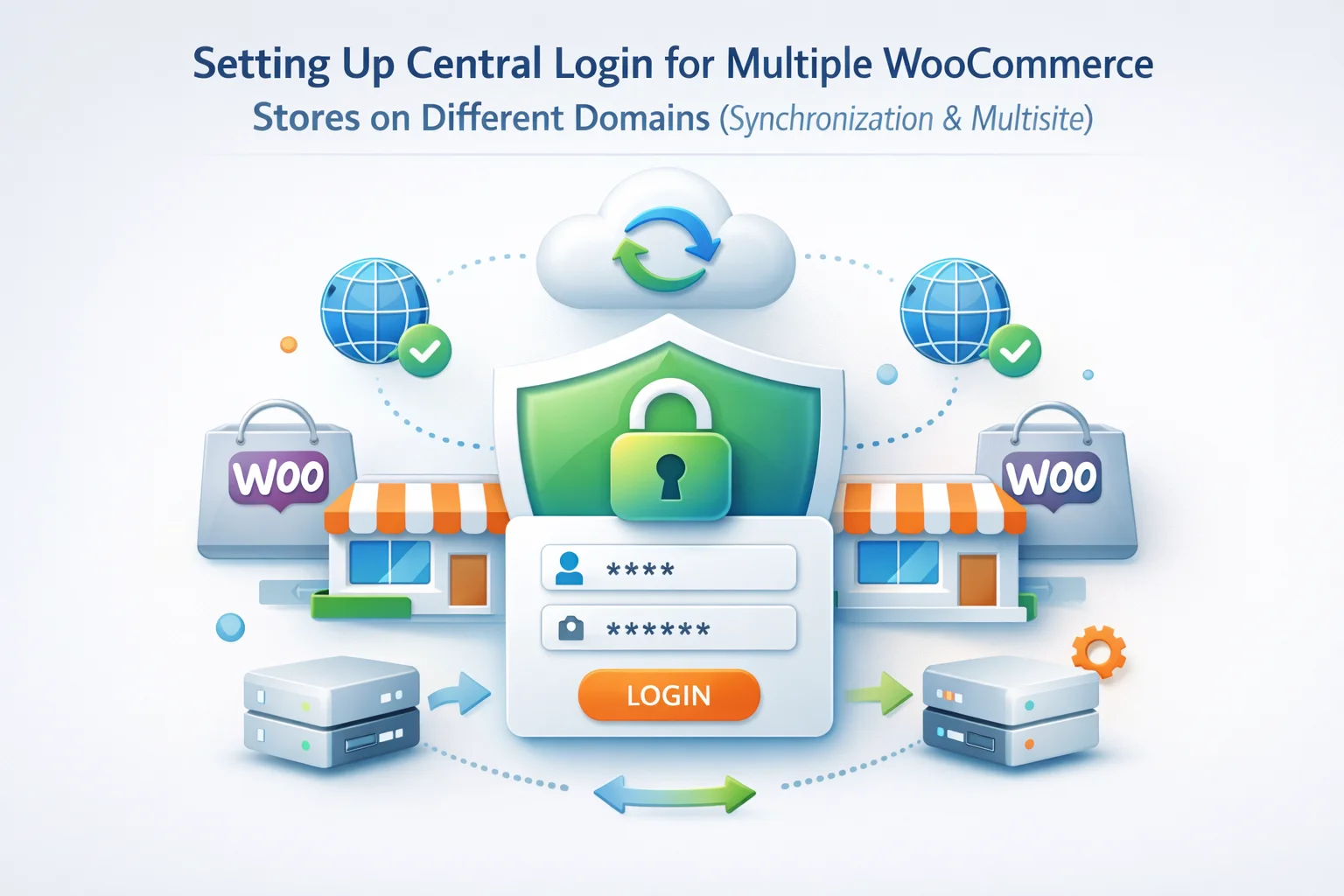
Central login for WooCommerce stores requires two connected capabilities: user synchronization that keeps customer accounts consistent across stores, and Single Sign-On that allows authentication to flow between domains. A complete WooCommerce SSO solution provides both.
The architecture designates one store as the master, serving as the central authority for customer identity. Other stores connect as sub sites, trusting the master for authentication and receiving customer data from it. When a customer registers or updates their profile on any store, that change propagates across the network.
WooCommerce stores extensive customer information beyond basic WordPress user fields. Billing addresses, shipping addresses, phone numbers, and customer notes all need to sync for the experience to feel truly unified.
The WooCommerce-aware synchronization system understands the full set of customer meta fields that WooCommerce uses. Billing first name, last name, company, address lines, city, state, postcode, country, phone, and email. The same set for shipping addresses. All of these can be configured to sync automatically whenever a customer updates their information on any store.
This means a customer who enters their billing address during checkout on Store A will find that same address pre-filled when they visit Store B. No re-entry required. The seamless experience reinforces that these stores are connected, building trust and reducing checkout friction.
Implementing central login across your WooCommerce stores involves connecting the stores, configuring what data syncs, and enabling SSO. Here is the process.
Select which store will serve as the central authority. This is typically your primary store, the one with the largest customer base or highest traffic. The master holds the authoritative customer records and serves as the authentication hub for SSO.
Every WooCommerce store that will participate needs the synchronization plugin installed and activated. Start with your master store, configure it as the master, then proceed to each additional store.
Generate connection invites from your master store. Each invite contains encrypted credentials for secure communication. On each sub store, accept the invite to establish the connection. The stores can now communicate through authenticated API calls.
Enable synchronization for WooCommerce customer fields. Select which billing and shipping fields should sync across stores. Most implementations sync all address fields to ensure customers have their information available everywhere.
Activate SSO on all stores. Configure whether you want central login (redirecting all logins to the master) or silent SSO (checking authentication in the background). Test by logging in on one store and confirming automatic authentication on others.
If you are implementing central login on stores that already have customers, you need a migration strategy. The good news is that you do not have to disrupt existing accounts. The sync system can merge customers intelligently.
Customer accounts are matched by email address. If a customer with email [email protected] exists on both Store A and Store B, they are recognized as the same person. The sync unifies their records rather than creating duplicates.
When the same customer has different passwords on different stores, the master site’s password takes precedence once sync begins. Alternatively, whichever password was most recently changed can be propagated everywhere. The customer ends up with one working password across all stores.
After connecting stores, you can trigger a bulk sync to push all existing customers from the master to sub stores (and vice versa if configured). This migration happens in the background and can handle thousands of customers without manual intervention.
Once central login is running, you need visibility into how it is operating. Dashboard monitoring shows connection health, sync activity, and any issues that need attention.
Detailed logs capture every sync event and authentication flow. If a customer reports an issue with their account on a specific store, you can trace exactly what happened, when their data was synchronized, and identify where any problem occurred.
Central login transforms how customers perceive your multi-store operation. Instead of fragmented separate businesses, they experience a unified brand presence. Their loyalty is recognized everywhere. Their convenience is prioritized. This perception difference directly impacts customer lifetime value and cross-store purchase rates.
The Nexu User Sync plugin with WooCommerce SSO support provides everything needed to implement central login across your stores. Connect your domains, sync your customer data, enable SSO, and deliver the unified shopping experience your customers expect.
Nexu User Sync connects your WooCommerce stores with central login, billing address sync, and seamless SSO. Give your customers the unified experience they deserve.



Finally one login for all my stores!
as a retired teacher who still helps run our family's wholesale and retail stores, I was relieved to find this guide. the step by step instructions made connecting our two WooCommerce sites straightforward no tech headaches!
As a therapist running workshops across different regions, I needed store us.com and store eu.com to feel connected for attendees
Hey everyone, this guide saved me so much headache with our brand stores