Next-Level Code. Nexuvibe Style ...
Hrs
Min
Sec

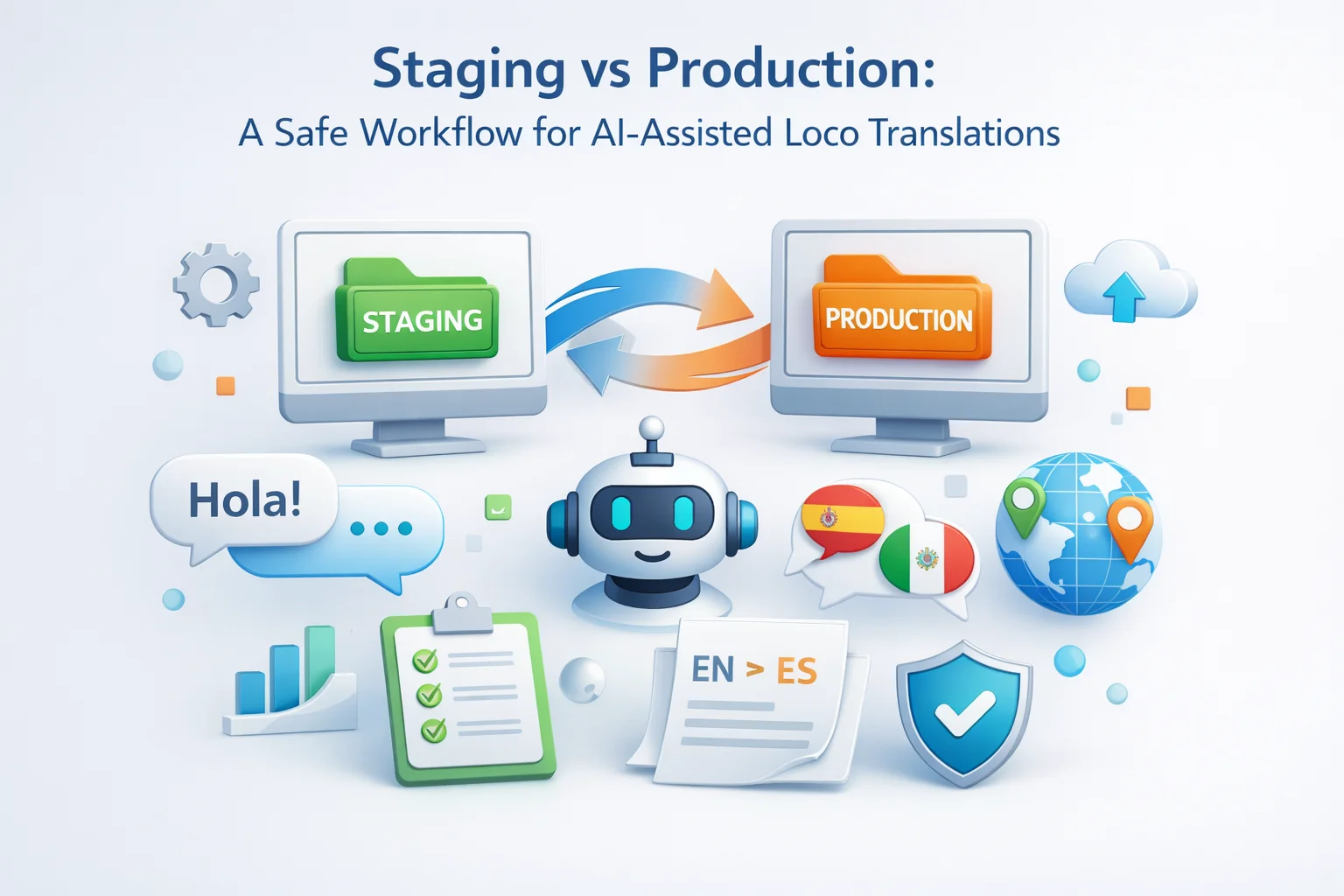
Store owners hear “we translated faster” and imagine a low-risk content update. Engineers know gettext touches checkout labels, gateway microcopy, subscription renewal notices, and account emails. Those surfaces tolerate copy tweaks only when placeholders, legal phrasing, and HTML structure remain intact. Running bulk automation directly on production Loco without a staging rehearsal is how teams learn that speed and safety trade off unless you engineer the pipeline.
This article is a practical workflow for WordPress and WooCommerce operators: how to keep staging faithful enough to trust, how to structure AI bulk jobs so they are reversible, and how to promote gettext changes without turning translation into an un-auditable server habit.
For teams adopting automation inside Loco, a Loco AI Auto Translator deployment pattern that keeps bulk jobs on staging until sign-off matches how mature release teams already treat code and configuration.
Production is where money changes hands. It is also where caching is aggressive, where editors feel pressure to “just fix it live,” and where a partial bulk job can leave a catalog half old and half new with no obvious boundary. AI assistance amplifies each risk because throughput encourages wide scopes. A human might translate twenty visible strings and stop when fatigue sets in. A bulk job cheerfully continues through admin-only domains unless you constrain it.
The specific failure you are preventing is invisible corruption: placeholders that no longer match PHP expectations, HTML that breaks responsive layouts in RTL locales, or gateway labels that diverge from the legal copy finance approved. Customers experience those failures as mistrust, not as “a translation bug.” Staging exists to convert those failures into tickets you can fix before they become revenue incidents.
Operational maturity also means saying no. When stakeholders ask to “just run the bulk job on live because staging is down,” the correct answer is to fix staging or rent a temporary clone, not to accept avoidable risk. Shortcuts convert a solvable infrastructure problem into an unbounded business risk problem. Document that policy once; cite it every time pressure mounts.
Once bad copy ships, you may need emergency deploys during peak hours. Staging rehearsal buys the option to schedule promotion calmly.
Production layers cache translated HTML and fragments. Staging lets you validate behavior after realistic purge steps without customers watching.
WordPress site health guidance from the ecosystem consistently treats staging as part of professional change management. Refer to WordPress.org documentation hubs for professional site operations when you need neutral language to justify staging costs to non-technical stakeholders.
Production-first bulk runs also destroy forensic clarity. When something breaks, you want a ticket that says “promoted gettext bundle 2026-04-12b after staging run SR-118.” Instead you get Slack threads guessing which afternoon someone clicked save. That ambiguity is expensive in retainers because clients assume malice or neglect when the truth is usually missing process. Staging gives you ticket-sized units of change that finance and legal can recognize.
Faithful staging does not mean identical data forever. It means identical code paths for the gettext you are testing: same major versions of WordPress, WooCommerce, and the extensions whose strings you bulk-filled, same PHP version family, and the same multilingual plugins that filter locales. If staging runs two WooCommerce minor versions behind production, your PO sync will disagree with reality and AI will confidently translate the wrong msgid set.
Mirror enough content to exercise templates: at least one variable product, a subscription or membership flow if those extensions exist, and tax scenarios your strings reference. Empty databases produce false confidence because many labels never render.
Align WooCommerce feature flags between environments where practical. If production enables a blocks-based checkout experiment and staging still runs classic shortcodes, your gettext inventory diverges for reasons unrelated to translation quality. The goal is not identical business configuration forever; it is knowing which divergences invalidate a staging sign-off. When marketing toggles experiments weekly, tie gettext promotions to experiment calendars or pause bulk jobs until the experiment stabilizes.
Internationalization expectations for WordPress code paths remain documented for developers maintaining those plugins. Keep WordPress internationalization guidance on developer.wordpress.org in your internal wiki so engineers align template updates with localization schedules.
Document the delta you accept between staging and production when perfect parity is impossible. Maybe production uses a CDN edge worker that staging lacks; note that explicitly in the promotion checklist and add one extra validation step on production after purge. Maybe staging uses anonymized customer data; ensure email templates still include the same merge tags present in live order objects. Parity is not binary; it is a declared list of known differences with compensating controls.
AI-assisted translation sends string batches to remote providers unless you self-host an engine entirely inside your network, which most WordPress stacks do not. That means API keys, request payloads, and logging destinations must be scoped per environment. A classic mistake is cloning production wp-config values into staging without rotating keys, which causes staging bulk jobs to hit production-billed accounts or to inherit overly broad scopes.
Another mistake is running staging with production database credentials “for realism.” Realism is not worth contaminating analytics, firing real webhooks, or emailing live customers from test orders. Isolate outbound integrations explicitly when rehearsing translation promotions.
Logging deserves the same boundary thinking. If translation plugins log prompt fragments or string payloads, route logs to staging-only sinks or scrub identifiers. Your observability stack should not become an accidental archive of customer-facing phrases tied to real order numbers. Security reviews increasingly ask where text leaves the network; answer that question with architecture, not assurances.
Nexu WP Loco AI Auto Translator multi-provider configuration for isolated staging translation trials helps teams rehearse provider choice and concurrency without touching live storefront risk surfaces prematurely.
Promotion should be boringly repeatable. Export PO (and MO if your pipeline commits binaries), attach checksums, deploy through the same mechanism you use for code, then flush caches in documented order. If your team promotes by pasting files over FTP while code deploys through Git, write that down explicitly and accept the operational risk. Mixed promotion paths are where gettext drifts silently.
Time promotions to avoid peak checkout windows when possible. gettext changes are low-risk statistically until they are not; a broken plural form in a tax string at the wrong hour still hurts. Communicate maintenance windows to support teams so they recognize new localization symptoms quickly instead of assuming unrelated gateway outages.
For WooCommerce, validate email templates and account endpoints immediately after promotion with a test user in the target locale. If your store uses HPOS, confirm admin screens still load the strings you expect; order storage changes have shifted UI surfaces in ways that affect gettext inventories over time.
AI-assisted Loco Translate bulk fills with export checkpoints for WooCommerce release managers only pay off when promotion is a named procedure, not an assumption.
After promotion, run a short commerce script: add to cart, view cart, proceed to checkout, place a zero-total or test gateway order, open order-received, trigger one customer email. Repeat in the localized path. These steps surface broken placeholders faster than scanning PO files. They also catch theme overrides that bypass gettext unexpectedly.
If you operate multiple markets, test at least one RTL locale when applicable. Layout issues masquerade as translation bugs and vice versa. Capture screenshots for the release record; future auditors will care.
Add performance sanity: localized pages should not regress TTFB dramatically after promotion. Occasionally a translation change interacts with caching plugins or string replacement layers in ways that increase HTML size. Staging should catch obvious regressions; production monitoring should watch error rates on checkout endpoints during the promotion window.
WooCommerce store operators can anchor operational expectations in official WooCommerce documentation for high-level store management concepts when training new team members on why checkout tests matter. See WooCommerce documentation on store customization and related admin concepts as a stable reference point alongside your gettext-specific runbook.
Before promotion, snapshot the production PO/MO pair or confirm your Git tag is deployable backward. After promotion, keep the pre-change archive for at least one billing cycle. Rollback is rarely “revert Git” on WordPress sites that also allow Loco saves on the server; sometimes you must re-import a known-good export. Practice that import on staging so panic does not invent new mistakes.
Treat object cache and transients as part of rollback. Text domains can be cached aggressively by optimization plugins. A file rollback without cache purge looks like a failed rollback to everyone except the engineer who forgot the flush step. Document the purge order: application object cache, full-page cache, edge cache, then browser verification with a clean session.
If AI introduced systematic errors, rolling back entirely may be faster than line-by-line repair. Treat that decision like a feature flag rollback: time-box the investigation, choose full revert if the blast radius is wide, then schedule a corrected staging run with narrower scope.
Stop additional bulk jobs until root cause is documented.
Import snapshot; recompile if required; flush caches.
Record prompt, glossary version, and scope to prevent repeat.
Loco AI Auto Translator for WordPress shops separating experimentation from live gettext commits aligns with rollback discipline when configuration and prompts are versioned like any other deploy artifact.
WordPress multisite networks and multi-store WooCommerce setups break the fairy tale of “one staging mirrors one production.” A bulk AI job might be correct for site ID 4 and dangerous for site ID 7 if legal wording diverges by brand. Before running wide automation, map which blogs share language directories, which use custom load_textdomain paths, and whether network-activated plugins inject strings globally. Your staging rehearsal should include at least one site from each class, not only the flagship storefront.
Canary promotion is useful when catalogs are huge: promote gettext changes to a single low-traffic storefront first, monitor support queues and conversion for a day, then widen. This is not always possible on single-site installs, but franchise and multi-brand operators should treat it as default. Pair canary windows with explicit success metrics—fewer English leaks on cart, no spike in checkout errors—not vague “looks fine” sign-offs.
When separate staging environments exist per client in an agency fleet, resist the temptation to copy prompts and glossaries blindly between them. A prompt tuned for EU consumer law language should not run verbatim on a US-only catalog without review. Staging isolation includes isolating configuration memory, not only databases.
Agencies should write the staging-first rule into statements of work. Clients who demand same-day production edits need explicit sign-off that accepts risk. Most clients, when shown a checkout smoke test script, prefer patience. Your job is to translate technical caution into business language: fewer incidents, predictable releases, measurable review time.
Include a lightweight RACI for gettext: who runs bulk jobs, who approves promotion, who executes cache flushes, who notifies support. AI tooling makes it tempting for one hero engineer to own everything; that hero becomes a single point of failure during vacations. Staging workflows distribute responsibility without distributing credentials recklessly.
Budget time in the project plan for the staging rehearsal itself. A two-hour blocked calendar slot with QA and engineering present prevents the classic failure mode where translations promote at 16:55 on a Friday because someone assumed verification was instantaneous. Treat that slot as part of the cost of AI speed; it is cheaper than weekend incident response.
Staging versus production is not about slowing localization down. It is about ensuring AI speed does not become production roulette. When parity, credentials, promotion, testing, and rollback are named, teams can increase bulk scope confidently because the pipeline absorbs mistakes where shoppers are not watching. Revisit the workflow quarterly: plugin stacks drift, new gateways appear, and prompts evolve. A stale checklist is only slightly better than none.
If you are ready to adopt that separation on WooCommerce builds, the Loco AI Auto Translator product for Nexu WP with Loco-integrated AI bulk translation controls belongs in the staging stack first, then follows the promotion discipline you already use for everything else that can take money. Treat that ordering as non-negotiable for any site where checkout revenue is material to the business and customer trust depends on consistent wording at payment and in post-purchase emails that shoppers re-read when disputes arise on short notice.




The guide says to mirror staging and production for gettext files does that mean I have to copy
The staging workflow here saved us from a messy rollback after an AI bulk translation job tweaked checkout labels on our department's WooCommerce store. We caught placeholder mismatches in staging that would've broken subscription renewals in production
This thing saved my Woo store twice!