Next-Level Code. Nexuvibe Style ...
Hrs
Min
Sec

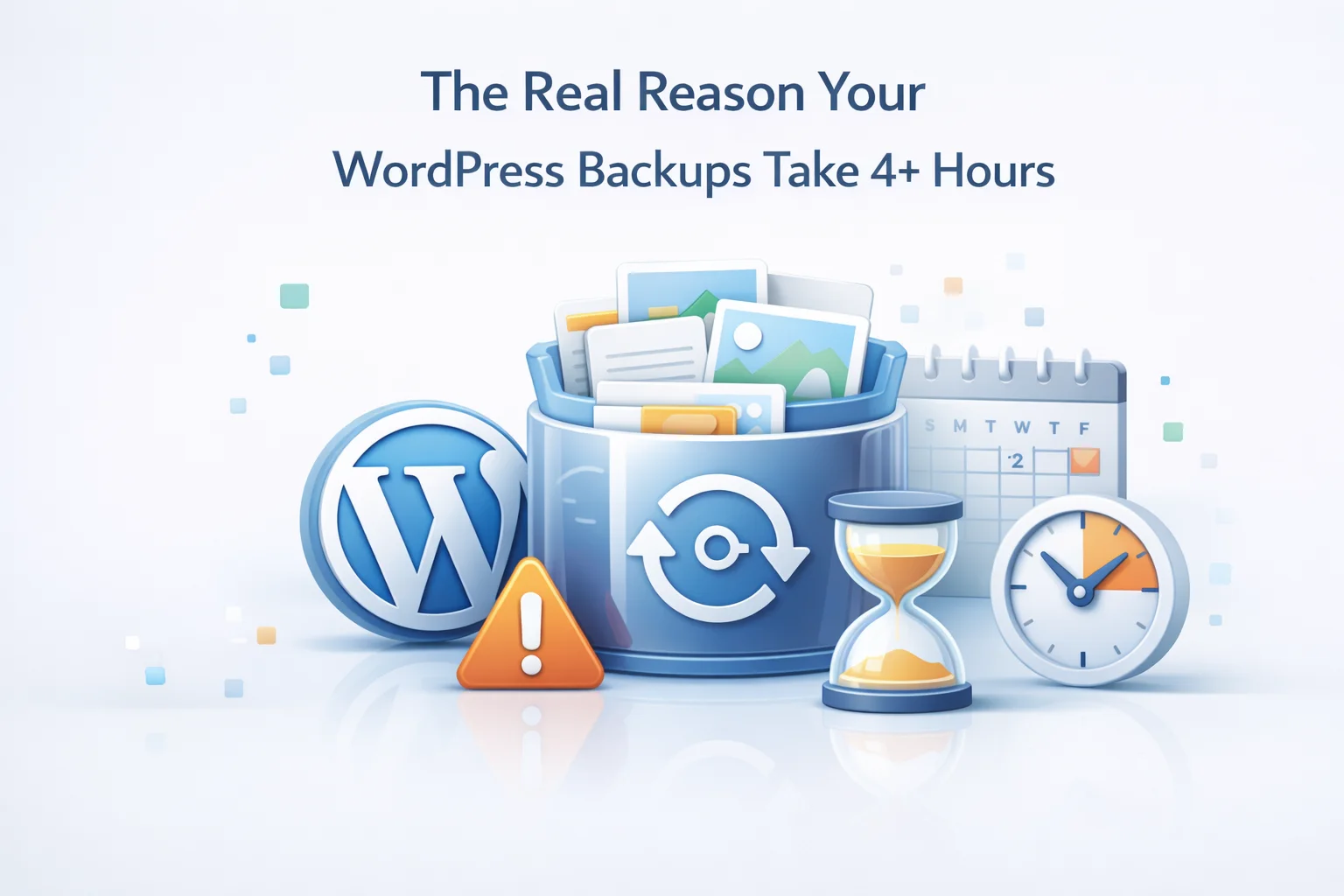
Every WordPress site owner who has been running a serious site for more than a year has encountered the slow backup problem. The backup job starts at midnight, and when you check in the morning it either finished at 4am or timed out partway through. The backup archive is 18GB. Your hosting storage is filling up with multiple copies of it. Restoring from it, if you ever needed to, would take hours.
The instinctive response is to look at the backup plugin settings, try a different backup plugin, or upgrade to a faster hosting plan. These responses address the wrong layer of the problem. The backup is slow not because the backup system is inefficient but because of what is inside the backup archive. Specifically, it is slow because your media library — potentially thousands of image files totalling many gigabytes — is included in every backup run, every night, even though it almost certainly did not change since yesterday.
This guide explains exactly what is inside a typical WordPress backup, how much of it actually changes between backup runs, and how restructuring your media storage eliminates the slow backup problem structurally rather than symptomatically.
A full WordPress backup contains four categories of data. Understanding what each category contains, how large it is, and how frequently it changes is the foundation of a rational backup strategy.
The numbers in that table tell the complete story. Up to 97% of a typical WordPress backup is the media library. And 98 to 99% of that media library did not change since yesterday’s backup. You are spending four hours every night backing up files that are identical to the files you backed up the night before. The backup system is not inefficient. The backup strategy is.
The database — which changes constantly, contains your actual business data (orders, customer records, posts, settings, user accounts), and is the component that actually needs to be backed up frequently — is less than 5% of the backup archive. It could be backed up in seconds on its own. Instead it sits inside a 20GB archive that takes four hours to create and store, and would take equally long to restore from.
Beyond the time waste of backing up unchanged files repeatedly, including the media library in daily backups creates specific operational risks that are worth understanding before the risks become incidents.
When a backup job runs on a schedule and times out because the media library is too large, many backup plugins record the job as completed or partially completed without clear error notification. You may believe you have a current backup when in reality the last successful complete backup was two weeks ago, before the media library grew past the timeout threshold. Discovering this during an actual disaster recovery situation is the worst possible moment.
If your backup plugin stores archives on the same hosting server you are backing up, a 14-day retention policy creates 14 copies of your 18GB media library totalling 252GB of backup archives on a hosting plan that may only provide 30GB of storage. This creates a circular problem: the media library is large, the backups of the media library consume more storage, triggering storage warnings, which are caused partly by the backup archives of the media library.
A disaster recovery event, whether a hacking incident, a database corruption, or an accidental content deletion, creates time pressure. Every minute your site is down or broken costs you in traffic, revenue, and credibility. Restoring from an 18GB backup archive takes as long as creating it: four or more hours. If the incident was a database corruption that a 50MB database backup could resolve in three minutes, you have spent four unnecessary hours restoring image files that were not affected by the incident at all.
Cloud backup services like BackBlaze B2, Amazon S3, or Google Cloud Storage charge based on storage used and data transferred. Including your media library in offsite backups means paying cloud backup storage and transfer costs for the largest component of your site, even though it changes least frequently. As your media library grows, your backup costs grow proportionally, creating an ongoing expense that scales with catalog size rather than with business value.
A rational WordPress backup strategy separates the four components of a WordPress installation and backs each one at a frequency appropriate to how often it changes and how critical its loss would be. This is not a complex strategy. It is simply treating different data types differently rather than bundling everything into one monolithic job.
Archive size: 18GB
Duration: 4 to 6 hours
Offsite transfer: 18GB nightly
Retention (14 days): 252GB
Restore time (full): 4 to 6 hours
Monthly backup cost (B2): ~$1.26/mo storage + transfer
DB backup size: 200MB
DB backup duration: 45 seconds
Offsite transfer: 200MB nightly
Retention (14 days): 2.8GB
Restore time (DB only): 2 minutes
Monthly backup cost: Near zero
Moving your media library to an external FTP server is the structural change that enables the rational backup strategy described above. Once media is on FTP, your WordPress hosting server’s wp-content/uploads directory is empty. Your backup plugin no longer has a large uploads directory to process. The backup job shrinks immediately to database plus application files, which in most cases is under 1GB and completes in minutes rather than hours.
The FTP server’s contents can be managed with its own backup approach entirely separately from WordPress. Most FTP storage providers allow you to enable point-in-time snapshots or versioning at the storage level, which provides media file protection without any active backup job. Alternatively, a dedicated backup tool like rclone can perform incremental syncs of the FTP server to a cloud backup destination, transferring only new or changed files rather than the entire library.
A backup that has never been tested is not a backup. It is a hypothesis. Many WordPress site owners discover this distinction for the first time during an actual recovery event. Here is how to verify that your backup strategy, once restructured around the media offload approach, is reliably protecting the data it is supposed to protect.
Once a month, take your most recent database backup and restore it to a local development environment or staging server. Verify that your WooCommerce orders, post content, and plugin settings are present and correct. A database backup that cannot be successfully restored is not a backup. This test takes 10 minutes and should be calendar-scheduled.
Connect to your FTP server with an FTP client and browse the directory structure. Confirm that the file and folder hierarchy matches what WordPress expects. Spot-check several images by downloading them directly and confirming they open correctly. This takes five minutes and confirms that your media files are intact and accessible on the FTP server.
Quarterly, perform a full site recovery drill on a staging environment: restore the database, deploy WordPress core and plugins, configure WP FTP Media to point at the FTP server, and verify that the site displays correctly with all images loading from the CDN. This drill confirms that your entire recovery process works end to end and identifies any gaps before a real incident does.
To ground this in concrete outcomes, here are the backup metrics from three representative WordPress sites before and after implementing media offload and the separated backup strategy.
The third case study is the most striking for agencies: backup storage cost dropped from $18 per month to $0.14 per month across eight sites. Not because the backup strategy was compromised but because it was corrected. The data that actually needed backing up was already a tiny fraction of what was being included. Removing media from the backup scope revealed the real size of what matters.
According to iThemes Security’s WordPress risk research, the ability to restore quickly after an incident is one of the most important practical security postures a WordPress site can have. A 45-second database backup that restores in 2 minutes provides better real-world protection than a 4-hour backup that times out, restores in hours, and leaves you uncertain whether the backup even completed. WP FTP Media’s WordPress backup transformation plugin enables this improvement by removing the component that makes the current backup slow, large, and unreliable from the hosting server permanently.
WP FTP Media moves your WordPress media library to external FTP storage, empties your uploads directory on the hosting server, and transforms your daily backup from a 4-hour media transfer into a 45-second database export that actually completes reliably every night.





Hey, this guide finally put words to the exact issue I've been fighting for months. my backups were crawling because no surprise 97% of that 18GB archive was just the same media files over and over
As a school principal managing our district's WordPress site, I've wasted so many nights waiting for backups to finish. This guide finally explained why turns out, we were backing up the same giant media library every single night for no reason. Moved those files to FTP storage instead, and now backups fly through in minutes. wish I'd known this years ago!
I've been fighting slow WordPress backups for years, trying different plugins and even upgrading servers. this guide finally made me realize I was attacking the wrong problem. Moving my media library to FTP storage cut my backup time from 3+ hours to under 20 minutes
Hey guys, just had to leave a quick review because this guide literally saved my site. I was so frustrated with my backups taking forever every night, and I kept blaming my hosting or the plugin. turns out I was backing up the same giant media files over and over for no reason! The breakdown of what's actually in the backup was such an eye opener. fixed my setup in like an hour and now backups fly through. So glad I stumbled on this wish I'd found it sooner!