
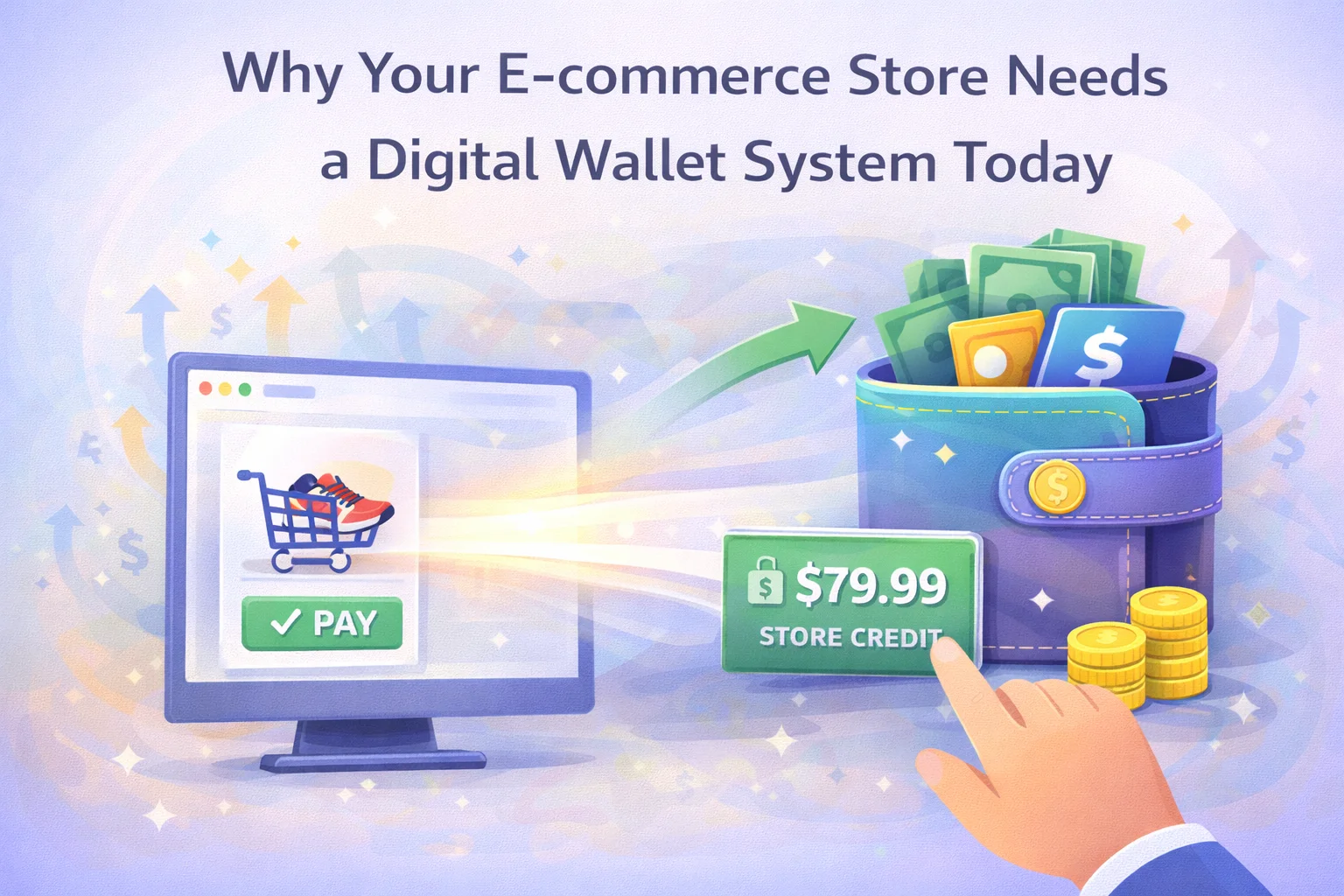
Think about the last time you used a coffee shop loyalty app. You did not open it because you were forced to. You opened it because there was money in it — a balance that only existed inside that specific ecosystem, earned through purchases you had already made, waiting to be spent. That balance changed your behaviour. You chose that coffee shop over the one across the street, not primarily because the coffee was better, but because you had credit there. And the coffee shop did not discount a single cup to earn your loyalty. They simply gave you a reason to come back that felt like it already belonged to you.
That mechanism — a credit balance inside a closed ecosystem, funded by purchases and cashback, that creates a persistent pull back toward the store — is exactly what a WooCommerce digital wallet system delivers. The coffee shop version costs tens of millions of dollars to build. The WooCommerce version is available as a plugin, configurable in an afternoon, and starts influencing customer behaviour from the first order that earns a cashback reward.
Most WooCommerce stores in 2026 still do not have one. Not because the technology is complex or expensive — it is neither — but because wallet systems have historically been associated with large platforms and enterprise retailers, and the assumption has persisted that they require either a massive customer base or a custom-built solution to be worthwhile. Both assumptions are wrong, and this guide will explain precisely why.
A digital wallet system is one of the few features a WooCommerce store can add that improves nearly every dimension of the customer relationship simultaneously: checkout speed, repeat purchase rate, cancellation recovery, refund management, and customer lifetime value. Understanding how each of those improvements works — and why they compound rather than simply add — is the starting point for deciding whether to implement one.
What a WooCommerce digital wallet actually is
A digital wallet in the WooCommerce context is a stored-value account attached to a customer’s profile. Customers can add funds to it directly — via credit card, bank transfer, or any payment method your store accepts — and those funds can be used to pay for orders at checkout, either in full or as part payment alongside another method. The wallet also receives credits from cashback rewards, refunds, cancellation recoveries, and any manual adjustments the store admin makes.
From the customer’s perspective, it behaves like a prepaid balance — similar to a gift card, but more flexible, more transparent, and more rewarding. From the store’s perspective, it functions as a loyalty and retention mechanism with a direct financial structure: money in the wallet is money already committed to the store, representing a near-certain future purchase rather than a hypothetical one.
A discount code reduces the price of a transaction that might happen. A wallet balance is a credit that already exists and already belongs to the customer. The psychological difference is significant: discount codes require the customer to choose to use them; wallet balances create an active motivation to use them. A customer with $22 in their store wallet is not passively aware of a potential saving — they are the custodian of an asset that needs to be deployed. That shift in framing changes behaviour in measurable ways.
The wallet in a well-implemented WooCommerce system is also a two-way instrument. Customers can top it up voluntarily, spend from it at checkout, check their transaction history, earn cashback that lands in it automatically, and — crucially — request a withdrawal if they want their money back. That last feature is what makes a wallet system trustworthy rather than coercive. A wallet customers can exit is a wallet customers will enter.
The six things a wallet system does for your store simultaneously
Most e-commerce features solve one problem. A wallet system solves six — and the solutions are interconnected in ways that produce compounding effects over time rather than isolated improvements.
Faster checkout — payment without re-entering card details
Checkout abandonment is highest at the payment step. A customer with a wallet balance can complete their order in seconds without touching a card. The friction of entering payment details — which represents a genuine barrier for a measurable percentage of customers on every device, and a particularly large one on mobile — is removed entirely for wallet users. Faster checkout means higher conversion on the orders that would otherwise fail at the final step.
Cashback rewards — loyalty that compounds automatically
A cashback system that credits a percentage of every completed order back to the wallet creates a compounding loyalty loop. The customer spends, earns a small reward, has a balance that represents value they would lose by shopping elsewhere, and returns to spend again — partly to use the credit, and partly because the store has become the path of least resistance. This loop does not require any active management once configured. It runs on every qualifying order, automatically, indefinitely.
Cancellation recovery — keeping refund revenue in the ecosystem
When an order is cancelled and the refund goes back to the customer’s card, that money leaves your ecosystem permanently. When it goes to their store wallet — optionally with a small bonus credit — the revenue stays in your store, the customer has a ready-made reason to re-order, and the cancellation becomes the beginning of the next transaction rather than the end of the customer relationship. This single configuration change can recover a significant portion of monthly cancellation losses.
Smarter refunds — resolving disputes without losing the customer
A store credit refund, processed quickly and generously, resolves the vast majority of customer disputes without initiating a chargeback. A customer who receives a prompt wallet credit — available immediately and with a small goodwill bonus — has far less incentive to escalate to their payment provider than one waiting 5–7 business days for a card refund. The wallet refund is faster for the customer and better for the store’s dispute rate.
Pre-committed revenue — customers who top up are already spending
A customer who voluntarily adds funds to their store wallet has pre-committed to a future purchase before they have even chosen what to buy. They are the highest-intent segment in your customer base — and the money is already in your store. Encouraging wallet top-ups, especially with a modest top-up bonus or reward, turns browser sessions into committed purchases before the customer has made a single product decision.
Customer lifetime value — the compounding effect of a retained buyer
Each of the five effects above increases customer retention in its own way. Faster checkout reduces abandonment. Cashback creates a loyalty loop. Cancellation recovery turns exits into returns. Better refunds prevent churn. Pre-committed top-ups anchor spending intent. All five operating together produce a customer lifetime value that is materially higher than the same customer would generate without a wallet system — not because any single feature is transformative on its own, but because they compound. A retained customer who buys three times a year instead of once is not three times as valuable: they have zero acquisition cost on purchases two and three.

The cashback system: designing a reward loop that works
The cashback component of a wallet system is where most of the loyalty value is created — but it is also where configuration decisions matter most. A cashback rate that is too low does not change behaviour. One that is too high erodes margins faster than the loyalty it generates is worth. Getting this right requires understanding what cashback actually does psychologically, and what rate achieves that effect at a sustainable cost.
Cashback works by creating a deferred reward — the customer spends today and receives a small credit that makes their next purchase marginally cheaper. This deferral is important. Unlike an instant discount, which reduces the perceived value of the current transaction, a deferred reward is additive: it makes both the current purchase and the next one feel more valuable. The customer leaves the current transaction satisfied, and arrives at the next one with a head start. Neither transaction was discounted. Both felt like good value.

In practice, 3–6% cashback on completed full-price orders is the effective range for most WooCommerce stores. Below 3%, the credit accumulates too slowly to feel meaningful — customers notice it in their account but it does not create urgency. Above 6%, margins begin to compress unless offset by the increase in repeat purchase volume the cashback generates, which requires a relatively high baseline repeat rate to justify.
The conditions attached to cashback matter as much as the rate. Restricting cashback to completed orders only — not pending, processing, or refunded — ensures rewards are issued only on genuine transactions. Excluding sale-price products from cashback eligibility prevents the system from layering discounts in ways that create unsustainable margins. And configuring automatic cashback reversal on cancellations closes the loop that would otherwise allow customers to earn rewards on orders they do not intend to keep.
All of these conditions are configurable from a single tab in Nexu Smart Wallet — and they can be adjusted at any time as the store’s data reveals how customers are responding to the current structure.
Top-ups and the voluntary deposit: turning browsers into committed buyers
One of the most underappreciated aspects of a wallet system is the voluntary top-up. When a customer adds funds to their wallet before they have even chosen what to buy, something important has happened in the store’s relationship with that customer: the financial commitment to the next purchase has already been made. The question is no longer whether they will buy from you, but what they will buy.
Customers who top up their wallets voluntarily are the highest-intent segment in any store that offers this feature. Their average time to the next purchase is shorter. Their average order value tends to be higher. Their cancellation rate is lower, because they are spending money they have already designated for this specific store rather than making an on-the-spot spending decision. And they are significantly more likely to become long-term repeat buyers than customers who pay by card on each individual transaction with no ongoing credit relationship with the store.

Transaction transparency: why visibility is the foundation of trust
A wallet system that customers do not trust is a wallet system that customers do not use. Trust in a financial feature is built almost entirely through transparency: can the customer see exactly where every credit came from? Can they see exactly where every debit went? Do they understand what their current balance means and how to use it? And — most importantly — do they know that they can get their money out if they want it?
The transaction history page is one of the most important pages in a well-designed wallet system. A customer who checks their transaction history and sees a clear, itemised record of every cashback credit, every purchase deduction, every top-up, and every refund — with dates and order references — experiences the wallet as a transparent financial instrument rather than a black box. That experience builds the kind of trust that turns occasional users into habitual ones.


The admin side: running and measuring the wallet system
The customer-facing half of a wallet system is what creates the loyalty and retention effects. The admin-facing half is what allows you to understand how well it is working, intervene when needed, and adjust the configuration as the data evolves. A wallet system without adequate admin tools is a system running blind — and adjusting a system you cannot see requires guesswork rather than judgement.
Nexu Smart Wallet organises its admin interface across dedicated tabs — Dashboard, Transactions, Cashback, Wallet, Logs, Withdrawal Requests, and Reports — each providing a focused view of a specific aspect of the system. The structure means you can check the overall health of the wallet in the Dashboard, drill into specific transaction anomalies in the Logs tab, and review cashback performance in the Cashback tab, without those tasks interfering with each other.


Settings: making the wallet work exactly the way your store needs
A wallet system is not a one-size-fits-all feature. The configuration decisions — how cashback is calculated, what happens at cancellation, how withdrawals are managed, how the wallet looks in the customer account — need to reflect the specific structure and customer base of your store. Nexu Smart Wallet organises this configuration across a set of focused settings tabs, each covering a distinct aspect of the system.


Getting started: the setup wizard and initial configuration
One of the genuine barriers to implementing features like wallet systems in the past was setup complexity. Configuring a multi-component financial feature across a WooCommerce store — cashback rules, withdrawal settings, cancellation behaviour, email notifications, appearance — used to mean navigating a series of unrelated settings menus and hoping they interacted correctly. That is not how Nexu Smart Wallet works.
The plugin includes a Setup Wizard that guides the initial configuration in a single sequential flow — covering every key setting in a logical order, with explanations of what each option does and why it matters. A first-time configuration of the entire system typically takes 20–30 minutes. After that, the wallet is live on every customer account, cashback is being earned on qualifying orders, and the cancellation recovery system is running automatically.

Frequently asked questions
The window between when digital wallet systems became technically accessible to independent e-commerce stores and when they became widely adopted is closing. Stores that implement a well-structured wallet system now — with cashback rewards that create a loyalty loop, cancellation recovery that keeps revenue in the ecosystem, and a transparent customer experience built on trust — are building a structural advantage in retention that is genuinely difficult for competitors without one to replicate. Loyalty is not just an emotion. It is a credit balance sitting in a customer’s account, waiting to be spent.
The customers who use your wallet will spend more, cancel less, return more often, and cost you less to retain than customers who do not. That is not a projection — it is the documented behaviour of every major platform that has implemented this model successfully, now available as a WooCommerce plugin configured in an afternoon.
Nexu Smart Wallet — loyalty, cashback, and retention built into your WooCommerce store
Customer wallet with top-up and withdrawal. Cashback rewards on every purchase. Cancellation recovery that keeps revenue in your store. Full admin dashboard with reports, transactions, and logs. Everything you need to build real customer loyalty — in one plugin, on your existing WooCommerce store.

Okay, so I grabbed this digital wallet plugin for my WooCommerce store mostly because the price was way lower than I expected. That whole "coffee shop loyalty app" comparison in the description got me those things cost a fortune to build, but this plugin does something similar for pocket change? Count me in. Setup wasn't terrible once I actually read the guide in the settings (yeah, I skipped it at first). the concept of customers having a balance they want to spend is pretty clever.
This actually works like my coffee shop app. Customers keep coming back because they've got credit waiting.
Just wanted to share how this wallet system actually changed how I think about my own purchases. I run a small contracting business and use WooCommerce for parts and supplies, and now I catch myself wanting to go back to stores where I've got a balance just sitting there