Next-Level Code. Nexuvibe Style ...
Hrs
Min
Sec

Building a WordPress site that successfully generates consistent, high-volume traffic is incredibly difficult. Managing that site once it actually succeeds, however, is a completely different operational nightmare. When you finally achieve the exponential growth you engineered your business for, the very mechanisms of that success begin to break down under their own weight. The systems and manual processes that worked flawlessly for one hundred daily visitors critically fail at ten thousand.
This operational friction manifests in two distinct, crippling bottlenecks that suffocate digital businesses. The first is the sheer volume of repetitive human interaction. As traffic scales, your inbox floods with pre-sales questions, basic support tickets, and repetitive navigation queries that a human operator must manually read, process, and reply to. The second bottleneck is structural and silent. As your content library expands to capture more search share, managing the internal architecture — specifically the internal link graph that dictates how search engines crawl, understand, and value your site — becomes a cognitive impossibility for any human editor.
You find yourself trapped in a paradox of success. You cannot write new, high-value content because you are too busy answering basic support emails. You cannot answer emails effectively because your site architecture is too poorly linked for users to find their own answers organically. Hiring more human agents to solve these problems destroys your profit margins, turning what should be a high-leverage digital asset into a traditional, bloated, low-margin service business.
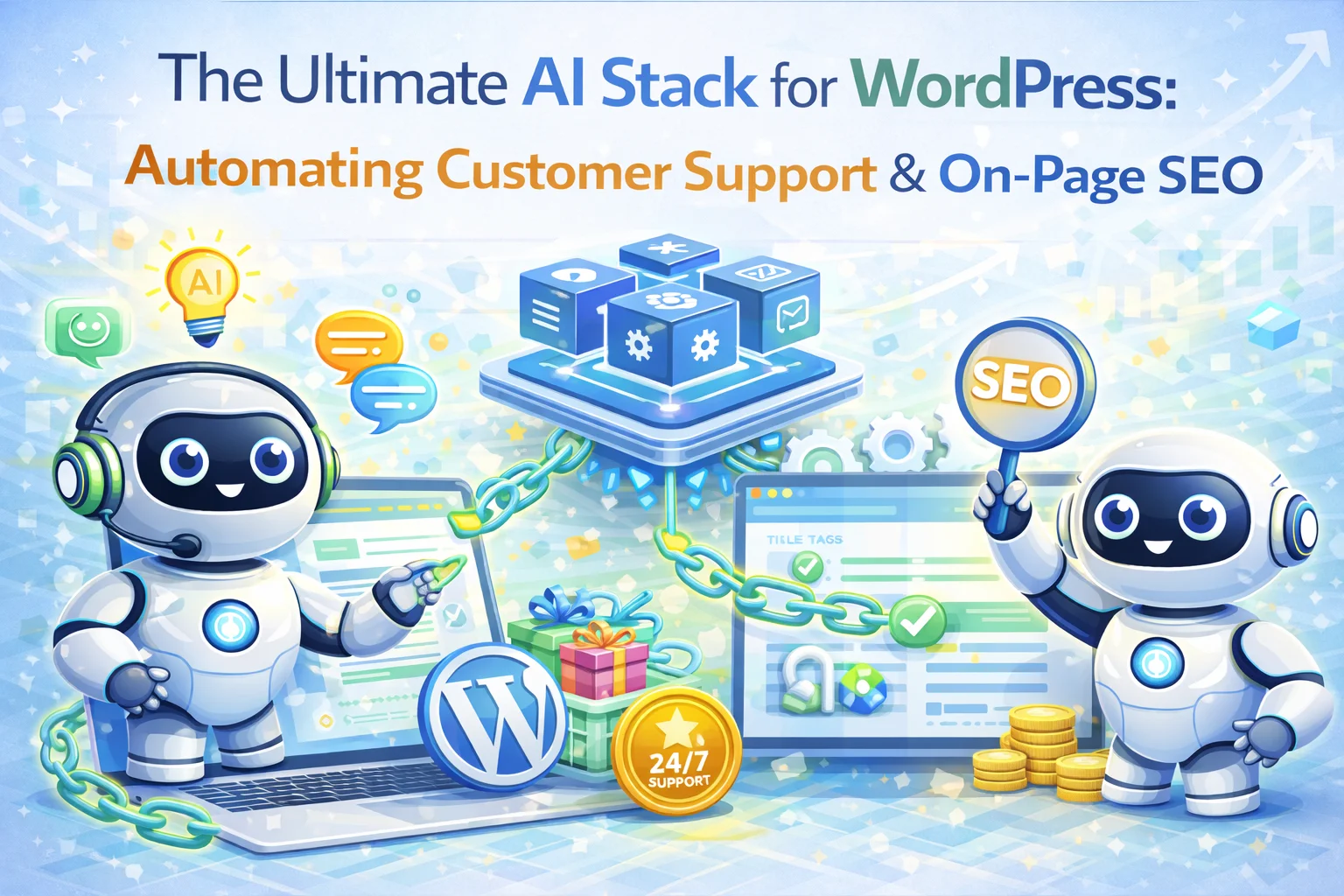
The solution is not working harder. The solution is not hiring a fleet of virtual assistants. The solution is adopting a strict, uncompromising automation protocol. By implementing a highly specific, purpose-built AI stack directly into your WordPress environment, you can entirely remove human effort from both customer support routing and on-page SEO structuring. This guide details exactly how to deploy this ultimate stack, focusing on the two critical systems that transform a manual website into a fully autonomous, self-sustaining digital asset.
Customer support is effectively a tax on your business success. Every new visitor, every new subscriber, and every new customer brings a statistical probability of a support query. If you sell a digital product, offer a B2B service, or even just publish dense technical content, people will ask questions. Historically, digital business owners had two bad options. Option one: ignore them, aggressively hide the contact page, degrade your brand trust, and lose lucrative sales. Option two: hire a tier-one support staff, immediately tying your operational overhead and payroll directly to your traffic volume.
The promise of artificial intelligence was supposed to fix this overnight. In the past couple of years, early adopters rushed to integrate generic ChatGPT API wrappers onto their WordPress sites. The results, as many discovered the hard way, were disastrous.
These basic bots suffered from a fatal, unfixable flaw known in the industry as hallucination. Because they were trained on the entire public internet, they acted like overconfident salespeople who didn’t actually know your product. If a user asked about your specific return policy, shipping times to Europe, or the exact pricing of your premium tier, a generic AI would confidently invent an answer. It would promise 30-day unconditional refunds you do not offer. It would invent product features that do not exist. It would quote pricing tiers from your competitors.
A hallucinating chatbot is not just annoying; it is actively dangerous to your business liability and reputation. This fundamental failure led many serious operators to abandon AI support entirely. They reverted to human agents, incorrectly assuming the technology simply was not mature enough for enterprise use.
They were not entirely wrong about the technology failing, but they were using the wrong architecture. The solution to AI hallucination is not a “smarter” general model; it is a restricted, deeply localized architectural framework called RAG, combined with frictionless automated indexing. This is the exact engineering philosophy behind the Nexu AI Chatbot for WordPress, which was built specifically to solve the liability issue of rogue AIs.
RAG changes this by intercepting the user’s query. When a customer asks a question, the system first performs a lightning-fast semantic search across your specific database. It retrieves the exact paragraphs from your docs. It then packages those facts and sends them to the AI with a strict prompt: “Answer using ONLY these facts. If you don’t know, say so.” It turns the AI from a creative writer into a strict librarian. Deploying a smart chat assistant plugin with auto-indexing guarantees zero hallucinations.
RAG is incredibly powerful, but traditionally, it was an enterprise-level nightmare to maintain. It required a data engineer to set up. You had to manually export your WordPress data, chunk the text, convert it into vector embeddings using a Python script, and store it in a dedicated vector database like Pinecone.
Worse, every time you updated a blog post, changed a policy, or adjusted a price on WooCommerce, you had to manually trigger this pipeline again to ensure the chatbot had fresh data. If you forgot, the chatbot would confidently give customers outdated information. For a fast-moving WordPress site, this manual maintenance entirely defeated the purpose of automation.
This is where Auto-Indexing separates true enterprise tools from basic wrappers. The Nexu AI Chatbot for WordPress actively listens to native WordPress hooks. When you hit “Update” on a post, a page, or a WooCommerce product, the plugin instantly detects the change in the background. It automatically chunks the new text, generates fresh vector embeddings via the API, and updates the local vector store seamlessly. The chatbot is always, flawlessly synchronized with the exact state of your website, requiring zero administrative oversight.
Consider a site receiving 50 support queries daily. A human agent takes roughly 6 minutes to read, research, and reply to a standard ticket. That equates to 5 hours of intensive labor every single day. An auto-indexed RAG chatbot resolves 85% of these tier-one queries instantly. The human workload drops from 5 hours to 45 minutes of handling only highly complex, escalated edge cases. You reclaim 20+ hours a week without sacrificing customer experience. The system pays for itself in the first 72 hours of deployment.
Once the bleeding of human hours is stopped by the chatbot, your attention must immediately pivot to traffic generation. You need to maximize the structural value of the content you publish. The most universally neglected aspect of on-page SEO is internal linking. It is neglected because, much like customer support, it is intensely tedious, brain-numbing human labor.
Search engine crawlers rely entirely on internal links to understand site hierarchy, distribute page authority (link equity or “link juice”), and discover newly published content. A perfectly linked site creates tight, semantic topical clusters that search engines actively reward with higher rankings. A poorly linked site is merely a collection of isolated islands that Google struggles to contextualize.
In the early days of a site, manual linking is highly feasible. You write post number 30, and you clearly remember writing post number 12, so you highlight a phrase and insert the hyperlink. However, human memory is strictly linear and keyword-dependent. By the time you reach post 100 or 200, it is mathematically and cognitively impossible for an editor to hold the entire content graph in their working memory.
To solve this structural decay, you must remove the human from the architecture entirely and deploy a smart SEO interlinking plugin for WordPress.
Older interlinking plugins were effectively blind. They operated on hardcoded, rigid logic: “Find the exact word ‘marketing’ anywhere on the site, and link it to URL X.” This resulted in highly repetitive, robotic, and highly penalizable link profiles. Google’s algorithms have evolved significantly past exact-match anchoring; they now look for contextual relevance and natural, varied phrasing.
Modern automation utilizes the exact same vector embedding technology that powers the RAG chatbot. An advanced automated AI internal linking plugin for WordPress does not look for specific keywords. Instead, it reads a paragraph, comprehends the underlying concept, searches your entire database for other posts that discuss highly related concepts, and then intelligently selects natural, conversational text within the paragraph to use as the anchor text.
For example, it will seamlessly link a paragraph discussing “reducing server load times” to a pillar post about “advanced caching strategies,” even if the words “caching” or “server” do not strictly overlap in the specific sentences. It understands the conceptual bridge. This semantic mapping creates a link graph that is structurally flawless, deeply contextual, and completely impervious to algorithmic penalties because it perfectly mimics—and exceeds—expert human editorial judgment.
The comparison above illustrates why scaling linearly with human capital is fundamentally flawed in modern digital ecosystems.
The framing of “complete automation” can sound intimidating to site owners who are used to micro-managing their properties. The reality of how top SEO professionals and technical founders use tools like the Nexu Automated AI Internal Linker and the Nexu AI Chatbot is not a blind hand-off. It is a highly controlled hybrid workflow. AI does the heavy lifting, but human judgment remains the final checkpoint.
Set your internal linker’s auto-apply threshold at a level that represents genuine mathematical confidence — say, 0.85 or higher. Suggestions above this threshold are applied automatically. You never need to see them unless you want to review the batch history. This covers 80% of linking work with zero manual involvement.
Links that score below your threshold but above a minimum relevance cutoff sit in a review queue. A weekly ten-minute review of these borderline cases is where human editorial judgment adds genuine value — deciding whether an edge-case link is worth placing in that specific context.
With the chatbot handling the actual conversations, your human team’s role shifts from answering questions to analyzing chat logs. You look for questions the bot couldn’t answer because the information wasn’t on your site. You then write a new FAQ or blog post covering that gap. The auto-indexer immediately picks it up, and the bot learns. It is a continuous improvement loop.
Treating these tools in isolation misses the broader strategic advantage. When you deploy a WordPress auto-indexing RAG chatbot alongside a semantic AI internal link builder, you create a closed-loop ecosystem that fundamentally changes how your business operates.
Consider the lifecycle of a single piece of content in this environment. You publish a highly detailed guide on a technical issue your customers frequently face. The exact moment you press publish, the ecosystem springs into action without a single command from you.
First, the Internal Linker scans the new document. It understands the deep semantic context, maps it against your thousands of existing posts, and immediately injects highly relevant outbound links into your new text. Simultaneously, it scans your archives, finds old posts that conceptually relate to your new guide, and surgically updates them to link forward to the new page. The new post is instantly integrated into the site’s power structure, ensuring search engines crawl it quickly and assign it high authority. Traffic begins to flow.
Second, the Auto-Indexing engine of the Chatbot detects the new publication. Within milliseconds, the new technical guide is vectorized, chunked, and added to the RAG database. Ten minutes later, a user visits your site and asks the chatbot a question related to that specific topic. Because the chatbot is perfectly synchronized with your live data, it instantly retrieves the facts from the guide you just published, formats an accurate, hallucination-free answer, and provides it to the user.
You did nothing but press publish. The site generated its own SEO authority, captured its own traffic, and handled the resulting customer inquiry autonomously. This is the definition of leverage. This is how small, high-performance teams outmaneuver massively funded corporate competitors.
The resistance to handing over core business functions to AI is real, and some of it is well-founded. Let us address the legitimate technical concerns directly.
The shift toward an autonomous AI stack is not happening because digital operators have become lazy. It is happening because the scale of modern digital business has fundamentally outgrown what careful manual processes can handle. Delaying the integration of these tools is an active financial decision to burn money on payroll and bleed organic traffic. The math is brutal and uncompromising.
Hiring a single junior SEO specialist to audit and update your internal link graph costs upwards of $4,000 per month. They will take weeks to analyze a moderately sized site, and their work will begin decaying the moment they finish as new content is added. Hiring a single tier-one support agent costs another $3,500 per month, plus the operational overhead of management and inevitable human error. You are looking at nearly $100,000 in annual recurring costs to solve two problems that software can now solve instantly, permanently, and with mathematical precision.
The competitive landscape of WordPress publishing has shifted permanently. The sites that dominate the next decade will not be the ones with the largest manual teams. They will be the ones that run incredibly lean, utilizing tools like the Nexu AI Chatbot and Nexu Internal Linker to handle the structural and support burdens autonomously, freeing their human capital to do the only thing AI cannot do: create uniquely original, deeply human primary content.
Let the Nexu AI ecosystem index your data, answer your customers with zero hallucinations, map your semantic links, and drive your growth automatically. Build a self-sustaining digital asset today.





Hey, still having link trouble.
Didn't expect the AI to actually stick to my site's content like this. No made up features, no random answers just pulls straight from my WordPress database. Saved me hours of cleaning up after bad chatbot replies
Hey guys, quick question about scaling with this setup. right now we're at about 5k daily visitors and our support team is drowning in basic questions. the article mentions "autonomous RAG support agents" handling enterprise traffic without adding staff does this actually replace human support for those repetitive queries, or is it more of a first line filter before tickets
Hey everyone, just wanted to share how this AI stack saved my sanity as a single parent running a WordPress site on the side. i was drowning in customer emails same questions over and over while trying to keep up with my kid's schedule. no way could I afford a full support team, and VAs just added more chaos