Next-Level Code. Nexuvibe Style ...
Hrs
Min
Sec

If you run an SEO agency or work as a freelance consultant across multiple WordPress projects, you have lived this scenario more than once. A new client comes in with a WooCommerce store that has 120 categories, 600 blog posts, and almost no internal link structure. The team digs in. A week later, fifteen categories have solid content and the other 105 are still waiting. The backlog grows faster than the work gets done.
This is not a capability problem. It is a scale problem. And scale does not get solved by working harder it gets solved by building smarter workflows. The agencies that have figured this out are not hiring bigger teams. They are automating the right parts of the process so their existing teams can focus on what actually requires human expertise.
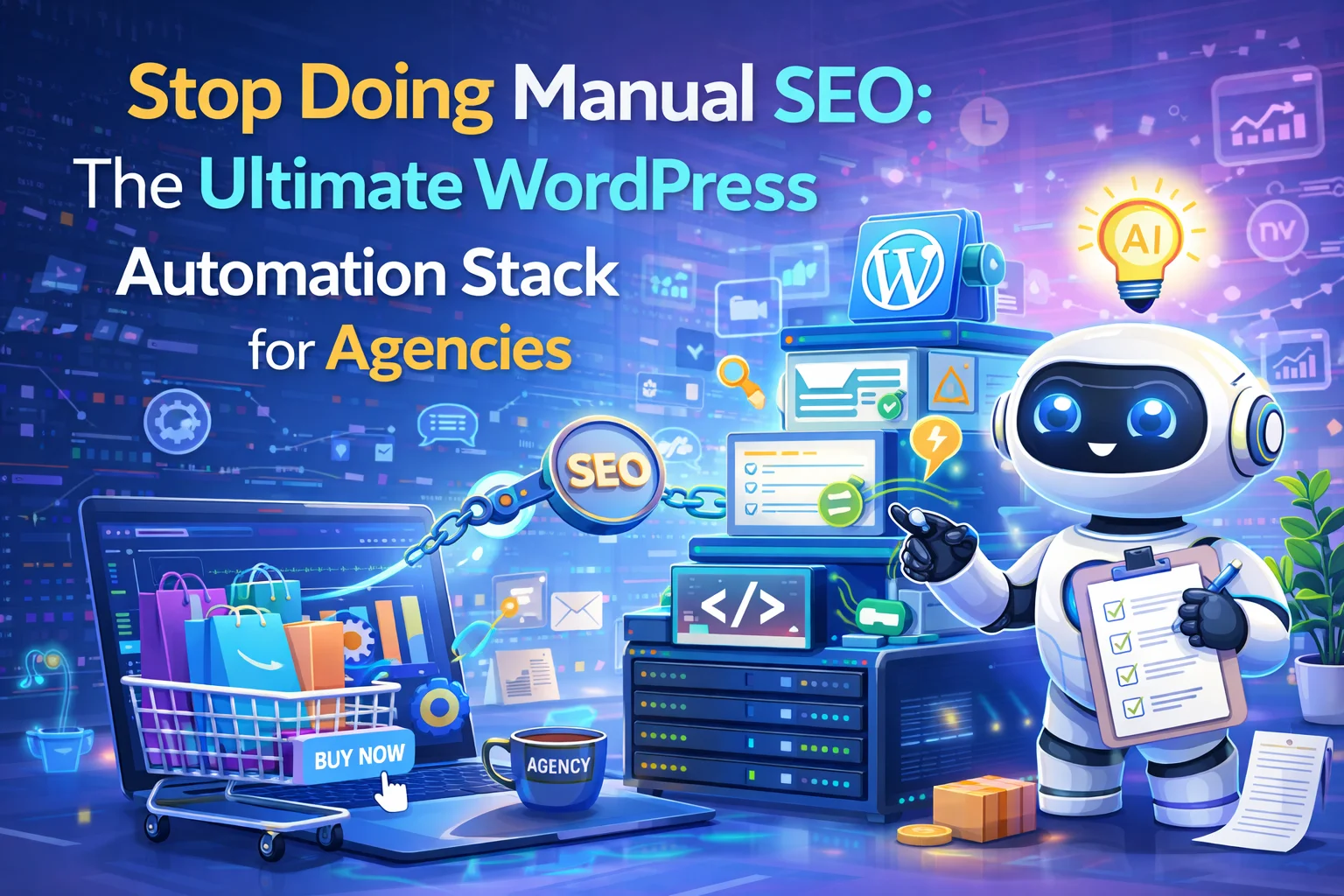
This article is a practical look at what a real WordPress SEO automation stack should include for agencies and developers managing multiple sites. Specifically, we will cover how Nexu AI Category SEO handles the bulk content production problem and how Nexu Automated AI Internal Linker handles the structural link building problem and why using them together creates an effect that is significantly larger than either tool on its own.
No exaggerated promises. Just an honest look at what these tools actually do and where they genuinely change the economics of agency SEO work.
Most SEO agencies have the same structural problem, and most of them do not frame it correctly. They think of themselves as sellers of time. Each hour of the team’s work gets allocated to a project, and when the hours run out, the engagement ends. This model works fine at small scale. At larger scale, it creates constant capacity pressure and puts a hard ceiling on how much the agency can grow without proportionally growing the team.
The bottlenecks that eat the most time in SEO agency work tend to cluster around two things: producing structured content for template-driven pages (category descriptions, FAQ sections, schema output) and building and maintaining internal link structures across large content libraries. Both are essential. Both are deeply repetitive at scale. And both are the kind of work that benefits enormously from systematic automation rather than individual human effort.
Consider the math. If producing solid SEO content for a single WooCommerce category takes 45 minutes of skilled work writing the intro, the body content, and a structured FAQ section then a store with 120 categories represents 90 hours of work before a single other task gets touched. At agency billing rates, that is a significant budget line item that the client either pays for or that eats into your margin. Neither option scales well.
When most SEO professionals hear “bulk content generation,” they picture low-quality templated text with obvious repetition the kind of content that fills space without saying anything useful. That image comes from older tools that worked by inserting keywords into fixed templates. What Nexu AI Category SEO does is structurally different.
The plugin was built specifically for WooCommerce category pages, with an understanding of what those pages actually need to do. A good category page has to orient the visitor immediately, signal topical relevance to search engines, and pre-answer the questions buyers have before they start comparing individual products. Filling in text is not the goal. Creating pages that work is.
The plugin generates three layers of content per category. The first is an intro section that appears above the product grid, giving visitors immediate context before they start scrolling through product cards. The second is a longer SEO content section placed below the products, which builds topical depth without pushing the product grid too far down for the initial visitor. The third is a structured FAQ block, configured to output clean schema markup that supports FAQ rich results in search.
Critically, none of this content is generated blind. Before producing output for a category, the system reads the category name, breadcrumb path, target keywords you have specified, existing description text, products within the category, and sibling category names. The result is content that is contextually anchored to the actual page rather than generic text that could apply to any category on any store.
One of the more practical design decisions in this plugin is that it does not lock you into a single AI provider. You can connect OpenAI, Claude, Gemini, DeepSeek, Mistral, or Grok. For agencies, this matters for two reasons. First, you can optimize costs by choosing lighter models for high-volume generation tasks and stronger models for higher-stakes content. Second, you are not exposed to sudden price changes or policy shifts from a single provider.
The setup also includes a two-step creator-to-humanizer pipeline. One model handles the initial drafting and the second model refines the output for natural language flow. In practice, this produces content that reads more like careful editorial work and less like AI generation with an obvious signature.
A persistent issue with bulk content generation is that AI will sometimes write exact prices, stock claims, time-sensitive language, or discount promises that become inaccurate as soon as conditions change. The Content Rules system in this plugin lets you define these guardrails before any generation runs. Every piece of bulk content produced will respect the rules you set no manual cleanup required after the fact.
The Display tab lets you control exactly where generated content appears on category pages above products, below products, or via shortcode without modifying the client’s theme files. For agencies working across different themes and setups, this is a meaningful practical advantage. The generated content slots into the existing page structure cleanly.
Every setup tab exists in service of one outcome: running the Bulk Generator. Instead of entering each category one by one, you select all categories that need content or filter by those that have no existing description and run generation for all of them in a single operation. The system processes in the background. You can close the browser, work on something else, and come back to a completed queue.
That background processing design is not a small thing. It means running bulk generation on a 150-category store does not require a team member to sit and supervise it. It runs while other work happens. At the end, the content is there for review and refinement not built from scratch, just edited where needed.
Good content without internal link structure is half a job. Google relies heavily on a site’s internal link graph to understand the topical architecture and to distribute ranking authority across pages. Pages that lack sufficient incoming internal links often rank well below their potential even when the content itself is strong. For agencies inheriting sites that have been published without a linking strategy, this is one of the most impactful problems to fix.
The challenge is that internal link building at scale requires something no human team member can actually do: holding awareness of an entire content library simultaneously, understanding the topical relationship between every page and every other page, and making consistent link decisions across hundreds of documents without unconscious bias toward recent or popular content.
When you inherit a site with hundreds of posts and no coherent internal link structure, the scale of the problem can feel almost paralyzing. Going post by post and adding links manually represents months of work that will still be incomplete when it is done, because no human reviewer can maintain consistent quality across that volume.
The Bulk Linker Tab in Nexu Automated AI Internal Linker changes this entirely. You select the posts you want to process the full archive, a filtered subset, or specific post types and the system builds vector embeddings of each piece of content. It then evaluates semantic similarity across every possible pair, identifying connections based on actual topical proximity rather than keyword overlap.
The output is a queue of link suggestions, each scored by relevance confidence. High-confidence suggestions can be set to apply automatically. Lower-confidence suggestions sit in a review queue where a team member can approve, edit the anchor text, or dismiss. Critically, every applied link is fully reversible. For agencies working on client sites, that undo capability is not optional it is the thing that makes the tool safe to use at bulk scale.
For agencies managing multiple sites, the analytics dashboard is one of the most underrated parts of the plugin. The dashboard shows an overall SEO health score, orphan page count, average incoming links per post, and link distribution analysis all updated in real time. Information that used to require expensive external crawling tools to approximate is now available directly inside the WordPress admin.
For client reporting, this creates a new category of data you can share: concrete before-and-after metrics on internal link structure that clients can understand without needing to know what a vector embedding is. The health score and orphan count are intuitive KPIs that show structural improvement even to non-technical stakeholders.
Each of these tools delivers real value independently. But the compounding effect of using them together is where the agency economics genuinely shift. Here is what a full onboarding of a large WooCommerce site actually looks like when both tools are in the stack.
Day one: you install Nexu AI Category SEO, configure the AI provider connection, define content rules that match the client’s brand voice and guardrails, and run the Bulk Generator across all categories that lack content. You can be doing other work while it runs. By the end of the day, every category page has structured intro text, SEO body content, and a FAQ section with schema output. Work that previously would have taken a content team two to three weeks is complete.
Day two: you install Nexu Automated AI Internal Linker, index the full site content library, and run the Bulk Linker across the entire archive. High-confidence suggestions apply automatically. The review queue for borderline suggestions gets a pass from a team member in a focused session. By end of day, the site has a coherent internal link graph where it previously had almost none. Orphan pages are connected. Mid-tier content is linked from topically relevant, higher-authority sources for the first time.
At the end of two days, the site’s SEO foundation is structurally stronger than it has ever been. Without this stack, achieving the same result would have required weeks of team effort and the result still would have been incomplete because manual processes cannot sustain that coverage at scale.
This comparison reflects performance on sites with over 100 posts and categories. At smaller scale the gap narrows; at larger scale it widens considerably.
Giving automation tools an honest evaluation means being clear about where they genuinely excel and where they are genuinely limited. For agencies, this distinction is practically important not just philosophically.
The core challenge of running an SEO agency has always been the same: how do you maintain quality as the volume of work grows beyond what any team can individually sustain? The old answer was always hire more people. The answer that works at scale in 2026 is different.
Pairing Nexu AI Category SEO for bulk WooCommerce content generation with Nexu Automated AI Internal Linker for bulk smart link building creates the kind of SEO automation stack that used to be available only to large agencies with dedicated engineering teams. The structural work that defines a well-optimized WordPress site gets done at a fraction of the time cost and done consistently, without the quality degradation that manual processes inevitably produce at volume.
Agencies that have already made this shift are taking on more clients with the same team, delivering faster initial results, and spending more of their team’s capacity on the strategic work that actually differentiates their service. The ones who have not made the shift yet are spending that capacity on category descriptions and internal link spreadsheets.
The question is not whether this transition makes sense. The economics are clear. The question is how much longer it makes sense to wait.
Two tools. One outcome: structural SEO work that used to take weeks, done in hours. Full human control over every final decision.




Eh, saved some time but still fixing links
Hey everyone! Just had to share this because it's been a game saver for our small agency. We used to drown in backlogs like, the work piled up way faster than we could knock it out
Just had to share this because it honestly saved my team so much stress. We run a mid sized marketing agency, and the hours we used to sink into manual SEO tasks were insane especially for clients with huge websites