
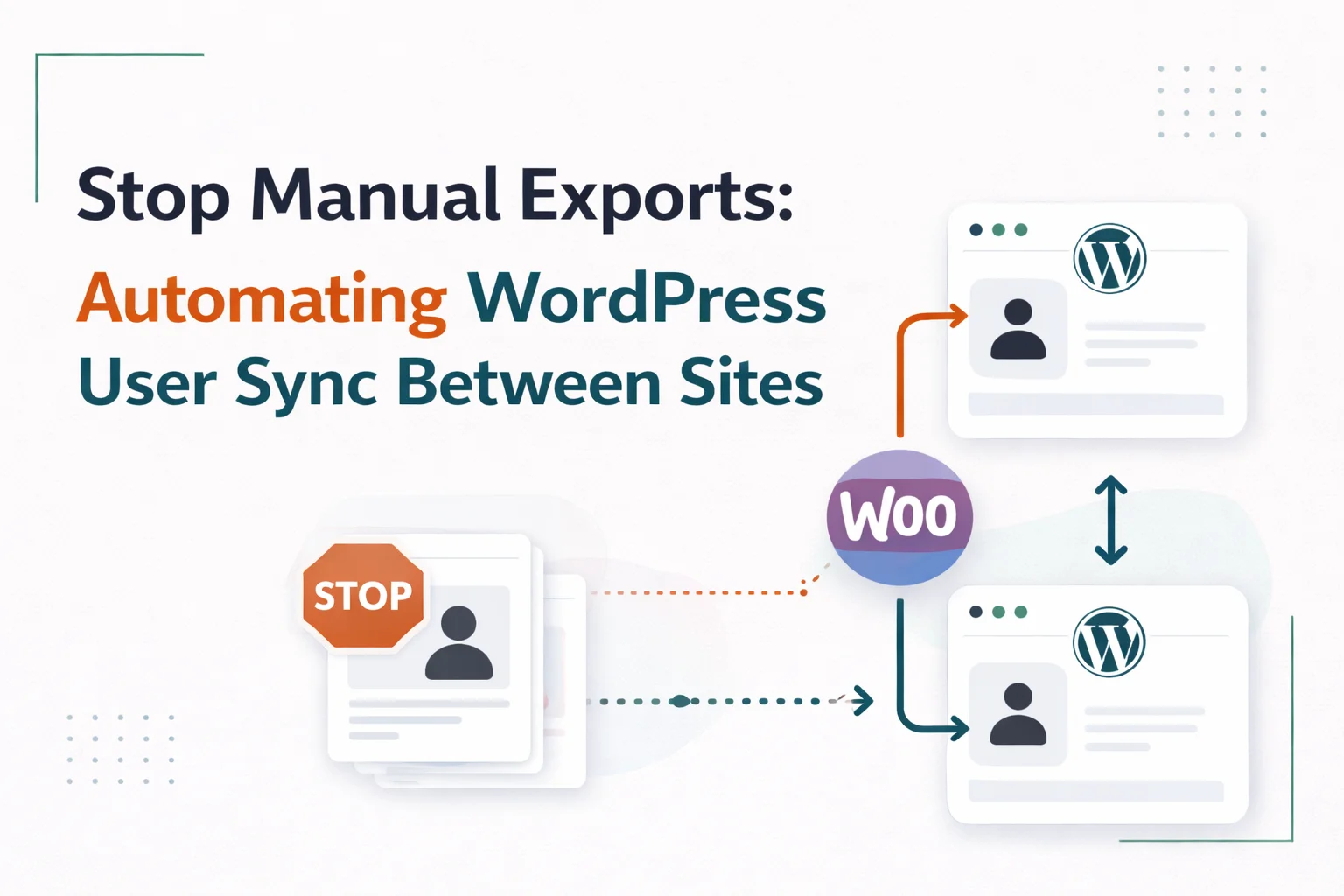
Every site administrator who manages more than one WordPress installation knows the export routine. You open the Users screen, export to CSV, open the file in a spreadsheet application, clean out the columns the import tool will reject, check for emails that already exist on the destination site, remove duplicates, save, switch to the other site, import, fix the errors that came back, and then close the tab and try to remember how long it will be before you have to do this again. A week? Two weeks? Whenever someone emails to say their account does not exist on the other site.
This workflow is not a solution to the user sync problem. It is a workaround that you have accepted as normal because nothing better was obviously available. But the workaround has real costs that compound over time: the hours spent on repetitive manual work, the user data that inevitably drifts out of sync between exports, the support tickets from users whose profiles are different on two sites they thought were connected, and the creeping anxiety every time something changes and you are not sure whether the last export captured it.
This guide is about stopping that routine permanently. Automating WordPress user sync between sites is not a complex project. It does not require custom development, server access, or restructuring your existing infrastructure. It requires the right plugin, configured correctly, running quietly in the background while you do literally anything else.
The real cost of the CSV export workflow
Let us be precise about what the manual export process actually costs, because the tendency is to absorb it as an invisible overhead rather than account for it as a real business expense.
A single export-clean-import cycle for a site with a few hundred users takes between 30 and 90 minutes depending on how clean the data is and how many errors the import tool throws back. For a site with several thousand users or custom user fields, that climbs to several hours. If you are doing this weekly or even monthly, you are spending somewhere between 6 and 30 hours per year on a task that produces no new value for your business. It maintains the status quo. It prevents things from being worse than they are. That is it.
Manual data processes introduce errors. A column that was mapped incorrectly. A duplicate that was missed in the de-duplication step. A user whose role was overwritten because the CSV had a stale value. An import that ran correctly but only processed 847 of 851 rows because of an encoding issue in four email addresses that contained special characters. These errors are not hypothetical edge cases. They are routine occurrences in manual data workflows, and they create data integrity problems that are often invisible until a user reports a symptom weeks later.
The moment a CSV export is generated, it begins aging. Users who register after the export do not exist on the destination site. Users who changed their email address after the export have the wrong address on the destination site. Users who updated their password after the export cannot log in to the destination site with their new credentials. In a weekly cycle, your data is on average 3.5 days stale at any given moment. In a monthly cycle, it is on average 15 days stale. That staleness has a direct user experience cost every time an affected user interacts with the destination site.
The downstream cost of data staleness arrives as support tickets. “I changed my password but it does not work on the other site.” “I registered last week but I cannot log in here.” “My address on your membership portal is wrong even though I updated it on your store.” Each of these tickets requires support time to investigate and resolve, often involving manual database checks, account lookups across two systems, and manual corrections. The actual cost of the manual export workflow includes not just the time spent exporting but also the support overhead that the resulting data gaps create.
Why scheduled sync is only a partial improvement
The first thing most people try when they want to stop doing manual exports is to automate the export itself. Set up a cron job. Use a plugin that runs an import on a schedule. Configure a workflow that runs every night at 2 AM and syncs users between sites automatically without any manual triggering. This approach is genuinely better than pure manual work, but it does not actually solve the problem. It just makes the problem smaller and less visible.
A scheduled sync that runs every night still leaves up to 23 hours and 59 minutes during which your sites are out of sync. A user who registers at 9 AM will not exist on your secondary site until the sync runs the following morning. A password changed at noon will not work on the other site until after midnight. For active user bases, this is not an acceptable window. The staleness problem is smaller with a nightly schedule than with a weekly manual export, but it is structurally the same problem.
Scheduled sync also shares another limitation with manual exports: it is batch-based. A batch process takes a snapshot of the current state and tries to reconcile it with another database. This creates conflict scenarios that real-time event-driven sync never encounters. If a user updated their email on Site A at 11 PM and then updated it again on Site B at 12:30 AM before the scheduled sync ran, which value is correct? The batch process has no way to know, because it does not track which change happened first. It can only compare the two current states and make a guess.
Real-time event-driven sync does not have this problem because it processes each change as it happens, in order, with a timestamp. The sequence of events is preserved. Conflicts are resolved correctly because the system knows what happened when, not just what the two databases currently say.
How real-time background sync works
Real-time event-driven sync operates on a fundamentally different model from batch exports. Rather than taking periodic snapshots and comparing databases, it listens for specific user events and acts on each one the moment it occurs. The architecture is conceptually simple: when something happens to a user on Site A, Site A immediately notifies Site B, Site B processes the update, and the two databases are consistent again within seconds.
Here is the specific sequence of what happens in the background when a user registers on one of your connected WordPress sites, with no manual action from you at any point.
The sync queue: what protects you when things go wrong
Every production environment has moments where things do not go as expected. A server restart during a maintenance window. A brief DNS propagation issue after a hosting change. A firewall rule that temporarily blocks API calls from an unfamiliar IP. In a manual export workflow, any of these events simply means the next export will be more out of date than usual and you might not notice for a while.
In a properly designed real-time sync system, these events are handled automatically by the sync queue. Every event that cannot be delivered immediately is recorded in the queue with its full payload and delivery attempt history. The system retries delivery on a schedule until the event is successfully processed. When the connectivity issue resolves, the queue drains automatically and the destination site catches up to the current state without any manual intervention.

The queue is also your operational safety net in a way that manual exports never were. With manual exports, a site that was offline during the export window simply did not get updated, and you would only discover this if you thought to check. With a sync queue, every undelivered event is visible, timestamped, and tracked. You can see at a glance whether all your connected sites are current or whether one has a backlog that needs attention. The visibility itself is a significant improvement over the opacity of the manual workflow.
What the logs show you that manual exports never could
One of the less obvious benefits of switching from manual exports to automated sync is what you gain in visibility. The manual export process is essentially opaque. You run it, you check for obvious errors, and then you assume it worked. There is no record of which specific users were updated, whether any fields were skipped, or whether the import had any silent failures that did not trigger an error message.

The automated sync log gives you a complete, timestamped record of every sync event across your network. You can see exactly which user triggered each event, which site it originated from, which sites it was delivered to, when it was delivered, and whether it succeeded. If a user reports that their profile update did not appear on a connected site, you can find the relevant log entry in seconds and trace exactly what happened. If a delivery failed, the log shows you the error. If it succeeded, you can confirm the timestamp and close the ticket immediately.
This kind of operational transparency is something the manual export workflow simply cannot provide. You traded it away when you accepted the opacity of batch processing. Getting it back is one of the quieter but genuinely valuable aspects of switching to automated real-time sync.
How to transition from manual exports to full automation
The transition from manual CSV exports to automated real-time sync with Nexu User Sync for automating WordPress user synchronization in the background is straightforward and can be completed without taking either site offline.

Before activating automated sync, run a final manual export from each of your sites and import into the others. This is the last time you will ever do this. The goal is to ensure both databases are reasonably aligned before the real-time sync takes over. Minor discrepancies are fine and will be resolved as users interact with the system, but starting with a reasonably current baseline avoids the automated sync trying to reconcile months of diverged data at once.
Install Nexu User Sync on all sites and connect them via the Connections tab. Generate a unique API key for each site pairing. Test the connection to confirm the two sites can communicate. This typically takes less than ten minutes per connection and requires no server configuration beyond ensuring the sites can reach each other over HTTPS, which is true for any properly configured WordPress installation.
Set up the sync configuration for each connection: which fields to include, how roles should map between the two sites, whether sync is bidirectional or one-way. Then run the bulk sync tool to process existing users in both databases. The bulk sync identifies users that exist on one site but not the other and creates the missing accounts. After it completes, your databases are aligned and real-time sync takes over.
After the bulk sync completes, watch the Logs tab for the next few registrations or profile updates that come through. Confirm that these events are being delivered to all connected sites with a success status. Once you have seen several successful automated sync events, you can be confident the system is working correctly. Delete the reminder in your calendar to run the next manual export. You will not be needing it.
What ongoing maintenance the automated system actually requires
The honest answer is: almost nothing. Once the initial configuration is done and the bulk sync has run, the automated system takes care of itself. There is no regular action required from you to keep user data in sync. No exports to run, no imports to process, no de-duplication to check.

The only routine maintenance that is genuinely useful is a brief periodic check of the dashboard and queue. Once a week, glance at the dashboard to confirm all connected sites show healthy status. If any site shows a queue backlog, investigate the connection. In practice, most sites will show a consistently clean dashboard with no action required week after week.
The other maintenance scenario is configuration updates. If you add a new WordPress site to your network, you add a new connection in the Connections tab and run a bulk sync for that site’s existing users. The configuration for existing connections does not need to change. If you add new custom user fields that you want to include in the sync, you update the field settings for the relevant connections. These are not routine maintenance tasks. They are one-time configuration changes that happen when your network changes.
The comparison with the manual export workflow is stark. The manual process requires regular, predictable blocks of time just to maintain the status quo. The automated process requires a few hours of initial setup and then genuinely minimal ongoing attention. The time you reclaim is real, the errors you eliminate are real, and the user experience improvement for anyone who crosses between your connected sites is immediate and permanent. The Nexu User Sync plugin for fully automated WordPress user sync without manual exports is what makes that transition possible without custom development or infrastructure changes.
The last manual export you run should be the first step of this setup
Nexu User Sync replaces the manual export workflow with real-time background sync that handles every registration, profile update, and password change automatically across all your connected WordPress sites, with a full audit log and a resilient retry queue.




Finally... no more CSV headaches. Worth every minute.
The background sync has saved me hours, but I had to tweak one column that was mapped incorrectly during the initial setup. Once fixed, it just runs no more manual exports or duplicate headaches. Still worth the effort, especially since I don't have to think about it every two weeks anymore.
Okay, so I manage a bunch of WordPress sites for different travel packages we offer, and keeping user accounts synced between them used to be such a headache. This guide actually showed me how to set up an automated sync that runs in the background no more exporting CSVs every week or dealing with duplicate accounts slipping through
Bought this to stop those "account doesn't exist" emails, but honestly? It's just as much of a hassle. still dealing with duplicates and sync problems after setting it up not the set it and forget it fix I was expecting