Next-Level Code. Nexuvibe Style ...
Hrs
Min
Sec

Sarah registered on your main website two years ago. She made purchases, left reviews, built up loyalty points. Then your company launched a regional store on a separate domain. Sarah visited, tried to log in, and discovered her account did not exist. So she created a new one. Same person, same email, but now two completely separate accounts with fragmented purchase history and split loyalty data.
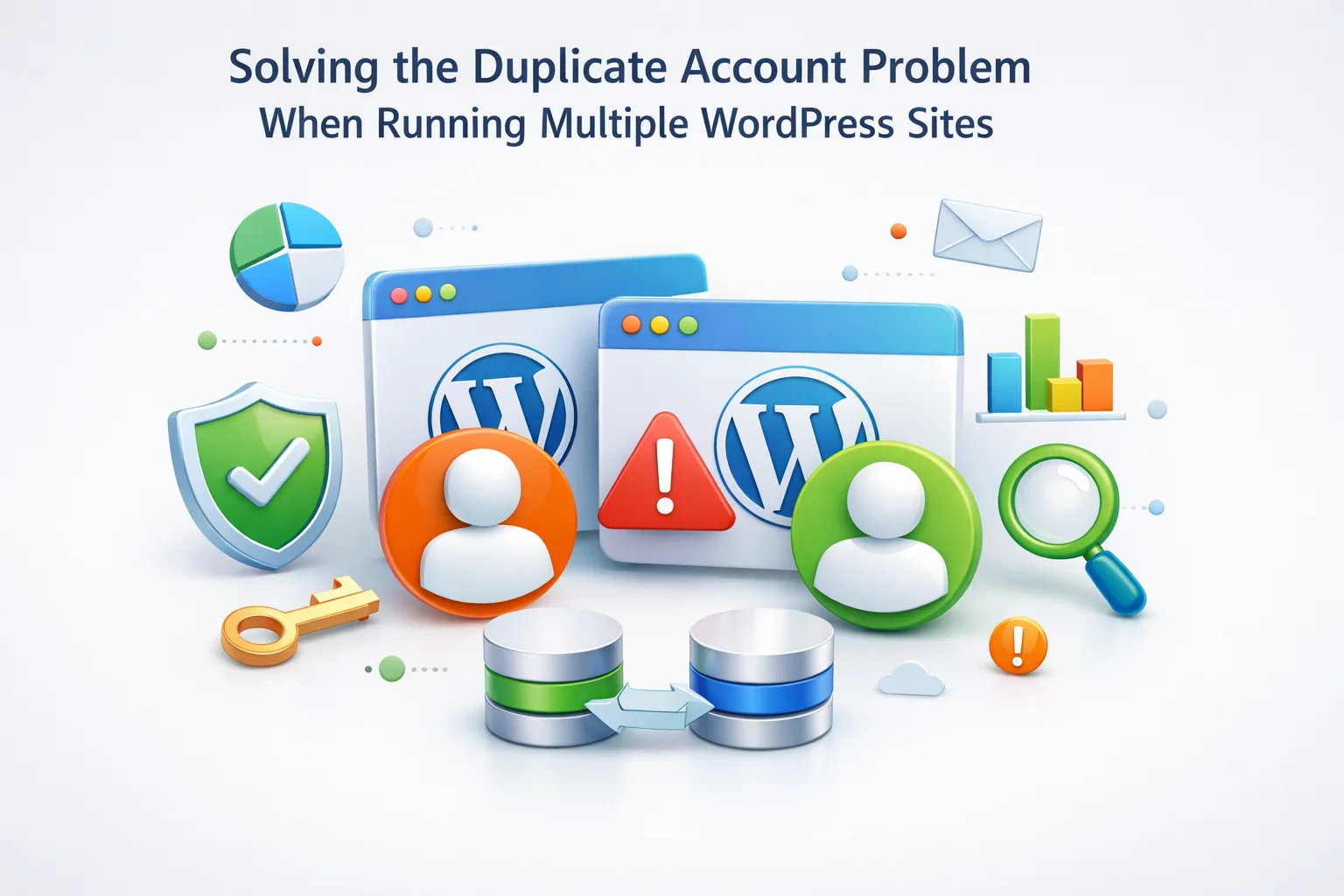
This scenario plays out constantly across multi-site WordPress operations. Every separate WordPress installation maintains its own user database. Without synchronization, there is no connection between these databases. The same person becomes multiple different users, each existing in isolation on their respective sites.
The duplicate account problem is not just an inconvenience. It corrupts your customer data, undermines personalization efforts, breaks loyalty programs, and creates support burden. This guide explains why duplicate accounts form, the real business cost they impose, and exactly how to eliminate them through proper user synchronization.
Each WordPress installation operates as a completely independent system. When you install WordPress on domain-a.com and again on domain-b.com, you have created two separate universes. Different databases, different user tables, different everything. WordPress has no built-in mechanism to recognize that [email protected] on Site A should be connected to [email protected] on Site B.
This isolation is actually a feature in many contexts. It provides security through separation and allows completely different organizations to run WordPress without any risk of data leakage. But for organizations that operate multiple WordPress sites as part of a unified business, this isolation becomes a liability.
Each WordPress installation has its own wp_users table. User ID 1 on Site A is a completely different record from User ID 1 on Site B. Even if both records have the same email address, WordPress treats them as unrelated entries in unrelated databases.
When a user registers on Site B, that registration creates a new record in Site B’s database. Site A has no idea this happened. Site B has no idea the user already exists on Site A. There is no communication between the systems to prevent this duplication.
Users often create different passwords on different sites. Now the same person has multiple credentials to remember. When they reset their password on one site, it has no effect on the other. Password confusion becomes inevitable.
Duplicate accounts might seem like a minor inconvenience, but their impact compounds across your entire operation. The costs are real and often underestimated.
Your customer’s purchase history is split across sites. Their total spend looks lower on each site than their actual relationship value. Personalization algorithms see incomplete data. Marketing segmentation misclassifies customers. Analytics reports show lower customer lifetime values than reality because they cannot connect the dots between accounts.
Loyalty points accumulated on Site A cannot be spent on Site B. Tier statuses do not transfer. Customers feel punished for shopping across your properties. The loyalty program that should encourage cross-site engagement instead penalizes it.
Confused customers contact support asking why their login does not work on Site B. They want to know where their loyalty points went. Each of these tickets takes time to handle and often ends with the unsatisfying answer that the systems are not connected.
The solution to duplicate accounts starts with recognizing that email addresses can serve as a universal identifier. WordPress user IDs differ between sites, but email addresses remain consistent. A user synchronization system that matches by email can unify identities across installations.
When [email protected] exists on Site A and registers on Site B, the sync system recognizes this email already exists in the network. Rather than creating a truly new account, it connects the Site B record to the existing identity. The user’s profile data, password, and other information synchronize. The two records become manifestations of a single identity.
What about duplicates that already exist? Most multi-site operations have been running long enough to accumulate substantial duplicate accounts. A comprehensive sync solution includes migration capabilities to merge these existing accounts.
Cleaning up existing duplicates solves the immediate problem. Preventing new duplicates ensures the problem does not recur. With real-time synchronization active, new registrations propagate instantly across all connected sites.
When a new customer registers on Site A, the sync system immediately creates their account on Sites B, C, and D. When they visit any of those sites, their account already exists. No duplicate registration needed. No duplicate account created.
With duplicate accounts eliminated and synchronization preventing new ones, you achieve something valuable: a unified customer view. Each customer exists as a single entity across your entire network.
The Nexu User Sync plugin provides all the tools needed to solve the duplicate account problem permanently. Merge existing duplicates through bulk sync, prevent new ones through real-time synchronization, and maintain confidence through comprehensive monitoring. One person, one account, everywhere.
Nexu User Sync merges existing duplicate accounts and prevents new ones through real-time synchronization. Give every customer a single unified identity across your entire WordPress network.







This plugin finally fixed our multi site login issues. Sarah can now access all regional stores with one account no more duplicate profiles or lost purchase history. Saved us so many support calls.
Finally fixed my duplicates!
Hey team, long time user here but really frustrated this time. bought this to fix duplicate accounts across our three sites, and yeah, it technically syncs but the real time part? Not happening. Customers still create duplicates because the sync lags by hours. my support team is drowning in "why can't I log in?
Hey, I've got a quick question about this duplicate account issue. the guide mentions WordPress creates separate accounts because each installation is independent but why doesn't WordPress just sync user data across sites by default? seems like a basic feature for anyone running multiple stores. Am I missing something in the setup?