Next-Level Code. Nexuvibe Style ...
Hrs
Min
Sec

Running a WooCommerce store that sells internationally comes with a review problem that rarely gets discussed in e-commerce optimization guides. Your products accumulate reviews in French, German, Spanish, Arabic, Portuguese, Japanese, and a dozen other languages depending on your markets. Each of those reviews contains genuine buyer intelligence: real opinions about product quality, real observations about sizing and compatibility, real answers to the questions your future buyers will have. And most AI review summary tools discard all of it because they were built to process English text.
The practical consequence is that a store with 400 reviews, where 180 of them are written in languages other than English, is feeding an AI tool only 220 reviews and calling the output a complete picture of buyer sentiment. It is not. The 180 discarded reviews contain opinions, concerns, and observations that are as valid as the English ones. The summary that ignores them is systematically biased toward the segment of your customer base that writes in English.
For stores running WPML or operating across multiple regional domains, this problem is compounded further. You may have review databases in multiple languages that need to be analyzed separately for each language context, with summaries delivered to buyers in their own language based on the store’s active language setting.
This guide covers how multilingual review analysis works in practice, what WPML compatibility means for review summary deployment, and how to implement a setup that gives every buyer, in every language, an accurate and complete picture of what your products are like using an AI WooCommerce review summarizer built for multilingual stores.
When a review summary tool silently ignores non-English reviews, most store owners do not notice immediately because the summary looks complete. It is a coherent paragraph about the product. It has pros and cons. It seems to capture the product experience. The problem is invisible unless you know what to look for.
What you cannot see is that the summary reflects only the opinions of buyers who wrote in English, who may be a specific demographic subset of your customer base with different use cases, different expectations, and different purchasing priorities than your French or German or Spanish buyers. If your product sells well in Germany but German buyers consistently report a sizing issue that English buyers do not mention, the English-only summary will not surface that concern. German buyers who read the summary and then encounter the sizing problem will feel misled.
The business impact is return rates that are higher than expected in specific markets, support tickets in languages your team struggles to handle efficiently, and buyer trust erosion in markets where the product experience does not match the summary. All of these are downstream consequences of the same root problem: the review intelligence was built on an incomplete picture of buyer experience.
Contemporary large language models, particularly the models available through the OpenAI, Anthropic, and Google APIs, are trained on text in dozens of languages and handle cross-language analysis with a level of competence that would have been impossible even a few years ago. The practical implication for review analysis is significant.
Modern AI models identify the language of each review automatically as part of the analysis process. There is no need to pre-sort reviews by language or tag them manually. The model reads the review corpus as a whole, detects the language of each entry, and processes all of them together in a unified analysis pass. Reviews in French, German, Spanish, Japanese, and Arabic are analyzed alongside English reviews without any additional configuration.
When a German buyer writes that the packaging was excellent and a Spanish buyer writes that the delivery was fast, the AI can recognize both as positive signals about the fulfillment experience and incorporate them into a summary that reflects the overall consensus. The sentiment is extracted from each language and aggregated into a unified picture. The output summary is written in your store’s primary language regardless of the language mix of the input reviews.
When a concern appears consistently in reviews from one language group but not others, a capable AI analysis can surface this as a specific observation rather than averaging it away in the aggregate. This kind of regional pattern detection is valuable for identifying market-specific product issues, sizing differences, or compatibility concerns that affect specific customer segments and that buyers from those segments need to know about before purchasing.
WPML is the most widely used multilingual plugin for WordPress and WooCommerce. It enables a single WordPress installation to serve content in multiple languages, with separate product pages, categories, and content for each language. For stores running WPML, the review summary deployment has specific requirements that go beyond simple multilingual analysis.
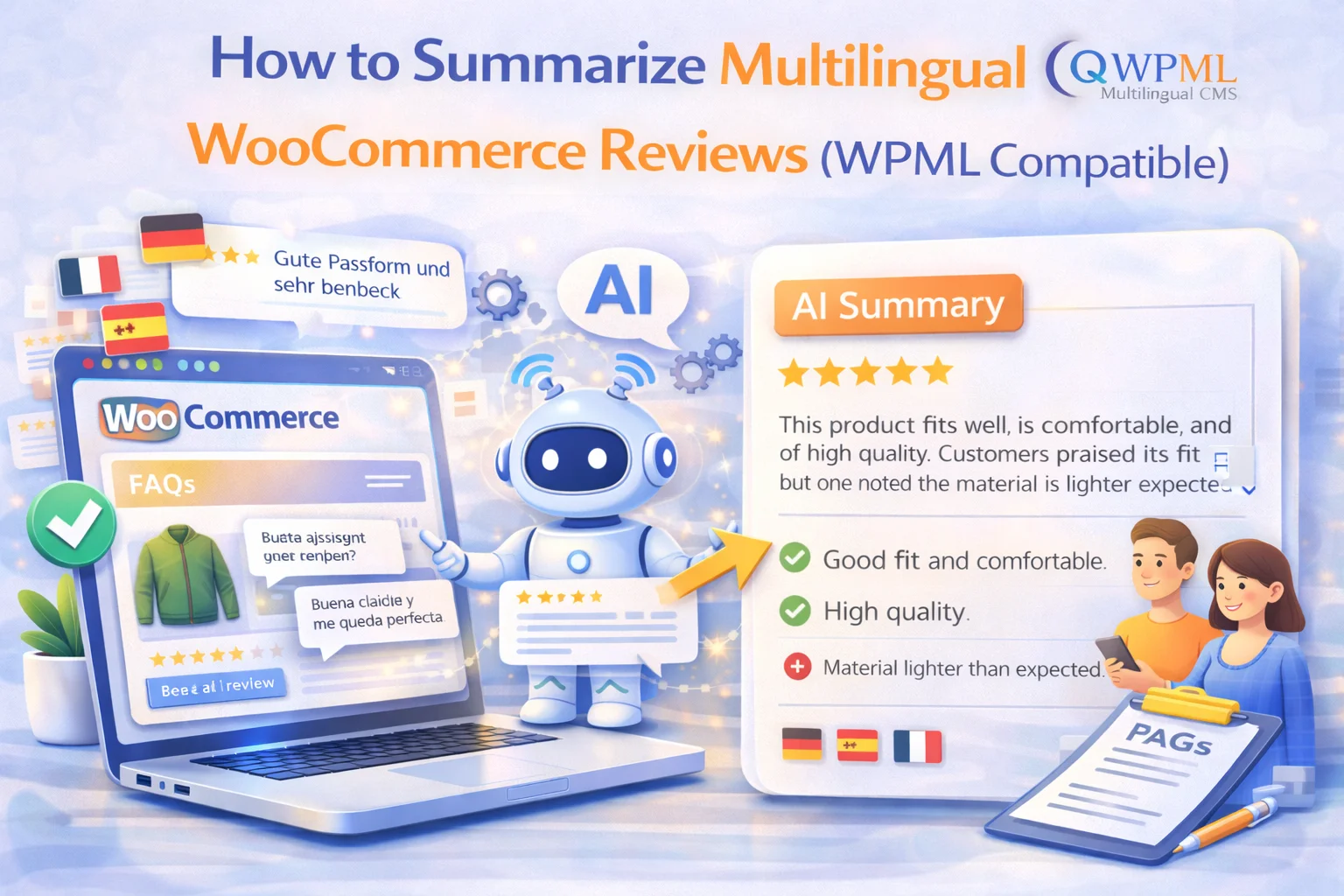
A WPML-compatible implementation needs to deliver the summary in the language that matches the active store language for the current visitor. A French-speaking buyer browsing the French version of your store should see the review summary in French. A German buyer on the German version should see the summary in German. This requires either generating separate summaries for each language version, or generating a primary summary and translating it appropriately for each language context.
In a WPML setup, the same product typically has a single underlying WooCommerce product entry with translated content for each language. Reviews left by buyers across all language versions of the product page are associated with that single product entry. A proper implementation reads this unified review corpus for analysis, ensuring that the summary reflects the full buyer experience across all language markets rather than only the reviews left on a specific language version of the page.
Shortcode-based placement of the summary section needs to work correctly in WPML-translated page templates. Because Nexu AI Review Analyzer uses standard WordPress shortcodes for flexible placement, the summary section can be embedded in product page templates that WPML manages across language contexts, and the output language adjusts based on the active WPML language setting.
The three AI providers supported by the Nexu multilingual WooCommerce review analyzer handle multilingual text with different strengths. For stores with significant review volume in languages other than English, model selection matters more than it does for English-only stores.
Google Gemini has the most extensive multilingual training data of the three major providers, reflecting Google’s decade-long investment in cross-language search and translation technology. For stores with reviews in Asian languages, Arabic, or other non-Latin script languages, Gemini’s multilingual competence is measurably stronger than the alternatives. If your review corpus includes substantial Japanese, Korean, Arabic, or Chinese text, Gemini is the model to test first.
GPT-4o handles European languages, including French, German, Spanish, Italian, Portuguese, and Dutch, with very high quality. For stores primarily selling into European markets with review volumes concentrated in those languages, GPT-4o produces excellent multilingual analysis results. It also handles mixed-language corpora well, correctly identifying and processing each language in a unified analysis pass.
Claude’s particular strength in multilingual contexts is sentiment nuance. Different languages and cultures express positive and negative sentiment with different conventions, levels of directness, and linguistic patterns. Claude tends to handle these cross-cultural sentiment differences more sensitively than the other models, which means the summaries it produces from multilingual corpora are less likely to flatten the genuine differences in how different buyer communities expressed their experience. For premium products where nuance matters, Claude is worth testing on your multilingual corpus.
Getting multilingual review analysis working correctly requires a few specific configuration decisions beyond the standard setup. Here is the recommended approach for international stores.
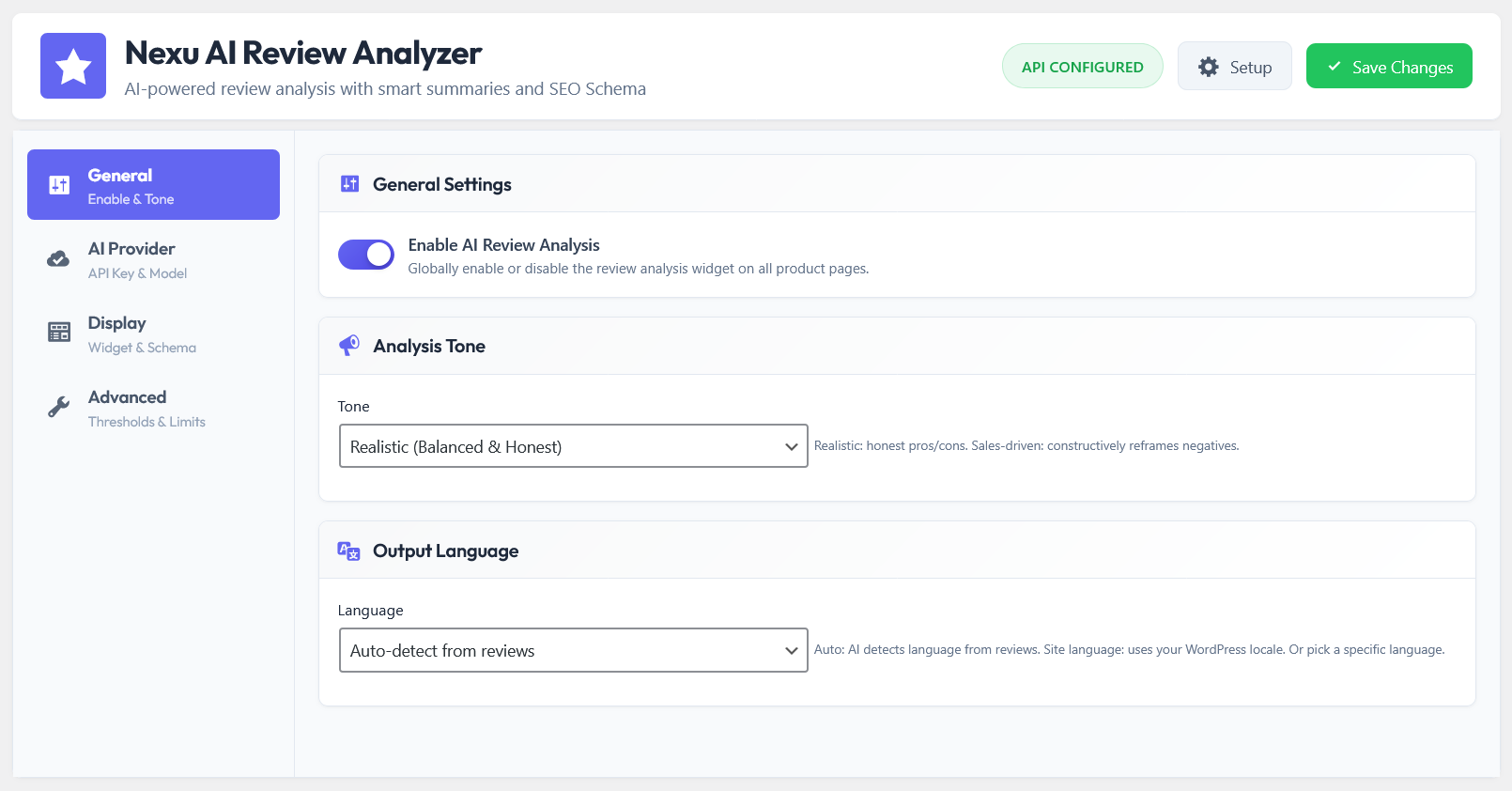
In the General tab, ensure the plugin is configured to include all reviews regardless of language in the analysis corpus. The default setting should include all reviews, but verify this is the case in your installation. If there is a language filter active, disable it so the full review set is analyzed. For WPML stores, also confirm that reviews from all language versions of the product are being included in the corpus.
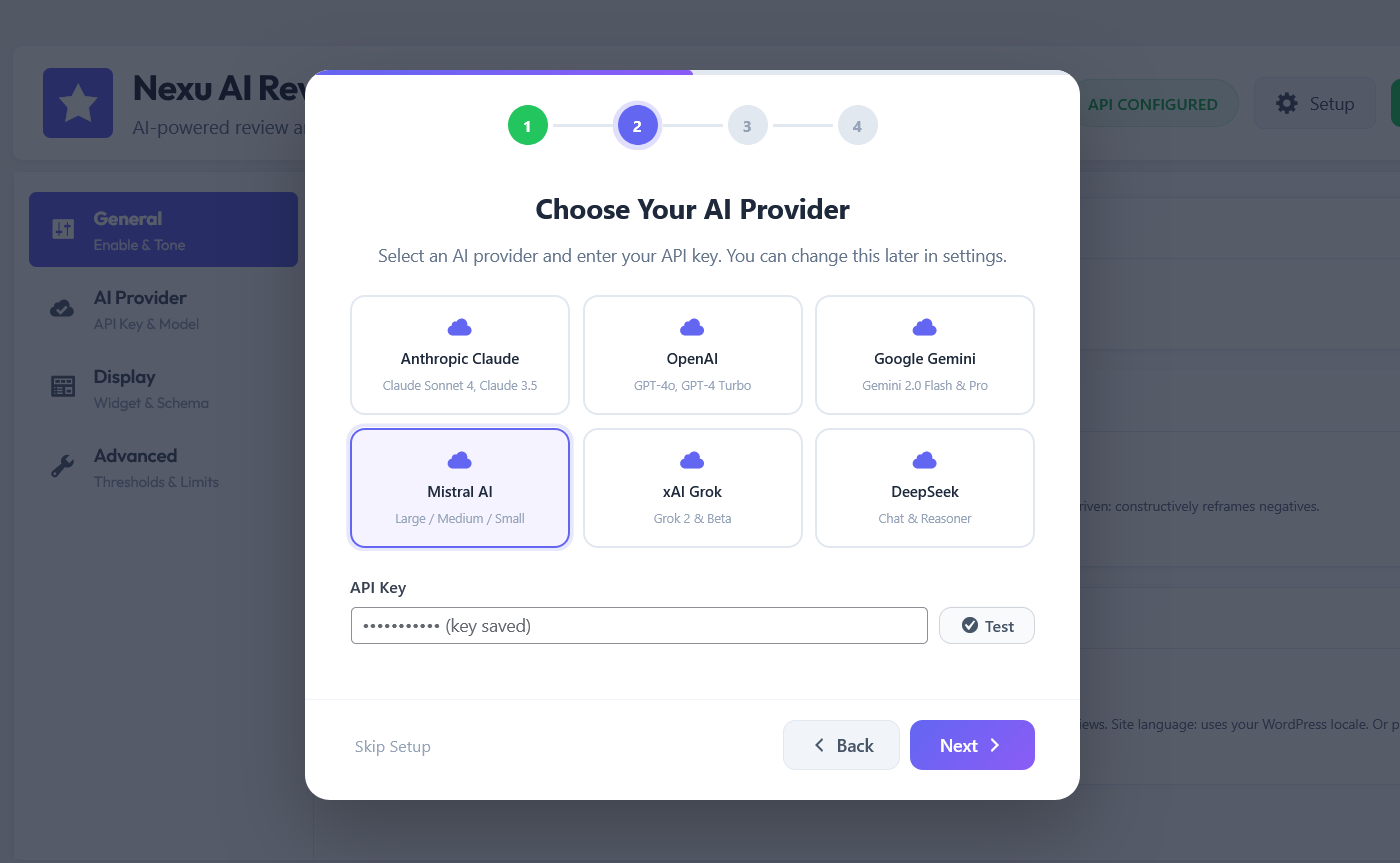
In the API tab, connect your Google Gemini API key and select Gemini as the active model. For stores with non-European language reviews, this is the strongest starting point. If your review corpus is primarily European languages, GPT-4o is an equally strong alternative. The key point is making a deliberate model selection based on your specific language mix rather than defaulting to whichever model you have used for other purposes.
Configure the summary output language in the general settings. For a store with English as the primary language, set the output to English and the AI will analyze all reviews regardless of their language and write the summary in English. For WPML stores, you may want to run separate analyses with different output language settings for each language version of the store, or configure the output language to follow the active WPML language context.
Before running the analysis across your full catalog, choose a product with a large number of reviews in multiple languages and run the analysis on that product first. Read the output carefully and check whether concerns or observations that appear specifically in the non-English reviews are reflected in the summary. This quality check tells you whether the multilingual analysis is working correctly before it scales to your entire catalog.
For WPML stores, use the shortcode placement method rather than relying on the default review section hook. Shortcodes placed in your product page template will render consistently across all language versions of the page and will display the summary in the configured output language for each language context. This is the most reliable approach for ensuring the summary appears correctly in every language version of your store.
For international WooCommerce stores, the gap between an English-only review summary and a genuinely multilingual one is the gap between a partial picture and an accurate one. Every review in your corpus, regardless of the language it was written in, represents a buyer who used your product and reported back on their experience. Including all of them in the analysis produces summaries that are more accurate, more representative, and more trustworthy to buyers from every market you serve.
The Nexu WooCommerce multilingual review intelligence plugin handles the cross-language analysis automatically, with no manual translation work and no pre-sorting of reviews required. Connect the API, set your output language preferences, and the full multilingual review corpus is analyzed as a single unified dataset. The result is a summary that actually reflects what all your buyers think, not just the ones who wrote in English.
Nexu AI Review Analyzer processes your full review corpus across all languages, detects language automatically, aggregates cross-language sentiment, and delivers accurate summaries for every buyer in every market you serve.




Finally found a solution that actually handles multilingual reviews properly! our store gets feedback in Spanish, French, and German daily, and most tools just toss those aside. this guide showed us how to pull insights from ALL reviews not just the English ones. huge for stores with global customers. worth every penny during the sale
Ugh, I was really hoping this would finally fix my multilingual review mess, but nope just another letdown. My shop gets reviews in Spanish, French, and English, and yeah, it says it combines sentiment from all of them, but the summaries still feel like they're mostly pulling from the English ones
A coworker suggested this guide after I wasted way too much time trying to figure out our multilingual reviews. the big takeaway that most AI tools just ignore non English feedback is 100% accurate