Next-Level Code. Nexuvibe Style ...
Hrs
Min
Sec

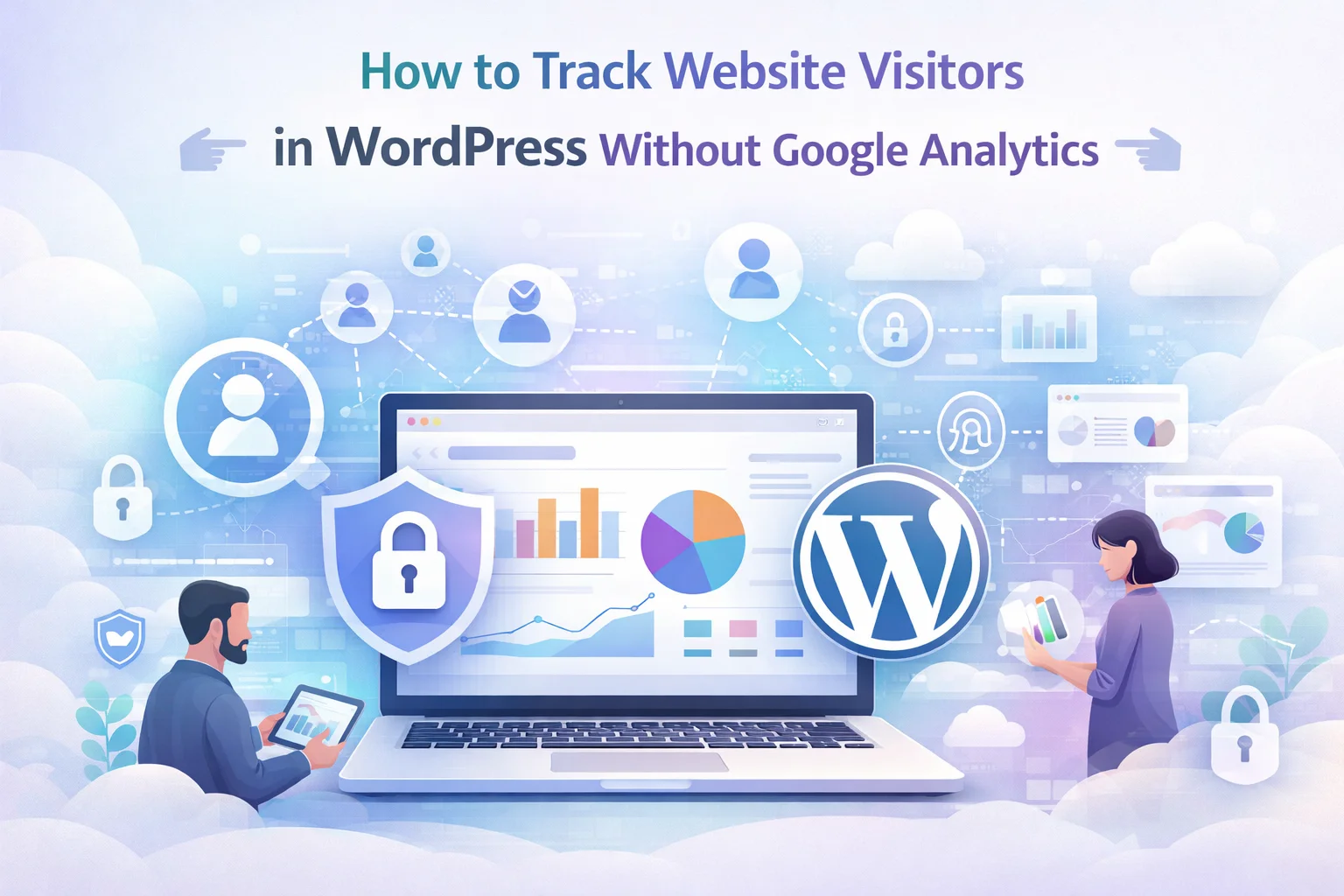
The assumption that tracking website visitors requires Google Analytics is so deeply embedded in WordPress culture that most site owners never question it. You install WordPress, you add GA4, and you wait for data. But this assumption deserves questioning, not because Google Analytics is bad at what it does, but because what it does may not be what you actually need, and the cost of using it, measured in privacy risk, performance impact, and data you do not own, may not be worth paying.
This guide walks you through setting up complete visitor tracking on WordPress without any Google involvement. By the end, you will have real-time visibility into who visits your site, where they come from, what content they engage with, what devices they use, and which traffic sources drive actual results. All of this data will live on your own server, inside your own WordPress database, where you control it completely.
We will use NEXU Real-Time AI Analytics for self-hosted WordPress visitor tracking as the primary tool in this walkthrough because it covers all the tracking capabilities we need in a single plugin. However, the principles apply regardless of which privacy-first analytics tool you choose.
Before setting up any tool, it helps to be clear about what “tracking visitors” means in practical terms. Most WordPress site owners need answers to a small set of questions: How many people visit my site? Which pages do they look at? Where do they come from (search engines, social media, direct)? What countries and cities are they in? What devices and browsers do they use? Are they real people or bots? And for more advanced use cases: What path do individual visitors take through my site?
Google Analytics answers these questions, but it also collects far more data than most site owners ever look at, sends all of it to Google’s servers, requires cookie consent banners in most jurisdictions, and adds external scripts that affect page load speed. The alternative approach is to answer the same questions using tools that store data locally and do not require sending visitor information to a third party.
Here is how to set up each layer of visitor tracking without Google Analytics.
The foundation of Google-free visitor tracking is a WordPress plugin that records visitor data directly into your WordPress database. No external servers, no third-party data transfers, no JavaScript loaded from someone else’s CDN.
Install your chosen analytics plugin the same way you install any WordPress plugin: through the WordPress admin panel or by uploading the plugin files. Once activated, the plugin begins collecting data immediately. There is no need to configure external accounts, generate tracking codes, or paste snippets into your header.
The critical difference between self-hosted analytics and Google Analytics is where the data lives. With GA4, every page view, every session, every geographic lookup is sent to Google’s servers. With a self-hosted plugin, all of that information stays in your wp_options or custom database tables on your own hosting. This single architectural difference eliminates the need for cookie consent banners in many jurisdictions (because there are no third-party cookies), eliminates the external script performance penalty, and gives you permanent ownership of your data.
One of the most important things analytics tells you is where your visitors come from. Are they finding you through Google search? Are they clicking links from social media? Are they typing your URL directly? Are they coming from another website that linked to your content?
Self-hosted analytics plugins capture this data through HTTP referrer headers. When someone clicks a link to your site from another website, the browser sends the referring URL along with the request. Your analytics plugin records this referrer and categorizes it: search engine, social platform, direct visit, or external website.
The practical value of referrer tracking is direct: it tells you which marketing efforts are working. If you publish a guest post on another blog and see a spike of referral traffic from that domain, you know the effort was worthwhile. If you share content on Twitter and see no corresponding traffic, you know your social strategy needs adjustment. This data is available without Google Analytics because it is built into how the web works, and any competent analytics plugin captures it automatically.
Knowing where your visitors are located is not just curiosity. If you run an e-commerce store, geographic data tells you which markets to target. If you publish content, it tells you which time zones to publish for. If you run a local business, it tells you whether your site is reaching the right geographic audience.
Self-hosted analytics plugins determine visitor location using GeoIP databases. These are files that map IP address ranges to geographic locations. The lookup happens on your server, so no visitor data is sent to an external geolocation service. The accuracy is generally reliable at the country and city level, which is sufficient for the vast majority of use cases.
With IP anonymization enabled (which is the default in privacy-first plugins), the full IP address is never stored. The geographic lookup happens at the time of the visit, the country and city are recorded, and the IP address is either truncated or discarded. This gives you the geographic intelligence you need without retaining personally identifiable data.
Understanding what devices your visitors use is essential for optimizing your site’s user experience. If 70% of your visitors are on mobile devices but your site is optimized primarily for desktop, you are delivering a poor experience to the majority of your audience. Device and browser data tells you where to focus your design and testing efforts.
Self-hosted analytics plugins detect devices and browsers by parsing the user agent string that every browser sends with each request. This is the same data Google Analytics uses, but the parsing happens on your server rather than on Google’s. The result is the same: you know the breakdown of mobile versus desktop, which browsers are most common among your visitors, and which operating systems they run. No external service is needed for this detection.
This is where self-hosted plugins like NEXU differ significantly from both Google Analytics and simpler alternatives. Real-time tracking shows you exactly who is on your site right now: what pages they are viewing, where they are located, what device they are using, and how they arrived at your site.
Real-time data is not just a novelty. It has practical applications. When you launch a new blog post and share it on social media, real-time tracking shows you immediately whether people are clicking through. When you run a sale or promotion, you can see the traffic impact in real time and adjust your strategy accordingly. If your site experiences a traffic spike from an unexpected source, you see it immediately rather than discovering it in tomorrow’s report.
GA4 offers real-time reporting, but it is a summary view. A self-hosted real-time tracker like NEXU WordPress real-time analytics with live session journey tracking goes further by showing individual visitor sessions, including the full navigation path each visitor takes through your site. This level of detail is invaluable for understanding how people actually use your content.
One of the least discussed problems with website analytics is bot traffic. Search engine crawlers, spam bots, AI training scrapers, and automated scripts can represent 30 to 50 percent of the traffic hitting your WordPress site. If your analytics do not filter this out, every metric you look at is inflated by non-human traffic. Your page view counts are too high. Your bounce rate data is skewed. Your geographic reports include locations that correspond to data centers, not real people.
A good self-hosted analytics plugin maintains a database of known bot user agents and behaviors and filters them out automatically. This is something Google Analytics does to some extent, but the transparency around how it handles bot traffic is limited. With a self-hosted solution, you can see exactly which bots are being detected and how they are being handled, giving you confidence that the data you are making decisions on represents actual human visitors.
Collecting data is only half the job. The other half is understanding what it means and what to do about it. This is where most site owners, especially those without analytics backgrounds, get stuck. They can see that their traffic went up or down, but they do not know why, and they do not know what action to take in response.
This is a capability that no version of Google Analytics offers: AI that reads your specific traffic data and generates a professional report with actionable recommendations tailored to your site. Not generic advice, but analysis based on your actual visitor patterns, your content performance, your traffic sources, and your geographic distribution. You can schedule these reports to arrive daily, weekly, or monthly, or generate them on demand for any date range.
The AI feature requires an API key from an AI provider (such as OpenAI or Claude), which does add a small cost per report generated. But the value is significant: you get the kind of strategic analysis that would normally require hiring an analyst, delivered automatically based on your own private data.
After setting up self-hosted visitor tracking, here is what changes practically. Your site loads faster because there is no external analytics script making requests to Google’s servers. Your visitors see fewer (or no) cookie consent banners because your tracking does not set third-party cookies. Your data is complete because you are not missing the 30 to 50 percent of visitors who decline cookie consent. Your data is accurate because bot traffic is filtered out with transparency. And you own your data permanently, in your own database, under your control.
What you give up is the Google Analytics ecosystem: the integration with Google Ads, the connection to Google Search Console (which you can still use separately), and the vast library of GA4-specific tutorials and documentation. For most WordPress site owners, what you gain far outweighs what you give up.
The web has matured past the point where a single company needs to mediate your relationship with your own visitors. The tools exist to track everything you need, on your own terms, on your own infrastructure. The only question is whether you are ready to make the switch.
Real-time tracking. Geographic analytics. Device detection. Bot filtering. AI-powered reports. All on your own server, inside your own WordPress dashboard.






Okay, I'll admit I was skeptical at first. As a UX designer who's relied on Google Analytics for years, switching to a self hosted solution felt like a big leap. But after testing this out for a few weeks during the sale, I'm really impressed by how much control you get over your data. the best part?
I was really hoping this would replace Google Analytics completely, and it does most things well. The visitor path tracking is useful I can see where people enter and which pages they visit before leaving. That's helpful for figuring out if my blog posts are actually leading folks to my shop page like I intended. But I'm still not entirely sure how accurate the referrer data is compared to what GA4 showed me. Sometimes the sources look a little off, like traffic marked as "direct" that I know came from Facebook
Hey y'all, this shows exactly what pages visitors
As a professor researching digital privacy tools for my curriculum, I was excited to test this plugin for self hosted analytics. The promise of keeping visitor data on my own server was exactly what I needed. However, after installation and following the setup guide, I found the path tracking feature completely unreliable. visitor journeys were either incomplete or missing entirely, making it impossible to analyze how users navigate through my academic resources. For a tool that emphasizes data control, this basic functionality should work flawlessly out of the box.
I grabbed this last week because I was tired of guessing which pages my visitors actually cared about. The basic WordPress stats are pretty useless, and honestly, I didn't want to mess with Google Analytics again. Getting it set up was pretty smooth once I checked out the instructions in the settings