
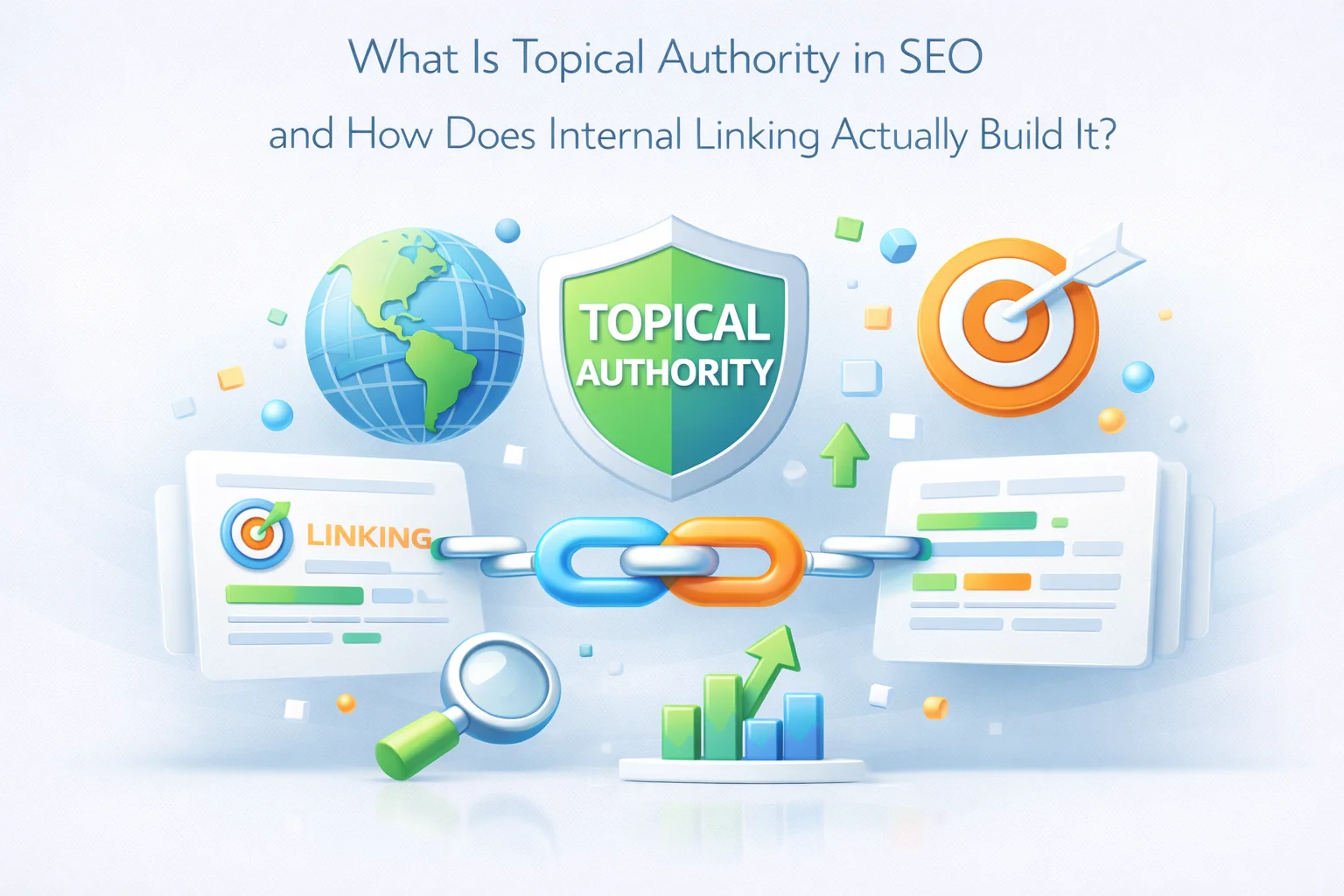
There is a specific frustration that every serious SEO practitioner has encountered: you publish excellent, well-researched content on a topic you know deeply, it sits in position 8 or 12 for months, and a competitor with a site that objectively seems less authoritative on the subject outranks you consistently. The content quality gap does not explain the ranking gap. Something else is happening.
That something is almost always topical authority, or more precisely, the absence of it. Google is not just evaluating the page you published. It is evaluating your entire site’s relationship to the subject area that page covers. A competitor who has published 40 interconnected posts about a topic, all of which cross-reference each other through intelligent internal linking, demonstrates a depth and breadth of coverage that a single excellent post cannot match, regardless of how good that single post is.
This guide explains exactly what topical authority is, how Google measures it, why internal linking is the primary structural mechanism for building it, and what a systematic approach to both looks like in practice on a WordPress site.
The practical section covers how tools like Nexu Link Brain implement the internal linking structure that topical authority requires, because understanding the theory without having a path to execution is only half the picture.
What topical authority actually means
Topical authority is a site-level signal that reflects how comprehensively and authoritatively Google believes your site covers a specific subject area. It is distinct from domain authority, which is a general measure of how many external sites link to you. A site with high topical authority on, say, home coffee brewing has demonstrated to Google through the depth, breadth, and interconnectedness of its content that it is a reliable and comprehensive resource on that subject specifically.
The practical implication is that a site with strong topical authority on a subject ranks better for queries related to that subject across the board, not just for the specific keywords it has targeted with individual posts. Google extends trust across the topical cluster. When your site ranks for “espresso tamping pressure” and “burr grinder settings,” and those posts are part of a well-linked cluster of coffee brewing content, Google is more likely to surface your content for adjacent queries like “home espresso setup” or “pourover vs drip brewing” even if you have not specifically optimized any post for those phrases.
Domain authority is about how many sites link to you. Topical authority is about how deeply your site covers a subject area. A site with mediocre domain authority but exceptional topical authority in a specific niche will consistently outrank a high domain authority site with thin, scattered coverage of that niche. This is why specialist sites regularly outrank news publications and aggregators for specific subject queries. The specialist demonstrates depth and interconnection that a generalist cannot match, regardless of raw link counts.
How Google measures topical authority: the signals that matter
Google has never published a specification called “topical authority score,” but the signals it uses to evaluate subject-area expertise are well-documented across its patents, public statements from its engineers, and the patterns that SEO researchers have consistently observed in ranking behavior. Four signals are particularly well-supported.
Google’s systems evaluate not just whether your site covers a topic, but whether it covers the full range of subtopics that a comprehensive resource on that subject should address. A site about home coffee brewing that covers espresso, pourover, French press, cold brew, equipment reviews, troubleshooting, and technique guides signals comprehensive coverage. A site that only covers one or two of those areas, even with excellent individual posts, signals partial coverage. The width of your topical footprint matters alongside the depth of any individual piece.
Content alone does not prove topical authority. The connections between your content pieces are what signal to Google that your coverage is coherent rather than fragmented. When your posts on related subtopics link to each other through semantically relevant anchor text, you are explicitly telling Google that these pages are part of the same topical cluster. Internal links are the mechanism through which Google reads your site’s topical structure. Without them, even comprehensive content exists as disconnected islands rather than an interconnected knowledge base.
When users arrive on a page from a search result and then navigate through multiple related pages on your site, that behavior pattern signals to Google that your site provides satisfying, comprehensive coverage of the subject. Internal links are the mechanism that makes this navigation possible. A well-linked topic cluster keeps readers engaged across multiple pages, which generates engagement signals that reinforce topical authority. Isolated, unlinked posts cannot produce this effect because readers have no pathway to discover related content.
PageRank flows through links. When multiple cluster content pages all link to a central pillar page on a topic, that pillar page accumulates internal PageRank from the entire cluster. Google interprets this concentrated authority signal as evidence that the pillar page is the most important, definitive resource on the topic within your site’s architecture. This concentrated authority helps the pillar page rank competitively for the primary keyword while cluster pages rank for subtopic variants. The entire architecture performs better as a unit than any individual page would perform in isolation.
The pillar and cluster model: the architecture Google rewards
The pillar page and cluster content model is the dominant framework for building topical authority through intentional site architecture. Understanding it at a structural level is essential before understanding how internal linking implements it.
A pillar page is a comprehensive, authoritative piece of content that covers a broad topic at a high level. It functions as the definitive resource on that topic within your site, linking out to cluster content pages that cover specific subtopics in depth. A pillar page about email marketing might be 4,000 words covering the landscape of email marketing, with sections on strategy, tools, list building, deliverability, and campaigns, each section linking to a dedicated cluster post that covers that subtopic exhaustively.
Cluster content pages are the individual subtopic posts that cover specific aspects of the pillar topic in depth. Each cluster page links back to the pillar page and also links to other related cluster pages. The result is a web of interconnected content where every page reinforces every other page’s authority, and the pillar page sits at the center of that web as the primary authority concentration point.

The reason this architecture works for topical authority is that it makes your site’s expertise legible to Google’s crawlers and ranking systems. The pillar page and its cluster form a recognizable pattern: a hub of comprehensive authority surrounded by spokes of specialized depth. When Google’s systems encounter this pattern across multiple topic areas on your site, they build a model of your site as an authoritative resource on those subjects.
The critical point is that the architecture only works if the links exist. You can publish the perfect pillar page and 20 excellent cluster posts, but if they are not connected through a systematic internal linking structure, Google cannot read the cluster relationship from the content alone. The links are what make the architecture visible. Without them, you have excellent individual posts that Google treats as 21 separate, unrelated pages rather than a coherent authority cluster on a subject.
Why most sites fail to build topical authority despite good content
Understanding the architecture is straightforward. Implementing it consistently across a growing content operation is where most sites fail. There are three specific failure modes that prevent good content from translating into topical authority.
The most common pattern is publishing related posts without linking them together. A site might have 15 posts about content marketing, 12 posts about SEO strategy, and 8 posts about analytics, but if these posts do not reference each other through internal links, Google sees three separate, unorganized collections rather than three coherent topic clusters. The topical authority that should result from covering each subject comprehensively never materializes because the structural signal is absent. The content is there. The architecture is not.
Many editors add links to new posts when they publish them, pointing outward to relevant existing content. But they rarely go back into older posts to add links to the new content. This means new posts receive no incoming internal links and accumulate no PageRank from the cluster, even though they are contributing to the cluster’s topical coverage. Topical authority requires bidirectional linking: new posts should link to older related content, and older related content should be updated to link back to new posts. Manual processes almost never maintain this discipline consistently.
Pillar pages without cluster links pointing back to them receive no concentrated PageRank from the cluster architecture. A pillar page that exists as a standalone comprehensive guide, with cluster content that does not link back to it, fails to accumulate the authority concentration that makes it rank competitively for broad keywords. The PageRank distribution that the hub-and-spoke model is designed to create never happens if the spokes do not consistently point back to the hub. Many sites have excellent pillar content that performs below its potential for exactly this reason.
Why semantic AI linking builds topical authority where keyword tools cannot
The relationship between topical authority and internal linking makes the superiority of semantic linking over keyword matching concrete rather than abstract. Topical authority is fundamentally about demonstrating that your content covers a subject area comprehensively and coherently. The connections that build that demonstration must be based on genuine topical relevance, not on vocabulary coincidence.
Keyword matching creates links when the same phrase appears in multiple posts. But topically related content often uses different vocabulary to cover the same subject from different angles. A cluster post about “shot extraction variables” and a cluster post about “water temperature for espresso” are both part of the same espresso brewing cluster, but they share no obvious keywords. A keyword matcher cannot see the cluster relationship. A semantic AI system does, because it understands that both posts are about the same underlying domain of knowledge, regardless of the specific terms they use.

This distinction matters enormously for topical authority because the cluster connections that most powerfully signal comprehensive coverage are often exactly the ones that keyword matching misses. The posts at the edges of a topic cluster, the ones that cover tangential but related aspects of a subject, are the ones that demonstrate breadth of coverage. They are also the ones least likely to share keywords with the pillar page. Only semantic understanding can reliably identify and connect these peripheral cluster members.
The pillar page priority feature in tools like Nexu Link Brain amplifies this further. By marking your primary topic pages as pillar content, you ensure the AI consistently directs link equity from cluster pages toward the authority hub. The result is a PageRank concentration on your most important pages that mirrors the hub-and-spoke architecture Google rewards, built automatically from the semantic understanding of your content relationships rather than from manually maintained rules.
A practical framework for building topical authority on WordPress
Understanding the theory is one thing. Having a concrete process to implement it is another. Here is a step-by-step framework for building topical authority on a WordPress site using a combination of content strategy and systematic AI-powered internal linking.
Start by mapping the two to five core subject areas your site is trying to rank for. For each subject area, identify the single page that represents your most comprehensive, authoritative treatment of that topic. This is your pillar page. It does not need to be the longest post on your site. It needs to be the one that serves as the best entry point for someone wanting a comprehensive overview of the subject. Mark these pages as pillar content in your linking plugin so the AI knows to route authority toward them.
Go through your published posts and assign each one to a topic cluster. You will likely find that many posts belong to a cluster but are not linked to the pillar page or to other cluster members. You will also find orphaned posts that do not belong to any current cluster, and gaps where subtopics are not yet covered. This audit reveals both the linking work that needs to happen and the content gaps you should fill to strengthen topical coverage.
With pillar pages marked and your content indexed, run a full bulk analysis through the AI linking plugin. The semantic engine will identify topical connections across your entire archive that a manual audit would miss, including the peripheral cluster members that share no obvious keywords with the pillar page. Review the suggestions with cluster membership in mind: prioritize applications that connect cluster pages to each other and to the pillar page. The visual link graph will show the emerging cluster structure as you apply links.
Topical authority is not built once and maintained passively. Every new post you publish either strengthens a cluster or fragments it depending on whether it gets connected to the relevant existing content. With auto-suggest enabled, every new post is analyzed against your indexed content as soon as it is saved. The AI identifies which cluster it belongs to and suggests the links that integrate it into the cluster architecture. New content reinforces topical authority rather than diluting it.
Topical authority does not have a direct score you can track. Measure it through proxy signals: average ranking position for keywords in your target topic areas, impressions for topic-related queries in Search Console, the number of queries for which you are appearing in the top 10 that you have not specifically targeted, and the ranking performance of your pillar pages for broad topic keywords. These signals together tell you whether your topical authority is building. Expect to see meaningful movement over a three to six month timeframe after implementing systematic cluster linking.
The compounding nature of topical authority
One of the most important properties of topical authority is that it compounds over time in a way that other SEO signals do not. Each piece of content you publish that belongs to an existing cluster strengthens that cluster’s authority signal. Each new cluster connection created through internal linking reinforces the topical coherence of your site. The aggregate effect of these incremental improvements is non-linear: a site that has been systematically building topical authority for 18 months does not have 18 times the authority of a site that started one month ago. It has far more, because earlier improvements have compounded through accumulating evidence.
This compounding nature is why starting the systematic approach to topical authority early matters more than starting it perfectly. The difference in SEO performance between a site that begins building structured topic clusters with systematic internal linking today versus a site that waits another six months is not six months of ranking performance. It is the compounding effect of six additional months of cluster reinforcement, plus the ranking improvements that come earlier and have more time to generate organic traffic and engagement signals that further reinforce the topical authority.
The practical implication for your WordPress site is clear. The AI-powered WordPress internal linking system that builds topical authority automatically does not just save time on linking tasks. It builds an SEO asset that grows in value with every post you publish, every cluster connection that forms, and every month that Google’s model of your site as a topical authority deepens. That is the competitive advantage that systematic topical authority building creates, and internal linking is the foundation it rests on.
Key takeaways: topical authority and internal linking
Build the topical authority that makes your entire site rank higher
Nexu Link Brain builds the semantic internal links that make your topic clusters coherent, routes PageRank toward your pillar pages, and creates the interconnected site architecture that Google rewards with topical authority rankings.

The guide on internal linking for topical authority was insightful. just wish the setup was faster
Finally, a guide that actually explains why my standalone "perfect" posts weren't ranking. i've spent months wondering why competitors with weaker content kept outranking me, and this broke it down clearly Google isn't just scoring the page, it's scoring how well your entire site covers a topic. The part about internal linking as a structural signal was a lightbulb moment.
This guide does a solid job explaining how internal linking signals topical authority, but I'm left wondering: if my WordPress site only covers one or two subtopics in depth (say, "SEO for local bakeries" and "Google My Business optimization"), will Google still see it as having strong topical authority?
This guide finally connected the dots for me on why some of my best content wasn't ranking. the way it breaks down how internal linking isn't just about navigation but actually proves to Google that you've covered a topic comprehensively that was a lightbulb moment. i've been treating links as an afterthought, but now I see how strategic anchoring between related posts could shift our domain's authority in niche areas. Only nitpick: the 2026 update note threw me for a second I had to double check the publish date.