Next-Level Code. Nexuvibe Style ...
Hrs
Min
Sec

Imagine you spent two years building a respectable backlink profile for your website. Solid editorial mentions, a few industry publication links, some natural links from sites in your niche. Real authority, earned slowly. Now imagine that almost none of that authority is reaching the pages you most want to rank. It is sitting in your homepage, or pooling in a handful of blog posts that were linked to years ago, while your product pages and your most commercially important content operate with almost none of it. This is not a hypothetical scenario. It is the actual situation on the majority of websites that have been publishing content for more than a year.
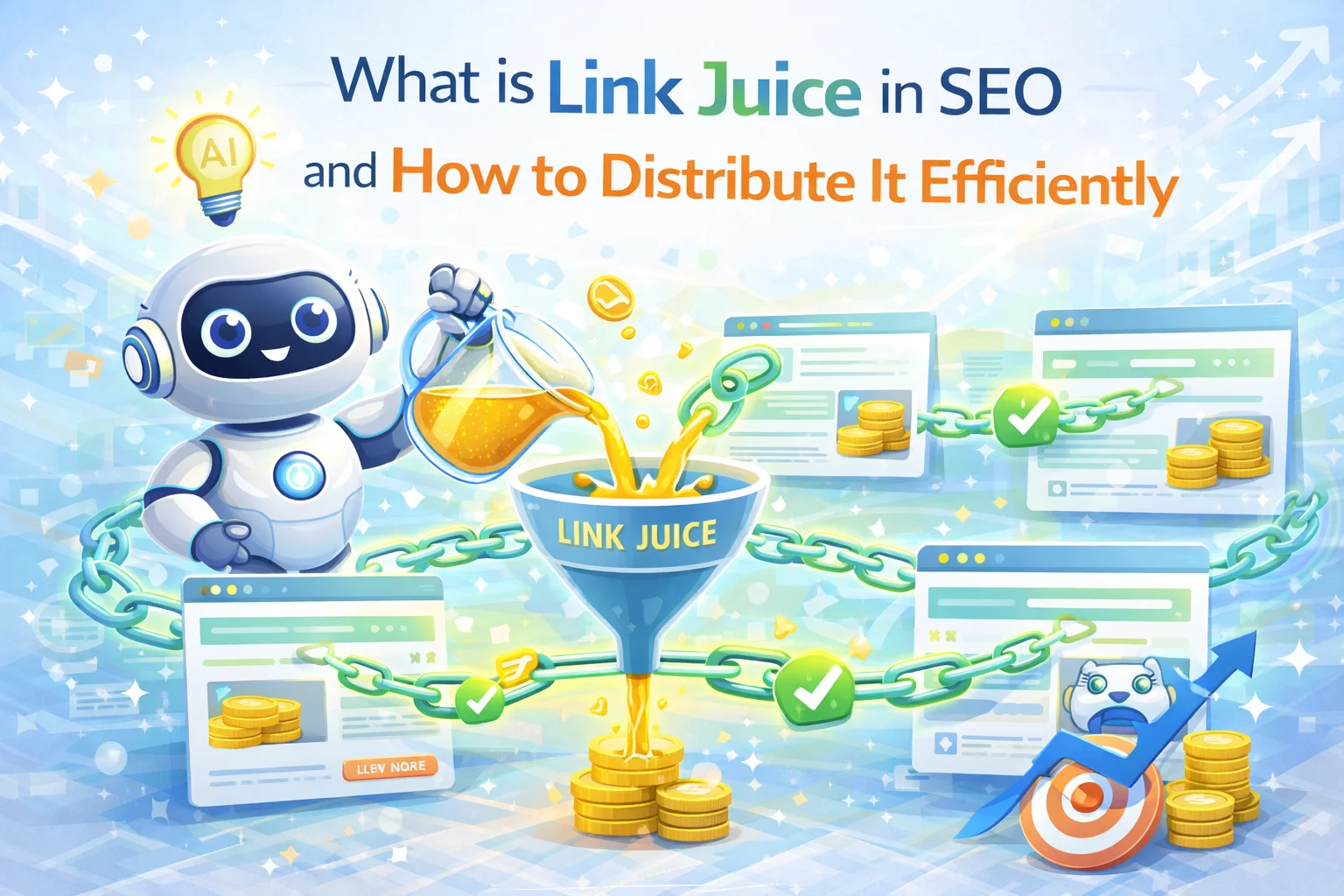
The term “link juice” is informal but the concept it describes is real and measurable. It refers to the authority value that passes from one page to another through hyperlinks, the same value that Google has used since its earliest days to determine which pages deserve to rank above others. Understanding how link juice flows, where it accumulates, and where it leaks is the foundation of a link architecture strategy that actually produces ranking improvements rather than just adding links for the sake of having them.
This guide covers the mechanics of link juice in precise terms, the structural mistakes that cause most sites to distribute it inefficiently, and the internal linking approach that lets you control where authority flows across your site. We will look at how tools like Nexu Automated AI Internal Linker make it possible to implement a distribution strategy at scale without the kind of manual audit work that makes this impractical on large WordPress sites.
By the end of this article, you will have a clear model of how authority moves through your site and a concrete set of practices for directing it toward the pages where it can do the most good.
The term “link juice” does not appear in any Google documentation. It emerged as shorthand in the SEO community to describe a concept that Google has been explicit about since the company’s founding paper: hyperlinks pass a signal of importance from one page to another, and that signal accumulates and flows through a site’s link graph in ways that determine how much authority each page has relative to every other page on the web.
The formal name for this signal is PageRank. The original formula is elegant in its simplicity: a page’s PageRank is determined by the number and quality of pages that link to it. Every page that links to another page passes a fraction of its own PageRank through that link. The fraction is determined by how many total links that source page has. A page with ten outgoing links passes one tenth of its PageRank through each link. A page with two outgoing links passes one half through each. This means that links from pages with few outgoing links pass more authority per link than links from pages with many outgoing links, even if those source pages have the same total PageRank.
The recursive nature of PageRank is what makes it both powerful and complex. The authority a page receives from its incoming links is not fixed. It changes as the authority of the pages linking to it changes, which changes as the authority of the pages linking to them changes, and so on through the entire web graph. This means that improving the internal link structure of your site does not just directly help the pages receiving new links. It creates ripple effects through the whole graph as authority redistributes and rebalances.
Google has not published PageRank scores publicly since 2016, and modern ranking algorithms are significantly more complex than the original formula. But the underlying logic, that links pass authority and that structural position in the link graph matters, remains intact and continues to produce measurable ranking effects. Every practitioner who has systematically improved a site’s internal link structure and watched specific pages climb from page two to page one has observed PageRank mechanics in action, even if the score itself is invisible.
Link juice leaks happen when authority flows somewhere it cannot be used effectively, when it stops flowing before reaching important pages, or when it disperses across too many destinations to accumulate meaningfully in any of them. These leaks are structural and they compound over time. A site that loses 20% of its usable authority to structural leaks today loses compounding value month after month as the problem persists.
A broken internal link, one that points to a deleted page or a changed URL without a redirect, passes zero authority. The link still exists in the HTML. It still costs outgoing link equity from the source page. But the authority it should be passing disappears into a 404 response. On sites that have been publishing and reorganizing content for several years, broken internal links accumulate silently. An audit on a 200-post site that has undergone two or three reorganizations frequently turns up 30 to 50 broken internal links. Each one represents a piece of the site’s authority graph that has been severed. The fix is straightforward: redirect the target URL or update the link destination. The ongoing challenge is detecting these breaks before they compound.
The nofollow attribute tells search engines not to pass authority through a link. It was designed for external links to untrusted sources, paid links, and user-generated content where you cannot vouch for the destination. Applying it to internal links is almost always a mistake. Some site owners add nofollow to internal links pointing to pages they do not want to rank, like login pages or thank-you pages, on the theory that this preserves juice for other pages. In practice, Google treats nofollowed internal links as hints rather than directives, and the authority that does not flow to the nofollowed target does not automatically redistribute to other pages. It simply leaks. The correct solution for pages you do not want indexed is noindex, not nofollow on the links pointing to them.
A 301 redirect passes most but not all of the authority from the original URL to the destination. A chain of two or three redirects, each passing slightly less than the one before it, can result in meaningful authority loss by the final destination. On sites that have migrated platforms, changed URL structures, or reorganized content categories multiple times, redirect chains accumulate in ways that are not immediately obvious. An internal link that points to URL A, which redirects to URL B, which redirects to URL C, is losing authority at each hop. Cleaning redirect chains by updating internal links to point directly to final destinations is one of the highest-ROI technical SEO fixes available on mature sites.
When a page accumulates authority from external backlinks but has few or no outgoing internal links, that authority stays in that page and does not distribute to the rest of the site. This is the classic homepage problem on many WordPress sites. The homepage receives a significant portion of all external backlinks pointed at the domain. But if the homepage only links to five or six top-level navigation destinations, the authority it holds disperses across those few targets and none of it reaches the dozens or hundreds of pages deeper in the site that could benefit from it. The fix is not to make the homepage link to every page, but to ensure the pages it links to are chosen strategically and are themselves well-connected to the rest of the site’s link graph.
Efficient link juice distribution is not a single tactic. It is the cumulative outcome of five specific decisions that determine how authority moves through your site’s link graph. Each decision applies to every internal link you create, and getting each one right consistently is what separates a site with a functional authority architecture from one where link juice pools uselessly in a handful of pages.
Understanding the mechanics of link juice is useful. Having a practical architecture that implements those mechanics across a real site with hundreds of pages is what actually moves rankings. The following framework translates the theory into a concrete structure that scales as your content library grows.
The first structural principle is that your highest-authority pages should link to your most strategically important pages. This sounds obvious but it requires explicitly deciding which pages are your authority sources and which are your authority destinations, rather than letting links accumulate randomly based on what writers happen to remember. Your homepage, your most-linked blog posts, and your most-visited landing pages are typically your authority sources. Your most commercially important product pages, your key conversion pages, and your cornerstone content are your authority destinations. The internal link strategy should create reliable paths from sources to destinations with as few hops as possible.
The second structural principle is that every page in your site should sit within reach of the authority flow rather than outside it. A page that receives no incoming internal links receives no authority from the site’s own network, regardless of how many external backlinks the domain has accumulated. This is the orphan page problem from a link juice perspective. Each orphaned page is a location where external authority the domain has earned cannot reach. Eliminating structural isolation, so that every published page is connected to at least a few well-positioned source pages, is the foundational fix that makes everything else in the architecture work.
The third structural principle is that authority flow is not a one-time project. It requires ongoing maintenance as new content is published, old content is reorganized, and the site’s priorities shift. A link architecture that works well today will develop structural gaps within six months if new posts are published without incoming links, if old posts lose their link sources through content changes, and if no one is monitoring the orphan count and broken link report on a regular basis.
This is the core operational argument for automated internal linking on any site publishing more than a few times a month. Nexu Automated AI Internal Linker maintains a live index of your content, generates incoming link suggestions the moment new posts are published, surfaces orphan pages as they appear, and reports on broken links before they compound. The link architecture does not drift because the system that maintains it never stops running. The authority you have earned through backlinks reaches the pages that need it because the internal plumbing is never allowed to deteriorate.
One of the most powerful tools available for link juice distribution is the ability to explicitly designate which pages should receive disproportionate incoming link support. Not all pages on your site are equally important. Some pages drive conversions. Some anchor your topical authority in the eyes of search engines. Some are the cornerstone resources your brand wants to be known for. These pages deserve more incoming links from more authoritative sources than the average piece of content on your site, and building that disproportion deliberately is what separates a thoughtful link architecture from one that distributes authority randomly.
In Nexu Automated AI Internal Linker, the pillar page priority setting lets you mark specific pages as high-priority link targets. When the AI evaluates linking opportunities across your content library, pages with this designation receive a scoring boost that makes them more likely to surface as the preferred link target when multiple candidate pages are similarly relevant to a given source post. Over hundreds of linking decisions in a bulk analysis, this systematic preference means your most important pages accumulate significantly more incoming internal links than they would through neutral ranking alone.
The practical effect is that your key pages sit higher in the site’s link graph, receiving authority from a broader range of source pages, which in turn makes them more effective at passing authority to the cluster content below them. The whole topical cluster that depends on a well-positioned pillar page benefits when that pillar page is properly supported. Pillar page priority is not just about ranking the pillar itself. It is about the authority multiplier effect that a well-connected pillar creates for everything connected to it.
Sites that maintain a healthy internal link architecture over an extended period develop a structural advantage that compounds in ways that are difficult for competitors to replicate quickly. The compounding happens through three mechanisms that reinforce each other.
First, every piece of new content that enters the index well-connected immediately benefits from the site’s existing authority flow rather than starting from structural zero. A new post that receives five relevant incoming links from well-positioned source pages on the day it is published starts ranking faster and from a stronger position than a new post that goes live with no incoming links and waits weeks or months for the linking process to catch up.
Second, as the content library grows, each new piece of content becomes a potential source of authority for all the existing content that preceded it. A well-connected site with 300 posts has a much richer network of potential outgoing links than the same site had with 100 posts. Each new post that enters the link graph creates additional pathways for authority to reach existing pages. The network becomes progressively more interconnected, which benefits older content retroactively as new source pages are published and linked appropriately.
Third, the topical authority signals that accumulate through consistent, semantically appropriate internal linking become progressively harder for competitors without the same depth of content and connection density to match. A site where every article in a topic cluster links to every other relevant article in the cluster, and where those clusters are interconnected through bridge articles, creates a topical authority footprint that Google’s systems recognize and reward with broader ranking coverage across more specific queries within that topic. This kind of topical authority is the durable SEO moat that no single backlink campaign can build and no algorithm update can easily erase.
Link juice is not an abstract concept you read about once and file away. It is the authority your site has earned through external backlinks and needs to distribute efficiently to the pages where it can drive rankings. Every structural leak, every orphaned page, every redirect chain, and every broken internal link is a place where authority your site already owns is being wasted. Fixing these problems does not require creating new content or building new backlinks. It requires building and maintaining the internal architecture that lets the authority you already have reach the pages that need it.
On a small site, this architecture can be maintained manually with discipline. On a site with hundreds of pages and a regular publishing cadence, it requires a system that monitors the link graph continuously, identifies structural problems as they emerge, and generates new connections as new content is published. Nexu Automated AI Internal Linker is that system for WordPress, maintaining a live view of your site’s authority graph, finding the highest-quality source-to-destination connections through semantic AI, and keeping the internal plumbing healthy as the site evolves.
The backlinks you have worked to earn deserve to reach every page on your site. Building the internal architecture to make that happen is not a side project. It is the foundation everything else in your SEO strategy sits on.
Nexu Automated AI Internal Linker builds and maintains the internal link architecture that distributes your site’s authority efficiently to every page that needs it, automatically, as your content library grows.








I wanted to share my thoughts on this guide. look, I know SEO isn't simple, but this felt pretty overwhelming for someone just trying to keep their small business website running. that part about spending two years building links? Yeah, that stung I have spent years on this, and now I'm worried all that effort might not even matter because of some "link juice" thing I've never heard of. The advice seems good, but it's lost in all the technical terms and worst case scenarios.
I get the concept of fixing broken links by redirecting or updating them, but how do you actually prioritize which ones to fix first on a large site?
Hey folks! just finished the link juice guide and wow this hit home. i've got a real estate site with about 200 posts after a couple redesigns, and sure enough, my last audit turned up nearly 40 broken internal links. the part about authority pooling in old blog posts while my listing pages starve? That's exactly what's happening
This guide feels way behind for today's SEO wouldn't trust it.