
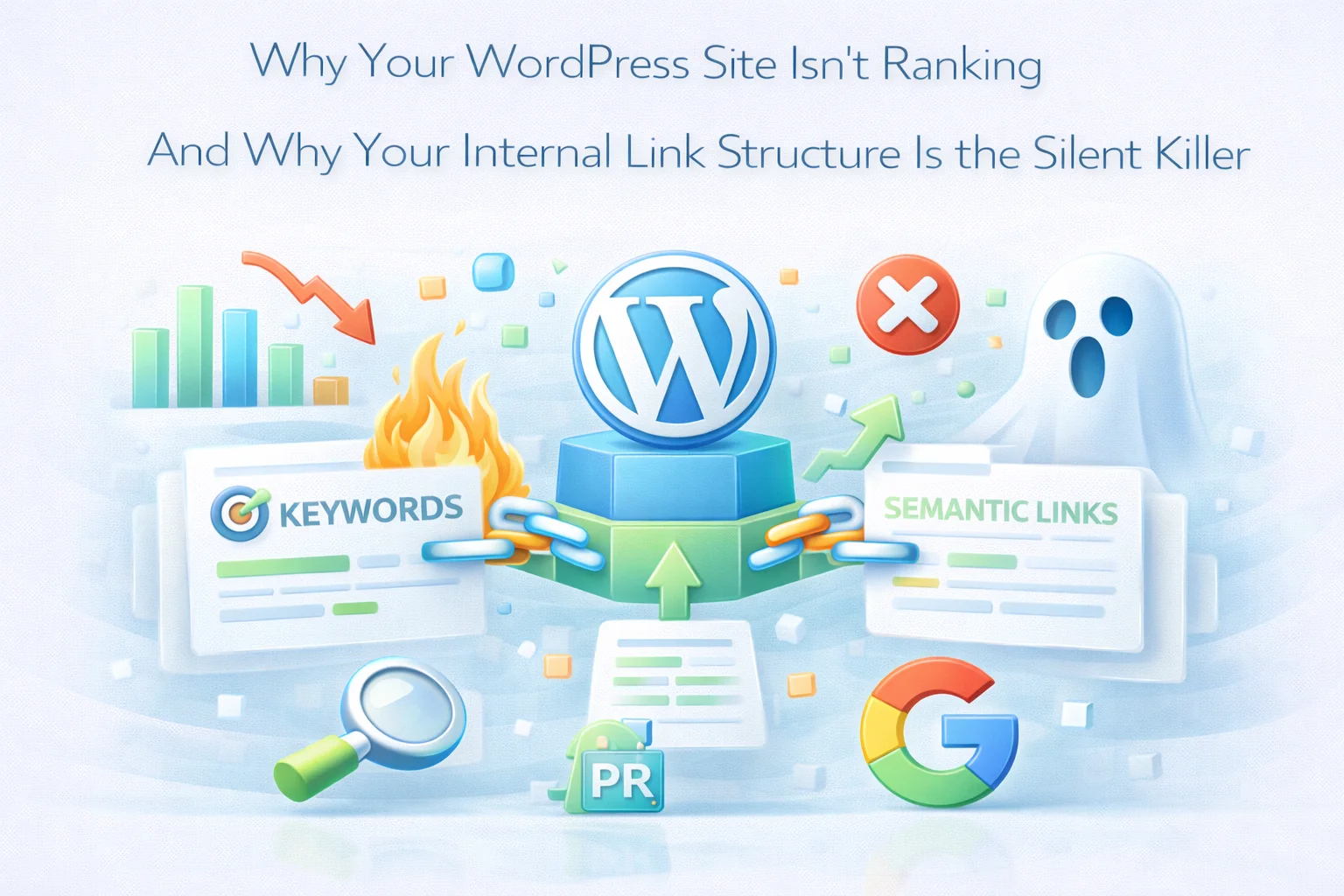
There is a specific frustration that drives people to search for answers about why their site is not ranking. It is not the frustration of having done nothing. It is the frustration of having done everything you were told to do. The content is well-researched and substantial. The technical SEO is clean. You have been patient. And still, the rankings you expected have not materialized, or they stalled somewhere in the middle of the first page and refused to move.
Most SEO troubleshooting content sends you down a checklist of usual suspects: page speed, mobile usability, schema markup, Core Web Vitals, meta tag optimization. These are all legitimate factors worth checking. But there is one structural problem that rarely makes the top of these lists despite being one of the most common causes of persistent underperformance on sites that have otherwise done their homework.
Internal link structure kills rankings silently because it does not produce error messages, it does not show up in audits as a critical issue, and it degrades slowly over time as a site grows. By the time its effect on rankings becomes noticeable, the structural problems have usually been accumulating for months or years.
This guide walks through the specific ways a poor internal link structure suppresses rankings, the diagnostic steps to determine whether this is your problem, and the concrete fixes that address it, including how Nexu Link Brain addresses these problems systematically.
First: how to tell if internal linking is your actual problem
Before going through the six killers, it helps to establish whether internal linking is likely your primary bottleneck. Not every underperforming site has an internal linking problem as its root cause. Some sites have content quality issues. Some have technical problems. Some are simply in too competitive a niche with too little domain authority to overcome. Internal linking is a powerful lever, but it is not the only one.
Internal linking is likely a significant factor in your underperformance if three or more of the following describe your situation.
Your site has been publishing content for more than 12 months and has more than 50 posts.
You have not audited your internal link structure in the past six months or have never done so.
You do not have a systematic process for adding links from older posts to newer posts when you publish.
Search Console shows a significant portion of your pages as “Discovered but not indexed” or with infrequent last crawl dates.
Pages you improved with better content did not produce ranking improvements, which is consistent with the structure suppressing the content quality signal.
Your site covers a coherent topic area but your rankings are scattered rather than clustering around a few strong topic areas.
If three or more of these apply, internal link structure is a very likely contributor to your underperformance. Read through the six killers below and assess honestly which ones apply to your site.
Silent killer 1: Orphan pages
An orphan page is a published page with no internal links pointing to it. Googlebot discovers it from your sitemap, visits it once, and then has no link-based reason to return frequently. The page receives no authority from the rest of your site. It contributes no topical signal to any cluster. It sits in isolation, unable to compete meaningfully for rankings regardless of its content quality.
Orphan pages accumulate invisibly. They are not an error you receive a notification about. They are the natural result of publishing content without a systematic process for creating bidirectional links between new content and related existing content. On sites that have been publishing for two or more years without such a system, orphan rates of 20 to 40 percent of the total published post count are not unusual.
Run the Orphan Pages report in Nexu Link Brain, or use a crawl tool like Screaming Frog to identify pages with zero inbound internal links. Compare the count to your total published post count. If more than 10 percent of your pages are orphaned, this is an active ranking suppressor on your site.
Use the orphan rescue workflow in a semantic AI linking tool to identify which high-authority pages on your site should link to each orphan, and create those connections. Prioritize orphan pages that are on commercially important topics or that historically generated traffic before their isolation. Each rescued orphan moves from the crawl margins into your site’s active link network and starts accumulating authority.
Silent killer 2: Fragmented topic coverage
You might have 15 posts on a topic. If those posts are not connected through internal links, Google does not read them as a coherent body of expertise. It reads them as 15 separate, unrelated pieces of content that happen to share a subject area. The topical authority signal that should emerge from comprehensive coverage never forms, because the structure that makes that coverage legible to search engines is absent.
This is the fragmentation problem. Your coverage is there. The connections that prove the coverage are not. A competitor with 8 posts on the same topic, all of which link to each other and to a central pillar page, demonstrates stronger topical authority than your 15 disconnected posts, even though you have more total content. Quantity without connectivity does not build topical authority.

Open the visual link graph and look for your main topic areas. Well-connected clusters appear as dense groups of nodes with many interconnecting lines. Fragmented coverage appears as scattered individual nodes with few connections. If your posts on a topic are scattered across the graph rather than clustered, that topic’s authority signal is fragmented.
Map your topic clusters manually or use the bulk linker to identify which posts belong together. Designate a pillar page for each cluster and run a targeted bulk analysis to generate all four directions of cluster connections: cluster to pillar, pillar to cluster, cluster to cluster, and new to existing. Apply the suggestions and verify the cluster formation in the visual graph.
Silent killer 3: Authority trapped on the wrong pages
Every site has its own internal authority distribution, with some pages accumulating significant PageRank through incoming links and others having very little. The problem arises when the pages with the most authority are not the pages you most want to rank, and those authority-rich pages are not linking to your priority targets.
This misalignment is common on content-heavy sites. A viral how-to post or a listicle that attracted many external backlinks becomes a high-authority page. But if that post does not link to your service pages, product pages, or monetizable content, all of that authority stays trapped within the well-linked cluster around the viral post and never reaches the pages where it would produce commercial ranking impact.
- High-traffic informational posts with no links to commercial pages
- Popular “best of” lists that never link to your own product reviews
- Well-linked evergreen content that predates your current site strategy
- Category pages with authority that link only to recent posts, not priority content
- Identify your 10 most-linked pages using link distribution reports
- Check whether each one links to your priority commercial or ranking targets
- Add contextually appropriate links from authority-rich pages to priority targets
- One link from a well-linked page is worth more than ten links from low-authority pages
Take your top 5 most externally linked pages. Check how many of those pages link to your pillar pages and commercial priority pages. If the answer is zero or very few, you have trapped authority. Create those connections and watch your priority page rankings improve as the authority bridge starts carrying PageRank from your best-linked content to your most important ranking targets.
Silent killer 4: New content published in isolation
Every new post you publish arrives as an isolated entity unless you actively integrate it into your existing link structure. Most content workflows add links from the new post to older content, which is good. But they almost never update existing posts to link back to the new post. The result is a one-directional, forward-linking structure where new posts have some outgoing links but very few, sometimes zero, incoming links from established content.
A new post with no incoming internal links cannot benefit from the authority your established content has accumulated. It starts from zero internal PageRank, which means it needs to build ranking performance entirely from external signals and content quality alone. On a competitive topic, that is a significant handicap. The post might eventually attract some external links and improve, but it will lag behind its potential throughout the early ranking period.
Multiply this effect across every post you have published over the past year without systematic backward linking, and the cumulative impact on your site’s overall internal authority distribution becomes substantial.

Enable auto-suggest on post save in Nexu Link Brain. Every time you save or publish a new post, the AI analyzes it against your indexed content and surfaces the most relevant existing posts that should link back to it. Apply those backward links before or immediately after publishing. For your existing archive, run the orphan rescue workflow to identify posts with the fewest incoming links and create backward connections from relevant established content.
Silent killer 5: Anchor text uniformity from automated linking
If you have used a keyword-based internal linking tool to automate link insertion, or if you have manually been using the same keyword phrase as your anchor text for links to the same page, you have potentially built an anchor text profile that Google reads as unnatural.
The ranking suppression from over-optimized anchor text is insidious because it specifically targets the keyword you are trying to rank for. A page with 50 incoming internal links all using the anchor “best project management software” may actually rank worse for that phrase than a similar page with 20 links using varied, natural anchor text. You are signaling manipulation rather than genuine editorial endorsement, and Google’s systems penalize or discount exactly that pattern.
Crawl your site and export all internal links with anchor text. For each important target page, calculate the percentage of incoming links using each anchor phrase. Any anchor representing more than 30 percent of a page’s incoming links is a concern. Dilute concentration by adding new links with varied anchors and selectively updating the most repetitive existing ones. Switch to a semantic AI linking tool that generates contextually varied anchor text automatically to prevent the problem from recurring.
Silent killer 6: Content improvements that cannot translate to rankings
This is the most discouraging of the six killers because it produces a feedback loop that feels like a broken algorithm. You improve a page’s content. You add more depth, better examples, updated information, improved structure. You wait. The rankings do not respond. You improve the page again. Still nothing. You conclude the algorithm is broken or your niche is too competitive.
What is actually happening is that the structural problem is suppressing the quality signal. A page with excellent content but very few internal links pointing to it, operating at great click depth from your most authoritative pages, receives minimal PageRank from your site’s authority pool. When Google evaluates the page, the weak internal authority signal can override the strong content quality signal, particularly on competitive keywords where many pages have adequate content quality.
Think of it this way: a job applicant with exceptional qualifications who is submitted by a staffing agency that no hiring managers know or trust will consistently lose to a slightly less qualified candidate submitted by a well-respected recruiter. The content is the qualifications. The internal link structure is the reputation of the recruiter. Both matter.

Identify the specific pages where you have made content improvements without ranking response. Check how many internal links point to each of those pages. If the answer is two or fewer, the internal authority signal is likely suppressing the content quality signal. Add five to ten relevant incoming internal links from your most authoritative posts, mark the page as a pillar priority if it is a key ranking target, and wait 8 to 12 weeks for Google to recrawl, reassess, and update its rankings. The content quality was always there. You are finally giving Google a structural reason to take it seriously.
The combined effect: why all six killers compound
The reason internal link structure is such a consequential ranking problem is that these six killers rarely appear in isolation. A site that has never systematically managed its internal linking typically has all six operating simultaneously to different degrees. Orphan pages create crawl inefficiency. Fragmented clusters prevent topical authority. Trapped authority means priority pages are underpowered. Isolated new content compounds the orphan problem daily. Anchor text uniformity creates over-optimization risk. And content quality improvements that should be producing results are blocked by structural suppression.
Fixing one of these killers helps. Fixing all six simultaneously is transformative. The combined impact of systematic internal link structure improvement on a site that has been suffering from multiple silent killers is consistently among the most significant ranking improvements an established site can make without creating new content or acquiring new backlinks.
The WordPress AI internal linking system for fixing underperforming site structure addresses all six killers systematically: orphan rescue for isolated pages, semantic cluster building for fragmented coverage, pillar page priority for authority routing, auto-suggest for new content integration, anchor diversity management for over-optimization protection, and health reporting that makes structural progress measurable. That is the complete solution to a problem that most SEO troubleshooting content does not adequately address.
Stop letting internal link structure suppress the rankings you have already earned
Nexu Link Brain rescues orphan pages, builds topic clusters, routes authority to your most important pages, integrates new content automatically, prevents anchor over-optimization, and gives you the health reporting to see exactly how your site’s structure is improving.





Hey, I grabbed this guide hoping it'd help with my café's blog since I've been stuck on page two for months. The breakdown on internal linking was solid, but honestly?
Hey, finally a guide that makes sense!
This guide was a serious wake up call about internal linking something I'd totally overlooked even after years of writing and tweaking content. the way it explained how bad structure can silently tank your rankings (even when the rest of your SEO seems solid) really hit home. my only gripe? I wanted more real world examples of how to actually fix and audit links, not just spot the issues. But honestly, if you're stuck in SEO limbo like I was, it's still 100% worth the read.