Next-Level Code. Nexuvibe Style ...
Hrs
Min
Sec

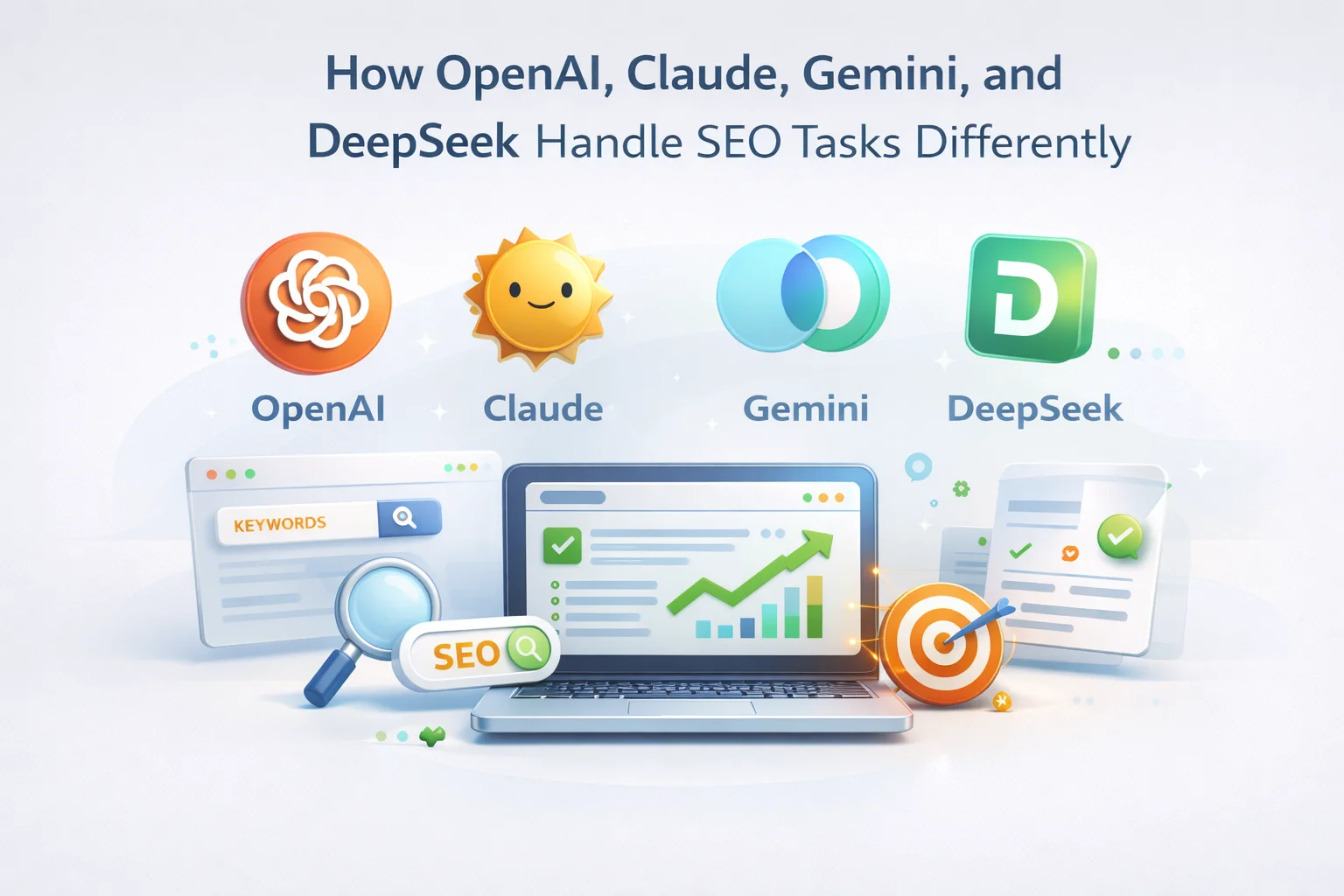
The AI landscape for SEO tools has fractured into multiple competing ecosystems. OpenAI’s GPT models dominated initially, but Anthropic’s Claude, Google’s Gemini, and the open-weight DeepSeek models now offer genuine alternatives with different strengths and tradeoffs. For WordPress site owners evaluating AI-powered SEO tools, understanding how these models actually perform on SEO-specific tasks matters more than reading marketing comparisons or general benchmarks.
This analysis examines how each of the four major AI providers handles the specific tasks that matter for SEO: content understanding, semantic similarity detection, anchor text generation, relevance scoring, and the nuanced judgment calls that determine whether an AI-suggested internal link actually improves your site. We tested these capabilities in the context of real WordPress content to provide practical guidance rather than theoretical comparisons.
The findings inform how tools like AI internal linking plugins that support multiple providers allow you to choose the model that best fits your specific content and requirements. Different sites benefit from different models, and understanding why helps you make the right choice.
Before diving into SEO-specific performance, understanding each provider’s general approach helps contextualize the differences. These are not interchangeable APIs with different names. They represent genuinely different architectural decisions and training philosophies that affect how they handle text.
OpenAI models benefit from the longest development history and the most extensive training data. GPT-4o offers strong general performance with faster response times, while GPT-4 Turbo provides deeper reasoning at higher cost. For SEO tasks, OpenAI excels at generating natural-sounding anchor text and understanding nuanced topical relationships. The text-embedding-3 models provide high-quality embeddings for semantic similarity, though at a higher price point than alternatives.
Claude models are designed with a focus on helpfulness and nuanced understanding. For SEO applications, Claude 3.5 Sonnet offers an excellent balance of capability and cost, with particularly strong performance on understanding content intent and generating contextually appropriate suggestions. Claude’s longer context window allows processing larger content chunks, which improves accuracy when analyzing comprehensive articles. The model tends to be more conservative with suggestions, which can mean fewer false positives.
Gemini models offer the largest context windows available, allowing analysis of extremely long documents or multiple pages simultaneously. Gemini 1.5 Flash provides fast, cost-effective processing for high-volume tasks, while Gemini 1.5 Pro handles complex reasoning. For SEO, Gemini’s connection to Google’s knowledge systems theoretically provides advantages in understanding how content relates to search intent, though this is difficult to verify directly. The models perform well on technical content analysis.
DeepSeek emerged as a surprising competitor with open-weight models that approach the performance of proprietary alternatives at significantly lower cost. For SEO tasks, DeepSeek-V2 handles content analysis and anchor text generation competently, though with occasionally less natural phrasing than the leading proprietary models. The cost advantage is substantial for high-volume processing, making it attractive for large sites where running thousands of API calls would be prohibitively expensive with premium providers.
The foundation of semantic internal linking is understanding what each page on your site is actually about. This goes beyond simple keyword extraction to identifying the core topics, subtopics, intent, and conceptual framework of each piece of content. Different models approach this task with varying levels of sophistication.
OpenAI’s GPT-4 models demonstrated the most thorough topic extraction, identifying not just obvious subjects but subtle thematic elements and implied audience characteristics. Claude models showed particular strength in understanding content intent, accurately distinguishing between informational, commercial, and transactional content even when the distinction was not explicit. Gemini performed well on technical content but occasionally missed nuanced topical connections in softer subject matter. DeepSeek provided adequate topic extraction but with less depth than the premium alternatives.
For internal linking specifically, the practical impact is that models with better content understanding produce more relevant link suggestions. When a model truly understands that an article about meal prep for busy professionals relates conceptually to content about work-life balance even though they share no keywords, it creates connections that simpler analysis would miss.
Vector embeddings are the mathematical representations that allow AI to compare content similarity. The quality of these embeddings directly affects how accurately a system can identify which pages are semantically related. Each provider offers embedding models with different characteristics.
OpenAI’s latest embedding models offer configurable dimensions, allowing you to balance quality against storage and computation costs. The large variant produces the highest quality embeddings in our testing, with excellent performance on capturing subtle semantic relationships. The small variant provides a good balance for most use cases. These embeddings are particularly strong at distinguishing between superficially similar but conceptually different content.
Google offers embedding models optimized for different use cases, including variants specifically designed for retrieval tasks. These embeddings perform well on identifying content that answers similar questions or serves similar user intents. The integration with Google’s broader AI ecosystem means these embeddings may align more closely with how Google Search understands content relationships, though this advantage is speculative.
Anthropic does not offer standalone embedding models, so systems using Claude typically pair it with embeddings from another provider. DeepSeek offers embedding models that provide competitive quality at lower cost, making them attractive for budget-conscious implementations. The combination of DeepSeek embeddings with Claude or GPT for anchor text generation is a common cost-optimization strategy.
The practical difference in embedding quality shows up in edge cases. High-quality embeddings correctly identify that an article about preventing burnout relates to content about sustainable work habits even though the vocabulary differs completely. Lower-quality embeddings might miss this connection or incorrectly flag unrelated content as similar based on superficial word overlap.
Generating natural, contextually appropriate anchor text is where the differences between models become most apparent. This task requires understanding both the source content where the link will appear and the target content being linked to, then creating text that accurately describes the relationship while fitting naturally into the source context.
Claude models consistently produced the most varied anchor text across multiple link suggestions, which is valuable for avoiding over-optimization patterns. GPT-4 models generated the most contextually sophisticated anchors, sometimes crafting phrases that elegantly bridge the source and target content. Gemini produced reliable anchors but with occasional awkward phrasing that would require manual editing. DeepSeek anchors were functional but sometimes generic, defaulting to safe but less engaging phrasings.
The difference matters because anchor text directly affects both SEO value and user experience. Unnatural anchor text interrupts reading flow and can signal manipulation to search engines. The premium models justify their cost partly through anchor text quality that requires less human review and editing.
AI costs add up quickly when processing large content libraries. Understanding the cost structure of each provider helps you choose the right model for your specific situation. The differences are substantial enough to affect which choice makes economic sense.
For smaller sites, the total cost difference between providers is minimal. A complete indexing and linking analysis might cost a few dollars regardless of provider. At this scale, choosing the highest quality option makes sense because the absolute cost is low and the quality advantage affects every link suggestion. GPT-4 or Claude 3.5 Sonnet would be the recommended choice for small sites prioritizing quality.
At medium scale, cost differences become meaningful. A full site analysis might range from $20 with DeepSeek to $150 with GPT-4, depending on content length and analysis depth. Gemini 1.5 Flash offers a middle ground with reasonable quality at moderate cost. Many site owners at this scale opt for a hybrid approach, using premium models for anchor text generation while using cost-effective models for initial semantic similarity calculations.
For large sites, the cost implications become significant strategic decisions. Processing 5000 pages with GPT-4 for both embeddings and anchor text could cost hundreds of dollars per full analysis run. DeepSeek becomes attractive at this scale because the cost savings compound across thousands of API calls. The quality tradeoff is real but may be acceptable when human review catches the occasional lower-quality suggestion.
Different models show varying performance depending on the type of content being analyzed. Our testing revealed patterns that can guide model selection based on your specific niche.
Gemini and Claude performed best on technical documentation, programming tutorials, and developer-focused content. Both models accurately understood technical relationships and generated anchor text that used appropriate terminology. GPT-4 also performed well but occasionally over-explained technical concepts in anchor text, making them longer than ideal.
GPT-4 excelled at understanding product relationships and generating anchor text with appropriate commercial language. Claude was more conservative, sometimes avoiding commercial-sounding anchors that would have been appropriate. For affiliate and e-commerce sites, GPT-4’s comfort with commercial language is an advantage.
Claude showed notable strength on sensitive topics, generating more carefully worded anchor text that avoided potentially problematic claims. For sites in health, finance, or other YMYL categories where precise language matters, Claude’s conservative approach is actually an advantage. GPT-4 occasionally generated anchors that implied stronger claims than the target content supported.
All premium models performed well on lifestyle content, with GPT-4 generating the most engaging anchor text. Claude produced anchors that were accurate but occasionally dry. For food blogs, travel sites, and creative content where voice and engagement matter, GPT-4’s anchor text quality provides tangible value.
Based on our analysis, here are specific recommendations for different scenarios. These account for both quality and cost considerations.
The ability to choose and switch between providers is one of the key advantages of using a multi-provider AI internal linking plugin for WordPress. As models improve and pricing changes, you can adjust your choice without changing tools. You can also test different providers on your specific content to see which performs best for your particular niche and content style.
The AI landscape continues evolving rapidly. New models appear regularly, and existing models receive updates that change their performance characteristics. The analysis here reflects the state of these models in 2026, but the underlying principles for evaluation remain constant: test content understanding, embedding quality, anchor text generation, and cost-performance tradeoffs on your specific content to make the optimal choice for your site.
Nexu AI Internal Linker supports all four major AI providers, letting you choose based on your content type, budget, and quality requirements. Switch providers anytime without losing your existing work.






Hey everyone, just wanted to share my experience with this comparison guide. as someone who works with semantic search in fashion design, I was really impressed by how clearly it broke down the embedding quality differences between models for semantic similarity detection
Nexu just works better for less.
I got this mostly to compare embedding quality, but the WordPress tests were pretty disappointing. It's supposed to catch subtle differences between similar content, but when I ran two almost identical service pages from my dental site through it, the similarity scores were wild. one tool said 89% match, another said 62%. That's not helpful that's just random. When you're dealing with something this precise, you need reliability, not a bunch of conflicting opinions.