
Here is the thing most model comparison articles miss: for a WordPress chatbot, the question is not which model scores highest on academic benchmarks. It is which model behaves best when a real visitor types a messy, ambiguous question about your product at 11pm, receives a retrieved chunk of your site content as context, and needs to produce an answer that is accurate, helpful, and on-brand. Those are different evaluation criteria entirely.
GPT-4o, Claude Sonnet, and Gemini 1.5 Pro are all genuinely capable models. None of them will embarrass you with obviously bad output on a well-designed chatbot. The differences that matter for WordPress deployments are subtler: instruction-following fidelity, behavior when context is sparse or contradictory, cost per quality conversation, and how gracefully each model handles the edge cases your visitors will inevitably hit.
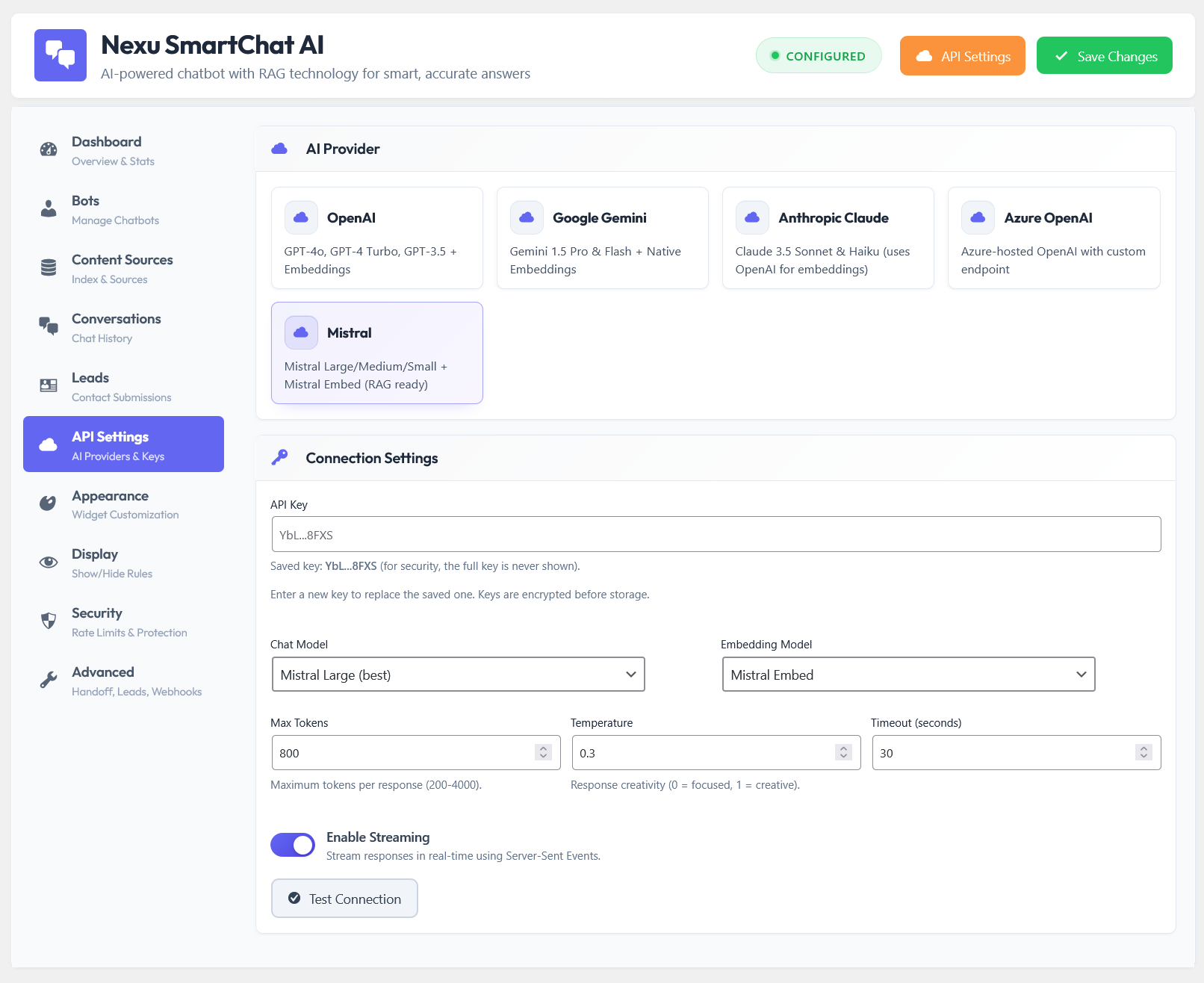
This comparison is written in the context of Nexu SmartChat, a multi-model WordPress AI chatbot plugin that lets you switch between OpenAI, Anthropic, and Google models from the same settings panel. That flexibility makes the model choice a real decision rather than a locked-in default, which is exactly why the comparison matters.
We will go through each provider, then look at the scenarios that actually differentiate them in a WordPress RAG context. By the end, you will have a clear enough picture to make a confident choice for your site.
Why the model matters more in a RAG chatbot than in a general assistant
When you use an AI model directly, as a general assistant, the model’s raw intelligence and knowledge breadth are what matter most. In a WordPress RAG chatbot, the dynamic is different. The retrieval layer is doing the heavy lifting on knowledge. The model’s job is to take a retrieved chunk of your content and convert it into a useful, accurate, appropriately toned response to a specific visitor question.
That shift in role means the qualities that differentiate models in a WordPress chatbot context are instruction adherence, contextual fidelity (does it stick to what the retrieved content says rather than wandering into its training knowledge?), response length calibration, tone consistency, and behavior on low-confidence retrievals where the right answer is to say “I don’t have that information” rather than to generate something plausible but wrong.
Every provider has multiple models at different price and capability points. “Using OpenAI” could mean GPT-3.5-turbo at roughly $0.50 per million input tokens or GPT-4o at several times that cost. “Using Claude” could mean Claude Haiku, which is inexpensive and fast, or Claude Sonnet, which is more capable and more expensive. The brand comparison is almost meaningless without specifying the tier. This guide focuses on the mid-tier capable models from each provider: GPT-4o, Claude Sonnet 3.7, and Gemini 1.5 Pro, which are the realistic choices for a production WordPress chatbot that needs to be both capable and economically sustainable.
OpenAI GPT-4o: the established default with real strengths
GPT-4o is where most WordPress chatbot owners start, and there are good reasons for that. OpenAI’s API is the most mature in the market, the most widely integrated, and the one with the broadest ecosystem of tooling and documentation. For a WordPress plugin developer, building against the OpenAI API is the path of least resistance, and GPT-4o is a genuinely strong model for conversational applications.
GPT-4o is exceptionally good at structured output. When you need the chatbot to produce a response in a specific format, follow a multi-step reasoning chain, or handle a question that requires synthesizing information from several retrieved content chunks simultaneously, GPT-4o tends to perform reliably. Its responses are well-calibrated in length: not too brief to be unhelpful, not so verbose that visitors stop reading. It has strong performance on product comparison questions, where multiple product specifications need to be weighed against each other from retrieved context. For WooCommerce stores with complex product catalogs, this is a meaningful advantage.
GPT-4o can be over-eager to answer. When retrieved context is thin or ambiguous, it has a tendency to supplement with training knowledge rather than acknowledging the gap. In a customer-facing chatbot, this produces the specific failure mode where the chatbot gives an answer that sounds like it came from your site but actually came from the model’s general training data. For a SaaS product chatbot where visitors are asking about your specific features, or a WooCommerce store where accurate specifications matter, this tendency needs to be explicitly controlled through system prompt engineering. It does not self-correct reliably. Cost-wise, GPT-4o at the full tier is not cheap, and a busy site will feel this at scale.
Anthropic Claude: the instruction-following specialist
Claude’s reputation in the developer community is built primarily on two things: unusually strong instruction-following and contextual fidelity. These are not abstract virtues. For a WordPress chatbot, they translate into concrete operational differences.
Strong instruction-following means that when you tell Claude in the system prompt to answer only from the provided context, not to speculate about topics outside the retrieved content, to always recommend contacting support for order-related questions, and to keep responses under a certain length, Claude actually does those things consistently. It does not drift. It does not occasionally forget the instructions when a visitor’s question is especially compelling. This consistency matters a great deal in production because a chatbot that follows instructions 95% of the time will still produce 50 confusing or out-of-bounds responses per day on a site with 1,000 conversations.
Contextual fidelity is Claude’s tendency to answer from what you gave it rather than what it knows generally. In a RAG chatbot, the retrieved chunks are passed to the model as context. A high-fidelity model treats those chunks as authoritative and answers from them. A low-fidelity model uses the chunks as a starting point but then layers in training knowledge, which introduces inaccuracies whenever that general knowledge differs from your specific content. Claude is the strongest of the three providers on this dimension. It sticks to the material you provide in a way that GPT-4o and Gemini do less reliably.
Claude is the best choice when your chatbot’s system prompt has complex, specific behavioral rules. If you are building a chatbot that must stay strictly on-topic, handle edge cases gracefully by deferring to support rather than speculating, and maintain a consistent persona tone across varied visitor questions, Claude delivers that reliability more consistently than the alternatives. It also handles longer retrieved contexts better, which matters when your indexed pages are detailed documentation or long-form product descriptions. Claude Sonnet 3.7’s cost-per-token ratio is competitive with GPT-4o-mini for mid-tier use cases, making it a serious option for high-volume deployments that need quality and cost control simultaneously.
Claude’s strong contextual fidelity can occasionally read as overly cautious to visitors. When retrieved context does not contain a confident answer, Claude is more likely than GPT-4o to say so explicitly rather than synthesizing a plausible response. Depending on your visitors and your chatbot’s purpose, this can feel unhelpfully conservative. Claude’s ecosystem and WordPress plugin integrations are slightly less mature than OpenAI’s, meaning that if you are using a basic free plugin, it may not support the Anthropic API at all. A flexible plugin like Nexu SmartChat’s multi-model AI chatbot for WordPress removes this barrier entirely.
Google Gemini: the multimodal contender with a pricing edge
Gemini 1.5 Pro entered the competitive conversation in 2024 and has matured significantly. Its headline claim is an extremely long context window, up to 1 million tokens in some configurations, which sounds highly relevant for WordPress sites with large content libraries. The practical picture is more nuanced.
Gemini 1.5 Flash is notably cheaper than its OpenAI and Anthropic equivalents at comparable quality levels. For a high-traffic WordPress site where cost per conversation is a primary concern and the questions are relatively straightforward, Gemini Flash offers a compelling economics case. Google’s infrastructure also means low latency in many regions. If your visitors are primarily in markets where Google’s data centers are geographically close, you may see faster response times than with OpenAI or Anthropic. Gemini’s multilingual performance is strong, making it a genuinely good choice for sites that serve non-English speaking audiences.
Instruction-following fidelity is Gemini’s weakest point relative to the other two providers. In a WordPress chatbot context where behavioral consistency matters, Gemini 1.5 Pro drifts from system prompt instructions more often than Claude and, to a lesser extent, GPT-4o. The long context window advantage is also less relevant in a RAG architecture, where you are passing only the most relevant retrieved chunks to the model rather than the entire site content. The supposed advantage of Gemini’s large context window mostly applies in workflows where you do not have a retrieval layer, which is precisely the architecture that produces hallucinations. With proper RAG, a 32k context window is more than enough for any chatbot conversation.
Real-world cost comparison: what 1,000 conversations actually costs
Token pricing changes frequently, so treat these numbers as a relative guide rather than a precise quote. The comparison assumes a mid-complexity RAG conversation: a system prompt of roughly 500 tokens, two retrieved content chunks averaging 300 tokens each, a user message of 40 tokens, and a model response of 150 tokens. That is approximately 1,290 input tokens and 150 output tokens per conversation turn. For a single-turn interaction, which is typical for product questions, this represents a complete conversation.
The cost spread between the most expensive and least expensive capable models is enormous. GPT-4o full tier costs roughly 34 times more per 1,000 conversations than Gemini 1.5 Flash. The more practically relevant comparison is between the mid-tier models that balance quality and cost: GPT-4o mini, Claude Haiku 3.5, and Gemini 1.5 Flash are all in the range of $0.14 to $1.63 per 1,000 conversations at the estimated token volumes above. For a site doing 500 conversations per day, the annual difference between the cheapest and most expensive mid-tier options could be several hundred dollars.
This is where a plugin that supports model flexibility pays for itself. Being able to run a cheaper model for straightforward FAQ questions and switch to a more capable model for complex support conversations, or being able to change models as pricing evolves without rebuilding your setup, is a genuine operational advantage that single-model plugins cannot offer.
How each model handles the five hardest chatbot scenarios
Benchmarks are only useful up to a point. What WordPress site owners actually care about is how the model behaves in the specific situations that make or break a chatbot deployment. Here are the five scenarios that most reliably differentiate the models in a production WordPress setting.
Claude: Will typically say it does not have that specific information and suggest contacting support. GPT-4o: May attempt to answer from training knowledge, which can produce plausible but inaccurate responses. Gemini: Inconsistent — sometimes defers appropriately, sometimes generates an answer with insufficient basis. The winner for this scenario is Claude, by a clear margin. In a production chatbot, you want the model to say “I don’t know” when it doesn’t know.
Claude: Strong structured synthesis from multiple retrieved chunks, with clear comparisons. GPT-4o: Excellent at this — arguably the strongest of the three for multi-product synthesis. Produces clean, organized comparisons. Gemini: Capable but can produce longer responses than necessary, which hurts readability in a chat widget. For WooCommerce product comparisons, GPT-4o and Claude are both strong choices; Gemini is a viable option but produces noisier output.
Claude: Significantly more robust against prompt injection and jailbreak attempts. Stays in character and scope under social engineering pressure. GPT-4o: Good but can be coaxed out of persona with creative framing, especially when the visitor roleplays or presents hypothetical scenarios. Gemini: The weakest of the three on this dimension. Instruction boundaries can be crossed with less effort. For a customer-facing chatbot where visitors will inevitably test the limits, Claude’s robustness on this dimension is a meaningful advantage.
Claude: Excellent conversational coherence across turns. Remembers earlier stated preferences and refers back naturally. GPT-4o: Strong, with good coherence. Occasionally over-references prior turns in a way that feels mechanical. Gemini: Adequate but conversation memory within a session is less fluid. All three handle this reasonably well, but Claude and GPT-4o produce more natural multi-turn conversations. This matters for pre-sales chatbots where visitors explore options across several messages.
Claude: Strong multilingual performance, particularly on European languages. Maintains persona and instruction-following fidelity across language switches. GPT-4o: Strong across a wide range of languages, with particularly good performance on widely spoken languages. Gemini: Excellent multilingual performance, arguably the strongest of the three for Asian languages and less common language pairs, due to Google’s language infrastructure. For multilingual sites with significant non-English traffic, Gemini deserves genuine consideration.
The concrete recommendation by site type
After working through the scenarios and characteristics above, the recommendation landscape becomes fairly clear. The right model is not universal. It depends on your priorities.
Start with GPT-4o mini. It handles product comparisons well, is cost-effective at volume, and has the broadest WordPress plugin compatibility. If you find visitors are getting inaccurate responses when questions sit outside your indexed content, switch to Claude Haiku for better contextual fidelity. Avoid using full GPT-4o unless the chatbot is handling genuinely complex, high-value sales conversations that justify the cost.
Claude Sonnet is the strongest choice here. Instruction-following matters most when your chatbot needs to stay rigorously on-topic, correctly scope what it can and cannot help with, and maintain consistent behavior even when users try to push it off-script. The higher cost per conversation is justified by the higher stakes of each interaction.
Gemini 1.5 Flash is worth serious consideration for the cost-per-conversation economics and multilingual strength. The instruction-following limitations are real but manageable with careful system prompt engineering. For a chatbot handling mostly factual questions in multiple languages, the economics are compelling enough to accept some behavioral variance.
Claude Sonnet or GPT-4o, depending on your budget. Pre-sales conversations have higher revenue stakes, and the chatbot’s ability to synthesize product information convincingly, stay in persona under pressure, and guide a conversation toward a conversion is worth paying for. This is not a volume-at-low-cost scenario. It is a quality-per-conversation scenario.
The most honest conclusion from this comparison is that model lock-in is a real risk. OpenAI’s pricing, capabilities, and terms of service will continue to evolve. So will Anthropic’s and Google’s. The right answer in 2026 may not be the right answer in 2027, and being trapped in a single-provider plugin means adapting to those changes is not your choice to make.
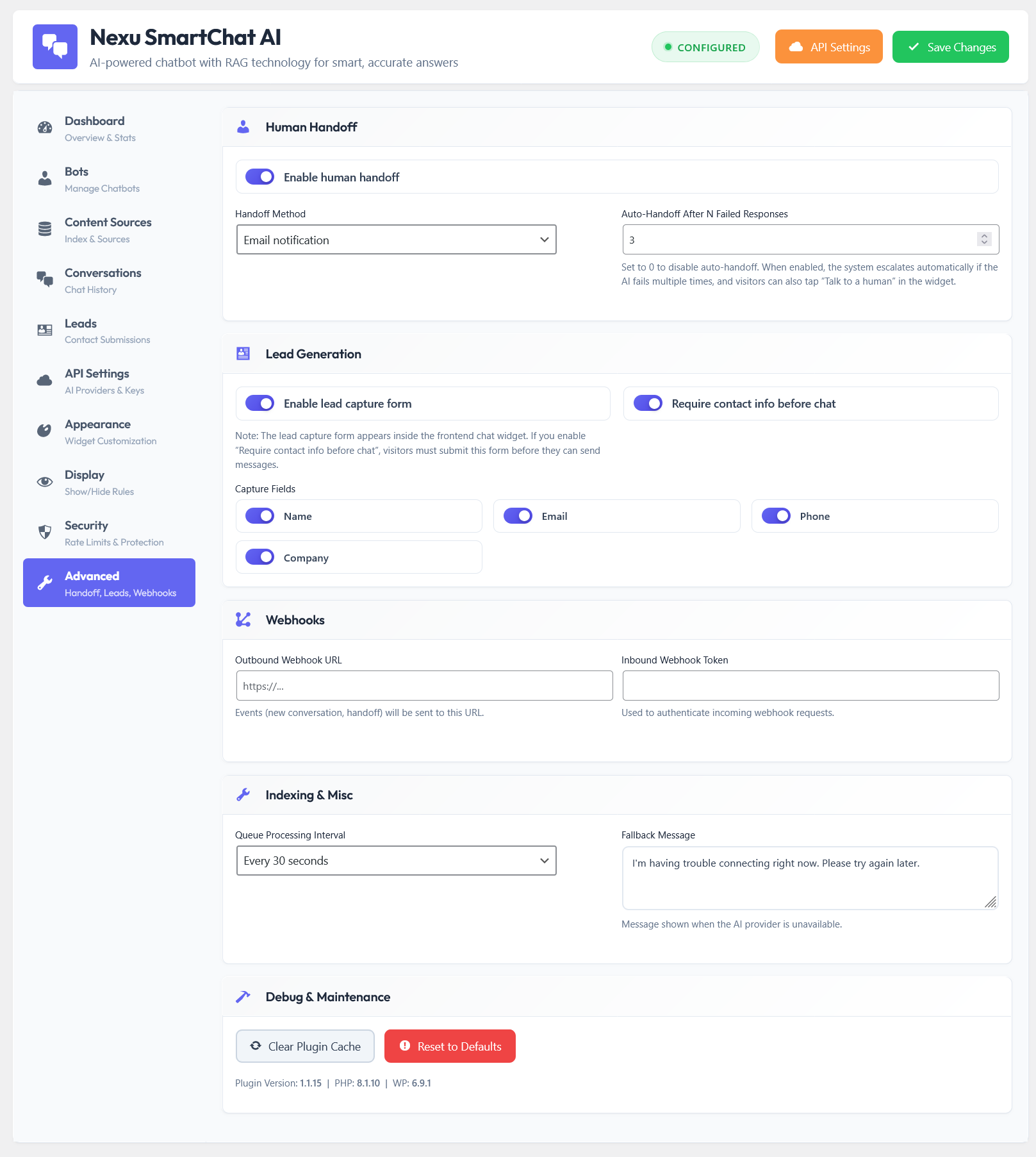
This is the strongest practical argument for using a multi-model WordPress AI chatbot plugin. Not because you will necessarily switch models frequently, but because having the option means your chatbot strategy is not dependent on any single provider’s decisions. The Nexu SmartChat WordPress plugin that supports OpenAI, Claude, and Gemini from a single configuration panel is built around exactly that principle: you bring the API key, you choose the model, and you change it whenever the balance of quality and cost shifts.
One WordPress chatbot plugin. Every major AI model.
Nexu SmartChat lets you connect OpenAI, Claude, or Gemini with your own API key, switch models without rebuilding, and run RAG-powered accurate answers from your real site content.




I was really hoping this comparison would help me pick the right model for my site's chatbot, but I'm left with more questions than answers. the breakdown of how each handles ambiguous questions is useful, but it doesn't dig deep enough into why some models default to filling gaps with generic training data instead of just admitting they don't have
I've been running a WooCommerce store with a chatbot for about six months now, and after trying out a few different options, this one really stands out when dealing with vague or incomplete product details. Most reviews just talk about specs, but in real world use especially with a big catalog what actually matters is how it handles missing info. This one doesn't just make up answers based on generic knowledge; it actually admits when it doesn't have enough context and asks follow up questions instead of guessing.
Just read this comparison, and wow it actually answered my biggest question: how these models handle vague customer questions late at night. No fluff, just real world examples. so nice to see something written for actual site owners!