Next-Level Code. Nexuvibe Style ...
Hrs
Min
Sec

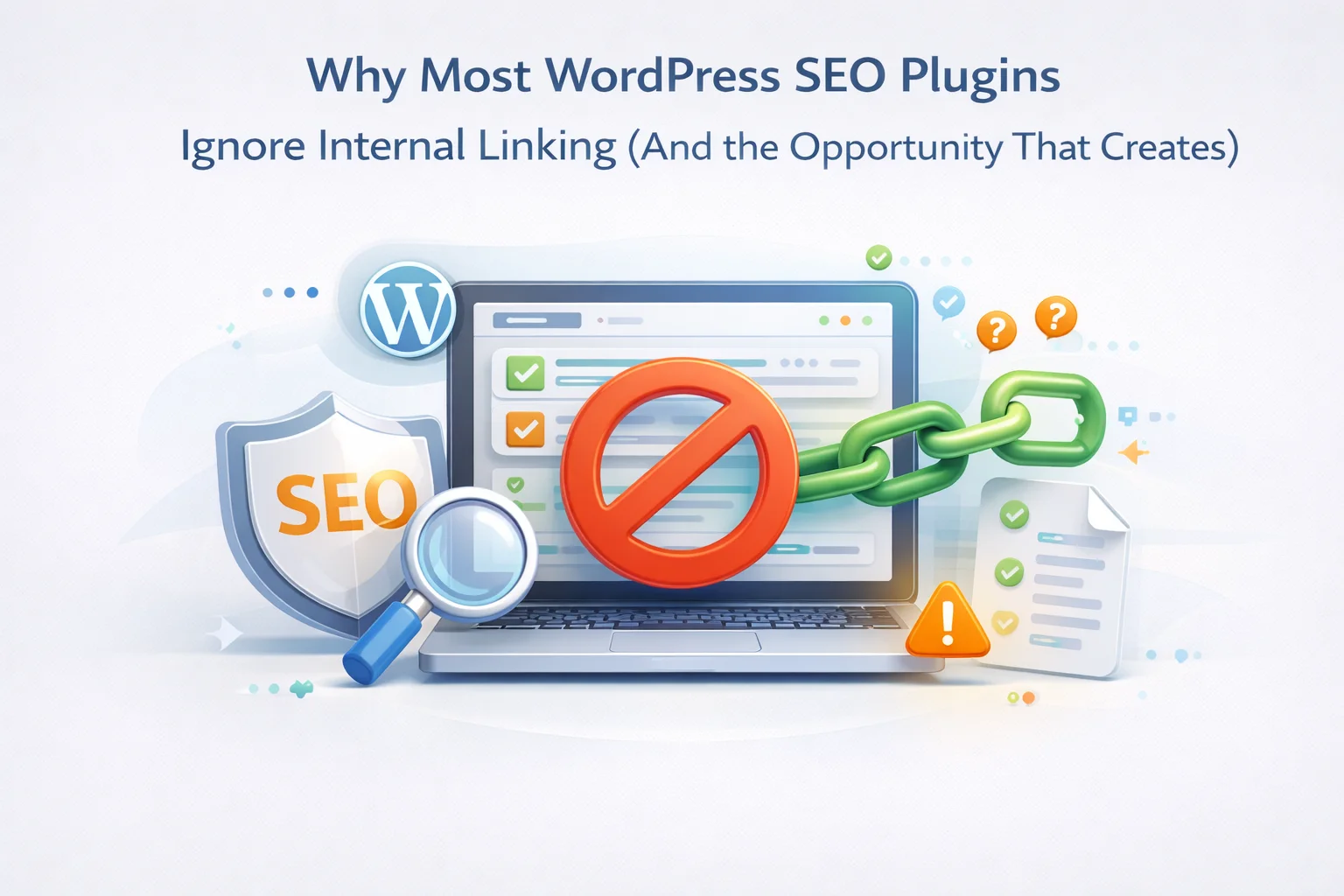
Open any major WordPress SEO plugin and count what it actually does. You will find meta title optimization, meta description fields, XML sitemap generation, schema markup, social sharing tags, canonical URL management, and technical audit features. What you will not find, in most cases, is meaningful internal linking functionality. The feature that Google’s own documentation emphasizes as critical for helping search engines understand your site structure is treated as an optional extra or ignored entirely.
This is not an oversight. It reflects how the WordPress SEO plugin market developed historically and the technical challenges involved in building genuine internal linking automation. But the gap between what popular SEO plugins provide and what effective SEO actually requires creates a significant opportunity for site owners who recognize it.
This analysis examines why internal linking remains underserved by mainstream SEO plugins, what that means for WordPress sites relying solely on those tools, and how the emergence of specialized AI-powered internal linking solutions for WordPress changes the equation for competitive site owners.
The dominant WordPress SEO plugins have converged on a similar feature set over the years. Understanding what that feature set includes helps clarify what it leaves out.
Popular plugins excel at on-page metadata management. They provide fields for meta titles and descriptions on every post and page. They generate XML sitemaps automatically. They add schema markup for various content types. They handle canonical URLs, robots directives, and social media tags. They run technical audits to catch missing alt text, broken links, and other issues. This functionality is genuinely valuable and well-implemented.
Most popular plugins provide minimal internal linking functionality. Some show a count of internal links on a page. A few offer basic suggestions when you are editing a post. But none provide comprehensive internal link analysis, automated link placement, orphan page detection, or strategic link architecture planning. The gap between what these plugins offer for metadata versus internal linking is stark.
The imbalance is striking when you consider the relative importance of these features. Meta descriptions do not directly affect rankings. Internal links do. Schema markup helps with rich snippets for some queries. Internal links affect every query your site might rank for. Yet the plugins that claim to optimize your site for search engines focus heavily on the former and barely address the latter.
The absence of robust internal linking features in major SEO plugins is not random. It reflects both how these plugins evolved and the genuine technical difficulties involved in doing internal linking well.
The major SEO plugins were built in an era when on-page optimization meant metadata optimization. Google’s algorithm has evolved significantly since then, placing more emphasis on content relationships and internal structure, but plugin feature sets often reflect the priorities of when they were designed rather than current ranking factors.
Adding a meta description field to every post is simple. Building a system that understands content relationships across thousands of pages and suggests relevant internal links is fundamentally harder. Before AI made semantic understanding accessible, the only options were simple keyword matching, which produces poor results, or manual curation, which does not scale.
Major SEO plugins compete on breadth of features and ease of use. Adding internal linking automation would require either significant development investment or integration with AI services that add cost. Neither fits the freemium model that dominates the WordPress plugin ecosystem. The features that exist are the features that are cheap to build and easy to explain.
Site owners have learned to think of SEO plugins as metadata managers because that is what SEO plugins have always done. The absence of internal linking features is not questioned because users do not expect them. This creates a self-reinforcing cycle where the gap persists because neither users nor plugin developers prioritize closing it.
The technical barriers that prevented good internal linking automation have largely been removed by advances in AI. What was difficult or impossible five years ago is now accessible through API calls to language models that genuinely understand content.
Modern language models can read a page and understand what it is actually about, not just which keywords it contains. This enables identifying topical relationships between pages even when they use different vocabulary. The limitation that made keyword matching the only option for automated linking no longer applies.
AI can generate anchor text that fits naturally within existing content and accurately describes the relationship between source and target pages. This eliminates the awkward, repetitive anchors that older automated systems produced and that search engines learned to recognize as manipulation signals.
Vector embeddings allow representing entire pages as mathematical objects that can be compared for similarity efficiently. Building a map of content relationships across thousands of pages, which would have required expensive computation previously, now happens quickly and affordably through modern embedding models.
When most sites in a niche have similar on-page optimization because they all use the same popular SEO plugins, the differentiating factor becomes the things those plugins do not handle. Internal linking is precisely that kind of differentiator.
The opportunity is particularly significant because most competitors are not addressing it. They installed their SEO plugin, checked the green lights it shows them, and assume they have done SEO. The internal linking gap in their strategy is invisible to them because their tools do not surface it. This creates an advantage for sites that recognize and fill the gap.
Understanding whether your current tools address internal linking adequately requires asking specific questions about what they actually do versus what you might assume they do.
Most do not. They might tell you which pages have few incoming links, but they do not systematically identify content with zero internal links pointing to it. Without this, orphan pages accumulate silently.
Some plugins suggest links when you type, but these suggestions are usually based on title matching rather than semantic content analysis. True semantic linking requires understanding what pages are about, not just what their titles contain.
Adding links to new posts is one thing. Retroactively improving internal linking across hundreds of existing posts is another. Most SEO plugins have no bulk analysis or application capability for internal links.
Understanding your internal link architecture requires seeing it. A graph visualization that shows how pages connect, where clusters form, and where gaps exist provides insights that tables of numbers cannot. Few mainstream SEO plugins offer this.
The solution to the internal linking gap is not replacing your existing SEO plugin. The metadata management, sitemaps, and technical features it provides remain valuable. The solution is adding a specialized tool that handles what the general-purpose plugin does not.
A dedicated AI-powered internal linking plugin for WordPress complements your existing SEO setup by handling the dimension that mainstream plugins neglect. It indexes your content semantically, identifies relationship opportunities, suggests and applies internal links at scale, rescues orphan pages, and provides the visibility into your link structure that informed optimization requires.
Specialized internal linking tools work alongside your existing SEO plugin, not instead of it. You keep using your current plugin for metadata, sitemaps, and technical SEO. You add the specialized tool for the internal linking dimension that your current setup lacks. The two systems address different aspects of SEO and do not conflict.
Unlike many SEO improvements that only affect new content, internal linking improvements can be applied retroactively across your entire archive. Running a bulk analysis and applying suggested links means your existing content immediately benefits. The investment pays dividends on everything you have already published.
Once configured, internal linking automation continues working as you publish new content. Each new post is automatically analyzed for link opportunities and integrated into your existing content structure. The competitive advantage you establish maintains itself without requiring ongoing manual effort.
The gap in mainstream WordPress SEO plugins represents both a problem and an opportunity. The problem is that sites relying solely on these tools have incomplete SEO strategies. The opportunity is that recognizing and filling this gap provides competitive advantage in a landscape where most sites have not addressed it.
Internal linking is not optional for serious SEO. It is foundational to how search engines understand your site structure and distribute authority across your pages. The fact that popular plugins largely ignore it does not make it less important. It makes addressing it more valuable for the sites that do. Implementing intelligent internal linking automation is how you close the gap that your current SEO plugin leaves open.
Nexu AI Internal Linker adds the semantic internal linking capability that mainstream SEO plugins lack. Works alongside your existing tools to complete your WordPress SEO strategy.






Finally, someone's fixing the internal linking mess these plugins leave. About time!
Still too much manual work.
The automatic XML sitemap feature actually works really well for basic SEO, which is nice. I was kinda surprised, though, that something so fundamental still feels like an afterthought while bigger structural SEO stuff like internal linking gets totally overlooked