
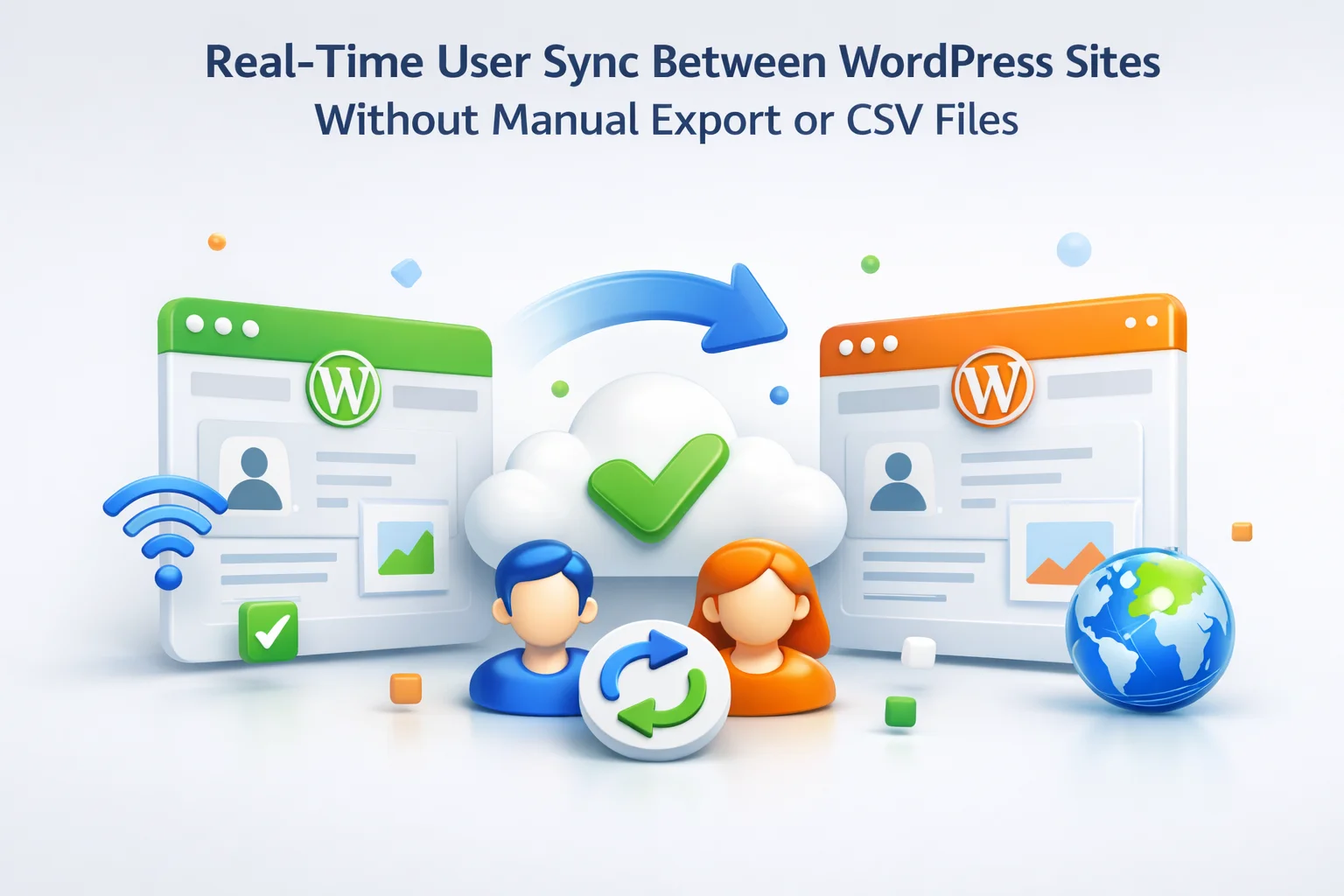
There is a particular kind of dread that comes with managing users across multiple WordPress sites manually. You know the routine. Export users from Site A to a CSV file. Open it in Excel. Clean up the formatting issues. Remove the columns that will cause import errors. Upload to Site B. Wait for the import to process. Fix the duplicate email conflicts. Repeat next week when everything is out of sync again.
This workflow made sense fifteen years ago when WordPress sites operated as isolated islands. Today, it is a massive bottleneck that introduces errors, wastes administrative time, and guarantees that your user data is never truly current across your network. The moment you finish an import, someone registers on Site A and the sync is already broken.
Real-time user synchronization eliminates this entire category of work. When a user registers, updates their profile, or changes their password on any site in your network, that change propagates instantly to all connected sites. No exports. No imports. No spreadsheets. No sync lag. The data flows automatically through secure API connections, and your sites stay aligned without any manual intervention.
This guide explains exactly how real-time sync works, why it is fundamentally different from batch processing approaches, and how to implement it on your own WordPress network.
The hidden costs of manual CSV synchronization
Manual CSV workflows seem simple on the surface. Export, import, done. But anyone who has actually managed user data this way for more than a few months knows the reality is far messier. The costs accumulate in ways that are easy to overlook until they become unsustainable.
A weekly user sync between two sites takes about an hour when you account for export, data cleaning, import, and troubleshooting. That is 52 hours per year, per site pair. If you have three sites that need to stay synchronized, you are looking at multiple days of staff time annually just moving user data around in spreadsheets. This is skilled labor that could be building your business instead.
Manual processes introduce errors. A column gets misaligned in the spreadsheet. Special characters in names cause encoding issues. Someone accidentally imports the wrong file version. These mistakes corrupt user data in ways that are difficult to detect and painful to fix. The errors often surface as customer complaints, damaged trust that costs far more than the time spent on the import itself.
Even if you sync weekly, your data is outdated the moment you finish. A customer who registered on Monday will not exist on your secondary site until the next sync cycle. If they try to log in during that window, they encounter a broken experience. The gap between reality and your database is a constant source of friction that no amount of careful scheduling can eliminate.
CSV exports do not include password hashes for security reasons. So even after a successful import, users cannot log in with their existing credentials on the new site. They have to reset their password, which generates support tickets and frustration. Some systems try to work around this with plaintext password fields, which creates serious security vulnerabilities.
How real-time synchronization actually works
Real-time user sync operates on a fundamentally different model than batch processing. Instead of periodically moving data in bulk, it responds to individual events as they happen. When a user takes an action that changes their profile, that specific change is immediately transmitted to connected sites.
The technical foundation is event-driven architecture. WordPress fires hooks whenever certain user actions occur: user_register when a new account is created, profile_update when profile data changes, after_password_reset when credentials are modified. A real-time WordPress user synchronization system listens for these hooks and triggers an outbound sync operation for each relevant event.

The sync payload contains only the changed data, not the entire user record. If someone updates their display name, the system transmits that single field change. This minimizes bandwidth usage and reduces the processing load on receiving sites. It also provides a clear audit trail showing exactly what changed and when.
All data transmitted between sites is encrypted using industry-standard protocols. The connection between sites is authenticated with unique API keys, and each request is validated before processing. Password hashes are transmitted securely, which is why real-time sync can keep credentials synchronized while CSV exports cannot.
The receiving site processes the incoming data and updates its local database accordingly. If the user already exists, their record is updated. If it is a new registration, the user is created with all their profile data intact. The entire process typically completes in under a second, making the synchronization effectively invisible to end users.
The role of background queues in reliable sync
Immediate synchronization sounds ideal, but there is an engineering challenge: what happens when your site experiences a traffic spike? If a thousand users register during a flash sale, you do not want a thousand simultaneous outbound API calls potentially overwhelming your server or the receiving sites.
The solution is a background queue system. When a user event occurs, it is not processed inline with the web request. Instead, the event is added to a processing queue. A background worker then handles the queue efficiently, batching operations where possible and managing the rate of outbound connections.

This architecture provides several important benefits. Your website remains responsive because user actions complete immediately without waiting for external API calls. The queue can implement intelligent retry logic, automatically reprocessing failed sync attempts when a connected site comes back online. And the system can handle bursts of activity gracefully by processing them over time rather than all at once.
By decoupling sync operations from the main request cycle, your website maintains full performance even during heavy sync activity. Users do not experience slower page loads or timeouts when the system is processing a large batch of profile updates.
If a receiving site is temporarily unavailable, the queue holds the pending sync tasks and retries them automatically. This ensures that brief outages or network issues do not result in lost data or permanent synchronization gaps.
The queue interface shows exactly what is pending, what is currently processing, and what has completed. This visibility makes it easy to verify that sync is working correctly and to identify any tasks that might need attention.
Configuring sync rules for your specific needs
Different networks have different requirements for what data should flow between sites and in which direction. A flexible user synchronization plugin for WordPress provides granular control over these sync behaviors rather than forcing a one-size-fits-all approach.

Sync direction is one of the most important settings. One-way sync pushes changes from a master site to sub sites, making the master the authoritative source of user data. This works well when you have a primary site where most registrations happen and secondary sites that need to mirror that user base. Two-way sync allows changes on any site to propagate to all others, which is useful when users might update their profiles on different sites depending on which they visit most often.
Field-level control lets you choose exactly which user data elements participate in synchronization. Core identity fields like username, email, and password typically need to sync everywhere. But you might have custom user meta that is only relevant to one site and should not clutter the databases of others. Being selective about what syncs reduces unnecessary data transfer and keeps each site’s user tables focused on what matters for that specific property.
Role mapping handles the translation of user roles between sites with different permission structures. An administrator on your main site might only need subscriber access on your documentation site. A customer on your retail store might need a different role on your wholesale portal. Smart role mapping ensures that users get appropriate permissions on each site without requiring manual role assignment.
Handling the WooCommerce customer data challenge
If you run WooCommerce stores, user synchronization becomes significantly more complex. Customers have billing addresses, shipping addresses, order history, and various commerce-related metadata that all need consideration. When someone updates their shipping address on Store A, you probably want that change reflected on Store B as well.

A proper WooCommerce user sync implementation tracks changes to customer meta fields and includes them in the sync payload. This means billing_first_name, billing_address_1, shipping_city, and all the other WooCommerce customer fields can stay consistent across your stores. When a customer checks out on any store in your network, their saved addresses are already there, creating a smoother checkout experience that reduces cart abandonment.
Order history itself typically does not sync between stores since orders are placed on specific stores and belong to those stores’ records. But the customer identity and profile data that travels with them absolutely should be synchronized so they are recognized immediately wherever they shop.
Conflict resolution when changes collide
In a distributed system where users can update their profiles on multiple sites, conflicts are inevitable. What happens when someone changes their display name on Site A at the same moment someone else (or even the same person in a different browser tab) changes it on Site B?
The simplest conflict resolution strategy is last-write-wins. Whichever change arrives most recently becomes the authoritative version. This is usually acceptable for most user profile data where having any recent version is better than having outdated data.
More sophisticated systems can implement master-priority, where the master site’s data always takes precedence in conflicts. This ensures a single source of truth even when changes happen simultaneously on multiple sites. Sub sites can push changes to the master, but if there is a conflict, the master’s version wins.
For most WordPress networks, true simultaneous conflicts are rare. Users do not typically edit their profiles on two different sites at the exact same second. The sync system needs to handle the possibility gracefully, but you should not over-engineer for edge cases that almost never occur in practice.
Monitoring your sync network
A real-time sync system that you cannot observe is a system you cannot trust. Comprehensive logging and monitoring are essential for verifying that synchronization is working correctly and for troubleshooting when issues arise.

Good logs record the timestamp of each sync event, the user involved, what data changed, the source and destination sites, and the outcome (success or failure with error details). This level of detail lets you answer questions like: Did user X’s profile update actually propagate to Site B? When did that happen? What specifically changed?
A dashboard view complements detailed logs by providing high-level metrics at a glance. Total synced users, recent sync activity, connection health status, and any pending items in the queue all help you quickly assess whether your network is functioning properly without digging through individual log entries.

Making the switch from manual to automated sync
If you have been managing user synchronization manually, the transition to a real-time automated system is straightforward. The first step is usually a bulk push of existing users from your master site to establish the baseline. After that initial sync, all new registrations and profile updates flow automatically.
The tools exist to make this transition painless. A complete WordPress SSO and user sync solution handles the initial bulk sync, establishes the real-time connection, and provides the monitoring infrastructure you need to trust that everything is working. The configuration takes minutes, and the improvement to your operational efficiency is immediate.
Stop wasting time on spreadsheets. Your user data should flow automatically, securely, and instantly across every site in your network. That is what real-time synchronization delivers.
Automate your WordPress user synchronization today
Nexu User Sync eliminates CSV exports forever. Real-time synchronization, encrypted data transfer, background queue processing, and complete monitoring for your entire network.



Just set this up for my grandson's network of hobby sites. the real time sync sounds great, but how exactly do the webhook triggers work? Do they fire every single time a user sneezes on one site, or only for big changes like registrations? Asking because 52 hours a year per pair adds up fast if it's pinging constantly.
I've been managing user data across three WordPress sites for years, and the old export to CSV routine was always such a pain. This plugin cuts all that hassle out completely no more waiting for imports to finish or dealing with duplicate conflicts. Just set it up once, and the users stay synced automatically. it's saved me hours every single week. still, totally worth it for how much time it saves me now.
Hey, I was really excited about this plugin after reading the description. The idea of real time sync without manual exports sounded perfect for our university club sites
Okay, I'll be honest this almost solves the headache of keeping user data in sync across multiple WordPress sites. The real time updates work great, and not having to mess with CSVs every time someone changes their email is a huge relief