
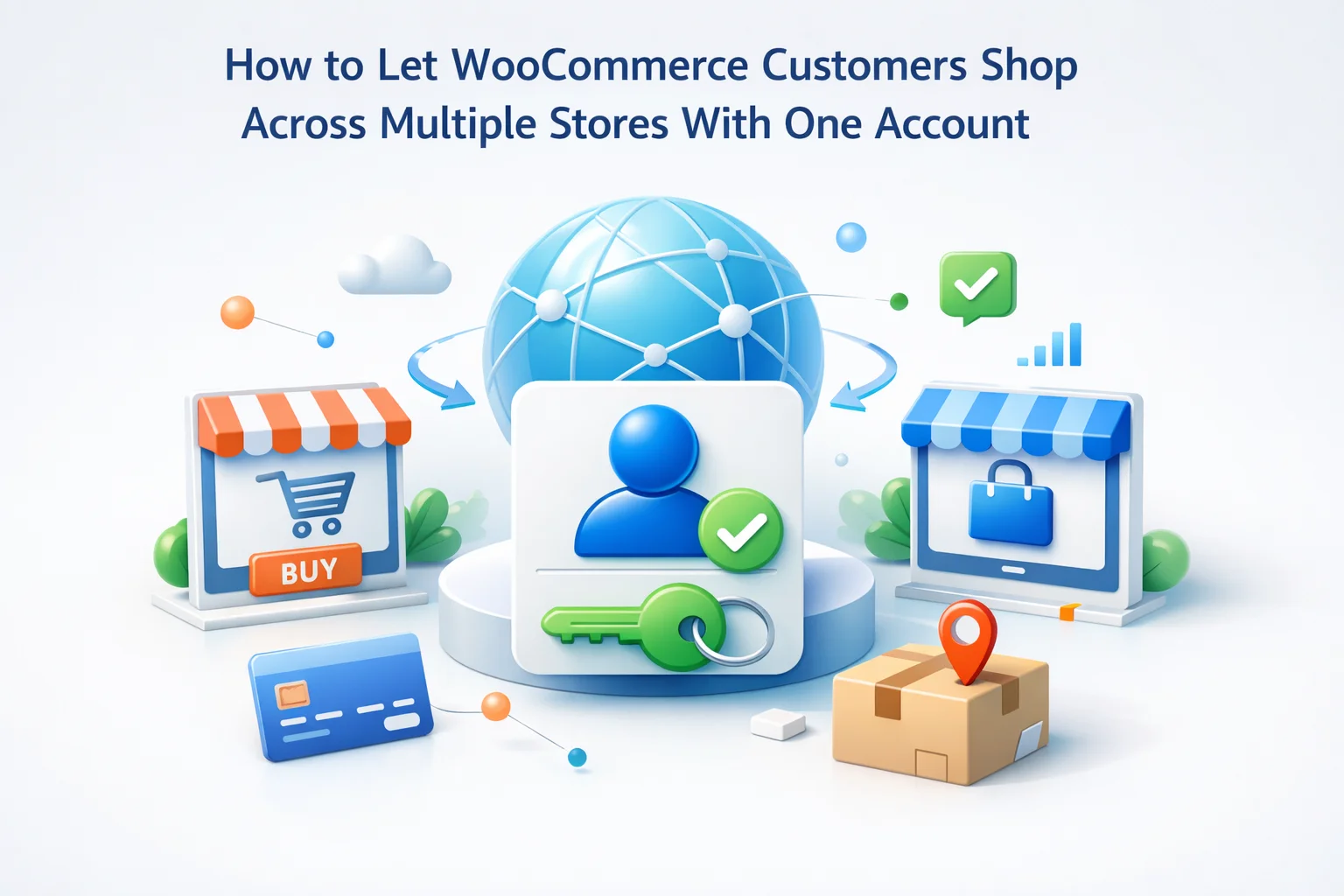
Running multiple WooCommerce stores makes sense for a lot of businesses. You might have separate storefronts for different product lines, regional stores serving different markets, a retail site alongside a wholesale portal, or distinct brands that target different customer segments. The operational logic is sound. The customer experience, however, often suffers.
A customer who buys from your main store expects to be recognized on your specialty store. They do not want to create another account, enter their shipping address again, or remember a different password. Every additional registration form is a point where potential revenue walks away. Every duplicate account is a support ticket waiting to happen.
The solution is connecting your WooCommerce stores so they share customer data. One account works everywhere. Billing and shipping addresses follow the customer. Profile updates propagate instantly. The customer experiences your multi-store operation as a single unified brand, and your conversion rates benefit accordingly.
This guide walks through exactly how to implement shared customer accounts across WooCommerce stores, the technical details of what data syncs and how, and the configuration options that let you customize the behavior for your specific business model.
The real cost of fragmented customer data
When each WooCommerce store operates with its own isolated customer database, you pay the price in multiple ways. Some costs are obvious. Others accumulate quietly until they represent a significant drag on your business performance.
A customer visits your specialty store from your main store. They find a product they want. At checkout, they are asked to create an account or log in. The login fails because they do not have an account on this store. The account creation form wants their address again. They abandon the cart. According to Baymard Institute research, 24% of cart abandonments happen because the site wanted the user to create an account. You just lost that sale to unnecessary friction.
Your customer moved last month. They updated their shipping address on your main store. They then place an order on your accessories store, where their old address is still saved. The package goes to their previous residence. Now you are dealing with a reshipping cost, a frustrated customer, and a support ticket that never needed to exist. All because address data was not synchronized across your stores.
You want to know the lifetime value of your customers. But the same person appears as different customers in each store’s database. Their purchase history is fragmented. Your analytics show smaller individual customers instead of the high-value repeat buyer they actually are. Marketing decisions based on this fragmented data will be systematically wrong.
A customer contacts support about an order. Which store was it on? The support agent has to check multiple admin panels. The customer gets frustrated explaining which store they ordered from. Password reset requests multiply as customers forget which credentials work where. Every conversation takes longer because the customer context is scattered across disconnected systems.
What WooCommerce customer data needs to sync
WooCommerce extends the basic WordPress user profile with commerce-specific customer data. A proper WooCommerce customer sync solution needs to handle all these fields to provide a truly unified experience.
The core user profile fields come first: username, email address, password, display name. These are the identity foundations that allow the customer to log in and be recognized across your stores.
Then come the WooCommerce-specific customer meta fields. Billing address information includes first name, last name, company, address lines, city, state, postcode, country, email, and phone. Shipping address has its own parallel set of fields. These are the details that pre-populate at checkout, and keeping them synchronized is what creates the seamless experience customers expect.

Beyond addresses, WooCommerce stores various customer metadata: payment method tokens if you use saved payment methods, customer notes, and any custom fields added by plugins. Which of these should sync depends on your specific setup. Payment tokens might need to stay store-specific depending on your payment processor configuration. Customer notes that reference store-specific interactions might not make sense on other stores.
Orders themselves typically do not sync between stores. An order placed on Store A belongs to Store A’s records, inventory, and fulfillment process. What syncs is the customer identity and profile data, so the customer is recognized everywhere, but their order history remains with the store where they made each purchase. This is usually the correct behavior for multi-store operations.
Configuring cross-store customer synchronization
Setting up shared customer accounts across WooCommerce stores follows the same master-sub pattern used for general WordPress user sync. One store acts as the master, holding the authoritative customer database. Other stores connect as sub sites and synchronize their customer data with the master.

The sync configuration for WooCommerce stores lets you specify exactly which customer data fields should be included. You might sync all billing and shipping fields for full checkout convenience. Or you might sync only the core identity fields if your stores have different address requirements. The flexibility lets you match the sync behavior to your business logic.

Once configured, synchronization happens automatically in real time. A customer registers on Store A, and within seconds their account exists on Store B and Store C. They update their shipping address on Store B, and the new address is immediately available on all connected stores. The customer never sees any of this, they just experience consistent recognition everywhere they shop.
Adding Single Sign-On for seamless shopping
Customer synchronization ensures accounts exist across all stores. Single Sign-On removes the login friction between them. Combined, they create the unified shopping experience where customers authenticate once and shop freely across your entire WooCommerce ecosystem.

Consider the customer journey with SSO enabled. They log into your main retail store. They browse, perhaps add items to their cart. Then they click a link to your accessories store on a different domain. Instead of seeing a login prompt, they land already authenticated. Their saved addresses are there. Their account details are current. They can checkout immediately without any authentication friction.
You can configure central login to direct all authentication through your main store. When a customer tries to log in on any store in the network, they are redirected to the main store’s login page. After successful authentication, they return to the store they were visiting, already logged in with a valid session. This centralizes your login experience and simplifies password management.
Real-world multi-store scenarios
Different businesses run multiple WooCommerce stores for different reasons. Here is how customer sync works across several common scenarios.
You run a B2C retail store and a separate B2B wholesale portal. Customers exist on both but see different prices and products. With sync enabled, a customer who registers on your retail store can later apply for wholesale access. Their core account exists. You simply upgrade their role on the wholesale store to unlock B2B pricing. No duplicate registration needed. Their billing information is already there.
You operate separate stores for different geographic markets: US, UK, EU, Australia. Each has its own currency, tax configuration, and possibly different product availability. A customer traveling from the US to the UK can shop on your UK store with their existing account. Their login works. Their name and contact details are recognized. Only the address might need updating if they are shipping to a UK location.
You own multiple brands, each with its own WooCommerce store and distinct identity. A customer who buys from Brand A might not even realize Brand B is the same company. But with shared accounts, if they do discover Brand B and want to purchase, their account already works there. You can offer them a cohesive experience across your portfolio while maintaining separate brand identities on the frontend.
Your main store sells a broad catalog. You also run specialty stores focused on specific product categories: a dedicated outdoor gear store, a home essentials store, a tech accessories store. Customers who shop the main store can seamlessly browse your specialty stores with the same account. Cross-selling between stores becomes frictionless because the customer experience is unified.
Monitoring your multi-store customer network
When customer data flows between multiple stores, you need visibility into what is happening. Dashboard monitoring and detailed logs let you verify sync health, troubleshoot issues, and maintain confidence that your customer data is consistent across the network.

Detailed logs record every customer sync event. When a customer updates their address, you can see exactly when that change propagated to each connected store. If a sync fails for any reason, the logs show the error details so you can address the issue. This level of visibility is essential for maintaining data integrity across a complex multi-store operation.

The competitive advantage of unified customer experience
The businesses that win in e-commerce are increasingly those that remove friction from the customer journey. Every unnecessary form field, every repeated data entry, every additional login is an opportunity for customers to leave and shop somewhere easier.
A complete WooCommerce customer sync and SSO solution transforms your multi-store operation from a collection of disconnected shops into a unified commerce ecosystem. Your customers get the seamless experience they expect from major e-commerce platforms. Your operations benefit from consolidated customer data and reduced support complexity. And your conversion rates improve because you have eliminated the friction that was costing you sales.
If you are running multiple WooCommerce stores and your customers still have to register separately on each one, you are leaving revenue on the table. The solution exists, it works, and implementing it takes far less effort than continuing to deal with the problems fragmented customer data creates.
Unify customer accounts across all your WooCommerce stores
Nexu User Sync handles complete WooCommerce customer data: billing addresses, shipping details, profile information, and SSO. One account, all your stores, zero friction.

Set this up for a client running three stores in different regions, and the unified account system makes sense on paper. customers actually like not having to re enter their details every time, and once we got the backend sync for addresses dialed in, it worked like it was supposed to.
Hey everyone, just wanted to leave a quick review for this multi store setup. I run a couple WooCommerce sites one for retail and one for wholesale and my customers used to complain all the time about having to create new accounts for each. seriously, I don't blame them why should they re enter their info if they just gave it last week? lost so many sales from people ditching their carts at checkout. this solved that problem instantly. One login works across all stores
Finally one login for all my stores.