Next-Level Code. Nexuvibe Style ...
Hrs
Min
Sec

There is a particular kind of operational debt that WordPress network owners accumulate slowly, almost invisibly, until it becomes impossible to ignore. It does not arrive as a single catastrophic event. It compounds quietly in the background: a few extra hours of admin work per week, a growing queue of support tickets about mismatched account details, a frustrated team member who spends Friday afternoon exporting CSVs and importing them somewhere else. By the time anyone thinks to quantify the cost of this routine, the number is usually much larger than they expected.
Manual user management across multiple WordPress sites is one of the most underestimated operational costs in the ecosystem. It survives because it feels manageable in small doses, and because the alternative — properly automating cross-site user synchronization — requires some upfront investment that gets perpetually deprioritized. This guide makes the case for that investment by mapping out exactly where and how the hidden costs accumulate, and what a connected, automated alternative actually looks like in practice.
We cover this in the context of automated WordPress cross-site user sync and SSO solutions built specifically for networks that are tired of maintaining user data by hand. The cost analysis here applies regardless of which tool you end up using. The goal is to make the true cost of the status quo visible.
For context: this guide assumes you are running two or more separate WordPress installations that share a user base in some meaningful way. Whether those are on different domains, subdomains, or hosted environments, the cost patterns described below apply consistently across all of these configurations.
The most visible hidden cost is also the most straightforward to quantify: the hours your team spends performing tasks that should not require human involvement at all. These tasks have one thing in common — they exist solely because your WordPress installations do not talk to each other automatically.
Exporting users from one WordPress installation and importing them into another requires manual exports, format cleaning, field mapping, and careful deduplication to avoid creating duplicate accounts. For even a modest user base of a few hundred people, a full sync via CSV takes one to three hours per cycle. Many network operators run this process weekly or after any major campaign or sale. The cumulative annual cost in team hours is significant before you count the errors.
When users cannot access a secondary site with their existing credentials, the path of least resistance is to email your support team and ask for help. In a fragmented network, these requests arrive constantly. Each one requires an admin to manually look up the user on the primary site, create or update their account on the secondary site, and respond to the ticket. Multiply this by the volume of users who encounter the problem daily and you have a meaningful drain on support capacity.
A customer updates their shipping address or email on your main store. Three weeks later they notice that their account on your sister site still has the old details. They contact support. An admin manually updates the record. This reactive cycle of correction is entirely preventable, but without automated sync it plays out thousands of times per year across a moderately active network. Each instance is small. The aggregate is not.
Manual processes introduce errors. This is not a criticism of the people performing them — it is a property of manual data handling at any scale. When a human copies user data from one system to another, the error rate per record is low but never zero. At thousands of records and multiple sync cycles per year, the accumulated data quality degradation is substantial.
Data integrity problems are particularly insidious because they are not immediately visible. A record with a stale email address or an incorrect role looks perfectly normal in the WordPress admin. The problem only surfaces when a customer encounters the consequences, at which point the error may be days or weeks old and traced back to a manual import cycle that is long finished.
Manual user management has a particularly damaging property: its cost does not scale linearly with your growth. It scales faster. A network with 200 users and two sites might have a manageable manual sync process. Scale that to 2,000 users across four sites and the complexity does not grow by a factor of ten. It grows by a factor of significantly more, because you now have more sites to keep in sync with each other, more opportunities for data to drift between sync cycles, more edge cases in your user base, and more support load from the larger audience encountering the friction.
This is the scaling trap: the manual process that felt acceptable at your current size becomes genuinely untenable at the size you are trying to reach. Growth makes the problem worse, not better. Organizations that recognize this pattern early and eliminate the manual process before it becomes a ceiling are able to scale without accumulating the operational debt. Organizations that do not recognize it often find that user management becomes a hidden bottleneck on their growth trajectory.
The cost categories discussed so far are operational — they affect your team. This category affects your customers directly, which means it affects your revenue. Manual user management degrades the customer experience in ways that are easy to dismiss as minor inconveniences but accumulate into measurable retention and conversion problems.
A user buys a product or membership on your main site on a Friday. Your manual sync process runs on Monday mornings. They spend the weekend trying to access the connected site they paid for and finding that their account does not exist there yet. The support ticket arrives Saturday afternoon. The refund request arrives Monday morning, minutes before your sync would have given them access anyway. This gap between purchase and access is one of the most preventable sources of refund requests in a multi-site network.
Customers who experience inconsistent account behavior across your sites do not frame it as “this network has a technical user sync limitation.” They frame it as “this company doesn’t have its act together.” Professionalism in digital products is experienced through seamless systems. Fragmented user management signals fragmented operations, regardless of how good your actual product is.
If your cross-sell strategy involves directing customers from one site to another, the conversion rate on that cross-sell is limited by how smoothly users can move between sites. Every account friction point in that journey is a conversion killer. Networks that unify their user experience consistently see higher cross-site engagement rates, not because the offer changed, but because the friction preventing the conversion was removed.
Manual user management creates a security risk that is rarely discussed in this context. When user accounts are not synchronized automatically, they are also not deactivated automatically. A user who should no longer have access to one of your sites — because their subscription lapsed, they were terminated as a contractor, or they requested account deletion — may retain active accounts on connected sites that were never updated.
This is not a theoretical concern. Security researchers consistently identify stale, forgotten accounts with elevated privileges as a significant attack vector. In a fragmented user management environment, the offboarding process is manual and therefore unreliable. You may remove a user’s access from the master site but leave their account intact and active on two connected sub-sites simply because the manual process was incomplete.
It is useful to be concrete about what changes operationally when you replace manual user management with a properly configured automated sync system. The shift is not just about saving time — it is about changing the nature of your team’s relationship with user data from reactive and error-prone to proactive and reliable.
One concern that often comes up when organizations consider moving from manual to automated sync is performance. If every user registration, profile update, and role change triggers a sync operation across all connected sites, will that create database load problems on the master site during high-traffic periods?
The answer depends entirely on how the sync system is architected. A naive approach that processes every event synchronously will create performance problems during traffic spikes. A properly designed system uses a background queue to decouple the sync operation from the user-facing event that triggered it. The registration completes instantly from the user’s perspective. The sync to connected sites happens asynchronously in the background, processed in batches that are sized to avoid overwhelming connected site APIs.
The background queue also handles the sub-site unavailability problem that manual operators know well. When a connected site is temporarily down for maintenance or experiencing a hosting issue, manual sync processes either fail silently or require the operator to notice the problem and re-run the sync manually. An automated queue system holds pending sync tasks and retries them automatically when the connection is restored. No data is lost and no human intervention is required.
One of the most underappreciated aspects of automated user sync is what it does for your ability to answer questions about your own network. With manual processes, the honest answer to “did user X get synced to site Y?” is usually “I think so, but let me check.” With a comprehensive event log, the answer is immediate and definitive.
This transparency matters for support quality, for debugging, and increasingly for compliance. Privacy regulations in many jurisdictions require organizations to be able to demonstrate what they did with personal data and when. An automated sync system with detailed logging provides this evidence as a natural byproduct of operation. A manual process with no systematic record provides nothing.
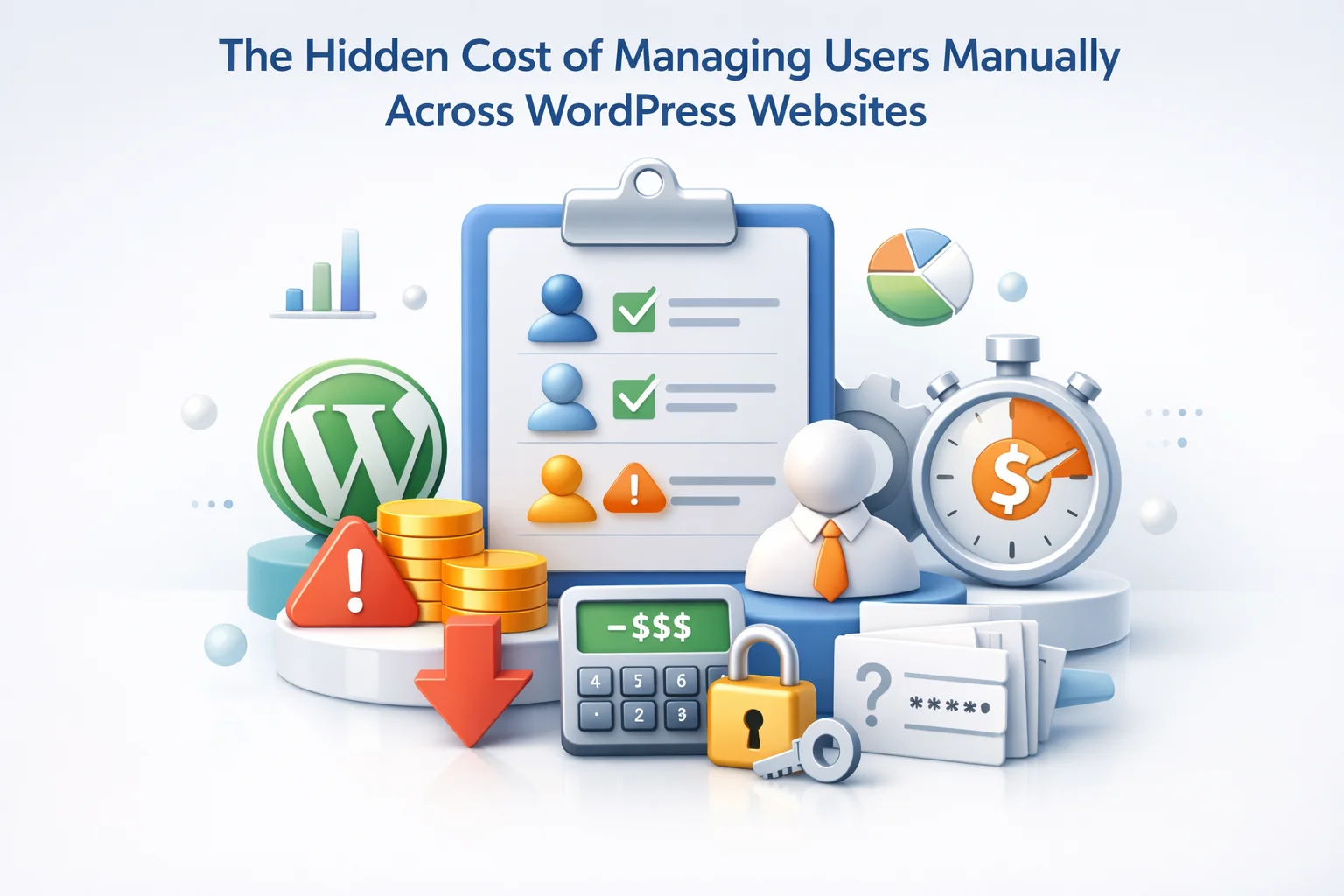
The hidden cost of manual user management across WordPress websites is not a single line item. It is the sum of administrative time, data quality degradation, customer experience damage, security exposure, and growth ceiling effects. Each category contributes to a total cost that most organizations have never formally measured, which is precisely why the status quo persists.
CSV cycles, manual account creation, reactive corrections, and password reset handling. These hours compound weekly and scale with your user base faster than your team capacity does.
Duplicate accounts, stale emails, role mismatches, and missing metadata. Each error has downstream consequences in support volume, deliverability, and access control that compound over time.
Manual processes become untenable before you reach the user counts you are targeting. The cost does not grow linearly with growth — it grows faster, eventually making further scaling operationally impractical without automation.
Access gaps after purchase, brand credibility erosion, and suppressed cross-site conversion rates. These costs are silent in your analytics but visible in your refund rate and customer lifetime value.
Stale accounts with lingering access on sites that were never updated when a user was offboarded. An attack surface that grows with every incomplete manual update cycle.
The decision to automate is not a technical upgrade. It is a business decision with a calculable return. The cost of the right tool is fixed and predictable. The cost of the manual alternative is variable, hidden, and guaranteed to grow. When you put those two things side by side on a spreadsheet, the case for automation is not close.
Nexu User Sync for eliminating manual WordPress multi-site user management is built specifically to replace the manual workflows described in this guide. Real-time sync, background queue processing, role mapping, WooCommerce metadata handling, and complete event logging — all of it designed to take the user management burden off your team permanently, so they can spend their time on work that actually requires human judgment.
Nexu User Sync replaces CSV imports, manual account creation, reactive corrections, and offboarding checklists with a single automated system that keeps all your WordPress sites perfectly in sync.






The numbers add up slower than you'd expect
Okay, so I run a few real estate sites on WordPress and decided to give this plugin a shot to keep user accounts in sync. the reactive profile updates do work when someone changes their email or address, it pushes the update across sites. But here's the catch: the more users and sites you add, the more time you end up spending cleaning up little mismatches. I know nothing's perfect, but when you've got hundreds of agents updating their info all the time, those "quick fixes" start to pile up
Wow this saved us so much time!