Next-Level Code. Nexuvibe Style ...
Hrs
Min
Sec

The marketing promises sound similar. “Reduce support tickets by 70%.” “Automate customer service.” “24/7 instant responses.” But behind these claims lie two completely different technical approaches to automated support. Understanding the difference is crucial because choosing the wrong approach can leave you with a chatbot that looks impressive in demos but fails to actually reduce your support workload.
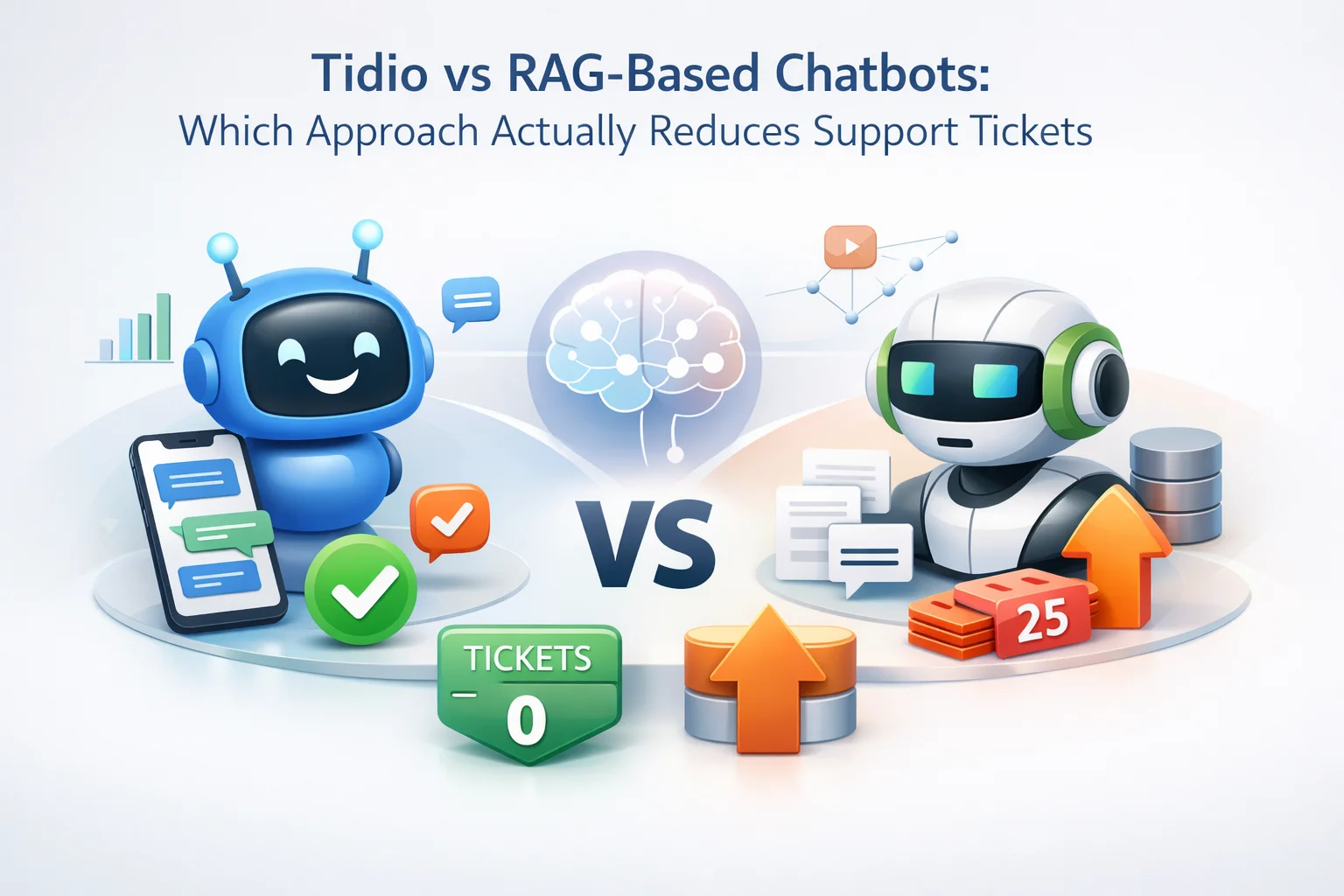
Tidio represents the flow-based approach: pre-built conversation templates, decision trees, and scripted responses. RAG-based chatbots like Nexu SmartChat represent the content-learning approach: AI that reads your actual website and generates responses based on what it finds. Same goal, fundamentally different methods.
This comparison examines both approaches honestly. Neither is universally better. The right choice depends on your specific situation, and understanding the tradeoffs helps you make that choice intelligently.
Before comparing outcomes, we need to understand how each system actually works. The technical architecture determines what each type of chatbot can and cannot do.
Flow-based chatbots work through pre-defined conversation paths. You create a flow: “If customer asks about shipping, show this message and these buttons.” The customer’s input is matched against trigger keywords or button clicks, and the corresponding scripted response is delivered.
This approach excels at guided conversations where you can predict the path. Lead qualification forms, appointment booking, product category navigation. The experience is polished and predictable. But it only knows what you explicitly programmed.
RAG (Retrieval-Augmented Generation) chatbots index your website content, then search that index when customers ask questions. The AI retrieves relevant content chunks and generates a natural response based on what it found. No pre-scripted flows needed.
This approach excels at answering unexpected questions using information that already exists on your site. Product specifications, policy details, how-to content. The bot does not need you to anticipate every question because it can find answers in your existing content.
Let us compare these approaches across the dimensions that actually matter for support ticket reduction.
Here is where the philosophical difference between approaches becomes practical. Support tickets exist because customers have questions. The question is: what percentage of those questions can each system handle?
Flow-based systems handle questions you anticipated. You built a flow for shipping questions, return questions, and sizing questions. Great. But what happens when someone asks “Does the blue jacket match well with khaki pants?” or “Is this coffee grinder loud enough to wake my roommate?” These are real questions that real customers ask. Flow-based systems cannot answer them because no one programmed a flow for them.
RAG-based systems search your content for relevant information. If your product description mentions the noise level of the grinder, the AI can find and reference that information. If you have a styling guide that discusses color combinations, it can access that too. The coverage is as broad as your content.
Initial setup is only part of the story. What happens over time determines the real cost of each approach.
When you launch a new product, someone must create a new flow for questions about that product. When you change your return policy, someone must update the return policy flow. When you discover customers are asking questions you did not anticipate, someone must build new flows. This maintenance is ongoing and scales with the complexity of your business.
When you publish a new product, the auto-indexing WordPress chatbot detects the change and updates its knowledge base automatically. When you update your return policy page, the chatbot learns the new policy. No manual intervention required. Your website content is the single source of truth.
The pricing models differ significantly, and the economics favor different approaches at different scales.
Note that these are approximate figures. Tidio pricing varies by feature tier. API costs depend on message length and model choice. But the pattern is consistent: one-time license plus usage-based API typically costs less than monthly SaaS subscriptions at most scales.
To be fair, there are scenarios where flow-based approaches like Tidio are genuinely the better choice.
When you need to guide visitors through a specific qualification process with defined steps, flow-based is ideal. “What is your budget range?” → “How soon do you need this?” → “Book a demo.” The structured path is the point.
Booking flows with integrations to calendars and scheduling systems work better as structured flows. The conversation has a defined outcome and limited valid paths to get there.
When compliance requires exact, pre-approved wording for certain responses, scripted flows give you complete control over what the bot says. AI-generated responses, while accurate, introduce variability that some regulated contexts cannot accept.
Conversely, RAG-based systems outperform in these scenarios.
When you have hundreds or thousands of products, creating individual flows for each is impossible. RAG chatbots for WooCommerce product questions index all products automatically and can answer questions about any of them.
Sites with extensive documentation, help articles, or educational content benefit from AI that can search all of it. The knowledge already exists. RAG makes it accessible conversationally without recreating it as chat flows.
When prices, availability, policies, or other details change often, maintaining scripted flows becomes a full-time job. Auto-syncing RAG systems eliminate this maintenance entirely by learning from your always-current website.
What do actual implementations achieve? Based on documented case studies and industry data:
Well-implemented flow-based chatbots typically deflect 30-45% of potential tickets. These are the common, predictable questions that flows handle well: operating hours, shipping times, return policies.
RAG implementations with comprehensive content indexing typically deflect 55-75% of potential tickets. The difference comes from handling the long tail of product-specific and unexpected questions.
The 25-30 percentage point difference in deflection rate represents real cost savings. For a business handling 1,000 support tickets monthly at $15 per ticket resolution cost, that is $3,750 to $4,500 in monthly savings from choosing the higher-deflection approach.
The choice is not about which technology is objectively better. It is about which approach fits your specific situation. Flow-based systems excel at guided interactions and compliance scenarios. RAG-based systems excel at flexible support coverage and e-commerce product questions.
For most WooCommerce stores prioritizing support ticket reduction, RAG-based chatbots deliver better results. The combination of automatic content learning, product-aware responses, and zero-maintenance synchronization addresses the core challenge: answering the unpredictable questions that customers actually ask.
Nexu SmartChat RAG chatbot for ticket deflection implements the content-learning approach specifically optimized for WordPress and WooCommerce. Auto-indexing handles the knowledge base. Multi-provider AI gives you model flexibility. And the result is a support automation tool that genuinely reduces the volume of tickets reaching your inbox.
Nexu SmartChat learns from your WordPress content to answer customer questions accurately. Higher deflection rates than flow-based systems because it handles the unexpected questions flows cannot.





Ugh, wasted my time reading this. still no clear answer about reducing my ticket
Bought this hoping it'd actually reduce support tickets, but honestly, it's just made things worse. the chatbot keeps giving answers that don't even line up with what's on our site, so customers end up more confused and still submit tickets.
Got this hoping it would handle all the random questions my school club's website gets, but honestly it's kinda hit or miss. The pre built templates are super easy to set up like, I had it running in 10 minutes which is great when people ask the same stuff over and over (meeting times, how to join, etc.).