
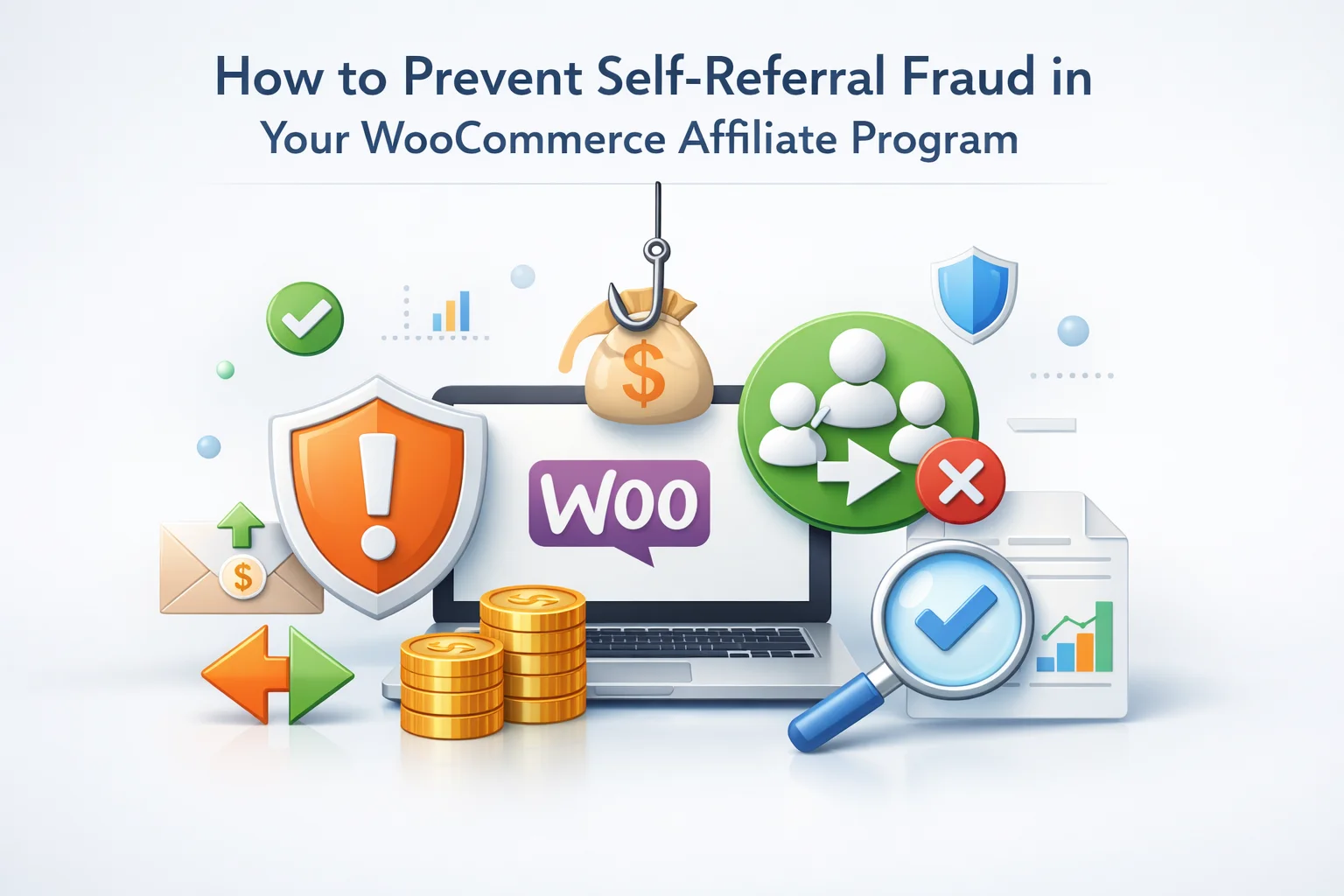
Self-referral fraud is the exploitation most likely to be present in your affiliate program right now, without your knowledge. Unlike click inflation or multi-account schemes which require deliberate technical effort, self-referral requires almost no sophistication: an affiliate simply uses their own link or coupon when they make a purchase, earning back a percentage of what they paid. For a customer who joins your affiliate program with no intention of promoting your products and every intention of getting a permanent discount on their own shopping, the barrier to entry is essentially zero.
The financial impact is real but often invisible. An affiliate earning 15% commission on $200 in monthly personal purchases has effectively reduced your margin by $30 per month — $360 per year — without generating a single genuine customer acquisition. Multiply this across a program with dozens of affiliates and the cumulative drain becomes meaningful. More sophisticated self-referral schemes — involving family members’ accounts, coupon code sharing, or order-and-refund cycles — can extract substantially more.
This guide covers every variant of self-referral abuse, the specific technical mechanisms that enable each variant, and the complete prevention configuration in Affiliate Engine, a WooCommerce affiliate management and fraud prevention plugin — including the settings that block self-referral at the point it occurs rather than detecting it after the fact.
The five variants of self-referral abuse
Self-referral is not a single behavior — it is a category of behaviors with meaningfully different technical mechanisms, different levels of intent, and different prevention requirements. Understanding each variant separately is what allows you to configure prevention that actually closes all of them rather than just the most obvious case.
The simplest form: the affiliate clicks their own referral link and places an order while logged in as themselves. The affiliate cookie is set with their own user ID, and when they check out — also logged in as themselves — the plugin’s default behavior would attribute the order to them. This variant is blocked completely by the standard logged-in user self-referral detection, which matches the purchasing user’s WordPress account against the affiliate account in the referral cookie. It requires the affiliate to be logged in to their account, which is the case for most direct purchases.
The affiliate uses their own coupon code at checkout rather than clicking their referral link — sometimes while logged out of their affiliate account to avoid triggering link-based self-referral detection. Because coupon code attribution does not check whether the buyer is the affiliated account holder, this variant bypasses the standard user-match self-referral block. It requires a separate coupon code self-referral check: when a coupon code is applied at checkout, the system should verify that the order is not being placed by the affiliate account linked to that coupon.
The affiliate shares their referral link or coupon code with someone in the same household — a partner, parent, or flatmate — who places the order on a different account. The technical detection challenge here is that this looks identical to a legitimate referral from the data perspective: a different user placed the order, the cookie or coupon was valid. IP address matching can flag this (both the affiliate and the buyer used the same network) but cannot definitively prove it is fraud rather than a genuine household referral. This variant sits in the grey zone — technical signals flag it, human review decides.
The affiliate creates a second WordPress customer account with a different email address, uses their affiliate link or coupon to place an order through that account, and collects the commission from their affiliate account. This exploits the fact that the user-match check only matches against the single registered affiliate account — it cannot know that the purchasing account belongs to the same real person. IP address matching flags this reliably, because both accounts typically operate from the same IP. Ghost account self-referral is always deliberate and should result in immediate suspension when confirmed.
The most aggressive variant: the affiliate places an order through their own link or a ghost account, the commission is approved before the hold period (or the hold period is shorter than the refund window), the affiliate collects the payout, then refunds the original order. The store pays both the product refund and the commission, having received nothing. This variant requires the self-referral to succeed first — blocking the underlying self-referral prevents the cycle. But the hold period configuration is the critical backstop if any self-referral slips through to commission approval stage.
Why the standard self-referral block is not a complete solution
The standard self-referral block in WooCommerce affiliate plugins — matching the logged-in buyer’s user ID against the affiliate account in the referral cookie — stops Variant 1 completely. This is the most common variant and the setting prevents it reliably. But it leaves Variants 2 through 5 open, because each of them exploits a different attribution pathway or a different identity mechanism.
The complete multi-layer prevention configuration
Closing all five self-referral variants requires four distinct configuration settings, each targeting a different pathway. None of these settings are complex or require technical expertise to implement — but all four need to be active simultaneously for complete coverage.

Enable the self-referral blocking toggle in the commission settings. When active, the plugin compares the WordPress user ID in the affiliate tracking cookie against the user ID of the logged-in account placing the order. If they match, no commission is generated. This is instantaneous, automatic, and costs nothing in legitimate program performance — genuine referrals from the affiliate’s network are different people with different user IDs and are entirely unaffected. This setting should be on by default from program launch with no exceptions.
When coupon code attribution is enabled, activate the coupon self-referral check. This adds a verification step for coupon-attributed orders: when a coupon code is used at checkout, the plugin checks whether the purchasing account is the affiliate account linked to that coupon. If they match, the coupon discount is applied (the coupon still works as a discount code for the buyer) but no affiliate commission is generated. This check must be separate from Layer 1 because coupon attribution uses different data paths — Layer 1 alone does not protect against coupon self-purchase.
Enable IP address matching in the fraud settings. When a referred order is placed from the same IP address that the affiliate account registered or last logged in from, the system flags the referral for manual review rather than approving it automatically. This flag catches both household proxy purchases (Variant 3) and ghost account self-referral (Variant 4) because both involve the same physical device or network, which shares an IP address. Configure the sensitivity to flag when the same IP is associated with the affiliate and the buyer — not just when the same IP generates multiple purchases, which is a different signal for a different fraud type.
Set the commission hold period to equal or exceed your refund window. If your store has a 14-day return policy, set a hold period of at least 16 to 21 days. This is the backstop that makes the order-and-refund cycle (Variant 5) financially unviable even if a self-referral slips through Layers 1 and 2. No commission becomes payable until the hold period expires — by which point the refund window has closed and a returned order automatically reverses the commission before payout. Any self-referral that was not caught by the earlier layers cannot be converted to cash before the refund period prevents the exploit.
Writing affiliate terms that make self-referral legally clear
Technical prevention is your first line of defense. Documented affiliate terms are your second — they establish the contractual basis for taking action when self-referral is detected and for recovering commission amounts paid out before detection. Without clear terms, a suspended affiliate has grounds to dispute the action. With clear terms, the situation is straightforward.
The household purchase policy is deliberately nuanced — it reserves the right to withhold commission without making an absolute prohibition that would penalize affiliates for genuinely innocent referrals to family members. The consequence statement is important because it creates a documented basis for commission recovery, which is relevant in cases where self-referral was discovered after payouts were already made. Include these clauses before your program launches and ensure affiliates agree to them explicitly at registration — a checkbox on the registration form confirming acceptance of the terms is the simplest mechanism.
Manual signals that indicate self-referral may have slipped through
No technical prevention system is perfect. Some self-referral attempts use patterns that technical controls cannot definitively identify. Periodic manual review of the referral records — looking for specific behavioral signals — catches the cases that automated systems flag as uncertain but do not block outright.

If the affiliate’s account and a “buyer” account that consistently generates commissions for that affiliate were created within a short time window — particularly on the same day — this is a strong ghost account signal. Check WordPress Users for accounts with similar registration timestamps. Two accounts created 10 minutes apart, one of which is the affiliate and one of which accounts for 80% of their referral commissions, is not a coincidence worth ignoring.
A buyer attributed to a specific affiliate who repurchases the same products every month — particularly consumable items — while generating commission on each order, shows a pattern consistent with a household self-referral arrangement. A genuine referred customer typically has variable purchase behavior across a program’s catalog. An affiliate’s domestic partner buying the same items monthly, with the affiliate earning each time, is statistically unusual enough to warrant a conversation.
An affiliate with a very low visit count but a disproportionately high number of attributed orders is a self-referral signal of a different kind. If genuine third-party referrals were generating the commissions, there would be corresponding visit traffic from various external sources. An affiliate whose visits are nearly zero but whose coupon code generates regular commission suggests the coupon is being used by a very small circle of people — possibly just the affiliate and one or two household members.
Responding proportionately to confirmed self-referral
When self-referral is confirmed, the response should match the severity and intent of the behavior. A first-time, low-value, apparently accidental self-purchase by an affiliate who is otherwise a genuine promoter warrants a different response than a systematic ghost account scheme that has been running for six months.
Self-referral prevention is one of the most financially efficient things you can configure in your affiliate program. The four-layer approach covers every variant of the behavior, requires no ongoing maintenance once configured, and has zero negative impact on legitimate affiliates. The only affiliates affected by self-referral prevention are those who were generating commission through behavior you never intended to pay for.
Affiliate Engine’s WooCommerce affiliate fraud prevention and self-referral protection plugin includes logged-in user self-referral blocking, coupon code self-purchase detection, IP address flagging for household and ghost account signals, configurable hold periods, and the Fraud dashboard where flagged records appear for manual review — all four prevention layers in a single plugin, configured once before your first affiliate is approved.
Block every self-referral variant before any commission is paid
Affiliate Engine includes all four prevention layers — logged-in user matching, coupon self-purchase detection, IP address flagging, and configurable hold periods — closing every self-referral pathway before a single fraudulent commission reaches payout.



Saved me a ton on those sketchy affiliate "discounts"! Only thing missing is blocking refund scammers by default
Finally a guide that actually blocks coupon abuse without breaking discounts. Works like it should.
This guide actually does a solid job breaking down how self referral fraud can slip through, especially the part about hold periods and refund windows. i run a small WooCommerce store on the side, and honestly, I had no idea how easy it was for affiliates to game the system just by timing purchases around refund policies