
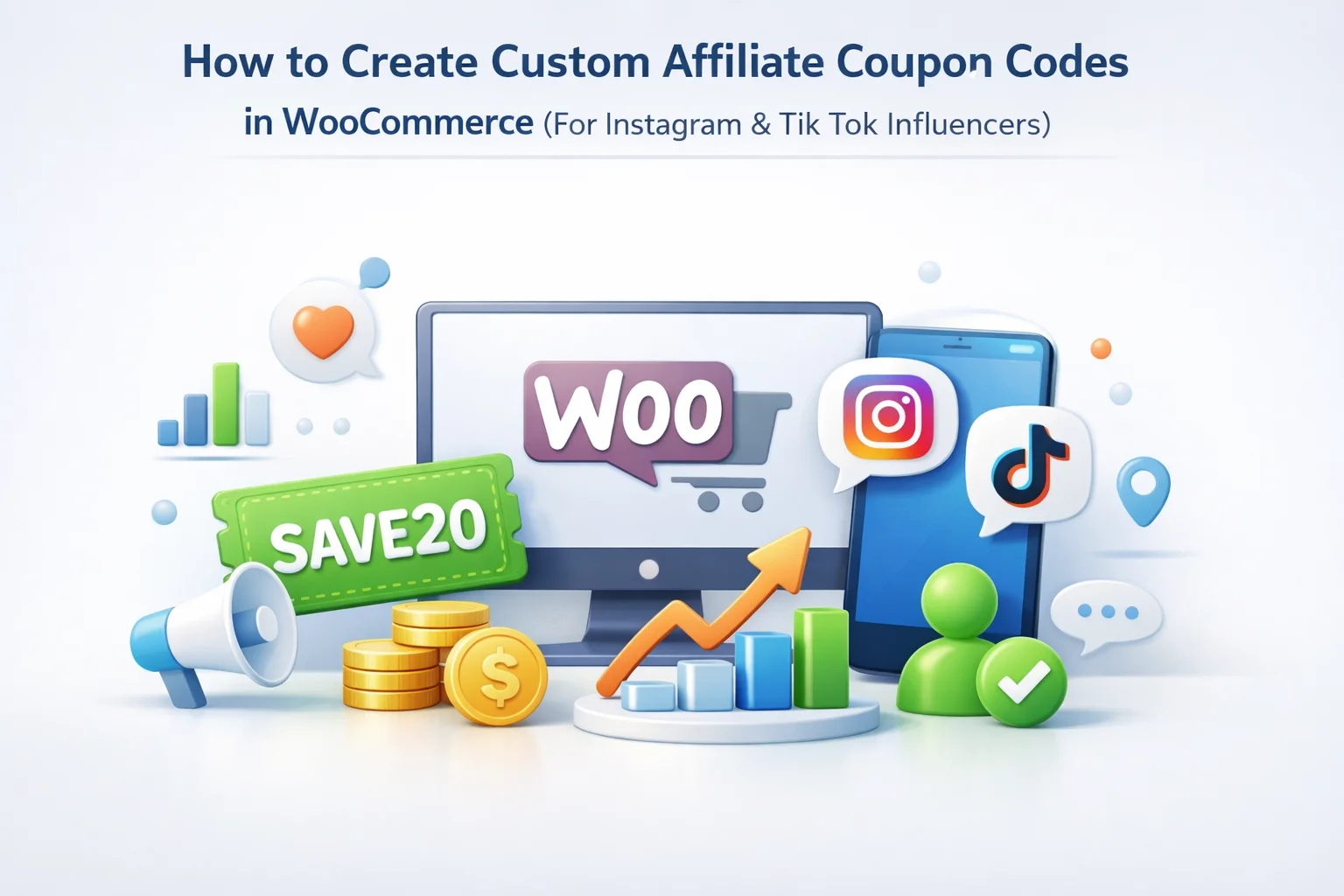
The way most people discover products on Instagram and TikTok in 2026 involves a creator they follow showing or mentioning a product, a coupon code appearing in the video or caption, and the viewer navigating to the store directly — by typing the URL, searching the brand name, or clicking a bio link. At no point in this flow does the viewer click an affiliate tracking link. There is no referral cookie. The only attribution signal that connects this sale to the influencer who drove it is the coupon code entered at checkout.
This is why custom personal coupon codes are not optional for influencer affiliate programs — they are the primary tracking mechanism. Every influencer you work with on social media needs a unique, personal code that they can share verbally, visually, and in captions. The code needs to be memorable, easy to type, unmistakably linked to the influencer in your mind and theirs, and correctly configured in WooCommerce to both apply a discount and attribute commission to the right affiliate account.
This guide covers the complete process — from the naming conventions that make influencer codes effective on social media, through the WooCommerce configuration that connects each code to an affiliate account, to the attribution and payout workflow in Affiliate Engine, a WooCommerce affiliate coupon tracking and influencer commission plugin.
Why coupon codes are the only reliable social media attribution
Before building your coupon configuration, it is worth understanding exactly why the standard affiliate link tracking that works well for blog and YouTube content fails on Instagram and TikTok — and why this failure is structural rather than fixable with better tools.
When someone taps a link in an Instagram bio or a TikTok profile, the app opens its own in-app browser rather than the user’s default browser. In-app browsers in Meta’s and TikTok’s apps have historically blocked, stripped, or immediately cleared third-party cookies for privacy and data control reasons. Even if an affiliate link is clicked directly, the tracking cookie may not be written, may be deleted before checkout, or may not persist between the in-app browser and the user’s regular browser where they eventually complete the purchase.
On Instagram Reels and TikTok videos, a very common viewer behavior is to note the brand name or product from the video and search for it directly in a browser — particularly for considered purchases. The viewer never clicks the affiliate link; they find the store independently and navigate directly to the checkout. The only connection between their purchase and the influencer who inspired it is the code they remember from the video. No link, no cookie, no attribution — unless they use the code.
A typical Instagram Reel or TikTok video about a product generates purchase intent that is often acted on days or weeks later — not immediately. The viewer saves the Reel, shows it to a friend, or simply remembers the product when they next need something in that category. Any cookie from an affiliate link click at the time of viewing will have long expired. A code mentioned in the video, written in the caption, or included in the creator’s pinned comment is the only attribution mechanism that spans this delay.
An influencer-only affiliate link (no personal coupon code) will systematically undercount their actual sales contribution — potentially capturing only 20–40% of the purchases they actually drove, depending on the platform and audience behavior. If you are paying influencers based on tracked commission data but they do not have coupon codes, you are both underpaying them (they are driving sales you are not attributing) and making flawed program decisions based on incomplete data. Give every social media affiliate a personal code from day one.
Coupon naming conventions that work for social media
The coupon code name is not just an internal identifier — it is something your influencer will say aloud in videos, type in captions, and include in their bio. A poorly named code reduces usage. A well-named code becomes a natural part of the influencer’s promotional content and gets used consistently.
Examples: SARAH15, JAKEFITNESS, PRIYA, TOMCOOKS. The creator’s name or recognizable handle, optionally suffixed with a discount percentage. This pattern works best because the code is indistinguishable from a personal recommendation — “use my code SARAH for 15% off” sounds like personal ownership of the code, which it is. It is also the easiest for the influencer to remember and communicate spontaneously in unscripted content.
Examples: SARAH15, JAKE20, PRIYA10. The discount amount is built into the code name, which reinforces the offer in the viewer’s mind when the code is shared. “Use code SARAH15 for 15% off” is slightly more compelling than just “use code SARAH” because the value is immediately stated by the code itself. This works particularly well for TikTok where viewers are scanning captions quickly.
Examples: GLOWSARAH, NEXUSARAH, BREWJAKE. The brand name leads, followed by the creator name. This works better for stores where brand recognition is part of the promotional message — it associates the creator with the brand explicitly. Less common on social media than creator-first patterns, but useful when the store’s identity is a central part of the influencer’s positioning.
Step-by-step: creating the WooCommerce coupon
Each influencer’s personal code requires two components: a WooCommerce coupon (which handles the discount at checkout) and an affiliate coupon link in Affiliate Engine (which attributes commission to the correct affiliate). These are separate records that must both exist and be correctly linked.
In newer WooCommerce versions, coupons are under Marketing; in older versions, they are directly under WooCommerce → Coupons. If you have the High-Performance Order Storage (HPOS) enabled, the coupon management interface may look slightly different but the field structure is identical.
In the Coupon code field, enter the influencer’s personal code exactly as they will share it (e.g. SARAH15). In General settings, set Discount type to “Percentage discount” for most influencer programs, and enter the discount value (e.g. 15 for 15%). Check “Allow free shipping” only if that is part of your offer. Leave the expiry date blank unless you are running a time-limited campaign — an influencer’s personal code should typically remain active indefinitely.
In the Usage Restrictions tab, set a minimum order amount if appropriate (this prevents the code from being used on $3 purchases where the discount barely covers payment processing). Leave the “Individual use only” checkbox checked — this prevents the influencer code from being stacked with other store coupons, which would reduce the order value on which commission is calculated. Leave the “Exclude sale items” decision based on your program policy — excluding sale items from commission is reasonable and should be documented in your affiliate terms.
In the Usage Limits tab, leave “Usage limit per coupon” blank (unlimited) — you want the code to work for everyone in the influencer’s audience indefinitely. Set “Usage limit per user” to blank or a high number. If you set this to 1 (one use per customer), buyers who want to make multiple purchases will find the code rejected on their second order, which creates friction and a poor customer experience. The personal affiliate code is meant to be used by the same customer repeatedly.
Use the Description field (visible only in admin) to note the affiliate’s name, social media handle, and the date the code was issued. For example: “Sarah Mitchell — @sarahfitlife Instagram — Affiliate code issued 2026-03-01.” This admin note is critical for programs with multiple influencers where codes are created over months — when you review the coupon list six months later, you will know immediately which influencer each code belongs to without cross-referencing the affiliate dashboard.
Click Publish. The coupon is now active in WooCommerce — any customer who enters this code at checkout will receive the configured discount. However, the coupon is not yet linked to an affiliate for commission attribution. That step happens in Affiliate Engine.
Linking the coupon to the affiliate account in Affiliate Engine
The WooCommerce coupon handles the discount. Affiliate Engine handles the commission attribution. These must be connected — an active WooCommerce coupon that is not linked to an affiliate account will give customers a discount but generate no commission record. A linked coupon generates both the discount and the commission correctly every time it is used.

In Affiliate Engine, navigate to the Affiliates tab and open the influencer’s affiliate account record. Find the Coupon Code field and enter the WooCommerce coupon code you just created (e.g. SARAH15). Save the record. From this moment, any WooCommerce order placed using the code SARAH15 will attribute commission to this affiliate account — regardless of whether the buyer clicked a referral link, which browser they used, or which device they shopped on.
Before informing the influencer about their code, place a test order using the code in a private browser window where you are not logged in as admin or as the affiliate. Verify two things: (1) the discount was applied at checkout correctly, and (2) a commission record appeared in the Referrals tab attributed to the correct affiliate. If both are true, the link is working. If the commission does not appear, verify the coupon code in the affiliate record exactly matches the WooCommerce coupon code — case sensitivity and extra spaces are the most common causes of link failure.
Managing coupon sharing, code leaks, and code rotation
Influencer coupon codes spread beyond their intended audience. This is usually a positive development — it means the influencer’s audience is sharing the code with friends, which is organic word-of-mouth driven by the influencer’s content. But code leaks to deal-sharing websites (Honey, RetailMeNot, coupon aggregators) require active management.
When an influencer’s audience member shares the code with a friend or family member, the code is used by someone who was not directly exposed to the influencer’s content but was influenced indirectly through a personal recommendation. Orders from this secondary sharing are attributed to the influencer — which is the correct economic outcome. The influencer’s network effect drove the sale. Commission is earned fairly.
If an influencer’s code gets indexed by a coupon aggregator site, orders may start arriving from deal-seeking visitors who found the code through search rather than through the influencer’s content. You can identify this pattern by checking if the coupon’s usage volume spikes suddenly without a corresponding spike in the influencer’s content activity. If aggregator traffic is material, generate a replacement code for the influencer and disable the leaked code — the new code is communicated to the influencer’s audience in their next post, and the old code stops working for non-organic traffic.
For influencers running a specific campaign with a time-limited offer, create a campaign-specific code (e.g. SARAH15SUMMER) alongside their permanent personal code (SARAH15). The campaign code can have an expiry date and a different discount value if the campaign warrants it. After the campaign ends, disable the campaign code. The permanent personal code continues to function for ongoing attribution. This approach gives influencers a fresh campaign angle without disrupting their ongoing referral tracking.
Briefing influencers on how to use their code effectively
Giving an influencer a code is not the same as ensuring they use it effectively. A brief, specific set of instructions in the approval email dramatically increases how consistently and how prominently influencers feature their code in content.
The combination of a well-named personal code, correctly configured WooCommerce coupon, proper affiliate attribution link, and a clear influencer brief closes the tracking gap that makes most social media affiliate programs unreliable. Influencers who know their code is being tracked accurately and paid correctly become more motivated to use it consistently — creating a positive feedback loop between measurement accuracy and promotional effort.
Affiliate Engine’s WooCommerce influencer affiliate coupon tracking and commission plugin links your WooCommerce coupon codes to individual affiliate accounts, attributes commission on every coupon-based order independently of cookie tracking, and shows full coupon attribution history per affiliate in the Referrals tab — giving you accurate, complete data on every influencer’s contribution even across Instagram, TikTok, and other platforms where link-based tracking fails.
Track every influencer sale on Instagram and TikTok — accurately, automatically, without cookies
Affiliate Engine links personal WooCommerce coupon codes to affiliate accounts and attributes commission on every coupon-based order — providing reliable tracking for Instagram and TikTok influencers where cookie-based tracking fails.

Just wanted to share my experience with this affiliate coupon setup. I've been running a small side hustle selling parts online while traveling, and the custom code feature for influencers is actually pretty smart. turns out a lot of people don't even click links anymore they just type in the URL or search the brand after seeing a TikTok or something. if you're working with creators, giving them their own codes from the start is a no brainer, otherwise you're missing out on easy sales
As a librarian who runs a small bookstore's online shop, I've tried so many affiliate tracking methods, but this guide finally clicked for me. It explained why coupon codes are the only reliable way to track influencer sales on Instagram and TikTok no messy links or cookies, just the code
Finally a guide that actually explains how influencer promo codes work in 2026. no links, no cookies just straight up attribution when the code gets used. Saved me so much hassle with payout disputes