Next-Level Code. Nexuvibe Style ...
Hrs
Min
Sec

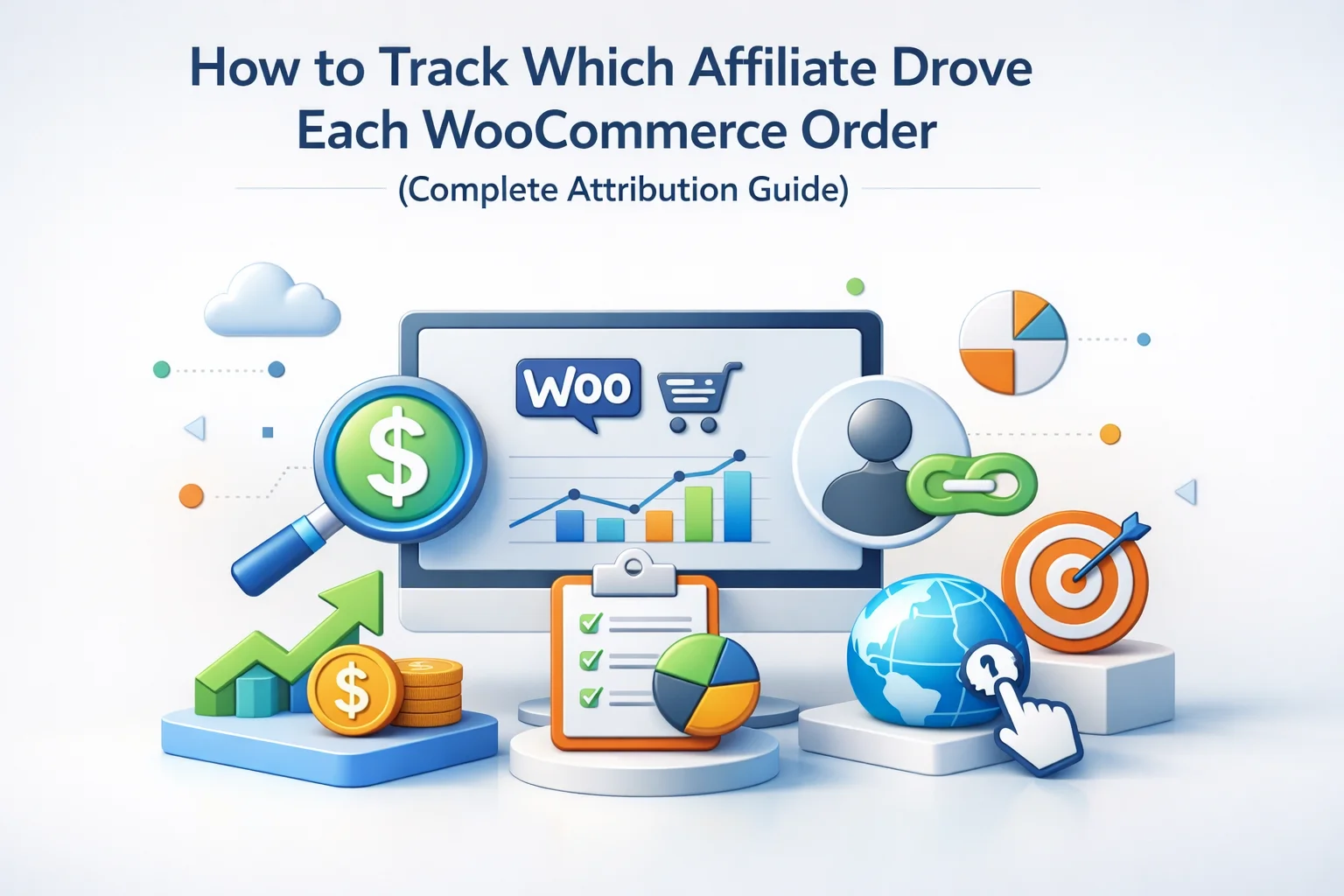
Store owners rarely dispute that affiliates matter. They dispute whether a specific affiliate earned a specific order. That dispute becomes expensive when it involves partial refunds, split carts, or customers who clicked one link and typed a friend’s coupon. The fix is not “more tracking pixels everywhere.” The fix is a clear primary signal, a fallback signal, and an admin trail that shows which signal won for each order.
WooCommerce gives you orders as the accounting unit. A serious referral plugin therefore attaches commissions to order IDs, not to vague sessions. In Affiliate Engine’s tracking flow, attribution is evaluated when WooCommerce fires woocommerce_checkout_order_processed, which is the moment a checkout completes and an order object exists with coupon lines and totals. Understanding that hook anchors the rest of this guide: attribution is decided at checkout completion, using the affiliate resolved from cookies, session-stored coupon linkage, or coupons printed on the order.
You will still need marketing judgement about cookie length and coupon policy, but you will not need mysticism about “what the system probably did.” A WooCommerce-native stack such as Affiliate Engine, the WooCommerce checkout attribution plugin with cookie and coupon priority controls turns those checkout signals into visit logs and per-order referral rows you can audit with finance.
For broader context on how Google thinks about qualifying traffic and site quality (useful when affiliates publish content that earns search visibility), see Google’s guidance on helpful content. For store mechanics, keep the WooCommerce order management documentation open beside your referral dashboard during audits.
First, the referral cookie path. A visitor arrives with a referral identifier in the URL, the store records a visit, and a cookie preserves the affiliate across subsequent page loads until expiry or conversion. Second, the coupon path. A shopper applies a WooCommerce coupon that you have linked to an affiliate, which is especially important when the shopper never clicked a referral link at all. Third, implicit order data: at checkout, the order object already contains the coupon codes the customer used, which the system can map back to affiliate accounts even when session storage is empty.
Affiliate Engine’s checkout handler evaluates those inputs under a configurable priority: cookie-first or coupon-first, with sensible fallbacks. When cookie priority is active, a valid tracking cookie wins unless coupon logic still needs to fill a gap. When coupon priority is active, coupon signals take precedence, then the cookie can still rescue attribution if no coupon maps to a partner. That design is how you operationalise a business rule like “creators with public codes always win over last-click blog links.”
Best for classic publisher flows: article → store → checkout within the cookie window. Integrity checks reduce tampering risk before you trust the cookie’s affiliate ID.
Best for social audio and video: shoppers remember a code, not a URL parameter. Affiliate Engine can read affiliate linkage from applied coupons at checkout.
The commission engine ultimately needs a WooCommerce order with a stable ID, totals, and line items. That is the object referral rows anchor to for reconciliation.
Cookie-first prioritisation rewards traditional affiliates who drive deliberate clicks. It respects the idea that a referral link initiated the journey. Coupon-first prioritisation rewards influencers and podcasters whose audiences type codes. Neither choice is universally “fair”; they optimise for different partner mixes. The mistake is leaving the default in place without reading it. Your terms page should name the priority explicitly so partners do not construct elaborate theories after the fact.
When coupon tracking is enabled, Affiliate Engine can resolve affiliates from WooCommerce session data captured at coupon application time, then clear that session marker after checkout so the next customer does not inherit someone else’s attribution. It also walks the list of coupon codes attached to the order, resolves each to a WooCommerce coupon ID, and maps that to an affiliate record when a linkage exists. That dual approach matters because some checkouts lose session state yet still contain the coupon text on the order, while others rely on session timing during multi-step checkout flows.
After the plugin resolves an active affiliate, it asks the commission service to create a referral for that order. The service first checks whether a referral already exists for the same order ID; if one exists, it stops. That guard prevents duplicate payouts when WooCommerce or third-party tools trigger multiple events you did not anticipate. It also means your operational notion of “unique commissionable order” lines up with WooCommerce’s notion of “this order number.”
The commission service then enforces programme rules you configured in settings: self-referral allowance, minimum order amount, and eligibility outputs from the commission calculator (category rules, product overrides, and priority order). Only when those checks pass does a referral row appear that your team will later approve or hold according to order status rules. Treat that pipeline as a contract: marketing sets expectations, the commission service enforces maths, finance watches approval timing.
Referral rows answer “who earned this order.” Visit logs answer “what happened before the order.” Affiliates rarely need visit URLs until something looks wrong: a campaign launched, traffic rose, but orders did not. A disciplined operator opens the visit tab, filters intelligently, and checks whether clicks are arriving with the expected referrer and landing paths. This is not about surveillance; it is about diagnosing broken UTM conventions, stale links, or mobile browsers that strip parameters.
Fraud checks can run on both visits and referrals. That means your anti-abuse story has two layers: prevent garbage clicks from poisoning confidence, and prevent garbage orders from becoming withdrawals. When you explain this to partners, translate it into service language: “We log visits to verify traffic quality, and we log orders to calculate payouts.” Most creators understand that distinction immediately.
Disputes decrease when affiliates can see pending versus approved earnings and understand that WooCommerce order status gates payouts. You do not need to expose internal fraud scores to partners, but you do need enough transparency that a good-faith partner can recognise their own traffic patterns. If your affiliate area shows referral links, creatives, and recent activity, creators spend less time guessing whether their latest post worked. Small UX touches matter: use plain language for statuses, show currency consistently with your storefront, and avoid hiding cancelled orders without any explanation.
Elementor widgets and shortcodes let you place that experience on branded pages instead of only inside My Account, which matters for stores that want the affiliate journey to feel like part of the marketing site, not an afterthought hidden behind WooCommerce defaults. Consistent design signals that your programme is mature, which indirectly improves recruitment quality.
Attribution answers who. Approval timing answers when a commission becomes withdrawable. Affiliate Engine listens to WooCommerce order status transitions and compares them to the status you selected for automatic approval. If you configure a hold period, the plugin can start a countdown anchored to the order date or to the moment the approval status is reached, depending on your hold reference setting. That detail matters for fashion and electronics categories with volatile return rates.
Operators sometimes treat these settings as bookkeeping trivia. Affiliates do not. A creator planning rent around “net thirty payouts” will remember whether you silently changed from completed to processing. When you adjust status rules, send a short partner notice and update your terms timestamp. Respect for timing is part of trust, which is part of long-term programme health.
| Question | Where to verify | Why it prevents disputes |
|---|---|---|
| Did this order attribute? | Referrals list filtered by order ID | Shows the winning affiliate for that exact checkout |
| Was a click recorded first? | Visits tab for the affiliate | Separates traffic problems from checkout problems |
| Why is commission pending? | WooCommerce order status + hold settings | Explains timing without manual spreadsheets |
Run three checkout tests before you declare victory. Test A: incognito referral link only. Test B: referral link, then abandon cart, return directly within the cookie window. Test C: no link, only an affiliate coupon. Record order IDs and confirm each produces the expected referral row and visit linkage. If Test C fails while Test A passes, your coupon mapping or coupon priority is wrong, not your cookie logic. Add a mobile Test E on the same device class your ads target: mobile Safari and Chrome differ in how aggressively they partition storage, and creators increasingly preview links on phones.
Add Test D if you use caching: hit a product page through a referral link behind your CDN and confirm the landing HTML still contains the identifier your JavaScript or server-side tracking expects. Caching plugins that ignore query strings quietly destroy programmes that looked perfect on localhost. This is not plugin-specific; it is infrastructure hygiene. The WordPress optimisation overview helps teams discuss caching trade-offs without pretending affiliate parameters are “just marketing fluff.”
Use a private window and disable admin toolbars that inject noise.
Match tax, shipping, and coupon stacks you expect in production.
WooCommerce order screen, referral row, affiliate-facing dashboard.
Real carts rarely match your mental unit tests. A shopper might stack a store-wide promotion with an affiliate coupon, or type a partner code while a roommate’s referral cookie is still present from an earlier browsing session. That is exactly why configurable priority exists: you are not trying to read customers’ minds; you are publishing a rule that chooses a winner when signals collide. Document the rule, then verify it quarterly when you change coupon strategy.
Guest checkout introduces another question: can you still recognise the customer on repeat purchase? Attribution mechanics do not replace CRM strategy. If your business depends on repeat orders from the same email, consider how partners should be credited on the second purchase when no new click occurred. Some programmes intentionally credit only the first order; others negotiate lifetime arrangements. Software can enforce either policy only when you encode it, so the debate belongs in leadership, not in a support ticket at midnight.
Manual order edits and goodwill credits also deserve a workflow. WooCommerce admins sometimes create adjustment orders or edit totals after the fact. Your finance team should know whether those adjustments produce new order IDs and therefore new referral evaluation moments, or whether they mutate existing orders in ways commissions should follow. Affiliate Engine’s order integration includes manual override tooling in admin for shops that need human judgment on exceptions; use it sparingly but document every override the way you would document a manual discount.
Even perfect click tracking fails if commission calculation returns “not eligible.” Category exclusions, product overrides, global percentages versus fixed amounts, and whether tax or shipping enters the base all change the number affiliates see. When someone says “my order did not count,” half of those conversations are eligibility maths, not tracking bugs. Keep a screenshot of your priority order and defaults whenever you change rates so support can answer confidently.
Strong programmes treat attribution and commission calculation as two halves of one support story. Weak programmes silo them, then wonder why tickets bounce between teams. A single owner for “partner economics” can bridge the gap even if engineering still implements changes.
As volumes grow, export discipline becomes part of attribution hygiene. Even when your dashboard answers ninety percent of questions, finance may still ask for CSV extracts that join orders to referral IDs for a given quarter. Decide early how you archive those exports and who can access them, because they contain customer commercial data. A predictable export cadence also makes tax conversations less frantic.
Finally, remember that attribution transparency is a recruitment asset. Publishers quietly compare notes about programmes that pay predictably versus programmes that argue. When your explanation of “who won the order” references observable records instead of tribal knowledge, you climb those comparisons without spending more on headline commission rates. Treat every support answer as a signal of how mature your programme feels from the outside. Consistency beats cleverness when partners compare screenshots in private chats. A boring, repeatable explanation builds more trust than a novel excuse each week, especially when payouts are due and real patience is thin.
If you need one WooCommerce-native system that binds visits, coupons, cookies, and order IDs into a coherent audit trail, Affiliate Engine Ultimate WooCommerce referral attribution and commission plugin for WordPress implements the checkout-time resolution described above and exposes the resulting referrals where both admins and affiliates can reason about them calmly.
Affiliate Engine connects referral visits to checkout attribution and stores commission rows per order so your ledger stays legible as volume grows.





Love that the order ID system makes audits a breeze, but handling partial refunds could be smoother. just had to manually fix a split cart last week, which was a pain.
Saved me hours of manual reconciliation. The order ID anchoring is solid.
Picked up this guide hoping it'd help untangle some messy affiliate disputes for my shop, and honestly? The section on how coupons and links interact was super helpful I finally get why some orders were getting double credited before. But wow, the part about partial refunds and split carts? that's where things got a little overwhelming.