Next-Level Code. Nexuvibe Style ...
Hrs
Min
Sec

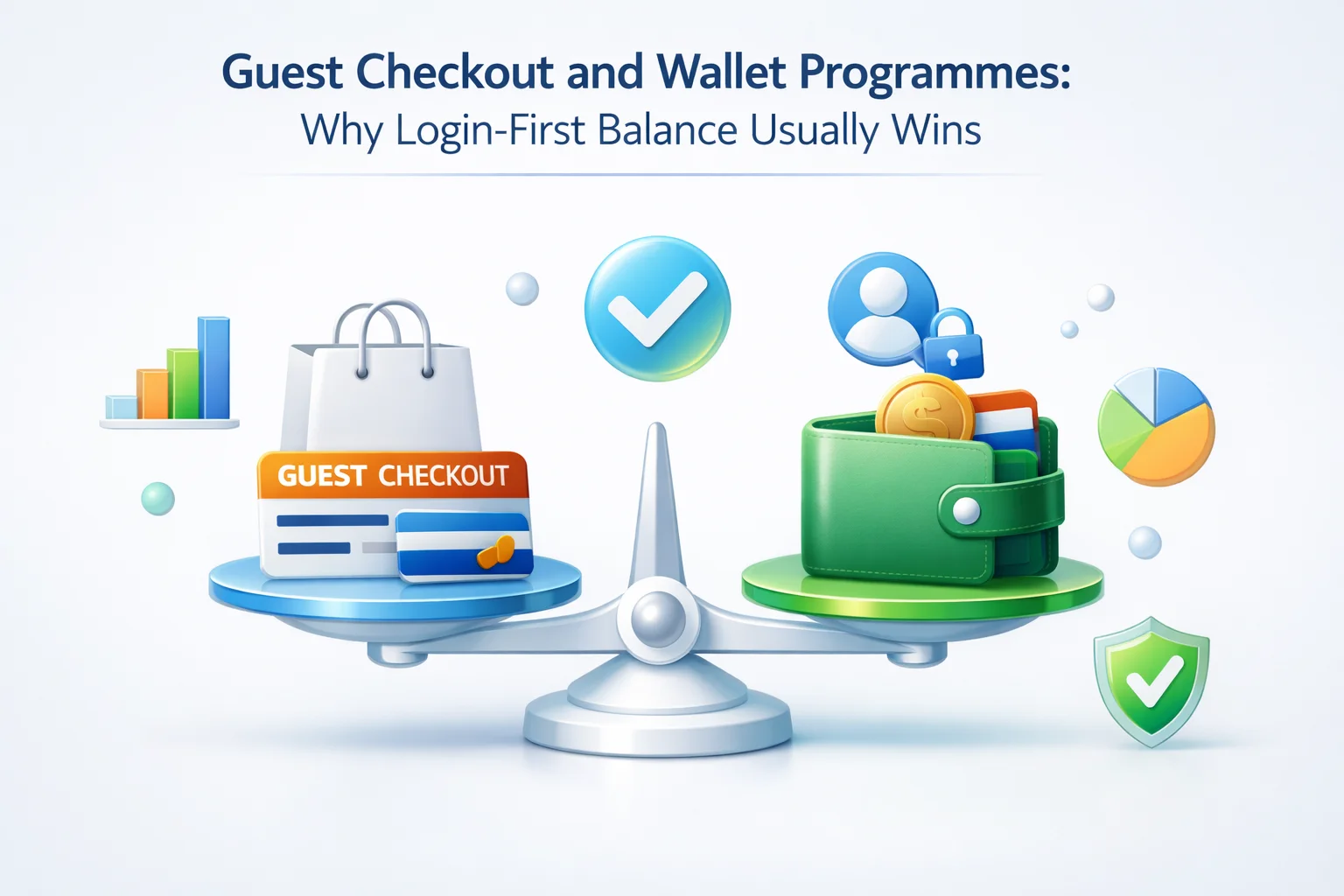
Retail orthodoxy treats guest checkout as conversion optimisation: fewer fields, fewer objections, faster revenue. Wallet programmes invert that calculus—they introduce ongoing obligations between purchases. A balance must survive sessions, refunds must find the correct ledger, cashback must resist duplicate claims across browsers. Anonymous sessions offer convenience without continuity; wallets demand continuity even when marketing still wishes for anonymity.
Stores attempting “wallet lite” on guests often stitch brittle identifiers—email hashes, cookies, device IDs—that fracture under cookie clearing, household sharing, or benign password resets. Customers experience disappearing balances through no moral fault of their own; support inherits impossible reconciliation puzzles. Login-first wallets shift those puzzles into solved territory because WooCommerce accounts already stabilise identity across sessions.
Implementing durable balances alongside cashback transparency typically leads teams to a WooCommerce wallet and cashback extension that binds balances to customer accounts with admin-grade controls rather than reinventing identity layers beside core WordPress users.
The tension is temporal: guest flows optimise the first conversion event; wallet programmes optimise lifetime sequences. Search landing pages written for cold traffic should not promise durable wallet privileges in hero copy unless downstream authentication actually delivers those privileges—otherwise you inherit refund narratives where customers claim marketing misled them about balance persistence after closing incognito sessions they no longer control.
Operators sometimes imagine lightweight email magic links as identity bridges. They help modestly yet still anchor to an inbox, not to WooCommerce customer records with auditable merge histories. When disputes arise, courts and card networks ask for coherent account timelines more often than clever token schemes—another reason login-first wallets tied to standard WordPress users remain the conservative engineering choice for serious liability loads.
Conversion specialists rightly fear unnecessary registration walls. First-time buyers evaluating unfamiliar brands hesitate at account creation—another password, another inbox promise, another future marketing relationship they may not want. Guest flows respect that hesitation by letting money change hands with minimal commitment. The trade is ephemerality: you learned little durable about the buyer beyond what payment processors and shipping forms required.
Wallet programmes are the opposite commitment. They assert that future value exists: stored credit, cashback accruals, withdrawal rights, refund-to-wallet policies. Those promises imply memory. A guest session, by definition, refuses long memory unless you graft synthetic identity atop it. The graft sometimes works for lightweight coupons; it fails more often for balances customers treat as fungible cash.
Low-friction acquisition for categories with high consideration variance or one-off gifts where repeat probability is uncertain.
Repeat replenishment, subscription-adjacent categories, B2B buyers with funded accounts, and markets where refunds and promotional credits circulate frequently.
WooCommerce core settings for accounts and checkout remain the backbone: toggling guest checkout alone does not create wallet-grade identity—you still need customer records when balances persist beyond a single order’s lifecycle.
Catalogue breadth compounds the identity problem: marketplaces aggregating third-party fulfilment must attribute wallet events to the correct vendor settlement paths—guest identifiers that evaporate between sessions risk misallocating promotional subsidies across sellers who refuse subsidising each other’s buyers. Login-first accounts provide at least one stable join key even when marketplace complexity escalates.
Enterprise procurement buyers illustrate the mirror case: they may demand guest-like frictionless reorder portals yet still require invoice histories tied to finance-approved profiles. Hybrid interfaces—magic links into authenticated shells—still boil down to identity persistence beyond anonymous carts when wallet balances cross fiscal quarters.
When balances bind to accounts, My Account becomes the honest home for liquidity: available funds, pending cashback, top-up actions, and transaction history customers can screenshot when something looks wrong. Visibility reduces suspicion—people trust numbers they can revisit without calling support. Guest-centric wallet experiments often hide balances behind emailed codes or fragile deep links; those interfaces feel provisional compared with the clarity of a logged-in wallet card anchored to identity.
The storefront presentation should emphasise continuity: same typography for currency amounts, plain-language labels for pending versus cleared funds, buttons that explain consequences before debiting balances at checkout.
Login-first does not mandate friction-heavy dashboards—only that durable wallet state attaches to credentials customers can recover through established WordPress password flows rather than begging support to merge ghost ledgers after a browser wipe.
Accessibility deserves mention: screen reader users navigating My Account benefit from predictable heading hierarchy and descriptive button labels on wallet actions—guest-token microsites often lag accessibility QA because teams treated them as temporary experiments. Login-first surfaces piggyback themes you already audit for WCAG regressions each release cycle.
Mobile-first cohorts reveal another split: thumb-friendly wallet cards inside native-feeling account areas outperform desktop-only ledger PDFs emailed after purchases. Younger demographics accustomed to closed-loop wallet apps from ride-hailing platforms evaluate your UX against those references unconsciously—anonymous flows feel dated fast when balances matter.
Finance teams defending wallet liabilities ask predictable questions: who owns this balance, which orders funded it, which refunds reversed it, which staff adjusted it? Answering requires stable customer IDs and immutable audit trails. Guest wallets masquerading as first-class programmes collapse under those questions because identifiers splinter across sessions—operations ends up reconstructing identity from shipping addresses and payment fingerprints, a brittle exercise that breaks privacy expectations when done aggressively.
Administrative configuration—minimum loads, maximum balances, withdrawal gates—presumes you can enforce per-customer rules uniformly. That enforcement maps cleanly to WordPress user records.
When marketing proposes “guest wallet beta” programmes, operations should respond with a reconciliation worksheet: show how each support scenario resolves without a user ID. If the worksheet looks like detective fiction, ship login-first instead.
Tax jurisdictions increasingly ask merchants to prove promotional credit issuance lines up with VAT or sales tax reporting: anonymous identifiers complicate exemption certificates and reverse-charge narratives because you cannot confidently attach incentives to verified business profiles. Login-first wallets simplify audit sampling even when headlines stay consumer-friendly.
Integration ecosystems reinforce the point: ERP connectors, CRM journeys, and customer-data platforms assume stable primary keys; wallet APIs emitting orphan transactions force brittle ETL transformations that break silently during schema migrations—another hidden tax on guest-wallet ambitions.
Login-first wallets succeed when registration clearly purchases benefits: faster checkout next time, visible balance history, proactive refund notifications, optional low-friction social sign-on where brand trust supports it. Hostage tactics—hiding order tracking unless shoppers create passwords—breed resentment that infects wallet adoption even when economics favour accounts.
Progressive profiling helps: allow guest purchase, then surface wallet enrollment post-checkout with transparent math (“Create an account to unlock £12 pending cashback from this order”). The wallet invitation becomes a receipt extension, not a barrier at cart. Pair invitations with immediate utility—saved addresses, reorder lists—so customers perceive accounts as productivity tools rather than marketing traps.
Transparency beats tricks: disclose how long pending cashback remains provisional, whether balances survive password resets, and whether merging duplicate emails could temporarily freeze funds while fraud checks complete. Customers tolerate friction loops when explanations appear before confusion—not only inside dense legal annexes nobody opens on phones.
International shoppers deserve currency clarity at invitation time: promising wallet balances without stating holding currency invites FX disappointment when redemption occurs under different rates than checkout imagination assumed. Login-first dashboards can display dual reference amounts responsibly where regulation permits.
Payment networks evaluate disputes partly on evidence trails. When customers cannot prove which ledger held promotional credit—because guest sessions multiplied—merchants struggle to produce coherent narratives. Login-first wallets attach movements to account histories support can export, reducing “he said, she said” cycles that push buyers toward issuer disputes out of frustration.
Google’s guidance on helpful, people-first pages applies to programme FAQs too: explain login requirements plainly before customers invest emotional energy in balances they later cannot access—surprise erodes brand equity faster than a modest signup step disclosed upfront.
Gift recipients illustrate grey zones: purchasers may remain guests while beneficiaries expect wallet continuity—family dynamics amplify disappointment when balances appear split across unrelated emails. Login-first enrollment flows that invite recipients to claim gifted credits into authenticated profiles reduce orphaned funds and awkward merge tickets handled manually each holiday peak.
Marketplace sellers piggybacking your hosted checkout occasionally misunderstand wallet liabilities as vendor-funded discounts—another operational misalignment cured when contracts reference customer IDs that map cleanly to ledger entries finance can reconcile per partner statements.
Structure incentives so guest buyers still receive fairness—standard discounts, honest shipping promises—while wallet-specific upside rewards continuity. Double standards feel extractive; layered fairness feels strategic. Examples: bonus cashback percentages only after account creation because ledger visibility becomes possible; early access drops for accounts because inventory allocation ties to identifiable loyalty; birthday credits that require birthdate storage customers knowingly provide.
Guests get transparent pricing; accounts unlock cumulative wallet value and history.
Guests pay inflated baselines so accounts look artificially superior—customers eventually notice.
Merchants implementing differentiated earn rates fairly often rely on programmable WooCommerce cashback rules paired with wallet balances visible after login so promotional complexity does not leak into checkout ambiguity for guests.
Seasonality magnifies contrasts: holiday guests chasing one-off gifts deserve gracious shipping policies without wallet obligations that imply long-term programmes they never opted into. Conversely, replenishment buyers subscribing adjacent categories merit escalating wallet perks tied to authenticated histories—personalisation engines simply cannot personalise anonymous noise.
Bundle merchandising introduces edge cases: partial returns on kits funded partly by wallet credits must specify whether promotional bundles unwind proportionally—anonymous carts lacking audit histories struggle to narrate partial bundle splits without fuelling disputes; authenticated ledgers absorb complexity more calmly.
Some categories blend modes legitimately: gift purchases where anonymous buyers want zero ongoing relationship yet recipients might adopt wallets later; corporate buyers placing one-off bulk orders versus employees maintaining funded accounts. Hybrid designs work when you label instruments honestly—short-lived store credits delivered by email distinct from wallet balances inside registered accounts—and when engineering prevents silent conversion between lanes without customer acknowledgement.
Avoid implicitly promoting guest credits to wallet balances without affirmative consent screens that explain persistence, visibility, and refund rules. Borderless fungibility sounds elegant until finance discovers liabilities appearing from channels nobody monitors.
Charitable campaigns occasionally mint goodwill credits delivered anonymously—those belong outside standard wallet rails or inside tightly scoped promotional ledgers that cannot migrate silently into withdrawable balances. Narrate each lane explicitly when CSR teams coordinate with commerce tooling.
Omnichannel retailers syncing in-store returns to online wallets amplify identity needs: associates capturing receipts must attach transactions to persistent profiles so ecommerce-led wallet balances reflect physical-world adjustments guests cannot spoof with ephemeral QR passes alone.
Confirm identity model: WordPress accounts authoritative, SSO optional but mapped, guest pathways explicitly scoped. Publish refund and cashback precedence. Train support on wallet adjustments with roles documented in your internal handbook. Align finance reporting on outstanding liabilities weekly—not quarterly surprises. Stress-test edge flows: merged duplicate accounts, password resets mid-checkout, partial wallet payments plus cards.
Board-level readiness: summarise wallet liabilities alongside cash equivalents so executives internalise liquidity risk—not merely marketing excitement. Scenario-plan macro shocks where customers accelerate redemption during downturns; login-first cohort data historically informs stress assumptions better than blended guest aggregates that hide concentration risk among anonymous sessions recorded unevenly.
Legal review should revisit promotional copy whenever engineering ships new wallet mechanics—incremental features deserve incremental scrutiny rather than assuming legacy terms still fit after behavioural shifts. Login-first programmes reduce ambiguity because contracts reference identifiable programme membership rather than metaphorical “wallet experiences” nobody can enforce consistently.
Before launch, schedule cross-functional simulation days: support agents attempt scripted journey breaks, finance reconciles synthetic orders against wallet exports, and developers observe latency under deliberate load spikes simulating flash promotions. Those rehearsals expose mismatches between guest optimism and wallet gravity while there is still budget to adjust messaging—not after customers broadcast disappointment during your busiest quarter.
Archive outcomes from each rehearsal with dated sign-offs so future teams inherit reasoning, not folklore. Institutional memory prevents repeating avoidable failures when reorganisations shuffle ownership and tooling contracts change between calendar years.
If you operate multiple brands on one WooCommerce multisite spine, clarify per-brand wallet segregation and customer-visible labelling—login-first architectures scale only when shoppers always know which ledger they are funding, especially when shared payment credentials blur cross-brand identities at the bank statement layer. Consistent colour and naming schemes in My Account reduce costly misredemption support.
WordPress user profiles and account fundamentals deserve a refresher on teams unused to thinking beyond posts—wallet programmes sit on user records whether merchandisers notice or not.
Guest checkout will remain essential for discovery purchases. Wallet programmes that behave like finance-grade instruments should not pretend otherwise. Login-first balances usually win because they align marketing romance with operational reality—and because customers forgive signup friction when the ledger they gain is transparent, portable within your ecosystem, and defended by policies you actually enforce. Standardise that stack with NEXU Smart Wallet and Cashback for WooCommerce as the authenticated wallet cashback backbone behind your retention roadmap once experiments graduate into promises printed on packaging.
Choose clarity over cleverness: let guests buy freely, let accounts carry balances honourably, and never blur the line without informed consent on both sides of the checkout wall.
NEXU Smart Wallet & Cashback delivers authenticated wallet cards, admin controls, and cashback configuration tuned for WooCommerce accounts.







The guide does a solid job explaining the tension between guest checkout convenience and keeping customers engaged long term. as someone who's tested both approaches, I appreciate how honest it is about how anonymous sessions just don't hold up for tracking balances or building relationships
This guide finally explained why our guest wallet tests kept failing. Just the audit trail section saved us weeks of support headaches. Wish I'd found it before we wasted time trying to patch together device IDs!
Hey, does this cover moving existing guest balances